
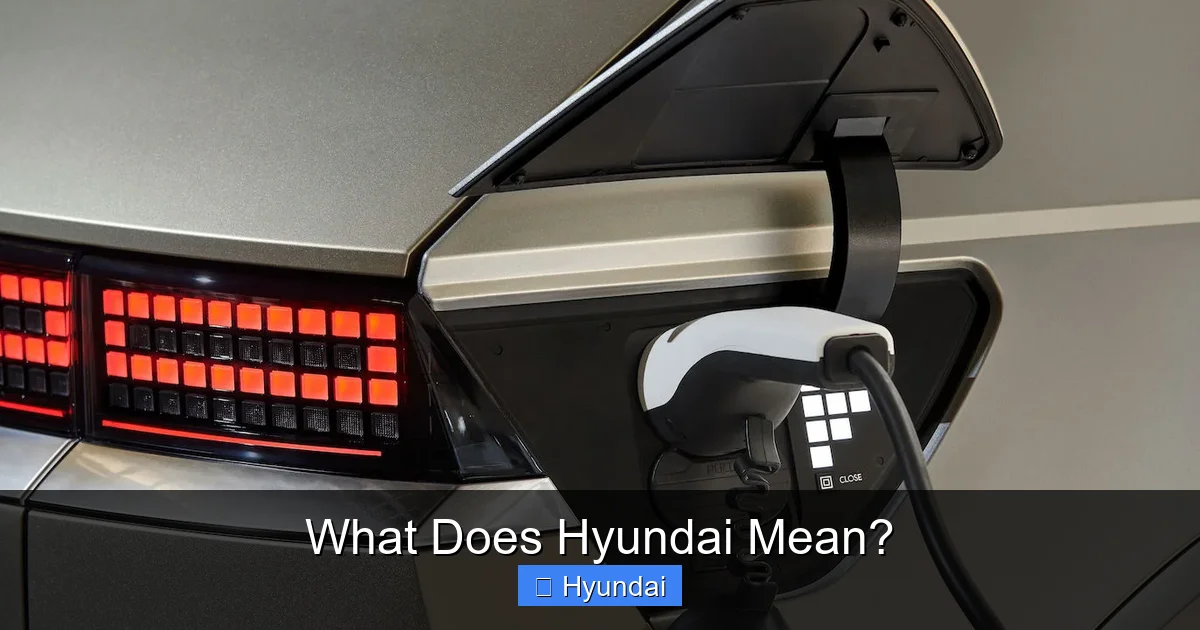
What Does Hyundai Mean?

Contents
- 1 Key Takeaways
- 2 📑 Table of Contents
- 3 The Literal Meaning: Decoding “Hyundai” in Korean
- 4 From Rubble to Roads: The Founding Vision of Chung Ju-yung
- 5 The Birth of Hyundai Motor Company: Entering the Automotive Arena
- 6 Hyundai’s Brand Philosophy: “Progress for Humanity”
- 7 Global Expansion and Cultural Impact
- 8 The Name in the Public Mind: Perception and Future
- 9 Conclusion: More Than a Name, a Promise
- 10 Frequently Asked Questions

Car Paint Touch Up Pen

Phone Mount for Bike

Car GPS Navigator

Waterless Car Wash Spray
Hyundai, a name synonymous with quality and innovation in the automotive world, actually means “modernity” or “the present age” in Korean. Founded by Chung Ju-yung as a construction company, the brand embodies progress and forward-thinking. Understanding Hyundai’s name reveals its core philosophy of blending tradition with cutting-edge technology, which you see in every vehicle they build today.
Have you ever looked at the Hyundai badge on a sleek Sonata or a rugged Tucson and wondered, “What does Hyundai mean?” It’s more than just a brand name you see on every street corner. It’s a word packed with history, ambition, and a deep cultural philosophy that drives one of the world’s most dynamic car companies. In this deep dive, we’ll unpack the literal translation, explore the incredible story of its founder, and connect the dots between a two-syllable Korean word and the cars millions of people drive every day. By the end, you won’t just know what Hyundai means—you’ll understand why it means so much to the automotive world.
Key Takeaways
- The name “Hyundai” directly translates to “modernity” or “the present age” in Korean, reflecting a commitment to innovation.
- It’s a Sino-Korean word: “hyun” (현) means “modern” and “dai” (대) means “era” or “age.”
- Founder Chung Ju-yung started Hyundai as a construction firm in 1947, long before the car company existed.
- Hyundai Motor Company was officially established in 1967, marking its entry into the global automotive market.
- The brand’s philosophy centers on “Progress for Humanity,” emphasizing quality, value, and accessible technology.
- From a local Korean contractor, Hyundai grew into a top global automaker, consistently ranking among the world’s largest.
- The meaning of its name directly influences Hyundai’s design language, engineering focus, and corporate messaging.
📑 Table of Contents
- The Literal Meaning: Decoding “Hyundai” in Korean
- From Rubble to Roads: The Founding Vision of Chung Ju-yung
- The Birth of Hyundai Motor Company: Entering the Automotive Arena
- Hyundai’s Brand Philosophy: “Progress for Humanity”
- Global Expansion and Cultural Impact
- The Name in the Public Mind: Perception and Future
- Conclusion: More Than a Name, a Promise
The Literal Meaning: Decoding “Hyundai” in Korean
Let’s start with the basics. The word “Hyundai” (현대) is a Sino-Korean term. To understand it, we break it into two parts: “hyun” (현) and “dai” (대).
“Hyun” (현) – The Concept of Modernity
The first character, “hyun,” carries the meaning of “modern,” “contemporary,” or “present.” It’s about being current, forward-looking, and not stuck in the past. In a business context, this implies a constant drive to adopt new technologies, fresh design ideas, and contemporary methods. It’s a statement of being in tune with the times.
“Dai” (대) – The Age or Era
The second character, “dai,” translates to “era,” “age,” or “generation.” It speaks to a period of time, a chapter in history. When combined with “hyun,” it forms the concept of “the modern age” or “the present era.”
Put them together, and “Hyundai” literally means “Modern Era” or “Present Age.” It’s a powerful, aspirational name. It doesn’t just describe a company; it declares an intention to be a leader of its time. This isn’t a name chosen from a dictionary of random sounds. It was a deliberate, philosophical choice that set the tone for everything the company would become. It promised a break from the old and a step into a new, modern future for Korea and, eventually, the world.
From Rubble to Roads: The Founding Vision of Chung Ju-yung
To truly grasp what Hyundai means, you must know the man who gave the name its weight: Chung Ju-yung. His story is the ultimate rags-to-riches tale, but it’s also a story of national reconstruction.
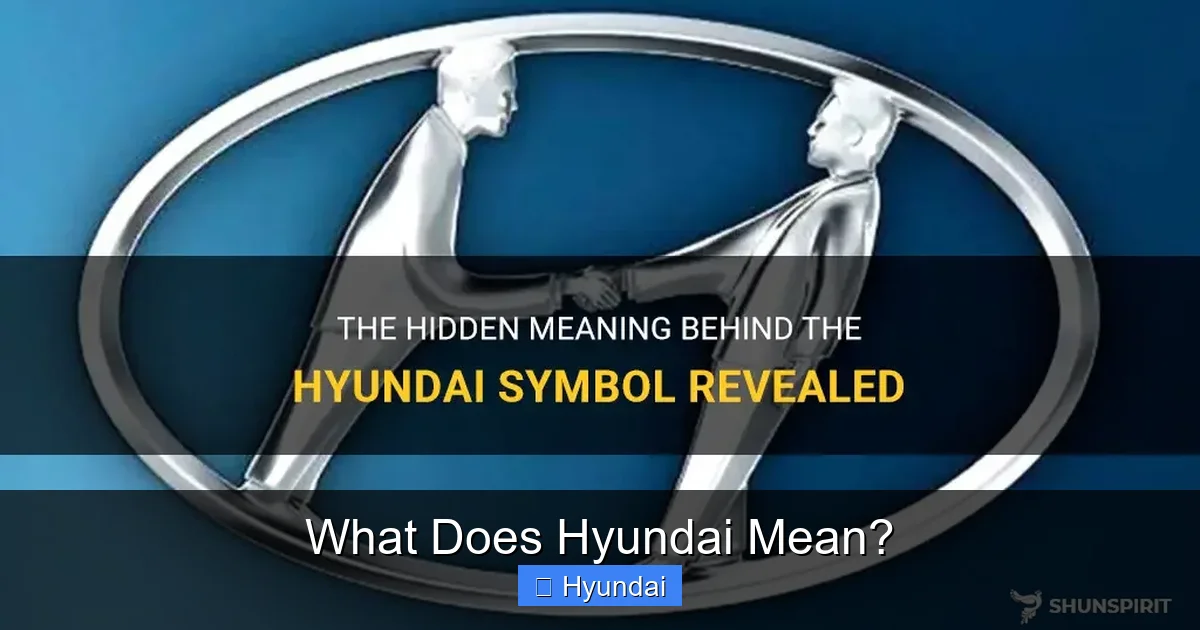
Visual guide about What Does Hyundai Mean?
Image source: shunspirit.com
The Post-War Landscape and Humble Beginnings
Chung Ju-yung was born in 1915 in what is now North Korea. In the aftermath of the Korean War (1950-1953), his homeland was devastated. Infrastructure was destroyed, economies were in shambles, and the future was bleak. Against this backdrop, Chung started a rice store with a friend in 1947. The company was named “Hyundai,” reflecting his desire to build a modern Korea. It was a tiny venture, but the name held a giant dream.
Building a Nation: Hyundai Engineering & Construction
The rice business didn’t last long. Chung pivoted to construction, a sector crying out for rebuilding. Hyundai Engineering & Construction (Hyundai E&C) was born. This wasn’t just about making money; it was about nation-building. Hyundai E&C took on monumental projects: the famous Gyeongbu Expressway connecting Seoul and Busan, the Korea World Trade Center, and countless bridges, tunnels, and industrial complexes. Chung Ju-yung and Hyundai literally built the backbone of modern South Korea’s economy. The name “Hyundai” was proven through concrete and steel—it was about creating the modern era, one project at a time.
This construction legacy is crucial. It instilled a culture of massive-scale project management, engineering excellence, and a “can-do” spirit. When Hyundai later decided to build cars, they weren’t starting from zero. They had the technical prowess, the logistical experience, and the national will to succeed. The meaning of “modern era” was now backed by a track record of delivering modernity.
The Birth of Hyundai Motor Company: Entering the Automotive Arena
By the 1960s, Chung Ju-yung had a new, audacious goal: to put Korea on the map in the global auto industry. The government of Park Chung-hee, eager to industrialize, supported the venture.
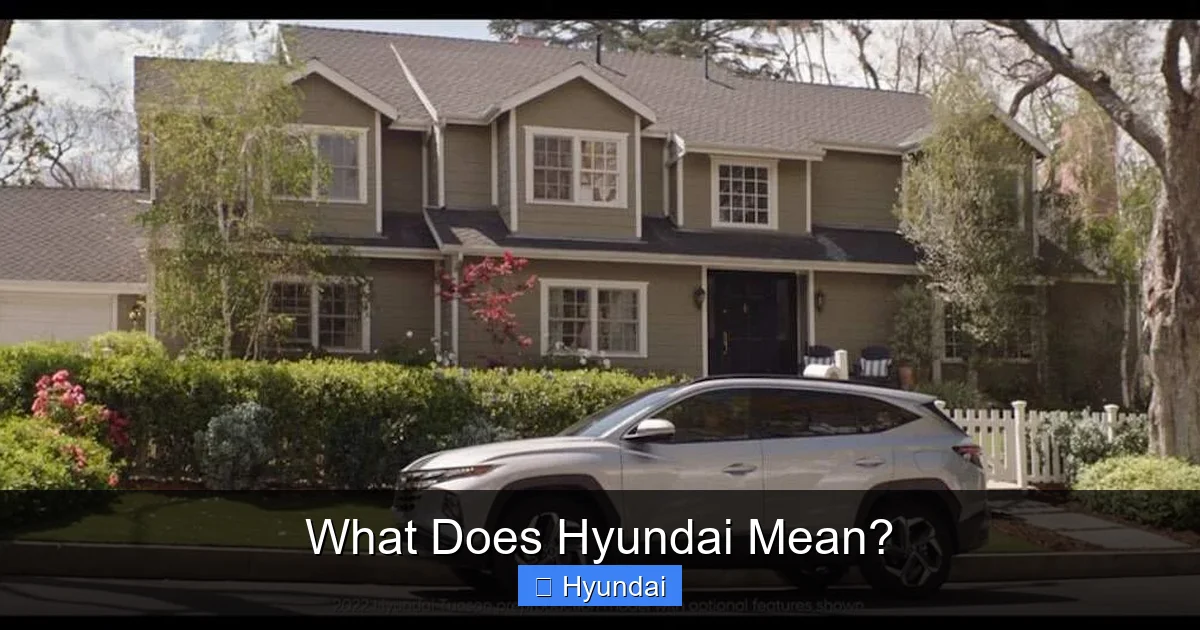
Visual guide about What Does Hyundai Mean?
Image source: motorbiscuit.com
A Strategic Partnership and the First Car
In 1967, Hyundai Motor Company was formally established. Instead of starting from scratch, they forged a smart partnership with the Ford Motor Company. This collaboration allowed Hyundai to gain crucial technology, manufacturing knowledge, and quality control processes. The first car, the Hyundai Cortina (a rebadged Ford), rolled off the assembly line in 1968. It was a starting point, a learning curve.
The Pony: Korea’s First Mass-Produced Car
The defining moment came in 1975 with the launch of the Hyundai Pony. This was Korea’s first independently developed mass-produced car. Designed by Giorgetto Giugiaro’s Italdesign studio, the Pony was a source of immense national pride. It wasn’t just a car; it was a symbol. It proved that a company named “Modern Era” could create a modern product. The Pony’s success at home and its exports to markets like Ecuador and the Middle East showed that Hyundai’s ambitions were global. The meaning of the Hyundai name was now cemented in the minds of consumers: it represented accessible, contemporary mobility.
This phase taught Hyundai a vital lesson: to be truly modern, you need global partnerships and world-class design. The strategy of learning from the best (Ford, then later Mitsubishi) and then developing in-house capability became a hallmark of their growth.
Hyundai’s Brand Philosophy: “Progress for Humanity”
Over the decades, Hyundai’s corporate slogan has evolved, but the core idea remains tied to its name. Today, it’s “Progress for Humanity.” This isn’t just a marketing tagline; it’s the operationalization of “Modern Era.”

Visual guide about What Does Hyundai Mean?
Image source: di-uploads-pod5.dealerinspire.com
Quality and Value: Democratizing Modernity
For years, Hyundai was known for inexpensive, no-frills cars. The turning point was the early 2000s with the industry-leading 10-year/100,000-mile powertrain warranty. This was a bold statement. It said, “Our cars are not just affordable; they are built to last.” It forced the entire industry to reconsider warranties. Hyundai was making modern quality and reliability accessible to everyone, not just luxury buyers. This directly connects to “dai” (era)—they were setting a new standard for the current era of car ownership.
Innovation for Everyone
Hyundai’s approach to technology is also philosophical. They don’t hide advanced features behind exorbitant price tags. Systems like Hyundai SmartSense (a suite of driver-assistance features) and even their Auto Hold system are widely available across their lineup, from the compact Accent to the flagship Palisade. You can learn more about how one of these user-friendly technologies works in our detailed guide on what Auto Hold means on a Hyundai. This commitment to democratizing innovation is a direct expression of “hyun”—bringing the modern age to the masses.
Design Language: “Sensuous Sportiness”
Since the early 2010s, Hyundai’s design has undergone a revolution under Chief Creative Officer Luc Donckerwolke. The “Sensuous Sportiness” language is fluid, emotional, and distinctly modern. It moves away from bland, appliance-like designs to cars with character and presence. The cascading grille, sharp lines, and coupe-like silhouettes (even on SUVs) signal that Hyundai is not just keeping up with the times; it’s trying to define them. Every curve and contour is a physical manifestation of the “Hyundai” meaning.
Global Expansion and Cultural Impact
Hyundai’s journey from a Korean construction firm to a top-5 global automaker is a case study in strategic execution. They entered the competitive U.S. market in 1986 with the Excel. It was cheap, but quality issues tarnished the early reputation. The subsequent, massive investment in quality, design, and R&D—especially at their Hyundai Motor Group Technical Center in California—turned the tide.
Building a Diverse Lineup
Today, Hyundai’s portfolio is incredibly diverse. It includes:
- Efficient Sedans: Elantra, Sonata
- Popular SUVs: Tucson, Santa Fe, Palisade, Kona
- Electric Vehicles: Ioniq 5, Ioniq 6, Kona Electric
- Performance N Models: Veloster N, Elantra N
- Hydrogen Fuel Cell: Nexo
This breadth shows a company that has fully embraced the “modern era” by addressing every segment of the market with tailored, modern solutions. They are not a one-trick pony; they are a full-spectrum mobility provider.
Manufacturing Footprint
Hyundai operates plants not just in Korea, but in the United States (Alabama), China, India, Russia, Turkey, and more. This global manufacturing presence allows them to serve local markets efficiently and is a testament to their global ambitions, perfectly aligning with a name that means “present age” on a worldwide scale.
The Name in the Public Mind: Perception and Future
So, what does “Hyundai” mean to you, the driver or potential buyer? For decades, it meant “value.” Then, it began to mean “quality.” Now, it increasingly means “innovative design” and “electrification leadership.”
Shifting Perceptions
In the 1990s and early 2000s, Hyundai was often the butt of jokes about cheaply made cars. The 10-year warranty began to change that narrative. The stunning design of the 2010s (like the original Genesis sedan) made people take notice. Today, models like the Ioniq 5, with its 800-volt architecture and retro-futuristic design, are winning awards and drawing crowds. The perception has shifted from “budget brand” to “design-forward, tech-savvy innovator.” The meaning of the Hyundai name is being rewritten in real-time by the products themselves.
Facing the Future: Electrification and Autonomy
The “modern era” is now defined by electrification and software. Hyundai is all-in. They are investing billions in EV development, battery technology, and autonomous driving through their Motional joint venture. Their dedicated E-GMP platform (used in Ioniq 5/6 and Kia EV6) is considered class-leading. The name “Hyundai” is becoming synonymous with serious, accessible electric vehicles. They are not just following the trend; they are helping to set it, which is the ultimate expression of their founding meaning.
Understanding this name helps you see the brand’s actions in context. When Hyundai announces a groundbreaking EV or a radical new design, it’s not a random pivot. It’s the logical continuation of a promise made in 1947: to build the modern era. It’s a name that carries the weight of a nation’s rebirth and the ambition to shape the future of transportation.
Conclusion: More Than a Name, a Promise
So, what does Hyundai mean? On the surface, it’s a simple translation: “Modern Era.” But as we’ve seen, it’s a multi-layered concept rooted in the vision of a man who helped rebuild a country. It’s a philosophy that moved from constructing highways to crafting cars. It’s a business strategy that traded on value to earn trust through quality and warranty. It’s a design ethos that now turns heads. And it’s a technological roadmap that aims to lead the electric age.
The next time you see a Hyundai, remember the story behind the name. It’s the story of Chung Ju-yung’s ambition, the sweat of Korean construction workers, the engineering prowess that produced the Pony, and the global teams designing tomorrow’s cars today. “Hyundai” is a promise—a promise of progress, modernity, and a relentless drive toward a better, more innovative future for all. It’s a name that has earned its meaning, mile by mile, model by model, and year by year. And that meaning continues to evolve, just as the brand itself never stops moving forward.
Frequently Asked Questions
What does Hyundai mean in English?
Hyundai directly translates to “Modern Era” or “Present Age” in English. It’s a Sino-Korean word combining “hyun” (modern) and “dai” (age/era).
Who founded Hyundai and what was its original business?
Hyundai was founded by Chung Ju-yung in 1947. It began as Hyundai Engineering and Construction, a company that built major infrastructure like expressways and buildings in post-war South Korea.
When did Hyundai start making cars?
Hyundai Motor Company was established in 1967. Its first car, the Hyundai Cortina, was produced in 1968 in partnership with Ford. The first fully Hyundai-developed car, the Pony, launched in 1975.
What is Hyundai’s current slogan or brand philosophy?
Hyundai’s current global slogan is “Progress for Humanity.” This philosophy emphasizes creating innovative, human-centric mobility solutions that make advanced technology accessible to everyone.
Does the meaning of Hyundai influence its car designs?
Absolutely. Hyundai’s modern design language, called “Sensuous Sportiness,” aims to evoke emotion and contemporary aesthetics. The brand’s focus on futuristic electric vehicles like the Ioniq 5 directly embodies the “modern era” meaning of its name.
How has Hyundai’s meaning changed over time?
Initially, “Hyundai” represented national rebuilding and basic, affordable transportation. Over time, it evolved to signify quality (thanks to the 10-year warranty), then design leadership, and now innovation in electrification and sustainable mobility. The core idea of “modernity” remains constant, but its expression has matured with the company.


