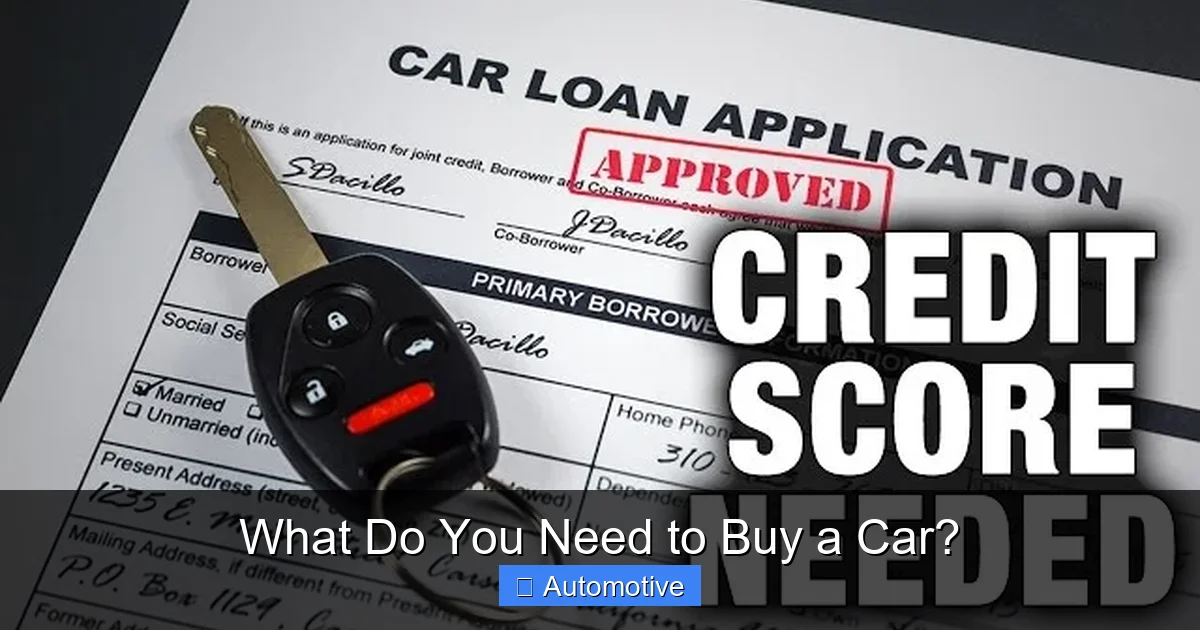
What Do You Need to Buy a Car?

Contents
- 1 Key Takeaways
- 2 📑 Table of Contents
- 3 Part 1: The Essential Documentation – Your Personal Paperwork
- 4 Part 2: Financing & The Money You Need
- 5 Part 3: Insurance – You Can’t Skip This
- 6 Part 4: The Vehicle Itself – Your Due Diligence
- 7 Part 5: The Final Transaction & Paperwork
- 8 Part 6: After the Purchase – Making It Officially Yours
- 9 Conclusion: Confidence Comes from Preparation
- 10 Frequently Asked Questions

Octane Booster

Magnetic Car Phone Mount

Multipurpose Lubricant Spray

Car Phone Holder
Buying a car involves more than just picking a model and color. You need specific documents, proof of finances, insurance, and a clear process to follow from research to final signature. This guide breaks down every essential requirement, from your driver’s license to the final bill of sale, ensuring you walk into the dealership or private sale fully prepared and protected.
So, you’ve decided it’s time for a new (or new-to-you) set of wheels. The excitement is real! But then the questions start swirling: “What do you need to buy a car?” It feels like there should be a simple list, but the answer can be a maze of documents, financial proof, and steps. Don’t worry. Think of this guide as your friendly, detailed roadmap. We’re going to walk through every single thing you need, from the moment you start your research to the minute you drive off the lot or the private seller’s driveway. By the end, you’ll know exactly what to have in your folder, what questions to ask, and how to avoid common pitfalls.
Key Takeaways
- Proof of Identity & Residence: A valid driver’s license and a recent utility bill or bank statement are non-negotiable for verifying who you are and where you live.
- Financing is Key: You need proof of income (pay stubs), a credit check, and either a down payment or a pre-approval letter from a lender before you start shopping seriously.
- Insurance Before You Drive: You must have an active auto insurance policy in place before the dealer can hand over the keys or you can register a privately bought car.
- Vehicle History is Critical: For used cars, always obtain and review the vehicle history report (like Carfax or AutoCheck) to check for accidents, title issues, and odometer readings.
- The Paperwork Trail: Be prepared to sign a sales contract/retail installment contract, the title, and registration forms. Read every document carefully before signing.
- Post-Purchase Steps: After buying, you must transfer the title, register the car in your name, and pay any applicable sales tax and fees to your local DMV.
📑 Table of Contents
- Part 1: The Essential Documentation – Your Personal Paperwork
- Part 2: Financing & The Money You Need
- Part 3: Insurance – You Can’t Skip This
- Part 4: The Vehicle Itself – Your Due Diligence
- Part 5: The Final Transaction & Paperwork
- Part 6: After the Purchase – Making It Officially Yours
- Conclusion: Confidence Comes from Preparation
Part 1: The Essential Documentation – Your Personal Paperwork
Before anyone will even talk seriously about selling you a car, they need to know who you are. This isn’t bureaucracy; it’s legal requirement and fraud prevention. Gather these core documents first.
Your Government-Issued ID
The absolute cornerstone is your valid, unexpired driver’s license. This serves as your primary proof of identity. If you’re a permanent resident but not a U.S. citizen, a valid passport and visa, along with a state-issued driver’s license or ID card, will be necessary. For military personnel, a military ID is often accepted, but you’ll still likely need a state driver’s license. Make sure the name on your ID matches the name on your financial documents and insurance. Any discrepancies can cause major delays at the finance office.
Proof of Residence
Why does the dealership care where you live? Two big reasons: state laws regarding sales tax, titling, and registration are tied to your address, and lenders use it to verify your stability. A recent utility bill (electric, water, gas) from the last 30-60 days is the gold standard. A bank statement, lease agreement, or mortgage statement also works perfectly. The document must show your name and your current address. If you’ve recently moved and haven’t updated your license yet, this is where a lease or utility bill in your new name is crucial.
Proof of Income & Employment
This is where you prove you can actually pay for the car. If you’re financing or leasing, the lender will scrutinize this heavily. You’ll typically need:
- Recent Pay Stubs: Usually, the last 2-3 most recent pay stubs covering a 30-day period. They should show your gross pay, net pay, and employer’s name.
- W-2 Forms from Previous Years: Often requested for salaried employees to verify annual income.
- Bank Statements: For self-employed individuals, contractors, or those with variable income, 2-3 months of business and personal bank statements are essential to show consistent cash flow.
- Proof of Additional Income: Documentation for alimony, child support (if you choose to disclose it as income), disability, or Social Security income.
The goal is to create a clear, documented picture that you have a stable, verifiable income stream to cover the monthly payment.
Part 2: Financing & The Money You Need
Unless you’re paying the full purchase price in cash with a cashier’s check, financing is part of the equation. Knowing what you need for this process is half the battle.
Visual guide about What Do You Need to Buy a Car?
Image source: bankrate.com
Understanding Your Credit
Your credit score is the single most important factor in determining your loan’s interest rate. Before you ever set foot on a lot, you need to check your own credit. You’re entitled to a free report annually from AnnualCreditReport.com. Look for errors and dispute them. Knowing your score gives you power. If you have excellent credit (740+), you’ll qualify for the best rates. If your score is lower, you might need a larger down payment or a co-signer. Speaking of down payments, the question Do You Need A Down Payment To Buy A Car? has a nuanced answer. While not always legally required, a down payment dramatically improves your chances of approval, lowers your monthly payment, and reduces the total interest you pay. Plan on at least 10-20% of the car’s value if possible.
The Pre-Approval Letter: Your Secret Weapon
Here’s a pro tip: get pre-approved for an auto loan from your own bank or credit union before you go shopping. This process is similar to applying at a dealership but happens on your terms. You’ll fill out an application, provide the same income/identity docs, and they’ll give you a conditional approval for a specific loan amount and interest rate, usually valid for 30-60 days. This piece of paper is incredibly powerful. It sets a firm budget, simplifies negotiations (you’re now a “cash buyer” to the dealer’s finance department), and protects you from dealership financing markups. It shows you’re a serious, prepared buyer.
The Down Payment & Trade-In Equity
If you’re putting money down, you’ll need those funds available. This can be via a personal check, cashier’s check, or a direct bank transfer. If you’re trading in your current vehicle, you need the title in your name (and any lienholders must be paid off first). The trade-in value becomes your down payment. Have a realistic idea of your car’s worth using Kelley Blue Book or Edmunds as a starting point. The dealer will appraise it, and any positive equity (value minus loan payoff) is applied to your new purchase. If you have negative equity (you owe more than it’s worth), that amount gets rolled into the new loan, making your down payment requirement effectively higher.
Part 3: Insurance – You Can’t Skip This
This is a legal and practical necessity. You cannot register a car or, in most states, even drive a newly purchased car off the lot without active insurance coverage.

Visual guide about What Do You Need to Buy a Car?
Image source: wholesalinginc.com
Getting a Quote Before You Buy
Smart buyers get insurance quotes before they buy. Why? Because the cost of insuring your dream car might be a nasty surprise. A sports car costs more to insure than a sedan. An SUV might have different rates. Call your current insurance agent or use online tools to get a quote for the specific year, make, and model you’re considering. Have your VIN (Vehicle Identification Number) ready for an accurate quote. This step ensures the monthly insurance premium fits your total transportation budget, not just the car payment.
The Insurance Binder or Card
Once you decide on a car and finalize the purchase, you must provide proof of insurance to the dealer or the DMV. Your insurance company can issue a binder—a temporary, one-page document that acts as instant proof of coverage until your official insurance cards arrive in the mail. This binder is what you’ll hand over to complete the transaction. For private party sales, you’ll need to show your insurance card at the DMV when you go to title and register the vehicle in your name. Driving without insurance is illegal in every state and can lead to fines, license suspension, and personal financial ruin in an accident.
Part 4: The Vehicle Itself – Your Due Diligence
Whether buying from a dealer or a private seller, you need to do your homework on the specific vehicle. The paperwork you get here is as important as your own personal paperwork.

Visual guide about What Do You Need to Buy a Car?
Image source: chennaiinfluencers.com
The Vehicle History Report is Non-Negotiable (For Used Cars)
For any used car, regardless of how trustworthy the seller seems, you must run a vehicle history report. Services like Carfax or AutoCheck pull data from national databases. You’re looking for:
- Accident History: Major collisions can cause hidden structural damage.
- Title Problems: Salvage, rebuilt, or flood titles are huge red flags. A clean title is ideal.
- Odometer Readings: Look for inconsistencies that could indicate rollback.
- Number of Owners: Fewer owners is generally preferred, but consistent, documented service is more important.
- Service Records: Some reports include maintenance history.
Ask the seller for the VIN upfront to run this report yourself. If they refuse, walk away. It’s a major red flag. The cost of a report ($25-$40) is peanuts compared to buying a car with a hidden, costly past.
Pre-Purchase Inspection (PPI)
This is the smartest move you can make for a used car, especially from a private seller. For $100-$200, an independent, certified mechanic will put the car on a lift and give it a comprehensive once-over. They check for hidden mechanical issues, rust, accident repairs, and overall condition. It’s an objective, professional opinion that gives you immense peace of mind or the leverage to walk away or negotiate a lower price to cover needed repairs. Never skip this step. It’s not about distrust; it’s about being an informed consumer.
Part 5: The Final Transaction & Paperwork
You’ve chosen the car, secured financing, and have your insurance ready. Now it’s time to make it official. The paperwork at this stage is dense, but you must understand what you’re signing.
The Sales Contract / Retail Installment Contract
This is the most important document you’ll sign. It outlines every single financial term of your purchase. Read it meticulously. Verify:
- Purchase Price: Is it what you agreed to?
- Total Financed Amount: Does it match the price minus your down payment/trade-in equity?
- Annual Percentage Rate (APR): This is your true interest rate. Is it what your pre-approval or the dealer promised?
- Monthly Payment: Does it match the quote?
- Term of Loan: 36, 48, 60, or 72 months?
- Total Cost of the Loan: How much will you pay in principal and interest over the life of the loan?
- Any Fees: Document fees, title fees, registration fees, etc. Are they legitimate and clearly itemized?
Do not let a finance manager rush you. Ask questions. If something is wrong, do not sign. This document is legally binding.
The Title and Bill of Sale
- For New Cars: The dealer will handle the Manufacturer’s Statement of Origin (MSO), which acts as the title until it’s processed by your state.
- For Used Cars from a Dealer: They will provide a properly signed-over title from the previous owner and a bill of sale.
- For Private Party Sales: This is critical. The seller must sign the title over to you in the designated area. Do not accept a title with any liens listed unless you have a signed lien release from the lender. You and the seller should also complete a Bill of Sale form. This is a private contract that states the sale price, VIN, odometer reading, and “as-is” condition. Both parties should keep a copy. Many states provide a specific form.
Once you have the properly signed title, you own the car. But you can’t legally drive it until it’s registered in your name.
Part 6: After the Purchase – Making It Officially Yours
The deal is done, but your work isn’t over. You must take the signed title and proof of insurance to your local Department of Motor Vehicles (DMV) or equivalent agency to title and register the vehicle in your name.
What to Bring to the DMV
This varies slightly by state, but a standard checklist includes:
- The properly signed and completed title (from the seller/dealer).
- The completed bill of sale (especially for private sales).
- A completed title/registration application form (available at the DMV or online).
- Your valid driver’s license and proof of residence.
- Proof of current insurance (the insurance card or binder).
- A vehicle identification number (VIN) verification form (sometimes required for out-of-state purchases).
- Payment for all applicable fees: This includes title fee, registration fee, license plate fee, and sales tax. Sales tax is often the biggest surprise for buyers. It’s typically a percentage of the purchase price and is due at the time of titling/registration. Be prepared for this cost—it can be several thousand dollars on a new vehicle.
Once you pay and they process everything, you’ll receive your new registration, license plates (or a plate transfer), and a new title in your name. Keep the title in a safe place; it’s your proof of ownership.
What To Do After Buying A New Car
Beyond the DMV, there are a few immediate post-purchase steps. First, make your first loan payment on time, according to the schedule in your contract. Set up online payments if possible. Second, review your auto insurance policy to ensure the coverage limits and deductibles are still appropriate for your new vehicle. Finally, schedule any needed maintenance or service based on the car’s history. If you bought a used car and didn’t get a PPI, consider taking it to a trusted mechanic for a general check-up anyway. For a comprehensive list of these crucial first steps, refer to our detailed guide on What To Do After Buying A New Car.
Conclusion: Confidence Comes from Preparation
What do you need to buy a car? The answer is a combination of personal readiness, financial proof, legal documents, and a clear process. Start by gathering your core ID and income documents. Then, understand your budget and get financing pre-approval. For used cars, insist on a vehicle history report and a pre-purchase inspection. When you find the one, read every line of the sales contract, secure insurance, and complete the title transfer properly at the DMV. The process has many moving parts, but each piece has a specific purpose: to protect you, the seller, and the lender. By coming to the table prepared with this checklist, you transform from a nervous first-time buyer into a savvy, confident consumer who knows exactly what they need to get the keys and drive away with peace of mind.
Frequently Asked Questions
What credit score do I need to buy a car?
There’s no single minimum score, as lenders have different criteria. Generally, a score above 660 will get you a decent rate. Scores below 600 may still qualify but with much higher interest rates and often require a larger down payment or a co-signer. It’s best to check your credit and improve it if possible before applying.
How much of a down payment should I make?
Aim for at least 10-20% of the car’s total price. A larger down payment reduces the amount you finance, lowers your monthly payment, improves your chances of approval with poor credit, and helps you avoid being “upside down” (owing more than the car is worth) immediately. If you can’t manage 20%, any amount down is better than none.
Can I buy a car without a driver’s license?
It’s difficult but not impossible. You typically need a government-issued photo ID (like a passport) and proof of residence. Some lenders may approve a loan if you have a state ID card and a co-signer with a valid license. However, you cannot legally drive the car without a license, and insurance companies may be hesitant to insure you. You’ll likely need to have a licensed driver listed on the policy and as a primary driver.
What happens if I buy a car and it breaks down the next day?
It depends entirely on where you bought it and what warranty, if any, is in place. From a dealership, the car comes with at least a minimal implied warranty of merchantability, and likely a limited factory or dealer warranty. You have legal recourse. From a private seller, the sale is almost always “as-is,” meaning you assume all risk after the sale. This is precisely why a pre-purchase inspection is so critical for private party purchases.
Do I need gap insurance?
Gap (Guaranteed Asset Protection) insurance covers the difference between what you owe on your loan and the car’s actual cash value if it’s totaled or stolen. It’s a smart buy if you made a small or no down payment, have a long loan term (60+ months), or are leasing the vehicle. It’s often offered by the dealer or your insurance company for a relatively small fee.
How long does the whole car-buying process take?
It varies. At a dealership, from test drive to signing paperwork, expect 2-4 hours if everything goes smoothly. Private party sales can be faster once you meet, but coordinating payment (using a secure method like a cashier’s check or bank transfer) and the DMV visit adds time. The DMV itself can take 1-3 hours depending on wait times. Plan for the entire process, including pre-shopping research and financing, to take a few days to a week.