What Can You Bring into Canada by Car?

Contents
- 1 Key Takeaways
- 2 📑 Table of Contents
- 3 Personal & Household Items: Your Clothing, Gear, and Used Belongings
- 4 Food, Agriculture & Plants: The Most Restricted Category
- 5 Alcohol & Tobacco: Know Your Personal Allowances
- 6 Medications & Controlled Substances: Legal ≠ Allowed
- 7 Pets & Animals: More Than Just a Rabies Shot
- 8 Vehicle, Camping Gear & Outdoor Equipment: Clean is the Keyword
- 9 Frequently Asked Questions



Crossing into Canada by car requires knowing strict CBSA rules to avoid fines or seizure. You must declare all items, including food, alcohol, tobacco, medications, and pets. Personal and household goods are generally allowed, but agricultural products face tight restrictions. Proper vehicle preparation and documentation for pets or medicines are non-negotiable for a smooth border crossing.
So, you’re planning a road trip to Canada. The scenery will be stunning, the drives unforgettable. But before you even think about packing the cooler or the hiking boots, you need to tackle one critical thing: understanding exactly what you can bring into Canada by car. The rules set by the Canada Border Services Agency (CBSA) are strict and enforced for good reason—protecting Canada’s agriculture, environment, and economy. Getting it wrong can mean anything from a delayed trip and seized goods to significant fines. This guide cuts through the confusion. We’ll walk through every category, from your suitcase to your car’s trunk, so you can cross the border with confidence.
Key Takeaways
- Declare Everything: You must declare all goods, including food, alcohol, and gifts, to the Canada Border Services Agency (CBSA). Failure can lead to fines, seizure, or denial of entry.
- Food & Agriculture is Highly Restricted: Most fresh fruits, vegetables, meat, and dairy products are prohibited or require permits. Always check the CBSA’s food list before you pack.
- Alcohol & Tobacco Have Strict Personal Limits: There are specific duty-free allowances for alcohol (e.g., 1.5L wine or 1.14L spirits) and tobacco (200 cigarettes). Exceeding limits means paying heavy taxes.
- Medications Must Be for Personal Use: Bring prescription meds in original containers with labels. Some substances, like medical marijuana, are generally prohibited despite state legality in the US.
- Pets Need Documentation: Dogs and cats require a rabies vaccination certificate and sometimes a vet health certificate. Other animals face much stricter rules or bans.
- Vehicle & Camping Gear Must Be Clean: Off-road vehicles, camping equipment, and outdoor gear must be free of soil, seeds, and insects to prevent invasive species.
- Keep Receipts and Proof of Ownership: For valuable items, receipts prove they are for personal use and not for resale. This avoids duty charges.
📑 Table of Contents
- Personal & Household Items: Your Clothing, Gear, and Used Belongings
- Food, Agriculture & Plants: The Most Restricted Category
- Alcohol & Tobacco: Know Your Personal Allowances
- Medications & Controlled Substances: Legal ≠ Allowed
- Pets & Animals: More Than Just a Rabies Shot
- Vehicle, Camping Gear & Outdoor Equipment: Clean is the Keyword
Personal & Household Items: Your Clothing, Gear, and Used Belongings
This is the easiest category. Canada is generally welcoming to your personal effects—the clothes on your back, the toiletries in your bag, and the used camping gear in your trunk. The guiding principle here is that these items are for your personal use during your trip and not for sale. You’re moving your life across the border temporarily.
What’s Clearly Allowed
Think of your standard suitcase contents: clothing, shoes, personal electronics (laptops, cameras, phones), jewelry you’re wearing, and everyday toiletries (toothpaste, shampoo, prescription glasses). Also included are used sporting goods like skis, golf clubs, or a tent you’ve owned for years. Tools of your trade, like a laptop for work or specialized tools for a job, are fine as long as you’ll take them back with you.
There’s a practical allowance for new items too. If you buy a new shirt or a souvenir while in the US, you can bring it in, but you should be prepared to declare it and possibly pay duty if its value exceeds your personal exemption limit (which varies based on your length of stay). The key is intent: are you bringing it for your own use, or does it look like you’re importing stock for a shop?
When You Might Face Questions
Border officers are trained to spot items that seem out of place. A brand-new, high-end DSLR camera still in the box, packed alongside worn hiking boots, might raise an eyebrow. They may ask, “Is this for your personal use?” Be honest. Similarly, if you’re bringing a large quantity of the same item—say, five new pairs of identical work boots—it could be interpreted as commercial importation, which has a whole different set of rules and taxes. Always pack in a way that clearly shows these are your belongings. If you’re moving permanently, the rules change entirely; you’ll need a detailed inventory and may qualify for a different exemption process.
Pro Tip: The “Garage Sale” Rule
A common point of confusion is used household items from a garage sale or thrift store. While used personal goods are allowed, items that could harbor pests or soil, like a used mattress or upholstered furniture, are often restricted. Canada is extremely cautious about bed bugs and other invasive species. It’s best to leave heavily soiled or questionable used items at home. For a smooth trip, ensure all your gear is clean and in good repair.
Food, Agriculture & Plants: The Most Restricted Category
This is where most travelers get tripped up. Canada’s agricultural restrictions are among the world’s toughest to protect its unique ecosystem from pests and diseases. The mantra is simple: when in doubt, leave it out. You cannot bring fresh fruits, vegetables, or meat products from the US into Canada without a permit, with very few exceptions. This includes that homemade beef jerky, the apple from your lunch, or the sausage from your cousin’s barbecue.

Visual guide about What Can You Bring into Canada by Car?
Image source: etacanadaonline.com
The Big No-Nos: Meat, Dairy, and Fresh Produce
Prohibited items include:
- All fresh, frozen, or canned meat and poultry products (including jerky, sausages, and cooked items) from most countries, with some limited exceptions for commercially prepared, cooked products in small amounts. The risk of diseases like African Swine Fever is taken very seriously.
- Fresh fruits and vegetables. There are specific exceptions for some grown in the US (like certain apples from specific states during certain months), but the list is short and changes. Assume all fresh produce is banned.
- Dairy products (milk, cheese, yogurt). Some commercially manufactured, shelf-stable dairy (like UHT milk in aseptic packaging) may be allowed, but it’s not guaranteed.
- Seeds, nuts in shells, and soil. Even a small amount of dirt on your hiking boots can be a problem.
Processed, commercially packaged foods like bread, cookies, crackers, and chocolate are typically allowed in reasonable quantities for personal consumption. But again, always declare them.
What You Can Bring (With Caution)
Small amounts of commercially prepared, cooked foods like bakery items, pasta, and canned goods are usually fine. Dried herbs and spices are generally allowed. However, any product containing meat or dairy derivatives (like a beef-flavored ramen packet or a cheese puff) must be declared. The final decision rests with the border officer. When you approach the booth, have these items easily accessible to show if asked. A good practice is to pack all food in one easily accessible bag or cooler.
The “Fruit of the Poisonous Tree” Problem
Why is this so strict? A single piece of infested fruit or a contaminated soil particle on your shoe can introduce an invasive insect or plant disease that could devastate a Canadian farm industry. The economic and ecological cost is immense. Don’t assume a small, packaged item is harmless. If it’s made from or with an agricultural product, declare it. The CBSA website has a searchable database of allowed food items. Check it before you pack.
Alcohol & Tobacco: Know Your Personal Allowances
If you’re over 19 (the legal age in most provinces, 18 in Alberta, Manitoba, and Quebec), you can bring in limited amounts of alcohol and tobacco duty-free for personal use. These are strict, quantifiable limits. Exceeding them means you will pay significant excise duties and taxes, and potentially face penalties.

Visual guide about What Can You Bring into Canada by Car?
Image source: etacanadaonline.com
Alcohol Allowances (Per Visit)
You can bring in one of the following amounts duty-free:
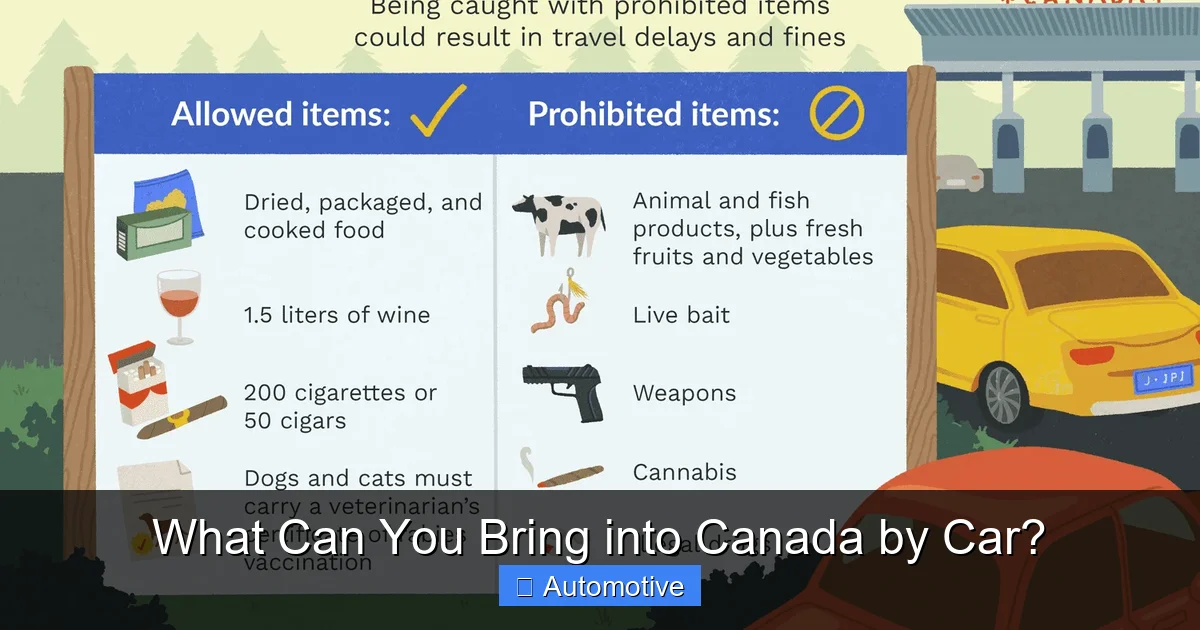
- 1.5 litres (53 imperial oz.) of wine
- 1.14 litres (40 imperial oz.) of distilled spirits (like vodka, whiskey)
- 24 cans or bottles (355 ml / 12 oz. each) of beer or malt liquor
You can combine these, but the total must not exceed the equivalent of 1.5 litres of spirits. For example, you could bring 1 litre of wine AND 24 cans of beer. Any amount over these limits will be taxed. For wine, the full duty and tax is applied to the entire quantity if you exceed the 1.5L limit. It’s not a graduated scale.
Tobacco Allowances (Per Visit)
The duty-free allowance is:
- 200 cigarettes
- 50 cigars
- 200 tobacco sticks
- 200 grams (7 oz.) of manufactured tobacco
You can bring a combination, but the total cannot exceed the equivalent of 200 cigarettes. Like alcohol, any excess is fully taxed and may incur fines. These are personal quantities. Bringing in multiple full cartons of cigarettes (10 packs/carton) is a clear red flag for commercial importation.
Important Considerations
First, these allowances are only if you are bringing the goods for your own personal consumption and you are of legal age in the province you’re entering. Second, these are in addition to your general personal exemption (which is based on your time away). Third, some provinces have additional restrictions or higher minimum prices for alcohol. The CBSA enforces the federal limits, but provincial liquor boards control retail sales. Always have your alcohol and tobacco in your possession, not packed away in a sealed shipping container from a vacation.
Medications & Controlled Substances: Legal ≠ Allowed
This is a critical and often misunderstood area. Just because a medication is prescribed to you or legal in your US state does not mean you can bring it into Canada. Canada has its own drug scheduling and importation rules.
Visual guide about What Can You Bring into Canada by Car?
Image source: tripsavvy.com
Prescription Medications
For your prescription drugs, you are allowed a “one-year supply” for personal use, but it must be for a condition you are being treated for in Canada. The medications must be:
- In their original pharmacy containers with clear labels showing your name, the drug name, dosage, and prescribing doctor’s name.
- Accompanied by a copy of the prescription or a doctor’s note explaining the need for the medication, especially for opioids, benzodiazepines, or stimulants.
Carrying large quantities of drugs like opioids can trigger intense scrutiny. The CBSA is on the lookout for potential drug trafficking. Only bring what you need for your trip plus a small emergency buffer. Over-the-counter medications (like ibuprofen, allergy meds) in standard consumer packaging are generally fine in reasonable quantities.
The Medical Marijuana Trap
This is the biggest pitfall. Despite being legal for medical or recreational use in many US states, cannabis (marijuana) and its derivatives remain a controlled substance under the Canadian Controlled Drugs and Substances Act when imported. You cannot bring recreational or medical marijuana from the US into Canada, even if you have a doctor’s note and a US state medical card. Traveling with medical marijuana across the border is prohibited. The only legal way to access cannabis in Canada is to purchase it from a licensed retailer (or federally licensed producer for medical use) after you have entered the country. Attempting to bring it in can result in arrest, charges, and a permanent bar from entering Canada. The same applies to CBD products derived from cannabis. Hemp-derived CBD (with 0.3% THC or less) is a gray area but should still be declared; it’s safest to avoid bringing any cannabis-related product.
Pets & Animals: More Than Just a Rabies Shot
Bringing your furry friend along requires meticulous planning. The rules differ significantly for dogs, cats, and other animals.
Dogs & Cats (The Most Common)
For personal pet dogs and cats entering from the US, you need:
- A valid rabies vaccination certificate in English or French, showing the pet’s details, vaccine date, and expiration. The pet must be at least 3 months old to be vaccinated.
- Proof of age (like a birth certificate or vet record) if the vaccination was given before 3 months of age.
- For puppies under 8 months or kittens under 3 months, additional documentation from a vet confirming they are healthy and have been in your possession since birth may be required.
While a general health certificate is not always required for dogs and cats from the US, it is highly recommended and may be requested by the officer. Traveling with your dog by car also requires you to consider pet safety, border wait times, and finding pet-friendly stops. Always have your pet’s paperwork in an easily accessible place in the car.
Other Animals (Birds, Rodents, Reptiles)
Bringing any animal other than a dog or cat is vastly more complicated and often requires an import permit from the Canadian Food Inspection Agency (CFIA) well in advance. This includes birds (even pet parrots), hamsters, guinea pigs, turtles, and snakes. Many species are prohibited entirely due to disease risks (like avian flu or salmonella). Do not attempt to bring these animals without written permission. The process can take weeks or months.
Service Animals
Service animals (like guide dogs) follow the same rabies vaccination rules but may have additional documentation requirements under accessibility laws. Have your service animal’s certification and identification readily available.
Vehicle, Camping Gear & Outdoor Equipment: Clean is the Keyword
Your car is your vessel, and what’s on or in it is subject to inspection. The primary concern here is invasive species—mud, seeds, and insects hitchhiking on your vehicle or gear.
The Critical “Clean” Requirement
Before you even reach the border, your vehicle and all outdoor equipment should be thoroughly cleaned:
- Under carriage and wheel wells: Hose off all mud and dirt. This is a major inspection point.
- Tires and fenders: Remove all soil and plant debris.
- Camping gear: Tents, sleeping bags, hiking boots, and firewood must be free of soil and seeds. Do not bring firewood. Transporting firewood across state/provincial or national borders is a primary vector for invasive insects like the emerald ash borer. Buy firewood locally at your destination.
- Bicycles, ATVs, motorcycles: Clean the tires and undercarriage.
Off-road vehicles (ORVs) like dirt bikes and quads are scrutinized heavily because they are prime carriers of soil. Be prepared for a possible secondary inspection of your vehicle’s undercarriage. Renting a car for your trip can sometimes simplify this, as rental companies maintain their fleets, but you are still responsible for the cleanliness of any gear you load inside.
Tools, Spare Parts, and Gas
Standard vehicle tools (jack, lug wrench, jumper cables) and a small quantity of spare parts (like a headlight bulb or a belt) for your personal vehicle are generally allowed. However, large quantities of parts, new tires, or automotive fluids (oil, coolant) may be seen as commercial importation. Carry only what’s necessary for a roadside repair. Regarding fuel, you cannot transport extra gasoline in portable cans across the border for safety reasons. Only the fuel in your vehicle’s tank is permitted.
Boats & Trailers
If you’re towing a boat, trailer, or RV, it will be subject to the same cleanliness rules. The hull of a boat must be free of aquatic invasive species like zebra mussels. Drain all water from live wells, bilges, and cooling systems before arrival. Have proof of ownership and registration for the trailer or boat readily available.
Frequently Asked Questions
Do I have to declare items if I’m just on a short trip?
Yes. You must declare all goods, regardless of trip length or value. The CBSA has no minimum threshold for declaration. Failure to declare, even a small item, is a violation and can result in seizure and fines.
What happens if I accidentally bring a prohibited food item and don’t declare it?
If discovered during inspection, the item will be seized and destroyed. You will likely face a monetary penalty (often $200-$400 CAD for a first offense) and could be subjected to increased future inspections. Repeated violations can lead to a record and more severe consequences.
Can I bring my prescription Adderall or opioids for my chronic pain?
You can, but with extreme caution. Bring only a small, clearly labeled supply in original containers with a copy of your prescription. Be prepared for questioning. Carrying large amounts may lead to arrest on suspicion of trafficking. Always check if your specific medication is on Canada’s list of controlled substances.
What is my “personal exemption” and how does it work with alcohol/tobacco?
Your personal exemption is a value-based amount (e.g., $800 CAD if away 24+ hours) you can bring back without paying duty. Alcohol and tobacco allowances are separate, specific quantities that are in addition to this monetary exemption. You can use your exemption for other goods like new clothing or electronics.
My dog has a rabies shot from 3 years ago. Is that okay?
No. The rabies vaccination must be current and valid at the time of entry. Check the expiration date on the certificate. If it’s expired, your dog will need a booster and a new certificate before travel. The certificate must also clearly identify your dog by breed, color, and other markings.
How clean does my car really need to be for the border?
It needs to be visibly free of accumulated mud, dirt, and plant matter. A quick rinse is not enough for an off-road vehicle. Pay special attention to wheel wells, the undercarriage, and tire treads. Officers may use a tool to check for soil. When in doubt, give it a thorough wash. Remember to clean any cargo carriers, bike racks, or campers attached to your vehicle.