What Are the Major Service Intervals for a Toyota Rav4?

Contents
- 1 Key Takeaways
- 2 📑 Table of Contents
- 3 Understanding Your Toyota RAV4’s Service Schedule
- 4 The 5,000-Mile / 6-Month Cornerstone: Oil & Filter Change
- 5 The 10,000-Mile / 12-Month Checkpoint: Tire Rotation & Comprehensive Inspection
- 6 The 30,000-Mile / 36-Month Milestone: The Major Service
- 7 The 60,000-Mile / 72-Month Overhaul: The Major Major Service
- 8 Beyond 60,000 Miles: Long-Term Care & Vigilance
- 9 Creating Your Personalized Maintenance Plan
- 10 Conclusion: Your RAV4’s Longevity is in Your Hands
- 11 Frequently Asked Questions



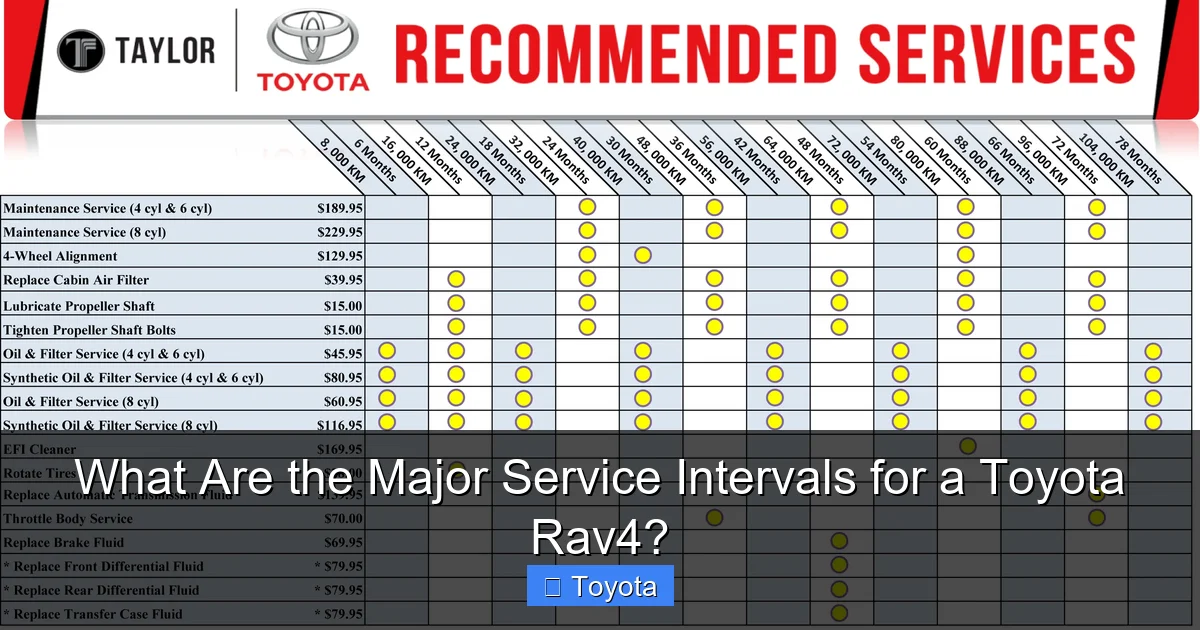
Adhering to your Toyota RAV4’s recommended service schedule is crucial for its longevity, reliability, and resale value. Toyota provides a detailed maintenance plan based on mileage and time, typically separating ” Severe” and “Standard” driving conditions. Key major intervals occur at 5,000 miles (oil/filter), 10,000 miles (rotation/inspection), 30,000 miles (major service), and 60,000 miles (major overhaul). Following these intervals prevents costly repairs, ensures optimal performance, and maintains your warranty coverage.
Key Takeaways
- Service intervals are not arbitrary; they are engineered to address wear and tear before it becomes a major problem. Following them is the single most important thing you can do for your RAV4’s long-term health.
- “Severe” driving conditions (lots of short trips, extreme temps, heavy loads, dusty roads) require more frequent maintenance. If your driving fits this description, use the severe schedule as your guide.
- The 5,000-mile/6-month oil change is the most critical and frequent interval. Even with newer synthetic oil, regular changes are non-negotiable for engine protection.
- Tire rotations at every other oil change (approx. 10,000 miles) are essential for even tread wear and maximizing tire life. Neglecting this leads to premature and uneven tire replacement.
- Major services at 30k and 60k miles involve comprehensive inspections and replacements of key fluids, filters, and spark plugs. These are investment points that prevent cascade failures in other systems.
- Always consult your owner’s manual for the exact schedule for your specific model year and engine (gas or hybrid). Hybrid models have unique considerations for the battery and regenerative braking systems.
- Keeping detailed service records is vital for warranty claims and proving your vehicle’s maintenance history to future buyers.
📑 Table of Contents
- Understanding Your Toyota RAV4’s Service Schedule
- The 5,000-Mile / 6-Month Cornerstone: Oil & Filter Change
- The 10,000-Mile / 12-Month Checkpoint: Tire Rotation & Comprehensive Inspection
- The 30,000-Mile / 36-Month Milestone: The Major Service
- The 60,000-Mile / 72-Month Overhaul: The Major Major Service
- Beyond 60,000 Miles: Long-Term Care & Vigilance
- Creating Your Personalized Maintenance Plan
- Conclusion: Your RAV4’s Longevity is in Your Hands
Understanding Your Toyota RAV4’s Service Schedule
Congratulations on choosing the Toyota RAV4! It’s consistently one of the best-selling SUVs in the world for a reason: it’s reliable, practical, and holds its value incredibly well. But that legendary Toyota reliability doesn’t happen by accident. It’s the direct result of disciplined, scheduled maintenance. Think of your RAV4’s service intervals as a personalized health plan designed by Toyota’s engineers. They’ve tested thousands of components under countless conditions to determine exactly when fluid degrades, filters clog, and parts wear. Sticking to this plan is the ultimate act of preventative care for your vehicle.
It’s important to understand that Toyota typically provides two schedules: “Normal” and “Severe.” Most drivers think they fall under “Normal,” but in reality, many driving patterns qualify as “Severe.” This includes frequent short trips (where the engine and oil don’t fully warm up), driving in extremely hot or cold climates, consistent stop-and-go traffic, towing a trailer or carrying heavy cargo, and driving on dusty, sandy, or muddy roads. If your lifestyle includes any of these, you should follow the more frequent “Severe” maintenance schedule. When in doubt, err on the side of caution—it’s cheaper to maintain than to repair.
Your owner’s manual is the absolute bible for your specific RAV4. The exact miles and months can vary slightly between model years (e.g., a 2019 RAV4 vs. a 2024 RAV4) and between the gas and hybrid powertrains. This guide will walk you through the major, milestone intervals that apply to the vast majority of recent RAV4 models, explaining what’s done and, most importantly, why it matters. We’ll also touch on some model-specific nuances, like the hybrid battery’s cooling system, that are easy to overlook.
The 5,000-Mile / 6-Month Cornerstone: Oil & Filter Change
This is the heartbeat of your maintenance schedule. Regardless of whether you have the traditional 2.5L 4-cylinder, the more powerful 2.5L 4-cylinder in the Adventure/TRD Off-Road, or the hybrid powertrain, the oil change is the most common and critical service. For decades, the 3,000-mile oil change was gospel. Today, with modern synthetic oils and tighter engine tolerances, Toyota extends this interval. For “Normal” driving, the recommendation is typically every 5,000 miles or 6 months. For “Severe” conditions, it drops to every 3,000 miles or 3 months. Always check your manual for your specific year’s advice.

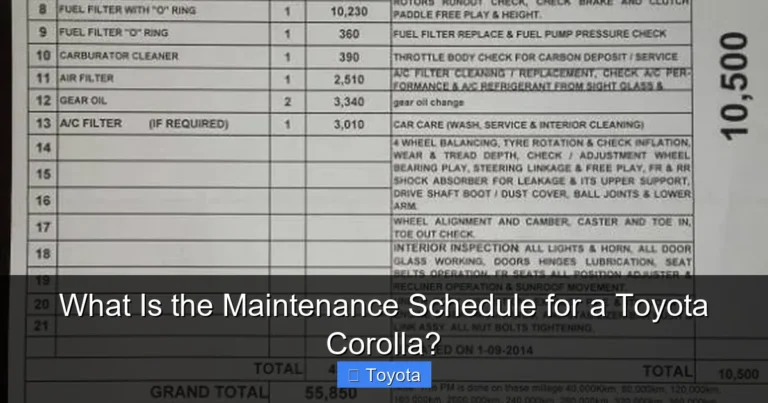
Visual guide about What Are the Major Service Intervals for a Toyota Rav4?
Image source: maintenanceschedule.com
Why This Interval is Non-Negotiable
Engine oil does three jobs: it lubricates moving parts to prevent friction, it cools the engine by carrying heat away, and it suspends tiny particles of dirt and metal wear. Over time, oil breaks down due to heat, oxygen, and contamination. The additive package that gives oil its protective properties depletes. The filter, which traps debris, becomes clogged and restricts flow. Running old oil is like running your engine on sandpaper—it causes accelerated wear on bearings, piston rings, and camshafts. This wear is permanent and leads to decreased performance, poor fuel economy, and eventually, catastrophic engine failure. An oil change is the cheapest insurance policy you can buy for your engine.
For RAV4 owners, a common question is about oil type and weight. Toyota almost universally recommends 0W-20 synthetic oil for recent models. The “0W” means it flows like a thinner oil in cold starts (the “W” stands for winter), providing immediate protection, while the “20” maintains its viscosity at high operating temperatures. Using the correct oil is vital for fuel economy and the function of systems like VVT-i (Variable Valve Timing with intelligence). If you’re wondering about the specifics, you can read more about what kind of gas does a Toyota RAV4 take, but remember, oil is equally, if not more, important.
What Happens During a Standard Oil Change
A proper service should include more than just draining the old oil and putting in new. The technician should:
- Drain & Replace Oil: Using the correct viscosity and quantity (usually 4.8-5.1 quarts for gas models, slightly more for hybrids).
- Replace the Oil Filter: A new filter is a must. The old one is full of trapped contaminants.
- Lubricate Chassis Points: Apply grease to specified fittings (if applicable—many modern cars are “lube-free”).
- Perform a Multi-Point Inspection: This is where you get your money’s worth. They should check fluid levels, tire pressure, lights, belts, hoses, and look for any leaks.
Many dealers and shops now offer “high-mileage” or “extended drain” oils, but stick to Toyota’s recommendation unless you have a very specific, documented reason to deviate. Also, consider the cost. If you’re budgeting, how much is an oil change for a Toyota RAV4 can vary between a quick-lube shop and a dealer, but the dealer often uses genuine Toyota oil filters and has technicians specifically trained on your model.
The 10,000-Mile / 12-Month Checkpoint: Tire Rotation & Comprehensive Inspection
If your oil change interval is 5,000 miles, this service often coincides with your second oil change. The star of the show here is the tire rotation. For most RAV4s, this is a simple cross-pattern (front tires straight back, rear tires crossed to the front). For models with different sized front and rear tires (some trim levels), it’s a front-to-rear swap without crossing. The owner’s manual will have the exact pattern.
Visual guide about What Are the Major Service Intervals for a Toyota Rav4?
Image source: d1l9oib0dboqqi.cloudfront.net
The Science of the Tire Rotation
Front-wheel-drive vehicles like the RAV4 put immense stress on the front tires. They handle steering, acceleration, and the majority of braking force. This causes the front tires to wear much faster and differently than the rears. Without regular rotation, your front tires will bald out in 20,000 miles while the rears still have 60% of their tread. Rotating them every 5,000-10,000 miles ensures all four tires wear evenly, maximizing their lifespan and maintaining balanced handling and traction. It also gives the technician a prime opportunity to inspect the tires for uneven wear patterns, which can be an early symptom of larger problems like alignment issues, suspension wear, or incorrect inflation.
Speaking of inflation, this is the perfect time to check and adjust tire pressure. The correct pressure is listed on a sticker inside the driver’s door jamb, not on the tire sidewall. Under-inflated tires are a leading cause of poor fuel economy, premature failure, and blowouts. Over-inflation reduces the contact patch and leads to a harsh ride and center-tread wear. For the most accurate reading, check tires when they are “cold” (driven less than a mile). If you’re unsure about the numbers, a resource on what is the correct tire pressure for a Toyota Sienna illustrates the principle—the location and method are the same for your RAV4.
What Else is Inspected?
This service is a comprehensive health check. Beyond tires, a good technician will:
- Check All Fluid Levels: Engine oil, coolant, brake fluid, power steering fluid (if applicable), windshield washer fluid, and for hybrids, the inverter coolant.
- Inspect Brakes: Measure pad and shoe thickness, check rotors for scoring or warping, and inspect calipers and hardware.
- Examine Battery & Charging System: Check battery terminals for corrosion, test battery health and charging voltage.
- Look at Belts & Hoses: Check for cracks, fraying, or leaks in the serpentine belt, timing belt (if your model has one—most recent RAV4s have a timing chain), and coolant hoses.
- Test Lights & Wipers: Ensure all exterior and interior lights work. Check wiper blade condition; if they streak or skip, it’s time for new ones. You might research what size wiper blades for a 2013 Toyota RAV4 if you have an older model and want to DIY.
This inspection is your early warning system. Catching a slightly worn brake pad now is a $200 job. Waiting until it grinds into the rotor is a $600+ job. Finding a tiny coolant leak now prevents an overheating disaster later.
The 30,000-Mile / 36-Month Milestone: The Major Service
This is the first major “check-up” that goes beyond the basics. It builds on all previous services and adds several key replacements. For “Normal” driving, this is a significant service. For “Severe” driving, it may be required sooner. This is the service where you start to see a higher bill, but it’s an investment that protects the engine, transmission, and cabin comfort.

Visual guide about What Are the Major Service Intervals for a Toyota Rav4?
Image source: mag.toyota.co.uk
Core Components Replaced & Inspected
At this interval, you can expect all items from the 10k service, plus:
- Replace Engine Air Filter: The air filter is your engine’s lungs. A clogged filter chokes your engine, reducing power, throttle response, and fuel economy. It’s an easy, inexpensive part to replace. If you live in a dusty area, you might need to do this more often.
- Replace Cabin Air Filter: This filter cleans the air you breathe inside the car. It traps pollen, dust, soot, and odors. A dirty cabin filter makes your HVAC system work harder, reducing airflow and putting strain on the blower motor. It’s often accessible behind the glovebox and is a great DIY project. A guide on how to change the cabin air filter on a Toyota RAV4 can save you money and is usually a 15-minute job.
- Inspect & Possibly Replace Spark Plugs: On many RAV4 models, platinum or iridium spark plugs are rated for 60,000 miles. However, the 30k service is the perfect time to inspect them for wear, fouling, or incorrect gap. For some older models, replacement at 30k is specified. Worn plugs cause misfires, rough idle, poor acceleration, and failed emissions tests.
- Inspect & Service Brakes: A full brake inspection, including measuring pad thickness, rotor condition, and caliper slide pin lubrication. Brake fluid is hygroscopic (absorbs water from the air), which lowers its boiling point and can lead to brake fade. Many manufacturers recommend flushing brake fluid every 2-3 years, regardless of mileage. The 30k service is an ideal time to assess this.
- Inspect Drive Belts: The serpentine belt that runs your alternator, power steering, and A/C compressor should be checked for cracks, glazing, or fraying. A broken belt leaves you stranded.
- Check & Top Off All Fluids: This includes transmission fluid (for older models with a dipstick; many newer ones are “sealed” but still need level checks during service), differential fluid (on AWD models), and washer fluid.
Hybrid-Specific Notes
For the RAV4 Hybrid, this service includes all of the above, with special attention to the hybrid system. The technician should:
- Inspect the Hybrid Battery Cooling System: Check the air filter (if equipped) for the battery’s cooling intake, usually located behind a rear side panel. A clogged filter can cause the hybrid battery to overheat and derate power.
- Check Inverter Coolant Level: The inverter (which converts battery DC to motor AC) has its own cooling circuit. Level and condition are important.
- Perform a Hybrid System Diagnostic Scan: A scan tool should be used to check for any stored fault codes in the hybrid control modules, even if no warning light is on.
Some owners also consider a fuel system cleaning at this point to keep injectors and valves clean, especially if they notice rough idle or decreased fuel economy. However, this is often an additional, recommended service rather than a mandatory interval item.
The 60,000-Mile / 72-Month Overhaul: The Major Major Service
This is the big one. The 60,000-mile service is comprehensive and often the most expensive single maintenance appointment you’ll have. It includes everything from the 30k service, plus several major component replacements that are critical for the next 60,000 miles. Think of it as hitting the reset button on many of your RAV4’s wear items.
The Big-Ticket Items
- Replace Engine Coolant (Antifreeze): Coolant degrades over time. Its anti-corrosion additives get used up, and it loses its ability to protect the radiator, water pump, and engine block from rust and scale. Old coolant can lead to overheating, water pump failure, and clogged heater cores. This is a complete drain-and-fill of the engine cooling system. It’s also a good time to inspect and replace any brittle or leaking radiator hoses.
- Replace Transmission Fluid & Filter (for applicable models): This is a critical and often misunderstood service. For many years, Toyota specified “lifetime” fluid for automatic transmissions, meaning lifetime of the transmission. This has been widely reinterpreted as needing service around 60,000-100,000 miles for severe service. For RAV4s with a traditional automatic (not the CVT), a fluid and filter change is highly recommended at 60k. Fresh fluid ensures smooth shifts, proper clutch engagement, and prevents the sludge that can cause transmission failure. For models with the CVT (continuously variable transmission), fluid changes are even more crucial and often recommended every 60k miles. Neglecting this is a surefire way to destroy a $4,000+ transmission.
- Replace Spark Plugs (if not done at 30k): If your RAV4 uses long-life iridium plugs rated for 60k, this is their replacement point. Worn plugs increase emissions, reduce power, and strain the ignition coils.
- Replace Timing Belt or Chain Tensioner (if applicable): Most recent RAV4s use a timing chain, which is “lifetime” but still has a tensioner that may need inspection or replacement. However, some older RAV4 models (pre-2019 with the 2.5L) have a timing belt that must be replaced at 60,000 miles or 5 years. A timing belt failure on an interference engine (which the RAV4’s is) means the pistons will collide with the valves, causing catastrophic engine damage costing more than the car’s value. This is the single most important item on this list for those models. Your manual will specify which you have.
- Complete Brake System Service: This includes a full brake fluid flush (as mentioned earlier), which is more involved than just topping it off. It removes moisture-contaminated fluid from the entire system.
- Full Suspension & Steering Inspection: At 60k, components like ball joints, tie rod ends, control arm bushings, and struts/shocks are showing age. They should be thoroughly inspected for play, leaks, or damage. Replacing worn suspension parts improves handling, safety, and tire wear.
The “Sealed” Component Myth
You’ll hear that many modern cars have “lifetime” or “sealed” fluids and components (like some transmissions, differentials, and struts). Be skeptical. “Lifetime” usually means “lifetime of the warranty” or “lifetime under ideal lab conditions.” In the real world of potholes, temperature extremes, and stop-and-go traffic, these parts wear out. A proactive differential fluid change at 60k on an AWD RAV4 is cheap insurance against a noisy or failing differential. Don’t let the “sealed” label scare you away from a discussion with your mechanic about preventative service.
Beyond 60,000 Miles: Long-Term Care & Vigilance
Once you clear the 60,000-mile milestone, your RAV4 enters its prime, but maintenance doesn’t stop. The intervals become more about inspection and repeating the major services on a longer cycle. The philosophy shifts from “preventative replacement” to “condition-based replacement,” where you rely more heavily on the detailed inspections at each service to determine what needs changing next.
The 90,000 to 100,000-Mile Window
This period often sees the repetition of several 60k-mile items:
- Second Transmission Fluid Service: If you did it at 60k, plan for another at 120k. If you missed it at 60k, do it now.
- Second Coolant Flush: Coolant should be replaced every 30,000-50,000 miles or 2-3 years, depending on the type. Don’t let it go 10 years.
- Major Spark Plug Check/Replacement: If they were replaced at 60k with standard plugs, they may be due again. Iridium plugs may last 100k.
- Inspect/Replace Accessory Belt: The serpentine belt that runs multiple accessories should be inspected at every service and replaced every 60,000-100,000 miles.
- Battery Replacement: Car batteries typically last 3-5 years. Have it tested at every service after the 3-year mark. A failed battery can leave you stranded and also strain the alternator.
Focus on High-Wear Items
At this stage, pay close attention to:
- Brakes: Pads and rotors wear out based on driving style, not just miles. You may need a second or third set. Listen for squealing or grinding.
- Tires: You’re likely on at least your second set. Monitor tread wear and age. Tires have a 6-10 year shelf life, regardless of tread depth.
- Suspension: Struts and shocks lose their damping ability over time. Signs include a bouncy ride, nose-diving when braking, and cupping on tire treads. Replacing them improves safety and comfort.
- Battery: As mentioned, test it. Also, check the terminals for corrosion, which can cause starting issues.
For hybrid owners, the high-voltage (traction) battery is designed to last the life of the vehicle. However, its cooling system filters and coolant should still be serviced as per the manual. The 12-volt auxiliary battery (which powers all the normal electronics) follows the same replacement cycle as a conventional car.
Building a Relationship with a Trusted Mechanic
As your RAV4 ages, having a trusted independent mechanic or dealership service department that knows your car’s history becomes invaluable. They can spot trends—”I notice your brake pads are wearing a little faster than last time, are you doing more city driving?”—and provide honest advice on what needs immediate attention versus what can wait. Don’t be afraid to ask questions and get itemized estimates. A good shop will explain what does hold mean on a Toyota RAV4 or other features if they come up during diagnostics, but their primary focus should be on your mechanical needs.
Creating Your Personalized Maintenance Plan
While the mileage/time intervals are your framework, the best plan is personalized. Start by finding your exact maintenance schedule in your owner’s manual. Then, create a simple log—a notebook or a spreadsheet—with columns for Date, Mileage, Service Performed, and Shop/Invoice #. This record is gold for warranty claims and selling your car.
Next, assess your driving. Be brutally honest. Do you make daily 2-mile trips to the store? Do you tow a small utility trailer on weekends? Do you live in a place with road salt that causes corrosion? If you answered yes to any, adopt the “Severe” schedule. It might mean an extra oil change or two a year, but it will pay dividends in longevity.
Finally, budget for it. A good rule of thumb is to set aside $0.10-$0.15 per mile driven for maintenance and repairs. For 12,000 miles a year, that’s $1,200-$1,800. This covers oil changes, tire rotations, and sets a fund for the larger 30k/60k services. By planning, you avoid the shock of a $1,200 bill and can spread the cost. Remember, a well-maintained RAV4 can easily surpass 200,000 miles, making your per-mile cost of ownership incredibly low.
Conclusion: Your RAV4’s Longevity is in Your Hands
The Toyota RAV4’s reputation for reliability is earned, not given. It’s a partnership between Toyota’s engineering and your commitment to maintenance. Those factory-defined service intervals—at 5k, 10k, 30k, 60k, and beyond—are not a profit scheme for dealers; they are the roadmap to 300,000 miles of dependable service. From the lifeblood of your engine (oil) to the shoes that stop you (brakes), from the tires that grip the road to the fluids that cool and lubricate, every service plays a vital role.
Ignoring the schedule is a gamble with high stakes. You risk a $5,000 engine rebuild from neglected oil changes, a $3,000 transmission replacement from old fluid, or a dangerous brake failure. Conversely, embracing the schedule transforms your RAV4 from a mere appliance into a long-term, low-stress companion. It will reward you with years of trouble-free driving, excellent fuel economy, and a high resale value when the time comes. So, open your owner’s manual, find your schedule, and mark your calendar. Your future self, stranded on the side of the road, will thank you for it.
Frequently Asked Questions
What happens if I skip a recommended service interval for my RAV4?
Skipping services allows wear and degradation to progress unchecked. What might have been a simple, inexpensive fix (like replacing a worn serpentine belt) can turn into a catastrophic failure (like a broken belt causing engine overheating). It also voids your warranty if the failure is linked to neglected maintenance, and it significantly harms your car’s resale value due to incomplete records.
Can I extend the oil change interval if I use full synthetic oil?
Even with full synthetic oil, you must follow Toyota’s published interval for your specific model year and driving conditions. While synthetic oil is more robust, the interval is based on the entire engine’s wear characteristics, not just oil stability. For most modern RAV4s, the normal interval is 5,000-10,000 miles. Extending beyond this, especially with “severe” driving, risks engine damage.
Is the 60,000-mile service really necessary?
Yes, it is arguably the most important major service. It includes critical replacements like transmission fluid (for non-CVT models), engine coolant, and a thorough inspection of the timing belt (if applicable) and major suspension components. Missing this service dramatically increases the risk of expensive transmission failure, overheating, and suspension breakdowns in the next 60,000 miles.
How do I know if my RAV4 has a timing belt or chain?
All RAV4 models from the 2019 model year onward (and most hybrids from earlier) use a timing chain, which is designed to last the life of the engine with proper oil maintenance. Models from 2018 and earlier with the 2.5L 4-cylinder engine typically have a timing belt that must be replaced at 60,000 miles or 5 years. Your owner’s manual will specify this clearly under the maintenance schedule.
What is the most important fluid change besides oil?
Engine coolant and transmission fluid are the next most critical. Coolant’s anti-corrosion properties deplete over time, leading to rust, clogs, and overheating. Transmission fluid (especially in conventional automatics and CVTs) loses its friction properties and can break down into sludge, causing slipping, harsh shifts, and eventual failure. Both should be changed per the severe/normal schedule.
Should I use genuine Toyota parts and fluids at my independent mechanic?
For major items like oil filters, cabin filters, and spark plugs, high-quality OEM (Original Equipment Manufacturer) or reputable aftermarket brands (like Fram, NGK, Denso) are fine. For fluids, using Toyota-approved specifications (e.g., Toyota WS transmission fluid) is crucial. You can ask your independent mechanic to use genuine Toyota fluids or specify a brand that meets Toyota’s exact specifications (often listed in the manual). For complex items like hybrid battery coolant, using the correct Toyota-specified fluid is essential.