
Stay in Your Car Oil Change in Cary, NC

Picture a regular Tuesday morning when everything feels urgent. Your to-do list is packed, and the last thing you want is to sit in a stuffy waiting room with a cup of burnt coffee while your car gets an oil change. That is exactly the situation a stay in car oil change in Cary, NC is built for: you stay in your car, your playlist keeps going, and a technician handles the service from the bay.
This guide explains how a stay-in-your-car oil change works, why the drive-in format has become popular around Cary, what it usually costs, and how to choose between conventional, synthetic blend and full synthetic oil. It also covers how often to change your oil and what to ask before you pull in. Shop names, prices, wait times and services change, so treat every figure here as a rough guide and confirm the details with the shop you plan to visit.
Key Takeaways
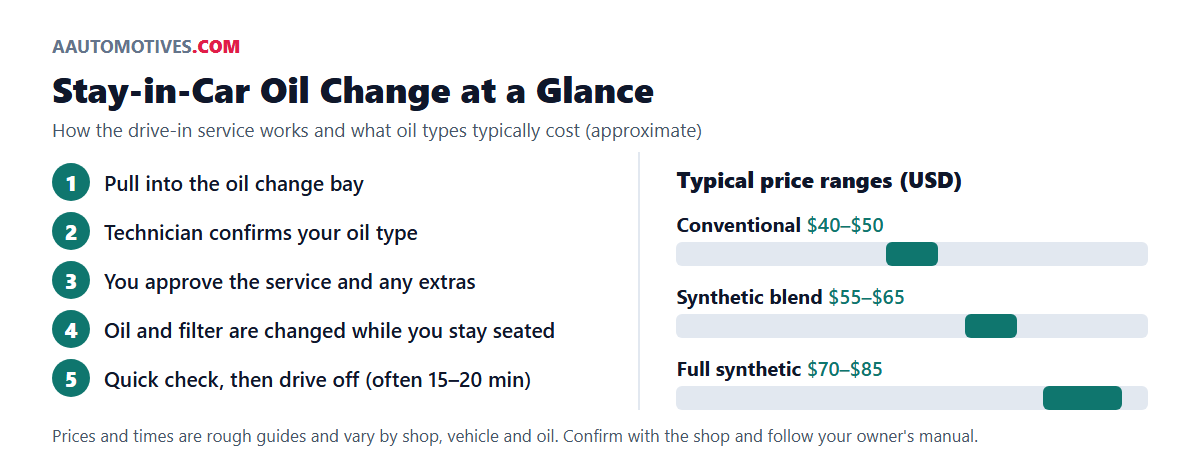
- You stay in the car: at a drive-in oil change bay the technician works on the oil and filter while you remain seated, and many visits take roughly 15 to 20 minutes.
- Service varies by location: not every shop or every store of the same chain offers stay-in-car service, so confirm before you go.
- Prices are ballpark figures: conventional oil often runs about $40 to $50, a synthetic blend about $55 to $65 and full synthetic about $70 to $85, depending on the shop, your engine and the oil capacity.
- Use the oil your car calls for: your owner’s manual lists the correct viscosity grade and specification, which matters more than the label on the bottle.
- Intervals depend on the car: many modern cars specify somewhere between about 5,000 and 10,000 miles, and an oil-life monitor, if your car has one, can refine that.
- Ask questions and approve extras: a quick inspection is common, but you decide on add-on services such as air filters or fluid flushes.
Table of Contents
- What Is a Stay in Car Oil Change?
- Why Stay-in-Car Oil Changes Are Popular in Cary, NC
- Places Offering Stay-in-Car Oil Changes in Cary, NC
- Time Is the New Luxury: Saving Minutes Without Cutting Corners
- Is a Stay-in-Car Oil Change More Expensive?
- Conventional, Synthetic Blend or Full Synthetic: Which Oil Do You Need?
- What a Typical Oil Change Includes
- How Often Should You Change Your Oil?
- Perfect for Families, Professionals and Seniors
- A Cleaner, Safer Experience Overall
- Traditional Oil Change vs. Stay-in-Car: A Head-to-Head Comparison
- What Drivers Typically Say About the Experience
- Tips for First-Time Visitors: What You Should Know
- Conclusion: It Is More Than Just Oil
What Is a Stay in Car Oil Change?
A stay in car oil change is exactly what it sounds like. Instead of dropping off your vehicle or waiting inside a service center, you remain seated in your car while a professional changes the oil. The shop is set up so the technician can reach the drain plug and filter from below the car (often from a pit under the bay) while you stay inside.
It may sound like something from a futuristic film, but it is a normal service at several quick-lube chains. You can listen to a podcast, finish your coffee and answer a few emails without walking across a slick floor or stepping around oil spills.
How It Works
Every shop runs its own process, but the typical flow looks like this:
- You pull into a designated oil change bay and follow the attendant’s directions.
- A technician greets you at the window and confirms the oil type your car needs.
- You approve the service and any recommended extras.
- The old oil is drained, the oil filter is replaced and new oil is added to the level your manufacturer specifies.
- A quick visual check of items such as fluid levels, tire pressure or lights may be included.
- You get your invoice and drive out, usually within 15 to 20 minutes.
It is like a drive-through for your car, except that instead of burgers it gets motor oil. The technician may ask you to keep your foot on the brake, shift into neutral or turn the engine off at certain points, so follow their instructions each time.

Why Stay-in-Car Oil Changes Are Popular in Cary, NC
Life in Cary moves fast, from family schedules to tech jobs to weekend walks at Hemlock Bluffs. Many residents want quick, reliable car services that fit into a normal day instead of taking over a morning. Here are the main reasons this format keeps gaining fans.
Convenience Beyond Measure
Sitting in a cramped waiting room for 45 minutes feels outdated when you can stay in your car and keep your day moving. You never have to arrange a ride or ask someone to wait for you at the shop.
Health and Hygiene Friendly
Staying in your vehicle limits contact with shared surfaces and other customers. For people who are health-conscious or immune-compromised, that can be a real advantage.
Family and Kid-Friendly
Parents know the struggle of dragging children into an auto shop. With a stay-in-car service, kids can stay buckled in their seats with a show or a snack while you handle car care. Just remember that children should never be left alone in a parked car, so plan to remain with them throughout.
Places Offering Stay-in-Car Oil Changes in Cary, NC
Several quick-lube brands operate around Cary and nearby towns such as Morrisville and Apex, and some of them are known for drive-in service. The table below lists the shops mentioned in this guide with the features each is generally associated with. Whether a particular location offers stay-in-car service, how long it takes and what it charges can vary, so check the shop’s website or call before you go.
| Oil Change Center | Features generally associated with it | Typical service time (approx.) |
|---|---|---|
| Take 5 Oil Change | Stay-in-car format, quick turnaround | About 10 to 15 minutes |
| Valvoline Instant Oil Change | Stay-in-car format, fluid top-offs | About 15 to 20 minutes |
| Jiffy Lube Cary | Multi-point inspection included | About 20 minutes |
| Express Oil Change | Technicians described as ASE-certified, brake checks | About 15 minutes |
Each one offers something slightly different, but the common promise of the drive-in format is that you never leave your seat. Online reviews on Google and Yelp change constantly, so read recent ones for the specific location you plan to use rather than relying on a single star rating.
Time Is the New Luxury: Saving Minutes Without Cutting Corners
Time, once gone, never comes back, and that is why this trend makes sense. On a first visit to a stay-in-car shop, many drivers are surprised at how quickly the whole thing is over. A typical visit includes fresh oil, a new filter, a fluid-level check and often a tire-pressure check, all while you keep sipping your coffee.
Fast does not have to mean careless. Technicians at these shops follow a streamlined routine, and a good one will still confirm the drain plug is tight, the filter is seated and the oil level is correct on the dipstick or monitor. If you want reassurance, ask the technician to show you the old oil or the dipstick reading before you leave.
Is a Stay-in-Car Oil Change More Expensive?
This is a fair question, because convenience often comes with a premium. In practice, stay-in-car locations usually price their oil changes in line with traditional quick-lube shops. Prices vary by shop, vehicle and oil type, but here is a rough picture of what drivers commonly see:
- Conventional oil change: roughly $40 to $50
- Synthetic blend: roughly $55 to $65
- Full synthetic: roughly $70 to $85
These are approximate ranges, not quotes. Engines that hold more oil, European models and vehicles that need a special filter or oil specification can cost more. Some shops advertise discounts for first-time customers, online coupons or membership perks, so it is worth checking the shop’s website. Always ask for the out-the-door price before you approve the work.
Conventional, Synthetic Blend or Full Synthetic: Which Oil Do You Need?
Choosing the oil is the part of the visit that matters most, and the answer starts in your owner’s manual rather than at the service counter. The manual lists a viscosity grade, such as 0W-20 or 5W-30, and often a specification such as API or ILSAC ratings or a manufacturer approval. Match both.
- Conventional oil is refined from crude oil. It is the least expensive option and is fine for some older or lower-stress engines when the manufacturer allows it.
- Synthetic blend mixes conventional and synthetic base oils. It costs more than conventional and gives better protection against heat and cold, which suits many daily drivers.
- Full synthetic is engineered for consistent performance over a wide temperature range and generally resists breakdown longer. Many newer engines, especially turbocharged ones, require it.
If your manual calls for full synthetic, do not downgrade to save a few dollars. If you are unsure, tell the technician your make, model and year, and ask which grade and specification the shop is using for your car. Most shops keep vehicle data in their system, and you can compare it against the manual.
What a Typical Oil Change Includes
A standard oil change generally covers draining the old oil, replacing the oil filter and refilling with the correct amount of new oil. Many shops add small extras, though exactly what is included differs by shop and package:
- A check of other fluid levels, such as windshield washer fluid, coolant and brake fluid.
- A tire-pressure check and adjustment.
- A visual check of belts, hoses, lights and wiper blades.
- A reset of your oil-change reminder or maintenance light, where applicable.
Recommendations for extras such as engine air filters, cabin air filters, wiper blades or fluid flushes are common. Some are worthwhile and some can wait. Ask the technician to show you the part, and compare the suggestion with the schedule in your owner’s manual before you say yes.
How Often Should You Change Your Oil?
The old rule of thumb was every 3,000 miles, but that is no longer true for most modern cars. Many manufacturers now specify intervals somewhere between about 5,000 and 10,000 miles when using the recommended oil, and some cars use an oil-life monitor that calculates the interval from how you drive. Severe conditions such as frequent short trips, heavy stop-and-go traffic, towing, dusty roads or extreme heat can call for shorter intervals.
The safest approach is to follow the schedule in your owner’s manual and the oil-life indicator on your dashboard, and to ask the shop to record your mileage so you know when the next change is due. Do not stretch intervals beyond what the manufacturer recommends.
Perfect for Families, Professionals and Seniors
Different lifestyles, one convenient solution.
Families
If you have young children, a stay-in-car service can spare you from tantrums in a waiting room and from wrangling strollers or car seats. Parents can hand out snacks, keep an eye on the kids and chat with the technician through the window.
Busy Professionals
If you are hopping between meetings or running errands on a lunch break, this format keeps you on the move. You can answer emails or take calls while the service is under way.
Seniors
Many older drivers appreciate the comfort and ease of staying in their vehicle. There is no need to walk far or navigate an unfamiliar building. If you have mobility needs, call ahead and ask how the shop handles them.
A Cleaner, Safer Experience Overall
In a town where people value tidy neighborhoods and safe streets, this style of oil change fits in well. Service areas are designed to keep the mess in the bay, so you are not dragging dirt and oil through a waiting room. Because you are inside your vehicle, there is also less chance of slips on wet floors and less contact with other customers.
It is a small detail, but it adds up. Cleanliness and safety are part of why many drivers prefer the format.
Traditional Oil Change vs. Stay-in-Car: A Head-to-Head Comparison
We have all been through the old way. You park, you wait in a cramped room with outdated magazines and a flickering TV, and then a technician comes in, explains things you do not fully follow and you nod along to avoid looking clueless. Here is how that traditional model compares with a stay-in-car service in general terms:
| Feature | Traditional Oil Change | Stay-in-Car Oil Change |
|---|---|---|
| Typical wait | Often 30 to 45 minutes | Often 10 to 20 minutes |
| Comfort | Waiting room | Your car, your music |
| Contact with others | Shared space | Minimal contact |
| Convenience | Requires drop-off or waiting inside | Pull up and drive off |
| Traveling with kids | Harder | Easier |
| Accessibility | Limited for some visitors | Often easier for older drivers |
| Visibility of the work | Often limited | You can ask questions at the window |
The comparison is a generalization, and individual shops differ. Still, it is not just about the oil. It is about your time, your comfort and being in control of your experience.
What Drivers Typically Say About the Experience
Drivers who switch to a drive-in oil change tend to mention the same few things. Parents say it removes the hassle of unbuckling a baby or keeping a toddler occupied in a waiting room. Commuters and remote workers like finishing a task between calls without leaving the car. Older customers value not having to walk around a busy shop floor. Some also appreciate that technicians will often point out a worn wiper blade, a burned-out bulb or low tire pressure while they are already there.
These are general impressions rather than guarantees. The quality of the experience depends on the individual shop, its staffing and how busy it is, which is why recent reviews of your specific location are worth a quick look before you go.
Tips for First-Time Visitors: What You Should Know
If you are planning your first stay in car oil change, these tips will help it go smoothly:
- Check wait times and policies online. Many shops show hours, services and sometimes check-in options on their websites.
- Know your oil type (conventional, synthetic blend or full synthetic) and the viscosity grade in your manual.
- Bring any coupons. Some shops honor mobile or printed discounts.
- Stay off your phone when the technician is talking to you so you do not miss questions or recommendations.
- Ask questions. Since you are right there, it is easy to understand what is being done and why.
- Follow instructions on engine, brake and gear position. Technicians may ask you to turn the engine off or hold the brake at specific moments.
- Keep valuables and pets under control. Make sure pets are calm and secured, and keep children seated and buckled.
These small preparations can make your visit fast, safe and pleasant.
Conclusion: It Is More Than Just Oil
A stay in car oil change in Cary, NC is a time-saver and a quality-of-life upgrade. You get fresh oil and a new filter without giving up your schedule, your comfort or your control over the process. To get the most out of it, know the oil grade your car needs, ask what the quoted price includes and follow the maintenance schedule in your owner’s manual. Because hours, prices and services change, always confirm the details with the shop before your visit.
Drive up, sit back and roll out with a healthier engine. Once you try it, there is a good chance you will not want to go back to the waiting room.
Frequently Asked Questions
Is a stay-in-car oil change safe?
Yes, when the shop follows its normal procedures. Technicians work below the car or at the engine bay while you remain seated, and they may ask you to keep your foot on the brake or turn off the engine at certain moments. Follow their directions and ask if anything is unclear.
What if I do not know which oil to use?
Your owner’s manual lists the correct viscosity grade and specification. If you do not have the manual handy, give the technician your make, model and year so they can look up the manufacturer’s recommendation, then check it against the manual later.
Do I need an appointment?
Many drive-in oil change shops accept walk-ins, but policies differ. Some locations offer online check-in or appointments, and calling ahead during peak hours can help.
Can I get other services while staying in the car?
Often, yes. Many shops can check tire pressure, top off fluids, replace wiper blades or bulbs and change air filters during the same visit. What is available depends on the location, and brake or tire work usually requires a different type of shop.
Is it okay to bring my dog?
Usually, as long as your pet is calm, secured and not distracting the technician. Ask the shop about its policy if you are unsure.
Are these oil changes as thorough as a traditional one?
They can be. The core service is the same: drain the old oil, replace the filter and refill to the correct level. Ask the technician to confirm the oil grade, the amount added and anything they noticed during the check.
How often should I get an oil change?
It depends on your car and the oil you use. Many modern vehicles specify intervals between about 5,000 and 10,000 miles with the recommended oil, and some have an oil-life monitor. Your owner’s manual is the best source.
Is there a wait?
There can be at busy times such as weekends and right after work. Many shops are staffed for quick turnover, and mid-morning and mid-afternoon are often quieter, but that varies by location.
Should I trust the extras the technician recommends?
Treat them as suggestions. Ask to see the worn part or dirty filter, compare the recommendation with your manual’s schedule and decide what to do now and what can wait.