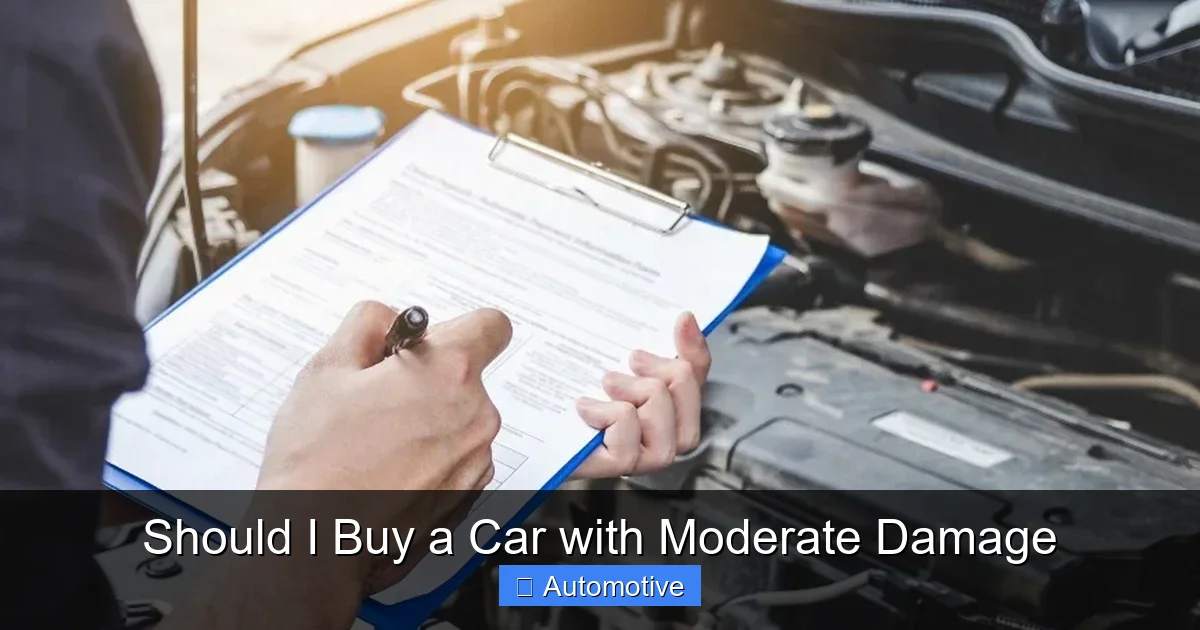
Should I Buy a Car with Moderate Damage

Contents
- 1 Key Takeaways
- 2 📑 Table of Contents
- 3 Should I Buy a Car with Moderate Damage?
- 4 What Counts as Moderate Damage?
- 5 The Pros and Cons of Buying a Car with Moderate Damage
- 6 How to Evaluate a Car with Moderate Damage
- 7 Negotiating the Price: How Much Should You Pay?
- 8 Insurance and Financing Considerations
- 9 Real-Life Examples: When It Worked (and When It Didn’t)
- 10 When to Walk Away
- 11 Final Thoughts: Is It Worth It?
- 12 Frequently Asked Questions


Buying a car with moderate damage can save you money, but it comes with hidden risks. This guide helps you weigh the pros and cons, assess repair costs, and avoid costly mistakes so you can make a smart, informed decision.
Key Takeaways
- Moderate damage doesn’t always mean unsafe: Many cars with moderate damage are structurally sound and safe to drive after proper repairs.
- Get a professional inspection: Always have a trusted mechanic inspect the vehicle before buying to uncover hidden issues.
- Check the vehicle history report: Use services like Carfax or AutoCheck to verify accident details, repair quality, and title status.
- Factor in repair and maintenance costs: Even if the car looks good, ongoing repairs may add up over time.
- Negotiate the price: Use the damage as leverage to get a lower purchase price—dealers and private sellers often expect it.
- Consider resale value: A car with a damaged history may be harder to sell and could lose value faster.
- Insurance may be affected: Some insurers charge higher premiums or refuse coverage for cars with prior damage.
📑 Table of Contents
- Should I Buy a Car with Moderate Damage?
- What Counts as Moderate Damage?
- The Pros and Cons of Buying a Car with Moderate Damage
- How to Evaluate a Car with Moderate Damage
- Negotiating the Price: How Much Should You Pay?
- Insurance and Financing Considerations
- Real-Life Examples: When It Worked (and When It Didn’t)
- When to Walk Away
- Final Thoughts: Is It Worth It?
Should I Buy a Car with Moderate Damage?
So, you’ve found a car you like—great price, good mileage, and it fits your needs. But there’s one catch: it has moderate damage. Maybe it was in a fender bender, had a side impact, or suffered hail damage. Now you’re wondering: should I buy a car with moderate damage?
It’s a smart question. And the answer isn’t always black and white. On one hand, you could save thousands by buying a car that’s been repaired after an accident. On the other hand, you might end up with hidden problems, expensive repairs, or a vehicle that’s harder to insure or resell.
In this guide, we’ll walk you through everything you need to know about buying a car with moderate damage. We’ll cover what counts as “moderate,” how to assess the risks, what to look for during an inspection, and how to make a smart decision that fits your budget and lifestyle.
Whether you’re shopping at a dealership, buying from a private seller, or considering a salvage-title vehicle, this guide will help you avoid common pitfalls and make a confident choice.
What Counts as Moderate Damage?

Visual guide about Should I Buy a Car with Moderate Damage
Image source: thumbs.dreamstime.com
Before you decide whether to buy a car with moderate damage, it’s important to understand what that term actually means. “Moderate damage” isn’t a legal or technical term—it’s more of a general description used by sellers, insurers, and mechanics. But it usually refers to damage that affects the car’s body, trim, or non-structural components, but doesn’t compromise the frame, safety systems, or major mechanical parts.
Examples of Moderate Damage
Let’s break it down with some real-world examples:
– A side door was dented in a parking lot accident and has been repaired with body filler and paint.
– The front bumper was replaced after a low-speed collision.
– The car was hit in the rear quarter panel, but the frame wasn’t bent.
– Hail damaged the roof and hood, but the glass and mechanical systems are fine.
– A minor front-end collision damaged the grille and headlights, but the radiator and engine mounts are intact.
These types of repairs are common and often done well. But “moderate” can also be a red flag if the seller is downplaying more serious issues. That’s why it’s crucial to dig deeper.
How to Identify Moderate vs. Severe Damage
The key difference between moderate and severe damage lies in the structural integrity of the vehicle. Severe damage typically involves:
– Frame or unibody bending
– Airbag deployment
– Damage to suspension or steering components
– Flood or fire damage
– Major mechanical failure due to impact
If any of these are present, the car may have a salvage title or be classified as a total loss by insurance companies. These vehicles come with bigger risks and should be approached with extreme caution.
Moderate damage, on the other hand, usually means the car can be safely repaired and returned to roadworthy condition. But again—this depends on the quality of the repair work.
The Pros and Cons of Buying a Car with Moderate Damage
Visual guide about Should I Buy a Car with Moderate Damage
Image source: thumbs.dreamstime.com
Now that you know what moderate damage looks like, let’s weigh the advantages and disadvantages of buying such a vehicle.
Pros: Why It Might Be a Smart Move
Lower Purchase Price
This is the biggest draw. Cars with damage history are often priced 10% to 30% below market value. If you’re on a tight budget, this discount can make a big difference.
For example, a 2020 Honda Civic with 40,000 miles might normally sell for $18,000. But if it has a repaired side impact, the seller might list it for $14,500. That’s a $3,500 savings—money you could use for repairs, insurance, or other expenses.
Potential for a Great Deal
Some sellers overestimate the impact of damage or don’t understand how much it affects value. If you do your homework, you might find a well-maintained car that’s been fairly repaired but is still undervalued.
Modern Cars Are Built to Withstand Minor Impacts
Today’s vehicles are engineered with crumple zones and reinforced structures designed to absorb energy in a crash. A moderate impact in one of these zones doesn’t necessarily mean the car is unsafe—especially if it was repaired correctly.
Cons: The Risks You Can’t Ignore
Hidden Damage
Even if the visible damage looks minor, there could be underlying issues. For instance, a bent suspension component might not be obvious but could cause uneven tire wear or poor handling.
Poor Repair Quality
Not all body shops do top-notch work. Some use cheap parts, skip steps, or don’t align panels properly. A poorly repaired car might have gaps between body panels, uneven paint, or rattling noises.
Reduced Resale Value
Even if the car runs perfectly, future buyers may be wary. A vehicle history report will show the accident, which can scare off buyers and lower your resale price.
Insurance Challenges
Some insurance companies charge higher premiums for cars with damage history. Others may refuse comprehensive or collision coverage altogether. Always check with your insurer before buying.
Potential for Ongoing Repairs
A car that’s been in an accident may be more prone to future issues. For example, a repaired suspension might wear out faster, or a replaced transmission cooler might leak.
How to Evaluate a Car with Moderate Damage
Visual guide about Should I Buy a Car with Moderate Damage
Image source: thumbs.dreamstime.com
If you’re seriously considering a car with moderate damage, don’t skip the evaluation process. A little due diligence can save you thousands and a lot of headaches.
Step 1: Get a Vehicle History Report
Start with a report from Carfax, AutoCheck, or the National Motor Vehicle Title Information System (NMVTIS). These reports will tell you:
– Whether the car was in an accident
– How severe the damage was
– If it has a salvage or rebuilt title
– If it was declared a total loss by an insurer
– How many owners it’s had
– If it has a clean maintenance record
Look for red flags like “structural damage,” “airbag deployment,” or “flood damage.” If the report shows the car was totaled, walk away unless you’re prepared for major risks.
Step 2: Have a Professional Inspection Done
This is non-negotiable. Even if the seller says the car was “professionally repaired,” you need an independent opinion.
Take the car to a trusted mechanic or a body shop that specializes in accident repairs. Ask them to check:
– Frame alignment (using a frame rack or laser measuring tools)
– Suspension and steering components
– Engine and transmission mounts
– Electrical systems (especially if airbags were involved)
– Rust or corrosion in repaired areas
– Paint quality and panel gaps
A good inspection might cost $100–$200, but it’s worth every penny. The mechanic can tell you if the repairs were done properly and if there are any hidden issues.
Step 3: Test Drive the Car
During the test drive, pay attention to:
– How the car handles (does it pull to one side?)
– Braking performance (any vibrations or noises?)
– Steering feel (is it loose or stiff?)
– Suspension (does it bounce too much over bumps?)
– Unusual noises (rattles, squeaks, or clunks)
If anything feels off, it could indicate unresolved damage.
Step 4: Check the Title and Registration
Make sure the car has a clean title—not a salvage or rebuilt title. A salvage title means the car was declared a total loss by an insurer. Even if it’s been repaired, it may be harder to insure, register, or sell.
In some states, a car with moderate damage can still have a clean title if the repair costs were below a certain threshold (often 70–75% of the car’s value). But if the damage was significant, the title may be branded.
Always verify the title status with your state’s DMV.
Negotiating the Price: How Much Should You Pay?
One of the biggest advantages of buying a car with moderate damage is the potential for a lower price. But how much should you offer?
Use the Damage as Leverage
Sellers know that damage reduces a car’s value. Use that to your advantage. Start by researching the car’s market value using tools like Kelley Blue Book (KBB) or Edmunds. Then, subtract the estimated cost of repairs—even if they’ve already been done.
For example:
– Market value of a 2019 Toyota Camry: $17,000
– Estimated repair cost for moderate damage: $2,500
– Fair offer: $14,500
You can also point out other factors that lower value, such as:
– The accident will show up on future vehicle history reports
– The car may be harder to resell
– Insurance costs could be higher
Most sellers will expect some negotiation, especially if the damage is visible.
Private Sellers vs. Dealerships
Private sellers are often more flexible on price, especially if they’re motivated to sell. They may not fully understand how much the damage affects value, so you might get a better deal.
Dealerships, on the other hand, are more aware of market conditions. They may price the car fairly but be less willing to negotiate. However, some dealers offer certified pre-owned (CPO) programs that include warranties—even on cars with damage history. This can add peace of mind.
Consider the Total Cost of Ownership
Don’t just focus on the purchase price. Factor in:
– Potential future repairs
– Higher insurance premiums
– Lower resale value
– Possible registration issues (in some states)
If the total cost over 3–5 years is close to that of a clean-title car, it might not be worth the risk.
Insurance and Financing Considerations
Buying a car with moderate damage isn’t just about the purchase—it’s also about what comes after.
Insurance Challenges
Not all insurers treat damaged cars the same. Here’s what to expect:
– Some companies may charge higher premiums due to perceived risk.
– Others may refuse comprehensive or collision coverage.
– A few insurers specialize in high-risk or salvage-title vehicles, but their rates are often steep.
Before you buy, call your insurance agent or get quotes from multiple providers. Ask specifically about coverage for a car with prior damage.
Financing the Purchase
Most lenders will finance a car with moderate damage, but there are caveats:
– The car must have a clean or rebuilt title (not salvage).
– The lender may require a professional inspection.
– Loan terms might be less favorable (higher interest rate, shorter term).
If you’re financing through a dealership, ask if they have lenders who work with damaged vehicles. Some banks and credit unions are more flexible than others.
Warranty Options
Factory warranties typically don’t cover damage-related issues. But you might be able to buy an extended warranty or service contract—especially if the car is still under the original warranty period.
Be cautious, though. Many third-party warranties have exclusions for pre-existing damage. Read the fine print carefully.
Real-Life Examples: When It Worked (and When It Didn’t)
Let’s look at a couple of real-world scenarios to illustrate the risks and rewards.
Success Story: The Smart Buyer
Maria found a 2018 Subaru Outback with 50,000 miles. It had a side impact on the driver’s door, but the frame was straight and the airbags didn’t deploy. The seller had the door replaced and repainted at a reputable body shop.
Maria:
– Ran a Carfax report (clean title, one minor accident)
– Had a mechanic inspect it (no hidden damage)
– Test drove it (smooth handling, no issues)
– Negotiated the price down by $3,000
She bought the car for $16,000 (market value: $19,000). Two years later, it runs great, and she’s saved money on insurance by choosing a high-deductible plan. She plans to keep it for 5+ years, so resale value isn’t a big concern.
Cautionary Tale: The Hidden Problem
James bought a 2017 Ford F-150 with a repaired rear bumper. The seller said it was a “minor scrape.” The price was $4,000 below market value.
But after a few months, James noticed the truck pulled to the right. A mechanic found that the rear axle was slightly bent—likely from the accident. The repair cost $1,800.
He also discovered the paint on the bumper was bubbling due to poor prep work. Repainting it cost another $600.
In the end, James paid $2,400 in unexpected repairs—erasing most of his savings. Plus, his insurance company refused to cover the axle repair because it was “pre-existing damage.”
The lesson? Don’t trust the seller’s word. Always get an inspection.
When to Walk Away
Not every car with moderate damage is a good deal. Here are signs you should walk away:
– The vehicle has a salvage or rebuilt title
– The damage involved the frame, airbags, or major mechanical parts
– The repair work looks sloppy (gaps, mismatched paint, rust)
– The seller refuses to provide a vehicle history report
– The mechanic finds hidden damage
– The price isn’t significantly lower than a clean-title car
– You can’t get insurance or financing
Trust your gut. If something feels off, it probably is.
Final Thoughts: Is It Worth It?
So, should you buy a car with moderate damage?
The answer depends on your situation.
If you’re on a tight budget, plan to keep the car for several years, and are willing to do your homework, a car with moderate damage can be a smart financial move. You can save money upfront and still get a reliable vehicle—especially if the repairs were done well.
But if you’re looking for a long-term investment, plan to sell the car in a few years, or want maximum peace of mind, it might be better to stick with a clean-title vehicle.
The key is to be informed, cautious, and realistic. Don’t let a low price cloud your judgment. Do your research, get an inspection, and make a decision based on facts—not emotions.
At the end of the day, a car is more than just a purchase. It’s your daily driver, your safety, and your responsibility. Make sure you’re making a choice you can live with.
Frequently Asked Questions
Can a car with moderate damage be safe to drive?
Yes, if the damage was properly repaired and didn’t affect the frame or safety systems. Always have a professional inspect the car to confirm it’s structurally sound.
Will a car with moderate damage cost more to insure?
It depends on the insurer. Some may charge higher premiums or limit coverage, while others treat it like any other used car. Get quotes before buying.
How much should I discount a car with moderate damage?
Aim for a 10% to 30% discount off market value, depending on the extent of the damage and repair quality. Use this as a starting point for negotiation.
Can I finance a car with moderate damage?
Yes, most lenders will finance it if the car has a clean or rebuilt title. Some may require an inspection or offer less favorable terms.
Will a car with moderate damage have a salvage title?
Not necessarily. A salvage title is only issued if the damage exceeded a certain percentage of the car’s value (usually 70–75%). Moderate damage often results in a clean title.
Is it harder to resell a car with moderate damage?
Yes, because the accident will appear on vehicle history reports. Buyers may be wary, which can reduce demand and resale value.