Sell Car in Germany
Selling a car in Germany doesn’t have to be complicated. Whether you’re upgrading, moving abroad, or simply decluttering, this guide walks you through every step—from preparing your vehicle to finalizing the sale legally and safely. With the right knowledge, you can sell your car fast, avoid scams, and get a fair price.
Selling a car in Germany can feel overwhelming—especially if you’re new to the process or unfamiliar with German regulations. But with the right approach, it doesn’t have to be. Whether you’re a long-time resident or just passing through, knowing the steps, required documents, and best practices can save you time, money, and stress.
Germany has one of the most organized automotive markets in Europe. From strict emissions standards to mandatory inspections, the system is designed to ensure safety and transparency. This means that when you sell car in Germany, you’re not just handing over keys—you’re transferring responsibility in a legally binding way. That’s why preparation is key. From gathering paperwork to choosing the right platform, every detail matters.
In this guide, we’ll walk you through the entire process, step by step. We’ll cover everything from pricing your vehicle and creating a compelling listing to finalizing the sale and avoiding common pitfalls. Whether you’re selling a used VW Golf, a luxury BMW, or an old Opel Corsa, these tips will help you get the best deal while staying compliant with German law.
In This Article
- 1 Key Takeaways
- 2 📑 Table of Contents
- 3 Understanding the German Car Market
- 4 Preparing Your Car for Sale
- 5 Setting the Right Price
- 6 Choosing the Right Platform to Sell
- 7 Handling Inquiries and Test Drives
- 8 Finalizing the Sale Legally
- 9 Avoiding Scams and Common Pitfalls
- 10 After the Sale: What to Do Next
- 11 Frequently Asked Questions
- 11.1 Do I need a TÜV to sell a car in Germany?
- 11.2 Can I sell my car without the original owner’s manual?
- 11.3 How long does it take to sell a car in Germany?
- 11.4 Can I sell my car if it has outstanding finance?
- 11.5 Is it better to sell privately or trade in at a dealership?
- 11.6 What happens if the buyer doesn’t register the car?
Key Takeaways
- Prepare all required documents: You’ll need the Zulassungsbescheinigung Teil I (vehicle registration), Teil II (vehicle title), and a valid TÜV inspection report to sell car in Germany legally.
- Set a competitive price: Research similar models on platforms like Mobile.de or Autoscout24 to price your car fairly based on age, mileage, condition, and market demand.
- Use trusted platforms: Online marketplaces like Mobile.de, Autoscout24, and eBay Kleinanzeigen are popular and safe for selling cars in Germany.
- Complete the sale legally: Sign an Abschlussbestätigung (sales agreement), notify the Kraftfahrt-Bundesamt (KBA), and ensure the buyer registers the car in their name.
- Be cautious of scams: Avoid cash payments from strangers, meet in public places, and never hand over documents before payment clears.
- Consider timing and season: Convertibles sell better in spring, while SUVs and all-wheel drives move faster in winter.
- Clean and maintain your car: A well-maintained, clean vehicle with service records increases buyer confidence and sale price.
📑 Table of Contents
Understanding the German Car Market
Germany is Europe’s largest car market, with millions of vehicles bought and sold each year. The country is home to iconic brands like Volkswagen, Mercedes-Benz, BMW, and Audi, and used cars are in high demand—both locally and across borders. This strong market means you have a good chance of selling your car quickly, especially if it’s in decent condition.
One of the first things to understand is that Germans value reliability, documentation, and transparency. Buyers expect full service records, a valid TÜV (technical inspection), and clear ownership history. A car with a clean record and recent maintenance will always attract more interest and higher offers.
Another key factor is the type of vehicle. Compact cars like the VW Golf, Ford Focus, and Toyota Corolla are always popular due to their fuel efficiency and affordability. SUVs and crossovers, such as the BMW X3 or Audi Q5, are also in demand, especially in rural areas or during winter months. Electric and hybrid vehicles are gaining traction too, thanks to government incentives and growing environmental awareness.
Seasonality plays a role as well. Convertibles and sports cars tend to sell faster in spring and summer, while all-wheel-drive vehicles and larger family cars see more interest in autumn and winter. Timing your sale can make a real difference in how quickly you find a buyer.
Popular Car Types and Buyer Preferences
German buyers are practical. They look for cars that are economical to run, easy to maintain, and hold their value. Diesel vehicles, once very popular, have seen a decline due to environmental regulations and city driving bans. Petrol engines remain strong, especially in smaller models. Electric vehicles (EVs) are on the rise, particularly in cities like Berlin, Munich, and Hamburg, where charging infrastructure is improving.
Buyers also pay close attention to mileage. A car with under 150,000 km is generally more attractive, though well-maintained vehicles with higher mileage can still sell if the price is right. Service history is crucial—buyers want proof that the car has been looked after, with regular oil changes, brake checks, and timing belt replacements.
Regional Differences in Demand
Demand can vary by region. In big cities, compact cars and EVs are preferred due to parking constraints and low-emission zones. In rural areas, larger vehicles with good ground clearance are more popular. For example, a used VW Passat or Skoda Octavia might sell faster in the countryside, while a Smart Fortwo or Renault Zoe could be ideal for urban buyers.
If you’re near the border, consider that some buyers from neighboring countries like Poland, the Czech Republic, or Austria may be interested in your car. However, cross-border sales require extra paperwork, including export documentation and VAT considerations.
Preparing Your Car for Sale
Visual guide about Sell Car in Germany
Image source: schumachercargo.com
Before you list your car, take time to prepare it properly. A little effort upfront can significantly boost your sale price and speed up the process. Think of it as staging your car for success.
Start with a thorough cleaning. Wash the exterior, vacuum the interior, and clean the windows. Remove personal items, trash, and any clutter. A clean car looks well-maintained and gives buyers confidence. Consider a professional detailing service if your car has stains, odors, or minor scratches.
Next, address any minor repairs. Fix broken lights, replace worn wiper blades, and top up fluids. If the tires are bald or unevenly worn, consider replacing them—safety is a top concern for German buyers. Even small fixes like replacing a cracked side mirror or fixing a sticky door handle can make a big difference.
Gathering Essential Documents
To sell car in Germany legally, you’ll need several key documents:
– **Zulassungsbescheinigung Teil I (Vehicle Registration Certificate Part I):** This is your car’s registration document, issued by the local Zulassungsstelle.
– **Zulassungsbescheinigung Teil II (Vehicle Title):** This proves ownership and must be signed over to the buyer.
– **TÜV/AU Report:** A valid technical inspection (Hauptuntersuchung) is required. It must be current—typically valid for 24 months for cars over three years old.
– **Service Records:** Keep all maintenance receipts and logs. A full service history increases buyer trust.
– **Insurance Cancellation Confirmation:** Once the sale is complete, you’ll need to cancel your insurance and provide proof.
Make sure all documents are up to date and in your name. If you’ve recently moved or changed your name, update the registration first.
Getting a Pre-Sale Inspection
Even if your TÜV is still valid, consider getting a pre-sale inspection from an independent garage. This can uncover hidden issues and give you a chance to fix them before listing. It also shows buyers that you’re transparent and serious about the sale.
Some sellers even include the inspection report in their listing, which can justify a higher price and reduce negotiation time.
Setting the Right Price
Visual guide about Sell Car in Germany
Image source: blog.droom.in
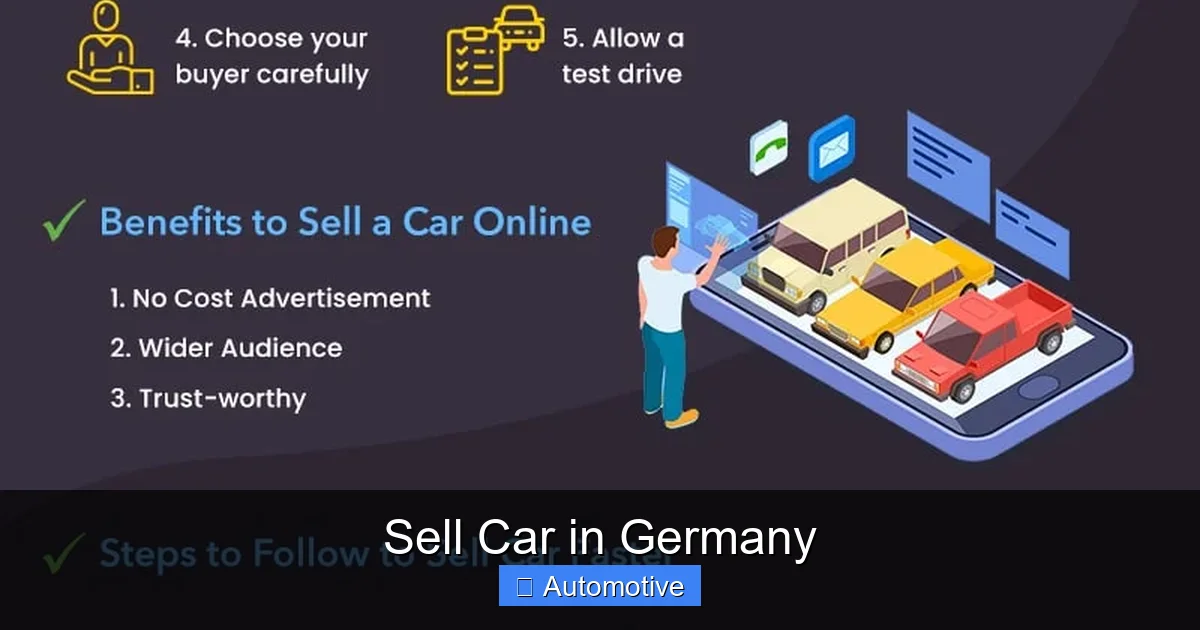
Pricing your car correctly is one of the most important steps. Overprice it, and it sits on the market for months. Underprice it, and you lose money. The goal is to find the sweet spot where your car is attractive to buyers but still reflects its true value.
Start by researching similar vehicles. Use platforms like Mobile.de, Autoscout24, and eBay Kleinanzeigen to compare cars of the same make, model, year, mileage, and condition. Look at both active listings and recently sold vehicles to understand the going rate.
Factors That Affect Price
Several factors influence how much you can sell your car for:
– **Age and Mileage:** Older cars with high mileage are worth less.
– **Condition:** A well-maintained car with no accidents commands a higher price.
– **Service History:** Full records can add 5–10% to the value.
– **Features:** Options like navigation, leather seats, sunroof, or advanced safety systems increase appeal.
– **Market Demand:** Popular models sell faster and for more.
– **Location:** Prices can vary slightly by region due to local demand.
For example, a 2018 VW Golf with 80,000 km, full service history, and a recent TÜV might sell for €14,000–€16,000 in Berlin, while the same car in a smaller town might go for €13,000–€15,000.
Using Valuation Tools
Many websites offer free car valuation tools. Mobile.de and Autoscout24 have built-in estimators that use market data to suggest a price range. You can also check the “Schwacke List,” a respected German vehicle valuation guide used by dealers and insurers.
Keep in mind that private sellers usually get 10–20% more than trade-in values offered by dealerships. So if a dealer offers €12,000, you might realistically sell for €13,500–€14,500 privately.
Choosing the Right Platform to Sell
Visual guide about Sell Car in Germany
Image source: thumbs.dreamstime.com
Once your car is ready and priced, it’s time to list it. Germany has several trusted platforms for selling cars, each with its own advantages.
Top Platforms to Sell Car in Germany
– **Mobile.de:** The largest and most popular car marketplace in Germany. It attracts serious buyers and offers premium listing options. Free basic listings are available, but paid ads get more visibility.
– **Autoscout24:** Another major platform with a large user base. It’s user-friendly and allows detailed filtering by buyers.
– **eBay Kleinanzeigen:** Great for local sales. It’s free, easy to use, and popular for private transactions. Ideal for quick sales in your area.
– **Facebook Marketplace:** Increasingly popular, especially for local deals. Be cautious of scams and meet in safe locations.
– **Local Classifieds:** Some regions have local newspapers or community boards where people post car ads.
Each platform has its pros and cons. Mobile.de and Autoscout24 are best for reaching a wide audience, while eBay Kleinanzeigen and Facebook are better for quick, local sales.
Creating a Compelling Listing
Your listing is your first impression. Make it count.
Start with a clear, honest title: “2017 BMW 3 Series, 90,000 km, TÜV until 2025, full service history.”
Write a detailed description. Include:
– Year, make, model, and trim
– Mileage and fuel type
– Condition (interior, exterior, mechanical)
– Recent repairs or upgrades
– Reason for selling
– Availability for test drives
Use high-quality photos. Take pictures in good lighting, from multiple angles—front, back, sides, interior, engine bay, and trunk. Show any flaws honestly; this builds trust.
Set your price clearly and mention if it’s negotiable. Be responsive to inquiries—quick replies increase your chances of a sale.
Handling Inquiries and Test Drives
Once your ad goes live, expect calls, emails, and messages. Be prepared to answer questions about the car’s history, condition, and price.
Screening Potential Buyers
Not every inquiry is serious. Some people are just curious or trying to lowball. Ask questions to gauge their interest:
– “Have you seen similar cars?”
– “What’s your budget?”
– “Are you looking to buy soon?”
Avoid sharing personal details like your home address early on. Use email or messaging for initial contact.
Arranging Safe Test Drives
Test drives are essential—most buyers won’t commit without one. But safety comes first.
Always meet in a public place, like a parking lot or shopping center. Bring a friend if possible. Ask the buyer to bring their driver’s license and proof of insurance.
Before the drive, check their license and make sure they’re sober. You can also ask for a small deposit (€50–€100) as a sign of good faith, which is refundable if they don’t buy.
During the test drive, stay calm and answer questions honestly. Let the buyer focus on driving—don’t distract them.
Finalizing the Sale Legally
Once you’ve found a buyer and agreed on a price, it’s time to complete the sale properly. This step is critical to avoid legal issues later.
Signing the Sales Agreement
In Germany, you must sign an **Abschlussbestätigung** (sales agreement) with the buyer. This document confirms the sale and transfers ownership. It should include:
– Names and addresses of both parties
– Vehicle details (make, model, license plate, VIN)
– Sale price
– Date of sale
– Signatures
You can find templates online or use the one provided by the KBA. Both parties should keep a copy.
Transferring Ownership
After signing, the buyer must register the car in their name at the local Zulassungsstelle. You, as the seller, must notify the KBA that the car is no longer yours. This is done by submitting the **Abmeldeformular** (deregistration form), which can be found on the KBA website or at the registration office.
You can also deregister the car online via the KBA portal. Once done, you’ll receive a confirmation, and your liability ends.
Payment and Handover
Agree on a secure payment method. Bank transfer is safest—avoid cash for large amounts. If using cash, meet at a bank so the buyer can withdraw and you can deposit it immediately.
Once payment is confirmed, hand over the keys, documents, and any extras (like spare keys or service books). Make sure the buyer understands how to register the car.
Avoiding Scams and Common Pitfalls
Unfortunately, car scams do happen. Protect yourself by staying alert.
Common Scams to Watch For
– **Fake Bank Transfers:** Some scammers send fake payment confirmations. Always wait for the money to clear in your account.
– **Overpayment Scams:** A buyer sends more than the agreed amount and asks for the difference back. The original payment is fake.
– **Test Drive Theft:** Never leave your car unattended during a test drive.
– **Document Theft:** Don’t hand over your registration or title until payment is secure.
Safety Tips
– Meet in public, well-lit areas.
– Bring a friend.
– Check the buyer’s ID.
– Use secure payment methods.
– Never sign documents under pressure.
If something feels off, trust your instincts and walk away.
After the Sale: What to Do Next
Once the sale is complete, there are a few final steps:
1. **Cancel Your Insurance:** Contact your insurer to cancel the policy. You may get a refund for unused months.
2. **Deregister the Car:** As mentioned, notify the KBA to remove your name from the registration.
3. **Keep Records:** Save copies of the sales agreement and payment confirmation for your records.
4. **Remove License Plates:** In most cases, the buyer will get new plates. Remove yours and return them if required.
By following these steps, you ensure a smooth, legal, and stress-free sale.
Selling a car in Germany doesn’t have to be daunting. With preparation, the right platform, and attention to legal details, you can sell your car quickly and safely. Remember: honesty, transparency, and safety are your best tools. Whether you’re upgrading to a new model or simplifying your life, a well-executed sale gives you peace of mind and a fair return on your investment.
Frequently Asked Questions
Do I need a TÜV to sell a car in Germany?
Yes, a valid TÜV (Hauptuntersuchung) is required to sell car in Germany legally. The inspection must be current, typically valid for 24 months for cars over three years old. Without it, you cannot transfer ownership.
Can I sell my car without the original owner’s manual?
While not legally required, having the owner’s manual increases buyer confidence and can help you get a better price. If missing, mention it in your listing and consider purchasing a replacement online.
How long does it take to sell a car in Germany?
It varies, but most cars sell within 2–6 weeks if priced correctly and listed on popular platforms. Well-maintained, in-demand models can sell in just a few days.
Can I sell my car if it has outstanding finance?
No, you must pay off any outstanding loans before selling. The car cannot be transferred until the finance company releases the lien. Contact your lender to settle the debt first.
Is it better to sell privately or trade in at a dealership?
Selling privately usually gets you 10–20% more money, but it takes more effort. Trading in is faster and easier but offers a lower price. Choose based on your priorities.
What happens if the buyer doesn’t register the car?
As the seller, you must deregister the car with the KBA to avoid liability. Once you submit the Abmeldeformular, your responsibility ends, even if the buyer delays registration.