
Safety 1st Grow and Go 3-in-1 Car Seat: Complete 2026 Guide

Quick Answer
The Safety 1st Grow and Go 3-in-1 car seat is a practical all-in-one choice for families who want rear-facing, forward-facing, and booster modes in one seat. It offers useful everyday features, but correct installation and child fit matter more than the number of modes. Follow your exact seat label and manual, plus NHTSA car-seat guidance, before changing modes.
Why families consider it
- Three riding stages: It converts from rear-facing to forward-facing harness use and then a belt-positioning booster.
- Long growth range: Current versions cover children from 5 pounds through a 100-pound booster limit.
- QuickFit harness: The harness and headrest adjust together on current models.
- Easy-clean parts: Current versions have washable padding and removable cup holders.
- Important limitation: Vehicle fit and installation can be less forgiving than on some newer premium seats.
Before using one
- Check the model number, manufacture date, instructions, recalls, child measurements, and installation before the first ride.
The Safety 1st Grow and Go 3-in-1 car seat has been around in several versions, which makes researching it surprisingly confusing. Specifications shown online may not match the labels on an older seat already sitting in your vehicle.
This guide focuses on what matters in daily use. I’ll cover the three modes, safety, installation, comfort, cleaning, vehicle fit, and the differences you should verify before using the seat in 2026.
In This Guide
- What Is the Safety 1st Grow and Go 3-in-1 Car Seat?
- How Do the Three Grow and Go Modes Work?
- Is the Safety 1st Grow and Go Car Seat Safe?
- Is the Grow and Go Easy to Install Correctly?
- How Is the Grow and Go for Comfort, Cleaning, and Daily Use?
- Safety 1st Grow and Go FAQ
- Is the Safety 1st Grow and Go Worth It?
What Is the Safety 1st Grow and Go 3-in-1 Car Seat?
The Grow and Go is an all-in-one convertible car seat. It stays installed in the vehicle and changes configuration as your child grows.
Definition: An all-in-one car seat combines multiple child-restraint stages in one product. The Grow and Go provides rear-facing harness, forward-facing harness, and belt-positioning booster modes.
That design is different from a detachable infant carrier. You don’t normally remove the entire Grow and Go to carry a sleeping baby into a house or store.
The appeal is simple. Instead of purchasing a different seat at every major stage, one shell can cover several years of growth.
- Rear-facing: For babies and younger children who remain within the rear-facing limits.
- Forward-facing: Uses the built-in five-point harness after rear-facing has been outgrown.
- Booster: Positions the vehicle’s lap-and-shoulder belt across an older child.
Current Grow and Go models also include a QuickFit harness system. Raising the headrest changes the harness height without repeatedly rethreading the main harness straps.
That is useful during growth spurts. A harness that was positioned correctly a few months ago may need another adjustment today.
Who is the Grow and Go best for?
I see the strongest case for this seat when a family wants simplicity and long-term use without moving into a high-priced premium model.
- Parents who prefer one installed seat for several stages
- Families who value washable padding
- Caregivers who want a no-rethread-style adjustment system
- Drivers with enough rear-seat room for a full-size convertible seat
- Families who don’t need a rotating loading mechanism
It is less compelling if your biggest concern is the easiest possible installation. Some newer seats use more sophisticated belt tensioning or lockoff systems.
Vehicle fit matters too. Never buy an all-in-one seat based on weight limits alone.
How Do the Three Grow and Go Modes Work?
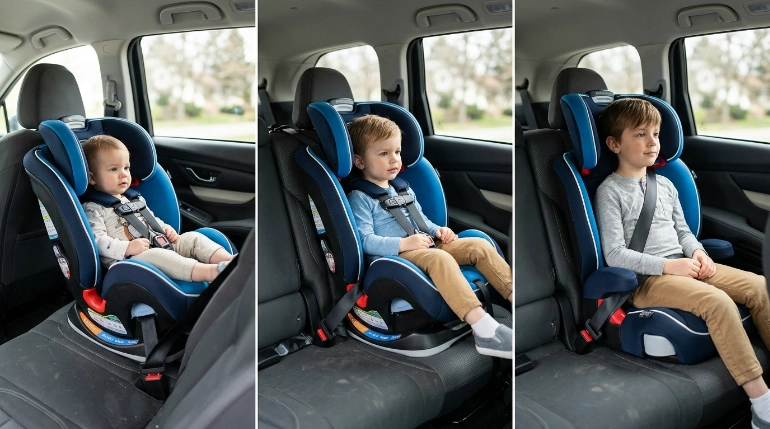
The Grow and Go covers three stages, but you should not move to the next stage simply because your child reaches the minimum requirement. Stay in the safer appropriate stage until its limits are reached.
NHTSA recommends keeping children rear-facing until they reach the maximum rear-facing height or weight allowed by their particular seat.
| Mode | Current Listed Weight Range | Current Listed Height Range | Restraint Used |
|---|---|---|---|
| Rear-facing | 5–40 lb. | 19–40 in. | Built-in 5-point harness |
| Forward-facing | 30–65 lb.* | 34.4–49 in.* | Built-in 5-point harness and tether |
| Belt-positioning booster | 40–100 lb. | 43.4–52 in. | Vehicle lap-and-shoulder belt |
*Safety 1st has sold multiple Grow and Go versions. Some older documentation and material show lower forward-facing minimums, including 22 pounds and 29 inches. Always use the limits printed on your exact seat and its matching manual.
Stage 1: Rear-facing
Rear-facing is the first mode. Current Grow and Go specifications list a 5-to-40-pound and 19-to-40-inch rear-facing range.
Don’t turn the seat forward just because your child reaches a certain birthday. Use your child’s measurements and the limits on the actual seat.
- Harness straps should follow the rear-facing position specified by the manual.
- The seat must use an approved rear-facing recline position.
- The harness should lie flat without twists.
- The chest clip should sit around armpit level.
NHTSA also advises making the harness snug enough that extra webbing cannot be pinched at the shoulder.
Stage 2: Forward-facing harness
Once rear-facing is truly outgrown, the seat can be configured forward-facing. Use the harness and the vehicle’s tether anchor as directed.
The top tether is not an optional convenience. It helps limit the forward movement of a forward-facing child restraint during a crash.
- Change the seat to the approved forward-facing configuration.
- Route the installation belt through the correct belt path.
- Attach and tighten the top tether.
- Adjust the harness according to the forward-facing instructions.
Stage 3: Belt-positioning booster
Booster mode removes the built-in harness from the restraint equation. The vehicle’s lap-and-shoulder belt restrains the child.
The booster positions that adult-sized belt across stronger areas of a child’s body. Belt fit matters more than simply reaching the minimum booster weight.
- The lap belt should sit low across the hips and upper thighs.
- The shoulder belt should cross the chest and shoulder.
- The belt should not run across the neck or face.
- The child must remain seated correctly for the entire trip.
Section Takeaway: Use the maximum limits of the safer current stage as your transition guide, not just the minimum number printed for the next mode. Your exact Grow and Go label and manual override numbers found on older websites.
Is the Safety 1st Grow and Go Car Seat Safe?
Current Safety 1st Grow and Go models are described by the manufacturer as engineered and tested to meet or exceed applicable federal safety standards. Current versions also state that they meet the federal side-impact standard.
That doesn’t make correct installation optional. Even a compliant restraint cannot work as designed when the belt path, recline, harness, or tether is used incorrectly.
What safety features does it have?
The basic safety system centers on a five-point harness during rear-facing and forward-facing use. Booster mode then uses the vehicle’s lap-and-shoulder belt.
- 5-point harness: Restrains the child at the shoulders, hips, and between the legs.
- Adjustable headrest: Helps maintain an appropriate fit as the child grows.
- Top-tether compatibility: Used during forward-facing installation as directed.
- Recline adjustment: Helps achieve the required position for each permitted mode.
- Booster belt path: Guides the vehicle belt over the child.
Safety 1st also lists an IIHS Good Bet designation for booster use on current product information. You should still check the belt fit on your own child and vehicle.
Does a more expensive car seat automatically mean safer?
No. All child restraints legally sold in the United States must satisfy applicable federal requirements.
Higher-priced models may add easier installation systems, rotating bases, additional adjustment, premium fabrics, or other convenience features. Those differences can affect how easy the seat is to use correctly.
Consumer Reports car-seat testing also evaluates factors beyond the minimum federal test, including ease of use and vehicle fit.
Check for recalls before using a secondhand or stored seat
A seat’s model name alone isn’t enough for a recall check. Find its exact model number and manufacture date first.
- Locate the manufacturer’s label on the seat.
- Record the model number and manufacture date.
- Visit the NHTSA recall lookup.
- Search under car seats or vehicle equipment.
- Follow the manufacturer’s remedy instructions if your model is affected.
NHTSA also recommends registering a child restraint with its manufacturer. Registration allows the company to contact you about future safety notices.
How long does a Safety 1st Grow and Go last?
Safety 1st Grow and Go owner guidance lists a 10-year expiration period from the manufacture date. Still, check the date and instructions printed on your exact seat.
Don’t estimate expiration from the day you bought it. A seat may have been manufactured months before the retail purchase.
Section Takeaway: The Grow and Go provides the expected restraint systems for its three modes, but safety depends on the exact model, correct installation, correct harness fit, proper mode selection, and current recall status.
Is the Grow and Go Easy to Install Correctly?
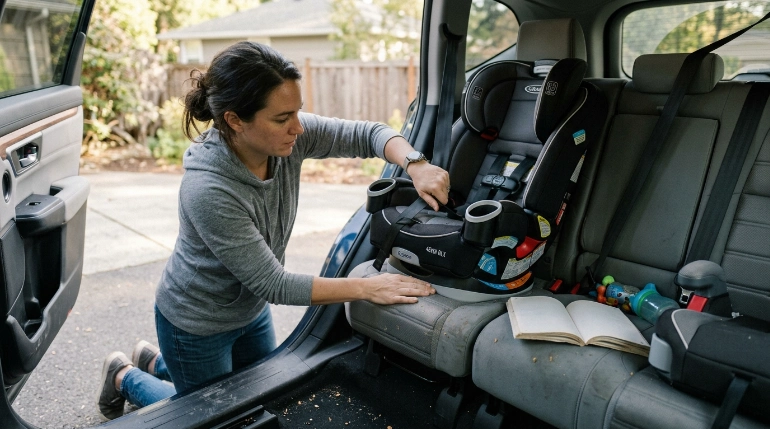
The Grow and Go can be installed securely, but it is not the type of seat I would choose solely because I wanted the simplest installation hardware available.
The challenge varies by vehicle. Seat shape, belt geometry, anchor location, and available front-to-back room all affect the process.
Rear-facing installation
For rear-facing use, confirm the correct belt path and recline setting before tightening. Never route a belt based on memory from another convertible seat.
- Place the Grow and Go rear-facing in an approved vehicle seating position.
- Set the required recline position for your child’s size and model.
- Choose the approved lower-anchor or vehicle-belt installation method.
- Route the belt through the rear-facing belt path.
- Remove slack while pressing the restraint into the vehicle seat.
- Check movement at the belt path.
NHTSA says a properly installed child restraint should not move more than one inch side-to-side or front-to-back when checked at the belt path.
Don’t grab the top of the shell for this check. Movement there can exaggerate what is normal.
Forward-facing installation
Forward-facing installation adds one especially important step: the top tether. Locate the vehicle’s correct tether anchor before tightening everything.
- Configure the Grow and Go for forward-facing use.
- Route the seat belt or approved lower-anchor strap correctly.
- Tighten the installation at the belt path.
- Connect the top tether to the designated vehicle anchor.
- Tighten the tether according to both manuals.
- Confirm the seat moves less than one inch at the belt path.
Read both instruction books. The car-seat manual tells you how the restraint works, while the vehicle manual identifies approved seating positions and anchors.
Don’t use lower anchors beyond their permitted limit
A common mistake is assuming lower anchors can always be used because the child still fits the harness. Lower-anchor limits are separate from harness limits.
If the lower-anchor method is no longer permitted, you may need to install with the vehicle belt while continuing to use the five-point harness.
Get an installation check when something feels wrong
If you keep tightening and still get excess movement, don’t improvise with unapproved padding or accessories. A certified Child Passenger Safety Technician can inspect the setup.
NHTSA provides inspection resources through its car seats and booster seats section.
Mechanic Alert: A car-seat installation normally doesn’t require automotive repair. If a seat belt, buckle, lower anchor, or tether anchor appears damaged, have the vehicle inspected by a qualified professional instead of modifying the restraint system yourself.
Section Takeaway: The Grow and Go can work well once installed correctly, but take time to verify the recline, belt path, movement, tether, and anchor limits. Ease of installation should be part of your buying decision.
How Is the Grow and Go for Comfort, Cleaning, and Daily Use?
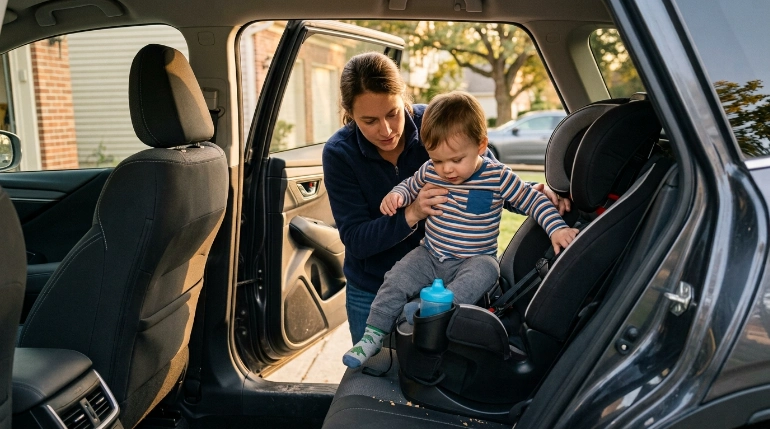
This is where the Grow and Go’s design becomes attractive. Several features solve the small annoyances parents deal with every day.
The seat is not luxurious, but it focuses on useful adjustments and easier cleanup.
QuickFit harness adjustment
The current QuickFit system moves the headrest and harness together. That saves you from manually rethreading the main harness whenever your child grows.
I consider this more important than decorative extras. A harness adjustment you can make quickly is less likely to be postponed.
Harness holders
The harness holders keep straps pushed toward the sides while the child climbs into the seat. That reduces the familiar problem of a toddler sitting directly on the buckle straps.
It is a simple feature. In daily school and daycare runs, simple features often matter most.
Three-position recline
Current Grow and Go versions offer three recline positions. The correct position depends on the mode and the instructions for that particular seat.
A recline adjustment can also affect how the restraint fits the vehicle seat. It does not guarantee a compact installation in every car.
Washable seat pad and cup holders
Current versions have a machine-washable and dryer-safe seat pad. The removable cup holders are also designed for easier cleaning.
- Remove crumbs before they work into the seat creases.
- Follow the manual when removing the cover.
- Wash only with methods approved by Safety 1st.
- Never soak harness webbing unless the manufacturer specifically permits it.
- Reassemble every part exactly as instructed.
Don’t substitute aggressive cleaners just because a stain is stubborn. Chemicals can damage restraint components or webbing.
Will it fit in a small car?
This question deserves more attention than it usually gets. A seat can fit your child perfectly and still be awkward in your vehicle.
Rear-facing installations consume the most front-to-back space. Taller front occupants may notice that first.
| Daily-Use Area | Grow and Go Strength | Potential Trade-Off |
|---|---|---|
| Growth adjustment | QuickFit harness/headrest | Exact fit still needs checking |
| Cleaning | Washable pad and removable cup holders | Must follow approved cleaning instructions |
| Loading a child | Harness holders | No rotating loading feature |
| Vehicle fit | Multiple recline settings | Rear-facing space can still be substantial |
| Long-term use | Three modes in one shell | Child may not achieve an ideal fit for every listed limit |
Pros and cons
- Pro: One seat covers rear-facing, forward-facing harness, and booster stages.
- Pro: Current models support children up to 100 pounds in booster mode.
- Pro: QuickFit adjustment simplifies harness-height changes.
- Pro: Washable padding makes everyday cleanup easier.
- Pro: Harness holders are helpful with active toddlers.
- Con: Installation may take more effort than seats with premium tensioning systems.
- Con: Rear-facing fit can consume meaningful vehicle space.
- Con: Specifications vary between Grow and Go generations, so online numbers can be misleading.
- Con: It does not provide the rotating access found on newer 360-degree seats.
Section Takeaway: The Grow and Go’s strongest advantages appear during everyday ownership: easy harness-height changes, washable materials, cup holders, and three-stage use. Its biggest practical questions are installation and vehicle fit.
Safety 1st Grow and Go FAQ
Is the Safety 1st Grow and Go suitable for newborns?
Current Grow and Go specifications begin at 5 pounds and 19 inches in rear-facing mode. However, a newborn must also achieve a proper harness and recline fit, so verify the baby’s measurements and follow the exact manual before use.
When should I turn the Grow and Go forward-facing?
Keep your child rear-facing until the rear-facing height or weight limit of your exact seat is reached, following its instructions. NHTSA recommends staying rear-facing as long as the child remains within the manufacturer’s permitted limits.
Why do some Grow and Go manuals show different forward-facing limits?
The Grow and Go name has been used across different versions and production periods. Current Safety 1st material prominently shows 30–65 pounds and 34.4–49 inches, while some older material shows 22–65 pounds and 29–49 inches. Use your seat’s label and matching manual.
Does the Safety 1st Grow and Go expire?
Yes. Grow and Go owner guidance lists a 10-year expiration period from the date of manufacture. Check the exact expiration information printed on your restraint because the manufacture date, not the purchase date, starts that timeline.
Can the Safety 1st Grow and Go be used on an airplane?
Safety 1st states that the Grow and Go is certified for aircraft use when used as a harnessed child restraint, subject to the instructions on the exact model. Booster mode cannot work with an aircraft lap belt because a belt-positioning booster requires a lap-and-shoulder belt.
Can I use the Grow and Go after buying it secondhand?
A used seat requires more than a visual check. Confirm its model, manufacture date, expiration, recall status, crash history, complete parts, labels, and manual before trusting it for a child.
Is the Safety 1st Grow and Go Worth It?
For the right family, yes. The Safety 1st Grow and Go 3-in-1 car seat offers useful long-term versatility without depending on complicated premium features.
Its three-stage design is the main attraction. The adjustable harness, washable padding, cup holders, and harness holders improve everyday usability.
- Consider it if: You want one convertible seat covering three stages.
- Consider it if: Easy cleaning matters in daily family use.
- Consider it if: Your vehicle has enough room for a full-size convertible seat.
- Compare alternatives if: Installation simplicity is your highest priority.
- Compare alternatives if: You need a narrow three-across setup or rotating seat.
The biggest lesson is not to shop by the words “3-in-1” alone. A child restraint is only a good choice when it fits the child, fits the vehicle, and can be used correctly every trip.
Before buying or reinstalling a Grow and Go in 2026, check the current Safety 1st Grow and Go information and then compare it with the label and manual supplied with your exact seat.
Final takeaway: The Safety 1st Grow and Go remains a practical value-focused all-in-one seat, but model-specific instructions should always outrank specifications copied from retailers, reviews, or older versions of the product.
“`