Power of Attorney Form to Sell Car
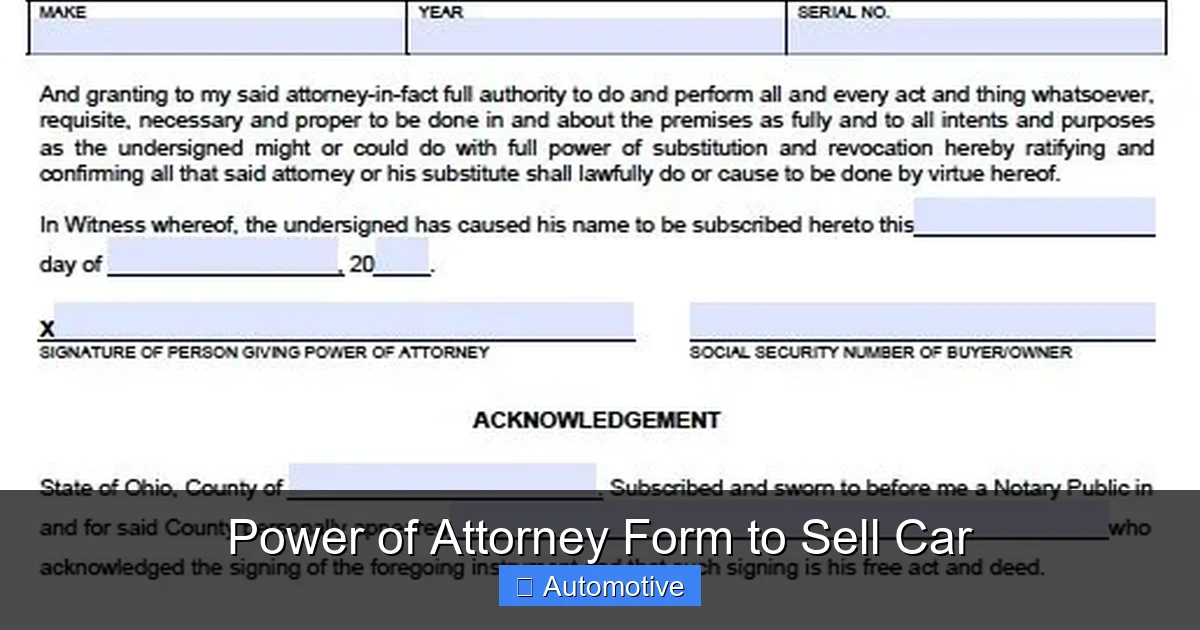
A power of attorney form to sell car allows someone else to handle the sale on your behalf legally. Whether you’re out of town, ill, or simply busy, this document ensures a smooth, authorized transaction without delays.
This is a comprehensive guide about power of attorney form to sell car.
In This Article
- 1 Key Takeaways
- 2 What Is a Power of Attorney Form to Sell Car?
- 3 When Do You Need a Power of Attorney to Sell a Car?
- 4 Types of Power of Attorney for Car Sales
- 5 How to Create a Power of Attorney Form to Sell Car
- 6 State-Specific Requirements and Legal Considerations
- 7 Common Mistakes to Avoid
- 8 Sample Power of Attorney Language for Car Sales
- 9 Conclusion
- 10 Frequently Asked Questions
- 10.1 Can I use a power of attorney to sell my car if I’m out of state?
- 10.2 Does the power of attorney need to be notarized?
- 10.3 Can my agent sell my car for any price they want?
- 10.4 What happens if I change my mind after signing the POA?
- 10.5 Can I use the same POA to sell multiple cars?
- 10.6 Is a power of attorney required if the car is paid off?
Key Takeaways
- Legal Authorization: A power of attorney (POA) grants another person the legal right to sell your vehicle, sign documents, and transfer ownership.
- Types of POA: You can choose between a general, limited (specific), or durable power of attorney depending on your needs and duration.
- State Requirements Vary: Each state has different rules for POA forms, so always check your local DMV or legal guidelines before proceeding.
- Notarization is Often Required: Most states require the POA to be notarized to be valid, especially for vehicle transactions.
- Protect Against Fraud: Clearly define the agent’s powers and include safeguards like expiration dates or witness signatures to prevent misuse.
- Use Official Forms When Possible: Many states provide free, standardized POA forms for vehicle sales—using these reduces errors and increases acceptance.
- Keep Copies Handy: Provide your agent with multiple signed and notarized copies, as buyers, DMVs, and banks may all request proof of authority.
[FEATURED_IMAGE_PLACEHOLDER]
What Is a Power of Attorney Form to Sell Car?
Imagine you’ve decided to sell your car, but you’re suddenly called away on a family emergency, deployed overseas, or recovering from surgery. You can’t be there to sign the title, meet the buyer, or complete the paperwork. What do you do? That’s where a power of attorney form to sell car comes in.
This legal document allows you—the car owner—to appoint someone else, known as your “agent” or “attorney-in-fact,” to act on your behalf in selling your vehicle. The agent can sign the title, handle negotiations, accept payment, and even register the sale with the Department of Motor Vehicles (DMV). It’s like giving someone a trusted key to handle one specific task: selling your car.
The power of attorney (POA) isn’t just for emergencies. Many people use it for convenience—maybe you’re traveling for work, live in another state, or simply prefer to let a friend or family member manage the sale. Whatever the reason, a properly executed POA ensures the transaction is legal, binding, and recognized by all parties involved.
When Do You Need a Power of Attorney to Sell a Car?
You might be wondering: “Do I really need a POA just to sell a car?” The short answer is: it depends. If you’re present and able to sign the title yourself, you likely don’t need one. But there are several common situations where a power of attorney form to sell car becomes essential.
You’re Unable to Be Physically Present
The most obvious reason is physical absence. If you’re out of state or country—whether for travel, military duty, medical treatment, or relocation—you can’t sign the title in person. A POA lets your agent complete the sale without requiring your physical presence.
You Have a Medical Condition or Disability
If you’re hospitalized, recovering from surgery, or living with a disability that makes it difficult to manage transactions, a POA ensures your car can still be sold. This is especially important if the sale is urgent—for example, to cover medical bills or downsize your vehicle fleet.
You’re Selling on Behalf of an Estate
After someone passes away, their assets—including cars—must be sold or transferred. If you’re the executor of the estate, you may need a POA (or court authorization) to sell the vehicle. In some cases, the deceased may have already granted you POA before passing, which simplifies the process.
You’re a Busy Professional or Frequent Traveler
Even if you’re healthy and available, you might not have the time to meet buyers, negotiate prices, or handle paperwork. Delegating the sale to a trusted agent via POA saves time and stress. Think of it as outsourcing a task you don’t have bandwidth for.
You’re Selling a Fleet or Multiple Vehicles
Business owners or car dealers often use POAs to authorize employees or agents to sell vehicles on their behalf. This streamlines operations and ensures sales can continue even when the owner is unavailable.
In all these cases, a power of attorney form to sell car provides legal clarity and prevents delays. Without it, buyers may walk away, DMVs may reject the transfer, or banks may refuse to release liens.
Types of Power of Attorney for Car Sales
Not all power of attorney forms are created equal. The type you choose depends on how much authority you want to give your agent and how long you want it to last. Here are the main types relevant to selling a car:
Limited (or Special) Power of Attorney
This is the most common type used for car sales. A limited POA grants your agent authority to perform one specific task: selling your car. It’s narrow in scope, which means your agent can’t access your bank accounts, sell your house, or make medical decisions.
For example, you might sign a limited POA that says: “I authorize my sister, Jane Doe, to sell my 2018 Honda Accord, VIN 123456789, and sign all necessary documents related to the sale.” This keeps the power focused and reduces the risk of misuse.
General Power of Attorney
A general POA gives your agent broad authority to handle multiple financial and legal matters on your behalf. While it can include the power to sell a car, it’s usually overkill for a single transaction. It’s better suited for situations where you’re incapacitated and need someone to manage all your affairs.
Because of its wide scope, a general POA should be used cautiously. If you only need to sell a car, a limited POA is safer and more appropriate.
Durable Power of Attorney
A durable POA remains in effect even if you become mentally incapacitated. This is important if there’s a chance you might lose decision-making ability due to illness or injury. For car sales, durability ensures the agent can still complete the transaction if you’re unable to act.
Most states require you to explicitly state that the POA is “durable” in the document. Without this language, the POA typically ends if you become incapacitated.
Springing Power of Attorney
A springing POA only takes effect under certain conditions—usually when you become incapacitated. While useful in estate planning, it’s less common for car sales because it requires proof of incapacity, which can delay the transaction.
For most car sales, a limited and durable power of attorney is the best choice. It’s specific, secure, and remains valid even if your health declines.
How to Create a Power of Attorney Form to Sell Car
Creating a valid POA doesn’t have to be complicated or expensive. With the right steps, you can draft one in under an hour. Here’s a step-by-step guide to help you get it right.
Step 1: Choose the Right Type of POA
As discussed, a limited and durable POA is usually best for selling a car. Decide whether you want the authority to start immediately or only under certain conditions.
Step 2: Select a Trusted Agent
Your agent should be someone you trust completely—like a spouse, adult child, close friend, or attorney. Make sure they’re responsible, available, and willing to take on the task. Discuss the sale details with them beforehand so they understand your expectations.
Step 3: Use a State-Specific Template
Many states provide free, standardized POA forms for vehicle transactions. Check your local DMV website or state government portal. Using an official template ensures the form meets legal requirements and is more likely to be accepted by buyers and agencies.
If your state doesn’t offer a specific form, you can use a general POA template from a reputable legal website. Just make sure to customize it for the car sale.
Step 4: Include Key Details
Your POA should clearly state:
- Your full name and address (the “principal”)
- Your agent’s full name and address
- The vehicle’s make, model, year, and VIN
- The specific powers granted (e.g., “to sell, transfer, and sign documents for the vehicle”)
- Whether the POA is durable
- An expiration date (optional but recommended)
- The date the document is signed
Example: “I, John Smith, grant my brother, Michael Smith, the authority to sell my 2020 Toyota Camry, VIN 987654321, including signing the title and completing the DMV transfer.”
Step 5: Sign and Notarize the Document
In most states, the POA must be signed in the presence of a notary public. The notary verifies your identity and confirms you’re signing willingly. Some states also require witnesses.
Never sign the document before meeting the notary. Bring a valid ID, and make sure your agent is aware of the signing appointment.
Step 6: Provide Copies to Your Agent
Give your agent multiple signed and notarized copies. They may need to show the POA to the buyer, the DMV, a bank (if there’s a lien), or a title company. Keep a copy for your records as well.
Step 7: Notify Relevant Parties (Optional but Helpful)
While not required, it’s a good idea to inform your bank, insurance company, and DMV that you’ve appointed an agent. This prevents confusion if they receive inquiries about the sale.
By following these steps, you’ll create a legally sound power of attorney form to sell car that protects your interests and ensures a smooth transaction.
State-Specific Requirements and Legal Considerations
One of the most important things to remember is that POA laws vary by state. What works in California might not be valid in Texas. Always check your state’s requirements before finalizing the document.
Notarization and Witnesses
Most states require notarization for a POA to be valid in vehicle transactions. A few states, like Florida and New York, also require one or two witnesses. Failure to meet these requirements can result in the POA being rejected.
DMV Acceptance
Some DMVs are stricter than others when accepting POAs. For example, California requires the POA to be on a specific form (DMV Form REG 260) for vehicle sales. Other states may accept a general POA as long as it’s notarized and includes the vehicle details.
Lienholder Approval
If your car has a loan or lien, the lender must approve the sale. Your agent may need to present the POA to the bank to release the title. Some lenders require their own authorization form in addition to the POA.
Out-of-State Sales
If you’re selling a car in a different state than where it’s registered, both states’ laws may apply. For example, if your car is registered in Ohio but you’re selling it in Michigan, Michigan’s DMV may require a POA that meets Michigan’s standards—even if it was signed in Ohio.
Expiration and Revocation
You can set an expiration date on the POA (e.g., 60 days from signing). This limits the agent’s authority and reduces risk. You can also revoke the POA at any time by notifying your agent in writing and, if possible, retrieving all copies.
Always consult your state’s DMV website or speak with a legal professional if you’re unsure about the requirements. A small mistake can delay the sale or invalidate the document.
Common Mistakes to Avoid
Even with the best intentions, people often make errors when creating a POA for a car sale. Here are some common pitfalls and how to avoid them.
Using a Generic Online Template Without Customization
Free templates are helpful, but they’re not one-size-fits-all. Failing to include your vehicle’s VIN, agent’s full name, or specific powers can render the POA invalid. Always tailor the document to your situation.
Forgetting to Notarize
This is a big one. A POA that isn’t notarized is often rejected by DMVs and banks. Don’t skip this step—even if you’re in a hurry.
Choosing the Wrong Type of POA
Using a general POA when a limited one would suffice increases the risk of misuse. Stick to the narrowest scope necessary for the task.
Not Informing the Agent
Your agent should know they’ve been appointed and understand their responsibilities. Surprising them at the last minute can lead to confusion or refusal to act.
Failing to Include an Expiration Date
An open-ended POA can be risky. Set a reasonable expiration date (e.g., 90 days) to limit the agent’s authority and protect yourself.
Not Keeping Records
Keep a copy of the signed POA, note when it was used, and save all communication with your agent. This creates a paper trail in case of disputes.
Avoiding these mistakes ensures your power of attorney form to sell car is effective, legal, and stress-free.
Sample Power of Attorney Language for Car Sales
Here’s an example of clear, legally sound language you can use in your POA:
“I, [Your Full Name], of [Your Address], hereby appoint [Agent’s Full Name], of [Agent’s Address], as my true and lawful attorney-in-fact to act in my name, place, and stead in any way which I myself could do, if I were personally present, with respect to the following matter:
To sell, transfer, and convey my 2019 Ford F-150, VIN 1FTFW1ET5KFC12345, including but not limited to signing the vehicle title, completing the bill of sale, accepting payment, and filing all necessary documents with the Department of Motor Vehicles.
This power of attorney is limited to the sale of the above-described vehicle and shall expire on [Expiration Date]. This power of attorney is durable and shall not be affected by my subsequent incapacity.
In witness whereof, I have hereunto signed this power of attorney on this [Date].”
Follow this with signature lines for you, your agent (if required), witnesses, and the notary.
Conclusion
A power of attorney form to sell car is a simple yet powerful tool that gives you flexibility, peace of mind, and legal protection when you can’t handle a car sale yourself. Whether you’re out of town, unwell, or just busy, this document ensures the transaction can proceed smoothly and legally.
By choosing the right type of POA, selecting a trusted agent, and following your state’s requirements, you can avoid common pitfalls and complete the sale with confidence. Always use official forms when available, get the document notarized, and keep detailed records.
Remember, a well-prepared POA isn’t just about convenience—it’s about safeguarding your rights and ensuring your vehicle is sold on your terms. Take the time to do it right, and you’ll save yourself headaches down the road.
Frequently Asked Questions
Can I use a power of attorney to sell my car if I’m out of state?
Yes, a power of attorney form to sell car is specifically designed for situations where the owner can’t be present. As long as the POA is properly signed and notarized, your agent can handle the sale on your behalf, even if you’re in another state or country.
Does the power of attorney need to be notarized?
In most states, yes. Notarization is required to validate the POA, especially for vehicle transactions. Check your state’s DMV website to confirm the specific requirements, as some also require witnesses.
Can my agent sell my car for any price they want?
Unless you specify otherwise in the POA, your agent can negotiate the price. To protect yourself, you can include a minimum sale price in the document or discuss your expectations with your agent beforehand.
What happens if I change my mind after signing the POA?
You can revoke the power of attorney at any time by notifying your agent in writing. It’s also wise to retrieve any copies of the document and inform relevant parties like the DMV or bank.
Can I use the same POA to sell multiple cars?
Only if the POA explicitly lists all vehicles or grants broad authority. For safety and clarity, it’s better to create a separate POA for each car or include all vehicles in one document with clear details.
Is a power of attorney required if the car is paid off?
Not always, but it’s still recommended if you can’t be present to sign the title. The POA ensures the sale is legal and prevents issues with the DMV or buyer, even on a lien-free vehicle.