How to Reset a Check Engine Light on a 2007 Toyota Camry

Contents
- 1 Key Takeaways
- 2 📑 Table of Contents
- 3 Understanding the Check Engine Light on Your 2007 Toyota Camry
- 4 Why You Should Diagnose Before You Reset
- 5 Methods to Reset the Check Engine Light
- 6 Step-by-Step: Resetting via Battery Disconnect
- 7 Step-by-Step: Resetting with an OBD2 Scanner
- 8 What Happens After You Reset the Light?
- 9 When to Seek Professional Help
- 10 Conclusion: A Light is a Message, Not a To-Do Item
- 11 Frequently Asked Questions


Seeing the check engine light on your 2007 Toyota Camry can be stressful. But before you reset it, you must diagnose the underlying issue to avoid serious damage. This guide covers safe reset methods and when to seek professional help.
Key Takeaways
- Diagnose First: Always read the trouble codes with an OBD2 scanner before resetting the light to identify the actual problem.
- Flashing Light = Emergency: A flashing check engine light indicates a severe issue, like a misfire, that can damage your catalytic converter. Stop driving and seek help immediately.
- Multiple Reset Methods: You can reset the light via battery disconnect, an OBD2 scanner, or by completing a specific driving cycle after repairs.
- Reset ≠ Repair: Clearing the light does not fix the mechanical or electrical problem; it only turns off the warning indicator.
- Light May Return: If the underlying issue isn’t repaired, the check engine light will likely come back on after a short drive.
- Emissions Test Implication: You cannot pass a smog or emissions test with a check engine light on or with incomplete readiness monitors.
- Professional Help: For persistent lights, complex codes, or if you’re uncomfortable, consult a qualified mechanic.
📑 Table of Contents
- Understanding the Check Engine Light on Your 2007 Toyota Camry
- Why You Should Diagnose Before You Reset
- Methods to Reset the Check Engine Light
- Step-by-Step: Resetting via Battery Disconnect
- Step-by-Step: Resetting with an OBD2 Scanner
- What Happens After You Reset the Light?
- When to Seek Professional Help
- Conclusion: A Light is a Message, Not a To-Do Item
Understanding the Check Engine Light on Your 2007 Toyota Camry
That little amber light on your dashboard, shaped like an engine, is one of the most misunderstood warnings in your 2007 Toyota Camry. Officially called the Malfunction Indicator Lamp (MIL), its primary job is to tell you that the car’s computer, the Engine Control Unit (ECU), has detected a problem outside of normal parameters. It’s not a “tattle-tale” light meant to annoy you; it’s a crucial communication tool from your vehicle’s brain.
For the 2007 Camry, this light is tied to the vehicle’s On-Board Diagnostics II (OBD2) system, a standardized protocol all cars sold in the US since 1996 must follow. When the ECU senses an issue—like a sensor reading out of range or a component malfunction—it stores a specific “trouble code” in its memory and illuminates the light to get your attention. The light’s behavior matters. A steady, solid light usually indicates a non-emergency issue, like a loose gas cap or a faulty oxygen sensor. However, a flashing check engine light is a severe warning of a condition that is likely causing immediate damage, such as a cylinder misfire that can overheat and destroy your catalytic converter. In this case, you should pull over safely and shut off the engine.
Common Triggers for a 2007 Camry
While hundreds of codes can trigger the light, some are particularly common for the 2007 Camry’s 2.4L 4-cylinder or 3.5L V6 engines. These often include:
- P0171/P0174 (System Too Lean): The air-fuel mixture is off, often from a vacuum leak, dirty mass airflow sensor (MAF), or faulty fuel pump.
- P0300-P0304 (Random/Multiple Cylinder Misfire): The engine isn’t burning fuel properly in one or more cylinders. Causes range from spark plugs and ignition coils to fuel injectors.
- P0420/P0430 (Catalyst System Efficiency Below Threshold): The catalytic converter isn’t working efficiently. This can be caused by a failing converter itself or by unburned fuel from a misfire damaging it.
- P0440-P0447 (EVAP System Leak): A leak in the fuel vapor recovery system. The simplest and most common cause is a gas cap that isn’t tightened properly.
- P0128/P0135 (Coolant Thermostat/O2 Sensor Heater): Issues with the engine’s temperature regulation or oxygen sensor heating circuits.
Knowing that a code exists is the first step. The second, and more critical step, is understanding what it means. This is why jumping straight to resetting the light without diagnosis is one of the biggest mistakes a car owner can make.
Why You Should Diagnose Before You Reset
Resetting the check engine light is like turning off a smoke alarm without checking for a fire. The light is a symptom, not the disease. If you simply clear the code and turn off the light without addressing the root cause, you are driving blind. The problem will persist, potentially causing more extensive and expensive damage down the road.
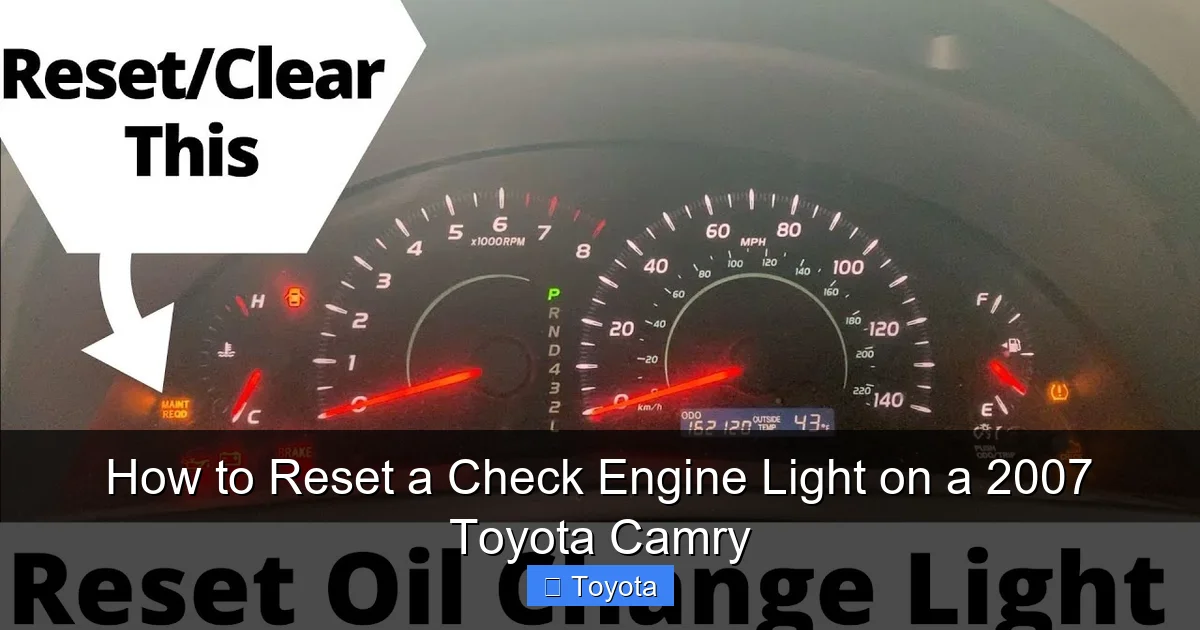
Visual guide about How to Reset a Check Engine Light on a 2007 Toyota Camry
Image source: i.ytimg.com
The Dangers of Ignoring the Codes
Consider a P0300 misfire code. If you reset the light and keep driving, the unburned fuel will flow into your exhaust system and ignite inside the catalytic converter. This superheats the converter’s ceramic substrate, causing it to melt and fail. A single catalytic converter replacement on a 2007 Camry can cost $1,000 or more. That’s a much steeper bill than replacing a $30 spark plug or a $50 ignition coil, which were the likely culprits.
Other risks of ignoring the initial problem include:
- Increased Emissions: Your car will pollute far more than legal limits, harming the environment and likely failing an emissions test.
- Poor Fuel Economy: An inefficient engine burns more gas. A faulty oxygen sensor alone can reduce MPG by 10-15%.
- Engine Damage: Running too lean (P0171) or too rich can cause internal engine damage over time, scoring cylinders or damaging piston rings.
- Safety Issues: Some problems, like a failing mass airflow sensor, can cause sudden loss of power or unpredictable engine behavior, which is dangerous in traffic.
Using an OBD2 Scanner to Read Codes
The absolute best practice is to read the stored trouble codes before you ever consider resetting the light. For a 2007 Camry, this is incredibly simple. Under the dash, just below the steering column, you’ll find a small, trapezoidal 16-pin connector—the OBD2 port. You can purchase a basic Bluetooth or wired OBD2 scanner for as little as $20-$50. These scanners plug into this port, pair with a smartphone app (like Torque or a dedicated scanner app), and instantly read and clear Diagnostic Trouble Codes (DTCs).
When you scan, you’ll get a code like “P0420.” You can then look this up online or in your scanner’s app to get a definition and common causes. This arms you with knowledge. You might discover it’s just a loose gas cap (P0440), a cheap and easy fix. Or, you might find a more serious code that requires a mechanic’s expertise. Never reset a code without first writing it down or understanding it. Once you clear the code, that diagnostic information is gone until the problem trips the sensor again.
If you don’t want to buy a scanner, many auto parts stores (like AutoZone, Advance Auto Parts, O’Reilly) offer free code reading services. They’ll plug in their professional scanner and print out the codes for you. This is a free and invaluable first step. You can then research the code specific to your 2007 Camry. For broader model-specific help, our guides for other Toyotas, like the Toyota Highlander or Toyota Corolla, often discuss common codes and their meanings for similar engines.
Methods to Reset the Check Engine Light
Once you have diagnosed the problem and completed the necessary repairs—or if you are absolutely certain the light came on erroneously (e.g., after a temporary sensor glitch)—you can proceed with resetting the light. There are three primary methods, ranked from simplest to most technical.
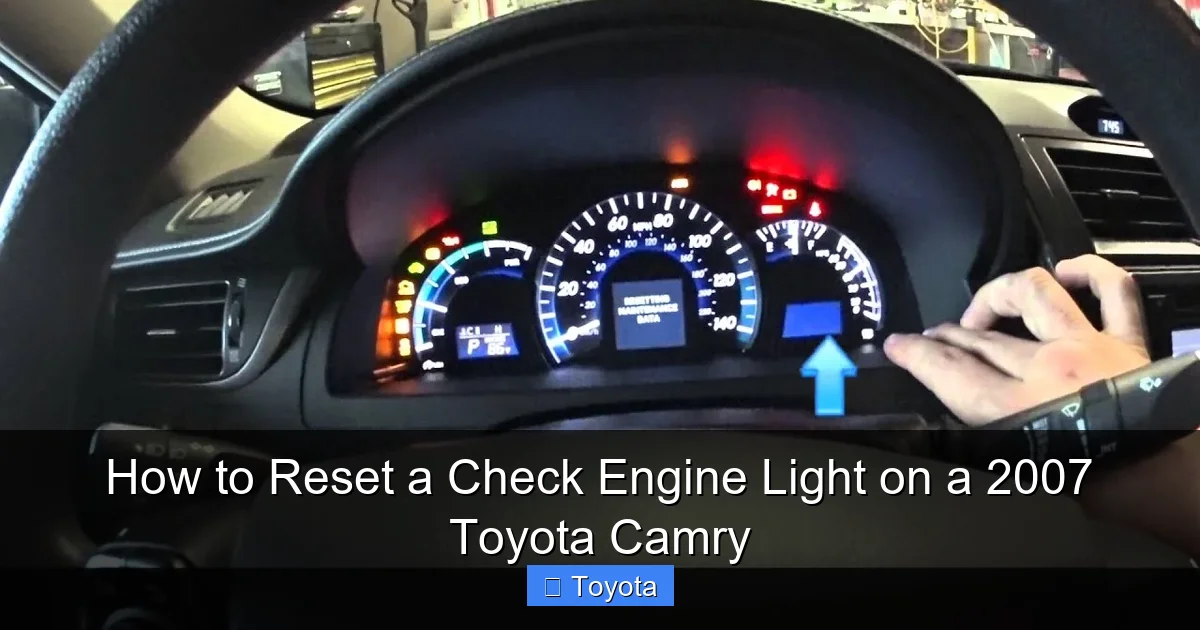
Visual guide about How to Reset a Check Engine Light on a 2007 Toyota Camry
Image source: i.ytimg.com
Method 1: The Battery Disconnect Reset
This is the old-school method and works on virtually any vehicle, including your 2007 Camry. The ECU’s memory is volatile, meaning it loses stored data when power is removed for a period. By disconnecting the battery, you clear the trouble codes and reset the check engine light.
Method 2: The OBD2 Scanner Reset
This is the modern, preferred, and most precise method. Using the same OBD2 scanner you used to read the codes, you simply navigate the menu to the “Clear Codes” or “Erase DTCs” function and execute it. This tells the ECU to delete the stored fault codes and turn off the MIL. It’s quick, doesn’t affect other vehicle systems, and doesn’t require any battery work.
Method 3:The Driving Cycle Reset
Sometimes, after you’ve fixed the problem, the check engine light will turn itself off. The ECU needs to see that the fault condition is gone and that the system is operating within specifications for a set period or drive cycle. This “drive cycle” is a specific sequence of driving conditions (engine warm-up, steady cruise, deceleration, etc.) that allows all onboard monitors to run and complete their self-tests. If no faults are detected during this cycle, the ECU will automatically extinguish the light. This can take several drive cycles and varying driving conditions. It’s passive and not a method you can actively force, but it’s good to know why the light might go out on its own after a repair.
Step-by-Step: Resetting via Battery Disconnect
If you don’t have an OBD2 scanner, the battery disconnect is your go-to method. However, it comes with important side effects you must be aware of.
Visual guide about How to Reset a Check Engine Light on a 2007 Toyota Camry
Image source: i.ytimg.com
Safety First and Necessary Precautions
Before you touch a wrench, put on safety glasses. You’ll be working with a car battery, which contains sulfuric acid and can produce explosive hydrogen gas. Also, disconnecting the battery will reset all electronic memories in your Camry. This means:
- Radio Presets: You will lose all saved radio stations.
- Clock: The time and date will reset to default.
- Power Window/Learning: The automatic window up/down feature may need to be re-learned (usually by holding the switch up/down for a few seconds).
- Engine Idle/Transmission Adaptation: The ECU’s long-term fuel trim and transmission shift points may revert to factory defaults, causing slightly rough idle or firm shifts for the first 10-20 minutes of driving as the computer re-learns your driving style.
- Security/Radio Code: Some aftermarket security systems or factory radios may require a code to reactivate. Have this code handy if needed.
The Disconnect Process
- Park and Secure: Park your Camry on a level surface, engage the parking brake, and turn off the ignition. Remove the key.
- Locate the Battery: Open the hood. The battery is typically in the front-right corner of the engine bay (on the driver’s side for right-hand drive markets).
- Identify Terminals: Identify the positive (+) terminal, usually marked with a red cover or a “+” symbol, and the negative (-) terminal, marked with a black cover or a “-” symbol.
- Disconnect the Negative Cable First: Using a 10mm socket wrench (the most common size for Camry battery terminals), loosen the nut on the negative (-) cable clamp. Once loose, carefully lift the clamp off the terminal and secure it away from the battery post so it cannot accidentally touch. This is the most important safety step—always disconnect the negative first to prevent a short circuit if your tool touches metal.
- Disconnect the Positive Cable: Now, loosen and remove the positive (+) cable clamp.
- Wait: Leave the battery disconnected for at least 10-15 minutes. This ensures all residual power drains from the ECU’s capacitors, clearing the memory.
- Reconnect: Reattach the positive (+) cable clamp first, tightening the nut securely. Then, reattach the negative (-) cable clamp and tighten it.
- Close Hood and Start Car: Close the hood, insert the key, and start the engine. The check engine light should be off. However, it may illuminate again immediately if the underlying problem is still present and actively triggering a code.
Step-by-Step: Resetting with an OBD2 Scanner
This method is cleaner, faster, and preserves all your vehicle’s electronic settings. It’s the professional standard.
Choosing the Right Scanner
For a 2007 Camry, you need a scanner that supports the OBD2 protocol (all do) and has a “Generic” or “All Makes” mode. You do not need an expensive, dealer-level Toyota-specific scan tool to simply read and clear codes. Basic Bluetooth adapters like the OBDLink LX or a standalone tool like the Autel AL319 are more than sufficient. Ensure your scanner’s app or interface has a “Clear Codes” or “Erase DTCs” function.
Connecting and Clearing Codes
- Locate the OBD2 Port: It’s under the dashboard, to the left of the steering column, often behind a small removable cover.
- Connect the Scanner: Plug the scanner’s connector firmly into the port. The key should be in the “ON” position (engine off, but dashboard lights on) or the engine should be running.
- Power On and Link: Turn on your scanner or open the app on your phone. It should automatically connect to the vehicle’s ECU.
- Read Codes (Again): Before clearing, it’s wise to read the codes one more time to confirm you are clearing the correct ones. Write them down if needed.
- Navigate to Clear Codes: Use the scanner’s menu to find the “Clear Codes,” “Erase DTCs,” or “MIL Off” function. Select it and confirm.
- Verify: The scanner should confirm that codes were cleared. The check engine light on your dash should go off immediately.
- Disconnect: Unplug the scanner from the port.
Important: Some advanced scanners also have a function to reset other systems, like the maintenance required light. If your goal is to reset that light after an oil change, the process is different. You can find model-specific guides, such as for a 2021 RAV4 or a Tacoma, which use a button-press sequence, not an OBD2 scan.
What Happens After You Reset the Light?
The moment you clear the codes, the check engine light goes out. But your job isn’t necessarily done. What happens next tells you if your repair was successful or if the problem persists.
Will the Light Stay Off?
This is the critical test. After resetting, drive your Camry normally for 50-100 miles under varied conditions (city and highway). If the underlying problem was truly fixed, the light should remain off. The ECU will run its internal monitors and, if no faults are detected, the light will stay off. However, if the problem was not fully repaired—for example, you tightened the gas cap but the seal is still faulty, or you replaced one ignition coil but another is failing—the ECU will detect the fault again and relight the check engine lamp, storing a new code. This is your cue that more diagnosis and repair are needed.
Preparing for an Emissions Test
In most states, you cannot pass a smog or emissions test with a check engine light on. Furthermore, even if the light is off, the test computer will check if all OBD2 “readiness monitors” have completed. Readiness monitors are self-tests the ECU runs on various systems (EVAP, catalyst, oxygen sensors, etc.). When you clear codes with a scanner, you also reset these monitors. They must all show “Complete” for a passing result.
It takes specific driving conditions to set these monitors. Simply driving to work may not be enough. You typically need:
- A cold start and drive until the engine reaches normal operating temperature.
- Steady cruising at 40-60 mph for several minutes.
- Several minutes of deceleration with no throttle input.
- Stop-and-go city driving.
This process can take 3-5 drive cycles. Using a scanner with readiness monitor status can tell you which tests are complete and which are still pending. Do not take your car for an official emissions test until all monitors are “Complete” and the light is off.
Monitoring for Recurrence
After a reset, be extra vigilant. Pay attention to how the car runs. Do you notice any rough idling, hesitation, loss of power, or strange noises? Does the fuel economy seem worse? These are clues that the problem may not be fully solved. Keep an OBD2 scanner handy or periodically scan at a parts store to check for pending codes before they trigger the light.
When to Seek Professional Help
While resetting the light is a simple task, the diagnostic and repair work leading up to it often requires professional expertise. Here are clear signs it’s time to call a mechanic.
Flashing Light or Severe Symptoms
As stated before, a flashing check engine light is an emergency. Pull over safely, turn off the engine, and have the vehicle towed. Driving with a misfire can destroy the catalytic converter in minutes. Similarly, if you experience severe symptoms like complete loss of power, engine stalling, loud backfiring, or smoke from the exhaust, stop driving immediately.
Persistent Codes After Repair
You’ve replaced the suspected part (e.g., oxygen sensor) and reset the light, but it returns with the same or a new code within a day or two. This indicates either the replacement part was defective, the installation was incorrect, or the initial diagnosis was wrong. Intermittent problems are also notoriously difficult to diagnose without advanced equipment and experience.
Complex Electrical or Multiple Codes
If your scan reveals multiple codes from different systems (e.g., an EVAP code, an oxygen sensor code, and a fuel trim code), it can point to a more complex, underlying issue like a wiring harness problem, a failing ECU, or a major vacuum leak. These require systematic diagnosis with wiring diagrams and advanced tools. Similarly, if you’re dealing with other dashboard warnings, like an airbag light on your Camry, that is a completely separate, safety-critical system that should only be handled by professionals.
For the 2007 Camry, common complex issues involve the Variable Valve Timing (VVT-i) system, intricate vacuum networks, or the electronic throttle control system. These are beyond the scope of a simple reset and require a technician’s knowledge.
Conclusion: A Light is a Message, Not a To-Do Item
Resetting the check engine light on your 2007 Toyota Camry is a straightforward process, but it must be the final step, not the first. The responsible approach is a three-step cycle: Diagnose with an OBD2 scanner to find the trouble code, Repair the underlying cause based on that information, and finally, Reset the light using either the battery disconnect method or, preferably, an OBD2 scanner. By following this logic, you protect your investment, ensure your car runs efficiently and cleanly, and avoid the frustration of a light that won’t stay off. Remember, your Camry’s check engine light is its way of asking for help. Listening to it, understanding it, and addressing its concerns is the key to keeping your reliable sedan running smoothly for years to come.
Frequently Asked Questions
Can I just reset the check engine light without fixing anything?
You can, but it’s strongly discouraged. The light will return once the computer redetects the fault. More importantly, you risk causing severe and costly damage to your engine or emissions system by ignoring the underlying problem.
How long does it take for the check engine light to reset itself after I fix the problem?
It varies. Sometimes it turns off immediately after a successful repair and reset. Other times, the ECU needs to complete a full “drive cycle” under varied conditions, which can take 50-100 miles of driving. Using a scanner to clear the code is instant.
Will my 2007 Camry pass a smog check if I reset the check engine light right before the test?
No. The test will immediately fail if the light is on during the test. Even if the light is off, the test computer checks if all OBD2 readiness monitors have run and are “complete.” Clearing codes resets these monitors, so you must drive enough to set them all again before taking the test.
What does it mean if the check engine light comes back on immediately after I reset it?
This almost always means the original problem was not properly repaired. The fault is still present and is being detected by the sensor again. You need to re-diagnose the issue, as your previous repair may have been incomplete or incorrect.
Can I reset the check engine light by disconnecting the battery in my 2007 Camry?
Yes, disconnecting the negative battery cable for 10-15 minutes will clear the codes and reset the light. However, this will also reset all radio presets, the clock, and window auto-up/down features, and may cause rough idle until the ECU re-learns.
My check engine light is on, but the car runs fine. Should I still reset it?
No. Even if the car seems normal, a stored code indicates a system is operating outside its designed parameters, often related to emissions. This will cause your car to fail an emissions test and could lead to poor fuel economy or future damage. Always read the code first to understand the issue.