
How to Get Coffee Stains Out of Car Seat: A Safe Step-by-Step Guide

Spilling coffee on a car seat can turn an ordinary morning into a frustrating cleanup job. Black coffee can leave a dark brown mark, while coffee with milk, cream, or sugar may also create sticky residue and unpleasant odors.
Fortunately, learning how to get coffee stains out of car seat upholstery is usually straightforward if you act quickly and use the right method for the seat material.
The biggest mistake is aggressively scrubbing or soaking the seat. Modern vehicle seats may contain heaters, ventilation components, occupant sensors, wiring, and airbag-related hardware. This guide explains how to remove fresh and dried coffee stains safely from cloth, leather, vinyl, and other common car-seat materials.
Quick Answer
To get coffee stains out of a car seat, blot fresh coffee immediately, use a small amount of mild upholstery-safe cleaner, gently work from the outside of the stain inward, and blot away the moisture. Avoid soaking the seat. For leather or specialty upholstery, use a cleaner specifically approved for that material.
What You Need to Remove a Coffee Stain
You usually do not need expensive detailing equipment for a small coffee spill.
Gather:
- Clean white microfiber towels
- Paper towels for initial blotting
- Lukewarm water
- Mild clear dish soap
- A small bowl or spray bottle
- Soft upholstery brush or detailing brush
- Wet/dry vacuum or extractor, if available
- Automotive upholstery cleaner for stubborn stains
- Leather cleaner for leather seats
Always check your vehicle owner’s manual before applying a cleaner to unusual or premium upholstery.
Choosing a product designed for vehicle interiors is often safer than experimenting with strong household chemicals. The EPA Safer Choice product database can also help consumers identify cleaning products that meet EPA criteria for safer ingredients.
First, Identify Your Car Seat Material
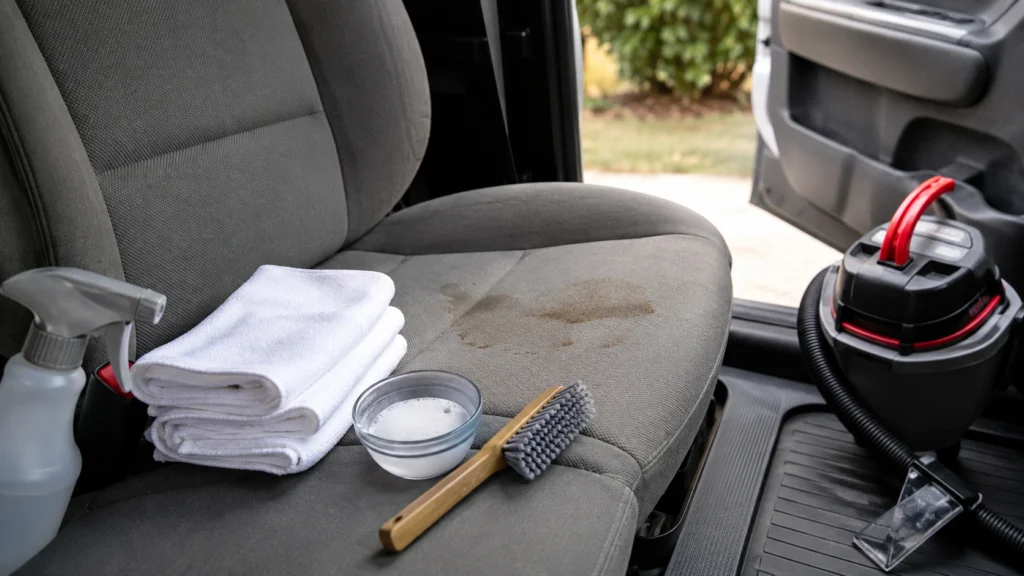
The safest cleaning method depends heavily on what covers the seat.
| Seat Material | Best First Approach | What to Avoid |
|---|---|---|
| Cloth/fabric | Mild soap solution or automotive upholstery cleaner | Heavy soaking and aggressive scrubbing |
| Leather | Damp microfiber and leather-specific cleaner | Vinegar, bleach, harsh detergents, excess water |
| Vinyl | Mild soap and damp microfiber | Abrasive brushes and strong solvents |
| Suede/Alcantara-type material | Manufacturer-approved specialty cleaner | Homemade mixtures unless specifically approved |
| Perforated leather | Very lightly applied leather cleaner | Filling perforations with liquid |
If you cannot identify the material, check the owner’s manual or manufacturer documentation before proceeding.
How to Get Coffee Stains Out of Car Seat Fabric
Cloth upholstery absorbs liquid quickly, so speed matters.
Step 1: Blot the Coffee Immediately
Place a clean microfiber towel or paper towel over the spill.
Press firmly enough to absorb moisture, then lift the towel straight up.
Repeat using clean sections of the towel.
Do not scrub. Scrubbing can spread coffee farther through the fibers and make the stained area larger.
Work from the outer edge toward the center.
Step 2: Remove Any Solid or Sticky Residue
Coffee containing sugar, syrup, whipped cream, or milk can leave more than a simple brown stain.
If there is visible residue, gently remove it using a damp microfiber towel.
Do not grind dried sugar or dairy residue deeper into the fabric.
Step 3: Make a Mild Cleaning Solution
For ordinary cloth seats, start with:
- About 2 cups of lukewarm water
- Approximately 1 teaspoon of mild clear dish soap
Mix gently.
You want a weak cleaning solution rather than thick foam.
Before treating the visible stain, test a small amount on a hidden section of upholstery. Wait several minutes and check for discoloration or texture changes.
Step 4: Apply the Cleaner to the Towel
Avoid pouring cleaning solution directly onto the seat.
Instead, lightly dampen a microfiber towel with the solution.
This gives you better control over how much moisture enters the cushion.
The upholstery should become damp, not saturated.
Step 5: Blot and Gently Agitate the Stain
Press the damp towel against the coffee stain.
For a stubborn mark, use a soft upholstery brush with gentle movements.
Start around the outside and gradually move inward.
This reduces the chance of creating a larger stain ring.
Step 6: Remove Cleaning Residue
Dampen another clean microfiber towel with plain water.
Wring it out thoroughly.
Blot the cleaned area several times to remove soap and loosened coffee residue.
Leaving too much cleaner behind can make the fabric feel stiff or attract dirt later.
Step 7: Extract the Moisture
Press dry towels firmly against the area.
If you own a wet vacuum or automotive upholstery extractor, you can carefully extract moisture from cloth upholstery.
Use the minimum amount of additional water necessary.
Do not repeatedly flood the seat just because an extractor can remove water.
Step 8: Let the Seat Dry Completely
Leave the doors or windows open in a safe, dry location where possible.
Good airflow is important.
A small fan directed toward the seat can speed drying.
Do not cover the seat while it is damp. Trapped moisture can create musty odors.
How to Remove a Dried Coffee Stain
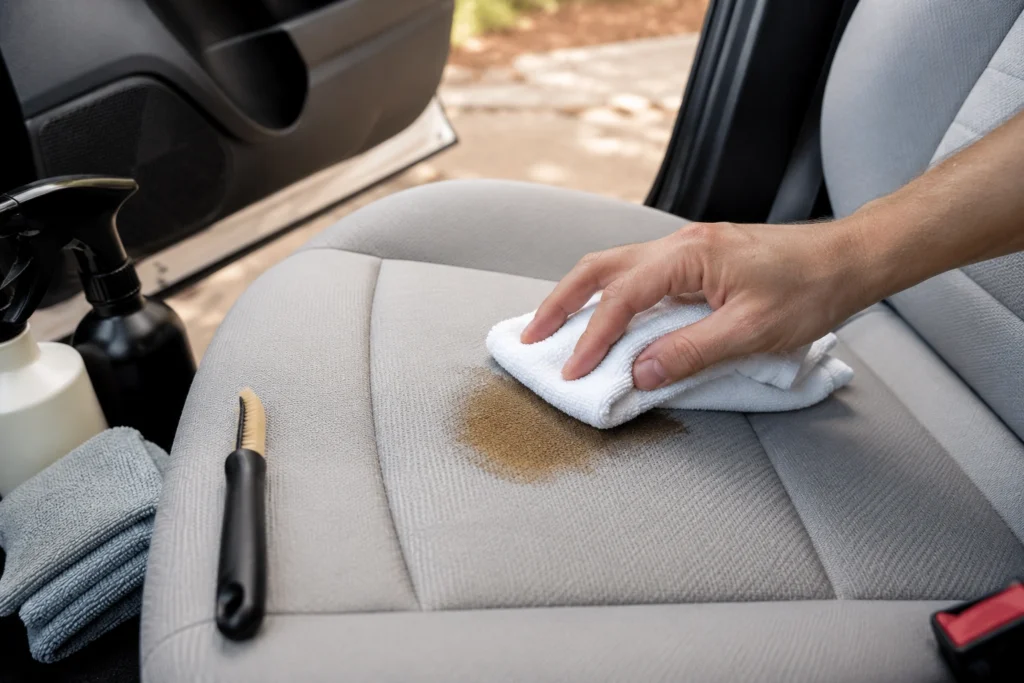
An old coffee stain usually takes more work because the liquid has already dried into the upholstery.
Start by lightly dampening the stained area with your mild cleaning solution.
Allow it to remain damp for a few minutes so the dried residue can soften. Do not saturate the cushion.
Then:
- Blot with a microfiber towel.
- Gently brush stubborn fabric fibers.
- Blot again using a clean section of towel.
- Rinse lightly with a damp towel.
- Extract or blot away moisture.
- Allow the seat to dry.
- Repeat once if necessary.
Several gentle treatments are safer than one aggressive cleaning session.
If the stain becomes noticeably lighter but does not disappear completely, switch to an automotive upholstery stain remover rather than continually increasing the strength of a homemade solution.
What If the Coffee Had Milk or Cream?
Coffee containing dairy presents another problem: odor.
Milk can penetrate cloth upholstery and reach the foam underneath. Even when the visible brown stain disappears, decomposing dairy residue can leave a sour smell.
For a small surface spill, the standard cleaning process may be enough.
For a larger spill:
- Blot immediately.
- Remove as much liquid as possible.
- Use an automotive fabric cleaner approved for food or organic stains.
- Extract moisture when appropriate.
- Dry the seat thoroughly.
An upholstery-safe enzyme cleaner may help with organic residue, but use one only when its instructions confirm that it is suitable for your seat material.
If milk reached deep into the cushion and the odor keeps returning, professional extraction may be worth the cost.
How to Remove Coffee From Leather Car Seats
Leather requires a different approach.
Do not automatically use the same mixture you would use on cloth.
For a Fresh Spill
Blot the coffee immediately with a soft microfiber towel.
Then use a second towel that is only slightly damp to remove remaining surface residue.
Dry the area afterward.
For a Visible Leather Stain
Use a pH-appropriate automotive leather cleaner that is suitable for your specific type of leather.
Apply the product to the towel or applicator rather than pouring it onto the seat.
Gently clean the affected area according to the product directions.
If your manufacturer recommends conditioning after cleaning, apply a suitable leather conditioner once the surface is clean and dry.
Avoid household hacks involving strong vinegar solutions, rubbing alcohol, peroxide, bleach, or abrasive powders. These can discolor or dry the protective finish.
What About Perforated or Ventilated Leather Seats?
Be especially careful with liquid.
Perforated seats contain many small holes leading toward the cushion and, on some vehicles, ventilation components.
Apply cleaner to a towel rather than directly spraying the seat.
Work with very small amounts.
If coffee has already traveled through the perforations and you notice persistent odor, electrical problems, or ventilation problems, professional inspection may be the smarter option.
Can You Use Vinegar on Coffee Stains?
Diluted white vinegar is commonly used on household fabric stains because its mild acidity can help with certain residues.
However, it is not automatically safe for every automotive upholstery material.
If you want to use it on ordinary synthetic cloth upholstery, first:
- Check the owner’s manual.
- Test an inconspicuous area.
- Use a heavily diluted solution.
- Never saturate the seat.
- Remove the residue afterward with a damp towel.
For leather, suede-like upholstery, or unknown materials, skip vinegar unless the manufacturer specifically permits it.
Can You Use Baking Soda?
Baking soda can help absorb some odors when used dry on ordinary fabric, but it is not the best first treatment for a coffee stain.
It can leave powder deep inside upholstery fibers and seat seams.
If the coffee stain is still visible, focus on removing the coffee residue first.
For persistent odors, professional extraction is often more effective than repeatedly adding powders or fragrances.
Should You Use Bleach?
Usually, no.
Bleach can permanently discolor upholstery and may damage interior materials. There is rarely a good reason to use it on a coffee stain.
Never experiment by combining multiple cleaners. The CDC’s guidance for safely using cleaning products containing bleach warns against mixing bleach with other cleaners or disinfectants because dangerous vapors can be produced.
Ventilate the vehicle whenever you use an interior cleaning chemical and follow its label directions.
Expert Tip
Expert Tip:
Treat the smallest possible area first. Most car owners cause more trouble by using too much cleaner and water than by using too little. You can repeat a gentle stain-removal process, but removing liquid that has soaked deep into seat foam is much harder.
How Much Does Coffee Stain Removal Cost?
A small coffee stain is usually inexpensive to handle yourself.
| Cleaning Option | Rough U.S. Cost | Best For |
|---|---|---|
| Mild DIY cleaning | $0–$10 | Fresh, small cloth stains |
| Automotive upholstery cleaner | $10–$25 | Dried or moderately stubborn stains |
| Extractor/rental equipment | $25–$75+ | Larger fabric areas |
| Professional seat cleaning/detailing | $50–$150+ | Deep stains, odors, multiple seats |
These are general ranges rather than fixed prices. Vehicle size, upholstery material, stain severity, and local labor rates can change the final price significantly.
A professional cleaning service becomes more worthwhile when repeated DIY cleaning would risk damaging expensive leather, specialty upholstery, seat electronics, or foam.
What If a Water Ring Appears After Cleaning?
A ring usually means the cleaned section dried differently from the surrounding upholstery.
This is especially noticeable on lighter cloth.
Instead of aggressively cleaning only the line, lightly clean a slightly larger section of the seat panel so the moisture transitions evenly.
Then extract or blot it evenly and allow the entire section to dry.
Do not keep adding more soap.
Common Mistakes Car Owners Should Avoid
Coffee stains often become harder to remove because of the cleanup method rather than the original spill.
Avoid these mistakes:
- Scrubbing aggressively. This can spread the stain and damage upholstery fibers.
- Soaking the cushion. Water can reach foam, wiring, sensors, or heating components.
- Using very hot water. This is particularly undesirable when the drink contains milk or cream.
- Using too much soap. Cleaner residue can attract additional dirt.
- Skipping the spot test. A cleaner may alter color or finish.
- Using bleach on upholstery. It may permanently discolor the material.
- Mixing cleaning chemicals. Chemical combinations can produce dangerous fumes.
- Using leather cleaner on fabric or fabric cleaner on leather.
- Closing the vehicle while the seat is still wet. Trapped moisture can contribute to odors.
- Ignoring a returning milk smell. Persistent odor often means contamination reached deeper material.
Protect Seat Electronics and Airbag Components
Cleaning a seat is different from cleaning a removable household cushion.
Some modern vehicles use sensors in the front passenger seat to determine occupant information, while vehicles may also have side-impact airbag systems associated with the seating area. The NHTSA airbag safety guidance explains that modern vehicles can use sophisticated sensing systems and both frontal and side airbags.
That does not mean a normal surface cleaning is dangerous. It means you should avoid flooding the seat, taking the seat apart, disconnecting wiring, or attempting sensor repairs simply to remove a stain.
If the airbag warning light appears after a major spill, have the vehicle inspected.
When to Call a Professional Mechanic
A coffee stain itself normally does not require a mechanic.
For stubborn upholstery stains, a professional automotive detailer or upholstery specialist is usually the better choice.
However, contact a qualified mechanic or repair facility if a significant liquid spill is followed by:
- An airbag or SRS warning light
- Passenger airbag indicator behaving abnormally
- Heated seat failure
- Ventilated seat failure
- Power seat problems
- Electrical clicking or intermittent movement
- Blown fuses
- Visible liquid around electrical connectors
- Burning smells
- Repeated warning messages
Do not remove the seat or unplug yellow SRS/airbag connectors unless you are trained to service those systems.
For an expensive leather seat or a vehicle with complex powered and ventilated seating, paying for professional cleaning can be cheaper than repairing accidental damage caused by excessive DIY cleaning.
How to Prevent Future Coffee Stains
A few simple habits can save you another cleanup job.
Use:
- A cup with a secure locking lid
- Cup holders that properly fit your travel mug
- Washable seat protectors where appropriate
- Microfiber towels stored in the trunk
- Interior-safe stain cleaner kept with detailing supplies
Clean spills as soon as it is safe to stop the vehicle.
Never attempt to clean a spill while actively driving. Pull over somewhere safe first.
FAQs
Can an old coffee stain be removed from a car seat?
Yes. Many dried coffee stains can still be removed. Lightly re-dampen the stain with an upholstery-safe cleaning solution, blot it, gently agitate if necessary, rinse with minimal moisture, and dry thoroughly. Several gentle treatments may be needed.
What is the best homemade cleaner for coffee stains on cloth car seats?
For ordinary cloth upholstery, a weak solution of lukewarm water and a small amount of mild clear dish soap is a sensible starting point. Always spot-test it first and check your vehicle’s upholstery-care instructions.
Does coffee permanently stain car seats?
Not necessarily. Fresh coffee is often relatively easy to remove. A stain becomes harder to treat when coffee dries deeply into fabric, contains milk or sugar, or has already been treated with inappropriate cleaners.
Can I use a carpet cleaner on my car seat?
Only if the cleaning product and machine are suitable for automotive upholstery. Avoid soaking the cushion. Car seats may contain electrical and safety-related components that household carpeting does not.
How do I remove coffee smell from a car seat?
First remove the actual coffee, sugar, and dairy residue. Then dry the seat completely. If a sour milk or coffee odor returns after cleaning, residue may have penetrated the cushion and professional extraction may be needed.
Can I use dish soap on leather car seats?
A dedicated automotive leather cleaner is generally the safer choice. Leather finishes vary considerably, and ordinary detergents can sometimes dry the surface or leave residue.
How long should a car seat dry after cleaning?
Drying time depends on how wet the upholstery became, airflow, humidity, and seat material. A lightly cleaned surface may dry within several hours, while heavily extracted upholstery may take considerably longer. Do not assume the seat is dry just because the surface feels dry.
Conclusion
Knowing how to get coffee stains out of car seat upholstery can save you from paying for unnecessary interior repairs or living with a permanent-looking brown mark.
For cloth seats, start by blotting the spill, then use a mild upholstery-safe solution with as little moisture as possible. Leather requires a material-specific cleaner, while specialty upholstery should be treated according to manufacturer instructions.
The most important rule is simple: clean gently and avoid soaking the seat.
If a stain remains after one or two careful attempts, or if coffee has reached seat electronics, ventilation components, or deep cushion material, stop experimenting. Have an automotive detailer, upholstery specialist, or qualified repair professional inspect the problem.
Treat the spill early, use the correct cleaner for your seat material, and you have the best chance of restoring the seat without causing more expensive damage.
