

How to Choose Airbrush for Automotive Painting (Beginner Guide 2026)

Contents
- 1 Key Takeaways
- 2 What Is an Automotive Airbrush and Why It Matters
- 3 Airbrush vs Spray Gun – Which One Should You Choose?
- 4 Types of Airbrushes (Choose the Right One)
- 5 Key Factors to Consider Before Buying
- 6 Best Airbrush Features for Automotive Painting
- 7 Common Mistakes to Avoid
- 8 Beginner vs Professional – What Should You Buy?
- 9 Pro Tips for Better Automotive Airbrush Results
- 10 Frequently Asked Questions (FAQ)
- 11 Conclusion
Ever tried painting a car panel and ended up with uneven coverage, rough texture, or paint that just didn’t look… right? You’re not alone. One of the biggest mistakes beginners (and even some experienced detailers) make is choosing the wrong airbrush for automotive painting.
Here’s the truth — the airbrush you use can make or break your finish. Whether you’re working on fine detailing, custom designs, or touch-ups, the right tool gives you smooth control, better paint flow, and that professional-looking result everyone wants.
But with so many options out there — single-action, dual-action, different needle sizes, gravity feed, siphon feed — it can get confusing really fast. Which one is actually best for car painting? And more importantly, which one is best for you?
Key Takeaways
If you’re short on time, here are the most important things to know before choosing an airbrush for automotive painting:
- Dual-action airbrushes offer better control and are ideal for most car painting tasks
- Needle size directly affects detail and coverage, so choose based on your use
- A good compressor is just as important as the airbrush itself
- Gravity feed airbrushes are easier to use and waste less paint
- You don’t need the most expensive model to get professional results
These basics will help you avoid common beginner mistakes and choose smarter.
If you’re exploring top-rated tools, you can check this Best Airbrush for Automotive Paint guide to compare reliable options.What Is an Automotive Airbrush and Why It Matters
An automotive airbrush is a small, precision painting tool that uses compressed air to spray a fine mist of paint. Unlike traditional spray guns, airbrushes are designed for detailed work, smooth blending, and controlled application.
This makes them perfect for:
- Custom paint designs
- Touch-ups and small repairs
- Fine detailing and shading
- Paint correction work
The biggest advantage of using an airbrush is control. You can adjust how much paint comes out, how fine the spray is, and exactly where it goes. This level of precision is hard to achieve with larger tools.
For example, if you’re working on a small scratch or adding custom graphics, a spray gun would be too heavy and imprecise. An airbrush, on the other hand, lets you work with accuracy and minimal waste.
In short, an airbrush is the go-to tool when detail and finish quality matter most.
Airbrush vs Spray Gun – Which One Should You Choose?
Both airbrushes and spray guns are used in automotive painting, but they serve very different purposes. Choosing the right one depends on what kind of work you plan to do.
Quick Comparison
| Feature | Airbrush | Spray Gun |
|---|---|---|
| Detail work | Excellent | Limited |
| Coverage area | Small | Large |
| Paint control | Very high | Moderate |
| Ease of use | Moderate learning curve | Beginner-friendly |
| Paint usage | Low | Higher |
When to Choose an Airbrush
- You need fine detail or custom designs
- You’re working on small areas or touch-ups
- You want maximum control over paint flow
When to Choose a Spray Gun
- You’re painting entire panels or full vehicles
- You need fast coverage
- You’re doing base coats or clear coats
For most people, the best approach is not choosing one over the other — but understanding when to use each.
However, if your focus is precision and detail, an airbrush is the better investment.
Types of Airbrushes (Choose the Right One)
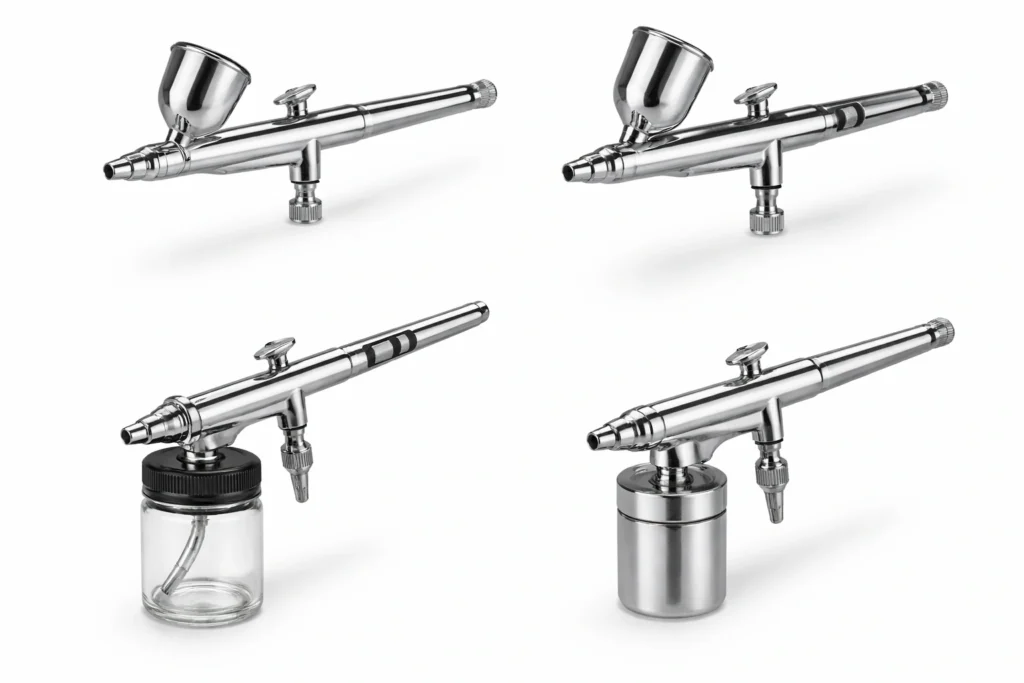
Not all airbrushes are the same. Choosing the right type can make your work easier and your results much better. Let’s break down the main options.
Single-Action Airbrush
A single-action airbrush controls airflow only. The paint flow is fixed.
- Simple to use
- Good for beginners
- Less control over paint output
This type is fine for basic work, but it’s limited when you need precision.
Dual-Action Airbrush (Recommended)
A dual-action airbrush lets you control both air and paint with the trigger.
- Press down → air
- Pull back → paint
This gives you full control over spray and detail, which is essential for automotive painting.
- Best for detailed work
- More flexibility
- Slight learning curve
If you’re serious about car painting, this is the best choice.
Gravity Feed vs Siphon Feed
Gravity Feed:
- Paint cup on top
- Uses less air pressure
- Better for detail work
- Easier to clean
Siphon Feed:
- Paint bottle below
- Holds more paint
- Better for longer sessions
- Requires more pressure
For most automotive tasks, gravity feed is the better option because it offers smoother control and efficiency.
Key Factors to Consider Before Buying
Before you buy an airbrush, you need to understand a few critical factors. These will directly affect your results.
Needle & Nozzle Size
This determines how fine or wide your spray will be.
- 0.2–0.3 mm → fine detail work
- 0.3–0.5 mm → general automotive use (best choice)
- 0.5+ mm → thicker paint and base coats
For most users, a 0.3 mm setup is the perfect balance.
Compressor Compatibility
An airbrush without the right compressor won’t perform well.
- Look for consistent PSI (15–30 PSI)
- Avoid weak compressors
- Stable airflow = smooth finish
Build Quality & Material
A well-built airbrush lasts longer and performs better.
- Metal body is more durable
- Precision parts improve spray quality
- Cheap plastic models wear out quickly
Ease of Cleaning
Automotive paint can clog your airbrush if not cleaned properly.
- Choose models that are easy to disassemble
- Quick cleaning saves time
- Better maintenance = longer lifespan
Budget Range
You don’t need to overspend, but don’t go too cheap either.
- $30–$80 → beginner models
- $80–$150 → mid-range (best value)
- $150+ → professional tools
A mid-range airbrush is usually the smartest choice.
Best Airbrush Features for Automotive Painting
When comparing airbrushes, certain features make a big difference in performance.
- Adjustable trigger control → better precision
- Fine atomization → smoother paint finish
- Paint cup size → affects workflow
- Replaceable parts → easier maintenance
- Stable airflow design → consistent results
If you’re exploring top-rated tools, you can check this best airbrush for automotive paint guide to compare reliable options.
Focus on features that improve control and consistency — those matter more than brand names.
Common Mistakes to Avoid
Many beginners waste time and money by making simple mistakes. Avoid these to get better results faster.
- Choosing the wrong needle size
- Ignoring compressor quality
- Buying the cheapest option without research
- Not cleaning the airbrush after use
- Using thick paint without proper thinning
One small mistake can ruin your finish. But the good news?
These are easy to avoid once you know them.
Beginner vs Professional – What Should You Buy?
Not every airbrush is suitable for every user. Your experience level should guide your choice.
Beginner Level
If you’re just starting out, focus on simplicity and control.
- Dual-action airbrush (easy to grow into)
- 0.3 mm needle size (balanced performance)
- Gravity feed system (easier handling)
- Affordable but reliable model
👉 The goal is to learn control without frustration.
Intermediate Level
At this stage, you already understand basics and want better performance.
- Higher precision dual-action airbrush
- Interchangeable needle sizes
- Better airflow control
- Mid-range compressor setup
👉 You should aim for consistency and improved finish quality.
Professional Level
Professionals need maximum precision and durability.
- High-end dual-action airbrush
- Multiple needle/nozzle options
- Premium build quality
- Advanced compressor system
👉 At this level, precision and reliability matter more than price.
Pro Tips for Better Automotive Airbrush Results

Even the best airbrush won’t give great results without proper technique. These tips can make a big difference.
- Thin your paint properly
Thick paint causes clogging and uneven spray - Test spray before applying
Always test on a scrap surface first - Maintain consistent distance
Keep a steady hand and even spacing - Use light, multiple coats
Heavy coats lead to runs and poor finish - Clean your airbrush after every use
This prevents buildup and keeps performance smooth
Small improvements in technique can dramatically improve your final result.
Frequently Asked Questions (FAQ)
What size airbrush is best for automotive painting?
A 0.3 mm needle size is the most versatile. It works well for both detail and general use.
Can I paint a full car with an airbrush?
Technically yes, but it’s not practical. Airbrushes are best for detail work and touch-ups, not full-body painting.
Is a dual-action airbrush better for beginners?
Yes. It may take a little practice, but it gives much better control and long-term value.
What PSI is needed for automotive airbrush work?
Most airbrushes work well between 15–30 PSI, depending on paint thickness and detail level.
How much should I spend on a good airbrush?
A solid airbrush typically costs between $80–$150, which offers the best balance of quality and performance.
Conclusion
Choosing the right airbrush for automotive painting doesn’t have to be complicated. Once you understand the basics — types, needle sizes, and key features — the decision becomes much easier.
For most people, a dual-action, gravity feed airbrush with a 0.3 mm needle is the perfect starting point. It offers the control, flexibility, and performance needed for both beginners and experienced users.
Remember, the tool is only part of the equation.
Practice, technique, and proper maintenance are what truly create professional results.
Take your time, choose wisely, and keep improving — your paint finish will reflect it.

