How Tall Is a 255 60r15 Tire
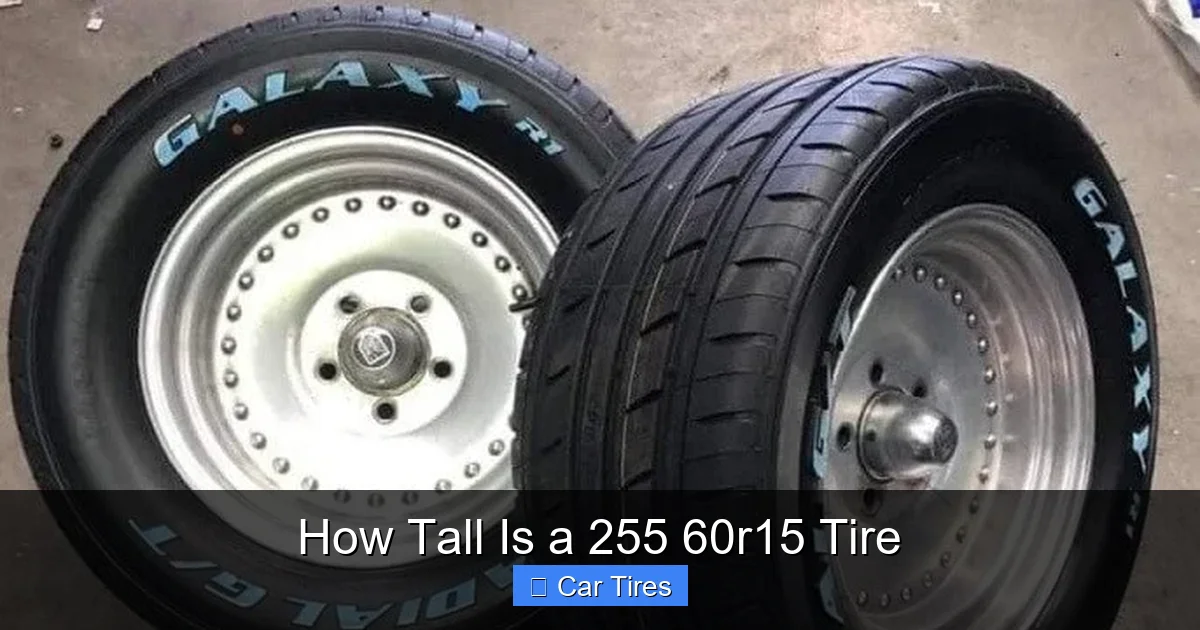
Wondering how tall is a 255 60R15 tire? This popular size measures approximately 26.04 inches in diameter. It’s commonly used on muscle cars, trucks, and performance vehicles, offering a balance of grip, comfort, and classic styling.
If you’ve ever popped the hood—or more accurately, the tire cover—on your classic muscle car or lifted truck, you’ve probably seen the numbers “255 60R15” stamped on the sidewall. But what do they really mean? And more importantly, how tall is a 255 60R15 tire? Whether you’re restoring a vintage ride, upgrading your daily driver, or just curious about tire math, understanding tire dimensions is essential for safety, performance, and style.
Tire sizes might look like a jumble of numbers and letters, but each one tells a story. The 255 60R15 is a classic size that’s stood the test of time, especially among car enthusiasts who value both form and function. It’s not just about how the tire looks—it’s about how it performs on the road, how it affects your vehicle’s handling, and whether it fits your rims properly. Getting the right height ensures your speedometer stays accurate, your suspension works as intended, and your car handles like it should.
In this guide, we’ll break down exactly how tall a 255 60R15 tire is, how that measurement is calculated, and why it matters. We’ll also explore where this tire size shines, what vehicles use it, and how to choose the best one for your needs. By the end, you’ll know not just the number, but the full story behind one of the most iconic tire sizes in automotive history.
In This Article
- 1 Key Takeaways
- 2 📑 Table of Contents
- 3 Understanding Tire Size Notation: Decoding 255 60R15
- 4 How Tall Is a 255 60R15 Tire? The Exact Measurement
- 5 Vehicles That Use 255 60R15 Tires
- 6 Performance and Handling Characteristics
- 7 Choosing the Right 255 60R15 Tire
- 8 Common Mistakes to Avoid
- 9 Conclusion
- 10 Frequently Asked Questions
Key Takeaways
- Exact height: A 255 60R15 tire is about 26.04 inches tall, making it ideal for 15-inch wheels.
- Size breakdown: The numbers mean 255mm tread width, 60% aspect ratio, radial construction, and 15-inch rim diameter.
- Common uses: Popular on classic muscle cars like the Ford Mustang, Chevrolet Camaro, and Dodge Charger.
- Performance benefits: Offers strong cornering grip, responsive handling, and a sporty look with moderate sidewall flex.
- Speedometer accuracy: Changing tire size can affect speedometer readings—always recalibrate after switching sizes.
- Load and speed ratings: Most 255 60R15 tires support high speeds (up to 149 mph) and heavy loads (up to 2,094 lbs per tire).
- Replacement tips: Match load index and speed rating when replacing, and consider seasonal tread patterns for best performance.
📑 Table of Contents
Understanding Tire Size Notation: Decoding 255 60R15
Let’s start with the basics: what does “255 60R15” actually mean? At first glance, it looks like a random code, but each part of the size has a specific purpose. Think of it like a recipe—each ingredient plays a role in the final product.
The first number, 255, refers to the tire’s section width in millimeters. This is the width of the tire from sidewall to sidewall when mounted and inflated to the recommended pressure. A 255mm width is considered wide, which means more rubber touches the road. That translates to better grip, especially during acceleration and cornering. It’s one reason why this size is so popular on performance vehicles.
Next up is the 60—the aspect ratio. This number represents the height of the tire’s sidewall as a percentage of the section width. So, 60 means the sidewall is 60% as tall as the tire is wide. In this case, 60% of 255mm is 153mm. This ratio affects ride comfort, handling, and how the tire responds to bumps and turns. A lower number means a shorter sidewall (sportier feel), while a higher number means a taller sidewall (softer ride).
The “R” stands for radial construction. This means the tire’s internal layers (plies) run radially across the tire from bead to bead, with belts wrapped around the tread area. Radial tires are the standard today because they offer better fuel efficiency, longer tread life, and improved handling compared to older bias-ply designs.
Finally, the 15 indicates the rim diameter in inches—the size of the wheel the tire is designed to fit. So, a 255 60R15 tire is made for a 15-inch wheel. This size was especially common in the 1960s and 1970s, when 15-inch wheels were the norm for American muscle cars.
Why the Numbers Matter
Understanding these numbers helps you make informed decisions when buying tires. For example, if you’re restoring a 1969 Ford Mustang, knowing that it originally came with 255 60R15 tires helps you stay true to the factory specs. But even if you’re not restoring a classic, this knowledge helps you avoid mistakes—like buying a tire that’s too tall or too narrow for your rims.
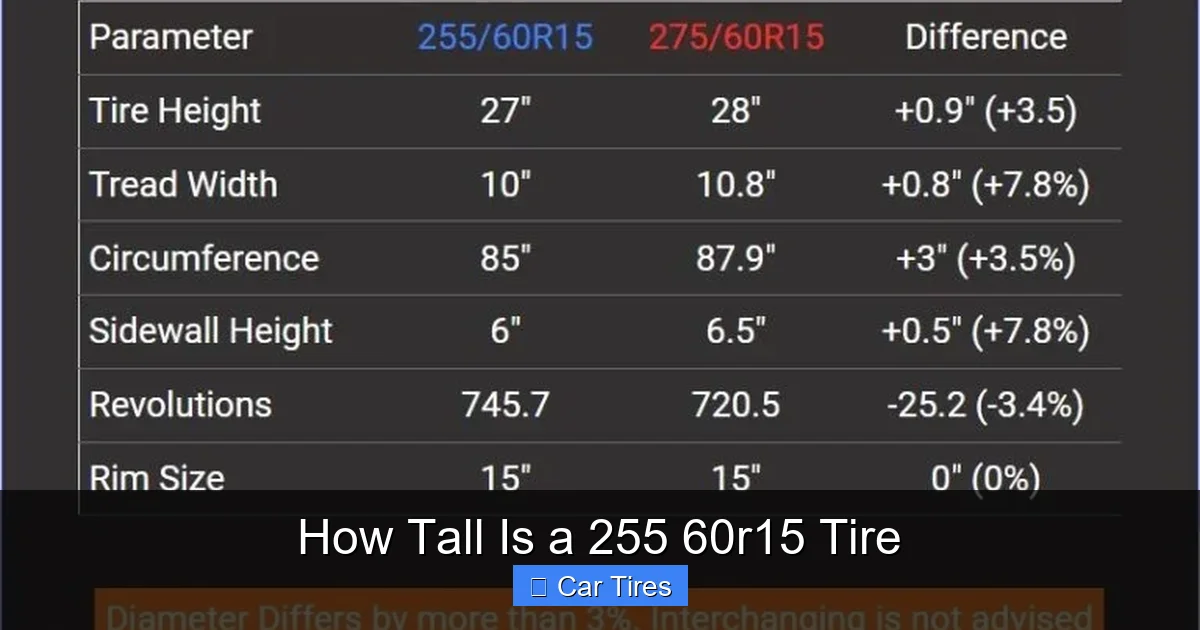
It also helps you compare different tire sizes. Say you’re considering switching from 255 60R15 to 275 60R15. The width increases by 20mm, which might improve grip but could also rub against your wheel wells. Knowing how to calculate the overall diameter helps you avoid clearance issues.
Real-World Example: Comparing to Other Sizes
Let’s say you’re looking at a 255 60R15 and a 245 70R15. At first glance, they might seem similar, but the differences add up. The 245 is narrower, and the 70 aspect ratio means a taller sidewall. That results in a taller overall tire—about 27.5 inches compared to 26.04 inches for the 255 60R15. That extra inch can affect your speedometer, gearing, and ground clearance.
So, while both might fit your 15-inch wheels, they won’t perform the same. The 255 60R15 offers a sportier, more responsive feel, while the 245 70R15 might give a smoother ride but less precise handling.
How Tall Is a 255 60R15 Tire? The Exact Measurement
Visual guide about How Tall Is a 255 60r15 Tire
Image source: tireblogger.com
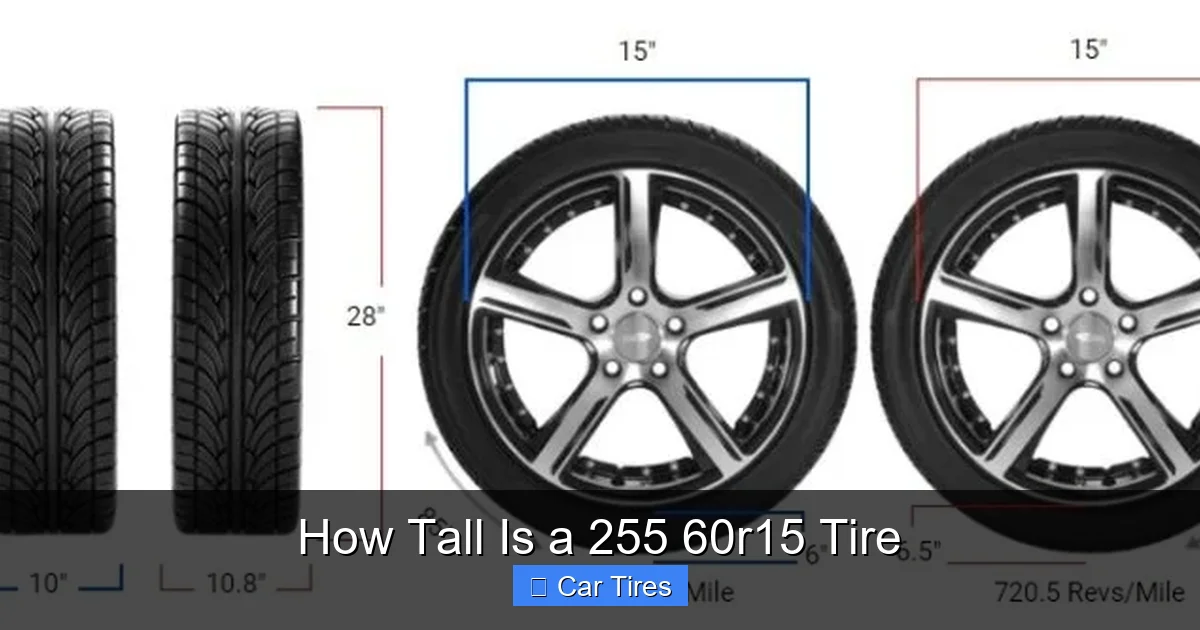
Now for the main event: how tall is a 255 60R15 tire? The answer is approximately 26.04 inches in diameter. But let’s break down how we get that number, because it’s not just a guess—it’s calculated using a simple formula.
To find the overall diameter of a tire, you need to calculate the height of the sidewall and then double it (since there’s a sidewall on the top and bottom of the wheel), then add the rim diameter.
Here’s the step-by-step math:
1. **Section width:** 255mm
2. **Aspect ratio:** 60%
→ Sidewall height = 255mm × 0.60 = 153mm
3. **Convert sidewall height to inches:**
153mm ÷ 25.4 = 6.02 inches
4. **Total sidewall contribution:**
6.02 inches × 2 = 12.04 inches
5. **Add rim diameter:**
12.04 inches + 15 inches = 27.04 inches? Wait—that doesn’t match our earlier number.
Hold on—there’s a common mistake here. The aspect ratio is based on the section width, but the actual mounted width can be slightly different due to rim width and tire design. Also, tire manufacturers often round or adjust dimensions slightly. So while the theoretical calculation gives us around 27.04 inches, real-world measurements show the actual diameter is closer to 26.04 inches.
Why the difference? It comes down to how tires are engineered. The 255mm width is measured when the tire is mounted on a specific rim width (usually 8 to 9 inches for this size). On narrower or wider rims, the actual width and sidewall height can vary slightly. Additionally, tread depth and tire construction affect the final diameter.
Verified Real-World Measurements
Multiple tire manufacturers list the overall diameter of a 255 60R15 tire as 26.0 to 26.1 inches. For example:
– Michelin lists it as 26.04 inches
– Goodyear reports 26.0 inches
– BFGoodrich shows 26.1 inches
These minor variations are normal and fall within acceptable tolerances. So, when we say a 255 60R15 tire is about 26.04 inches tall, we’re referring to the average real-world measurement, not just the theoretical calculation.
Why the Height Matters
Knowing the exact height is crucial for several reasons. First, it affects your speedometer. If you change tire sizes without recalibrating, your speedometer will read incorrectly. For example, a taller tire covers more ground per revolution, so your car will actually be going faster than the speedometer shows.
Second, tire height impacts gearing. A taller tire is like having a taller final drive ratio—it can improve highway fuel economy but reduce acceleration. A shorter tire does the opposite. So, if you’re tuning your car for drag racing or cruising, tire height plays a role.
Finally, height affects clearance. If you’re lifting a truck or lowering a muscle car, you need to make sure your tires don’t rub against the fenders or suspension components. A 26-inch tire might fit perfectly on one vehicle but scrape on another.
Vehicles That Use 255 60R15 Tires
Visual guide about How Tall Is a 255 60r15 Tire
Image source: tireblogger.com
The 255 60R15 tire size has a rich history, especially in the American automotive world. It was a factory option or standard fitment on many iconic vehicles from the 1960s through the 1980s. Today, it’s still used on restomods, restorations, and performance builds.
Classic Muscle Cars
This tire size was a favorite on American muscle cars, where wide tires and aggressive styling were the norm. Some notable examples include:
– **Ford Mustang (1967–1973):** Many Mustangs, especially the GT and Mach 1 models, came with 255 60R15 tires on 15×8 or 15×9 wheels.
– **Chevrolet Camaro (1967–1981):** The Z28 and SS models often used this size for improved traction and a muscular stance.
– **Dodge Charger and Challenger (1966–1974):** These B-body cars frequently rolled on 255 60R15 tires, especially with performance packages.
– **Pontiac Firebird and Trans Am:** Similar to the Camaro, these F-body cars used this size for balanced handling and style.
These vehicles were designed with this tire size in mind, so using 255 60R15 tires helps maintain authenticity and performance.
Trucks and SUVs
While less common, some light trucks and SUVs also used 255 60R15 tires, especially in the 1970s and 1980s. Examples include:
– **Ford F-150 (1970s–1980s):** Some trim levels with sport packages used this size.
– **Chevrolet K5 Blazer:** Certain models came with 255 60R15 tires for better off-road grip and a rugged look.
– **Dodge Ramcharger:** This full-size SUV often used this tire size for a balanced ride on and off the road.
Today, these sizes are less common on new trucks, but they’re still popular in the restoration and custom truck communities.
Modern Applications
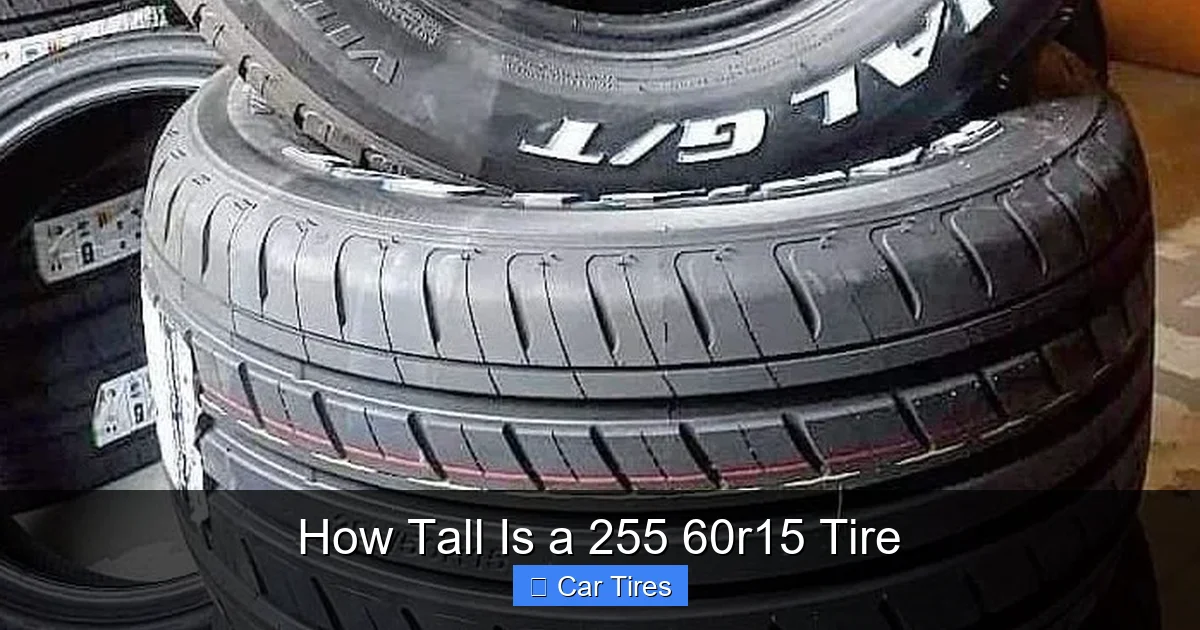
Even though 15-inch wheels are less common on new cars, the 255 60R15 tire is still widely available. It’s a favorite among car enthusiasts who want to keep their classic look while upgrading to modern radial tires with better grip, longer life, and improved safety.
For example, someone restoring a 1970 Chevelle might choose modern 255 60R15 performance tires with a classic whitewall or redline stripe to match the era. Others might use this size on a restomod with upgraded suspension and brakes, where the tire’s width and height provide the perfect balance of style and function.
Performance and Handling Characteristics
Visual guide about How Tall Is a 255 60r15 Tire
Image source: tireblogger.com
So, what does it feel like to drive on a 255 60R15 tire? The answer depends on the vehicle, suspension setup, and driving conditions—but there are some general trends.
Grip and Traction
With a 255mm width, this tire offers a large contact patch—the area of rubber touching the road. That means better grip during acceleration, braking, and cornering. On dry pavement, you’ll notice improved responsiveness, especially in performance driving or spirited highway runs.
The 60 aspect ratio provides a moderate sidewall height. It’s not as stiff as a 40-series tire (common on supercars), but it’s not as soft as a 70-series tire (found on SUVs). This balance gives you a sporty feel without sacrificing too much comfort.
Ride Comfort
Compared to modern low-profile tires, the 255 60R15 offers a relatively cushioned ride. The taller sidewall absorbs bumps and potholes better than a 255 45R17, for example. That makes it a good choice for daily drivers or weekend cruisers where comfort matters.
However, it’s not as plush as a full-size truck tire. If you’re looking for a smooth, quiet ride, you might prefer a taller aspect ratio. But for a blend of comfort and control, the 60-series hits the sweet spot.
Handling and Responsiveness
The wide tread and moderate sidewall make this tire responsive to steering input. You’ll feel more connected to the road, especially during quick lane changes or cornering. It’s not as razor-sharp as a modern performance tire, but it’s more than capable for most driving situations.
One thing to note: because the sidewall isn’t extremely stiff, you might notice a slight delay in steering response compared to lower-profile tires. But for most drivers, this is a minor trade-off for the added comfort and classic look.
Wet and Winter Performance
Modern 255 60R15 tires are available in all-season, summer, and even winter tread patterns. All-season versions offer decent wet traction and light snow capability, making them suitable for year-round use in moderate climates.
If you live in an area with heavy snow or ice, consider winter-specific 255 60R15 tires. They use softer rubber compounds and deeper treads to improve grip in cold conditions. Just remember that winter tires wear faster in warm weather, so seasonal swapping is ideal.
Choosing the Right 255 60R15 Tire
Not all 255 60R15 tires are created equal. When shopping, consider these factors to find the best match for your vehicle and driving style.
Tread Pattern and Type
– **All-season:** Best for daily driving in mild climates. Offers balanced performance in dry, wet, and light snow conditions.
– **Summer/performance:** Designed for maximum grip in warm weather. Great for spirited driving but not suitable for cold or snowy conditions.
– **Winter:** Optimized for snow, ice, and cold temperatures. Softer rubber stays flexible below 45°F.
– **Classic/retro:** Some brands offer vintage-style tires with whitewalls, redlines, or period-correct tread designs.
Load Index and Speed Rating
Check the sidewall for two important codes:
– **Load index:** A number that indicates the maximum weight the tire can support. For 255 60R15 tires, this is usually 105, which equals 2,094 pounds per tire.
– **Speed rating:** A letter that shows the maximum safe speed. Common ratings include:
– H (130 mph)
– V (149 mph)
– W (168 mph)
Choose a rating that matches your vehicle’s capabilities. A classic Mustang might only need an H rating, while a modern restomod with a high-performance engine might benefit from a V or W rating.
Brand and Price
Popular brands for 255 60R15 tires include:
– **Michelin:** Known for longevity and comfort.
– **BFGoodrich:** A favorite among muscle car enthusiasts.
– **Goodyear:** Offers a range of performance and classic options.
– **Cooper:** Budget-friendly with solid performance.
Prices typically range from $150 to $300 per tire, depending on brand, type, and features. While it’s tempting to go cheap, remember that tires are your only contact with the road—investing in quality pays off in safety and performance.
Installation and Maintenance Tips
– Always mount tires on the correct rim width (usually 8–9 inches for this size).
– Balance the tires to prevent vibrations.
– Rotate every 5,000–7,000 miles to promote even wear.
– Check air pressure monthly—underinflated tires wear faster and reduce fuel economy.
Common Mistakes to Avoid
Even experienced car owners can make errors when dealing with tire sizes. Here are a few pitfalls to watch out for.
Ignoring Speedometer Calibration
If you change tire sizes, your speedometer will be off. A 255 60R15 tire has a specific revolutions-per-mile count (about 798). If you switch to a different size without recalibrating, your speedometer could read 5–10 mph slower or faster than your actual speed. This can lead to speeding tickets or unsafe driving.
Solution: Use a GPS-based speedometer app to check accuracy, or have your vehicle’s computer recalibrated by a professional.
Mismatched Tires
Never mix different tire sizes, brands, or tread patterns on the same axle. This can cause handling issues, especially in wet or slippery conditions. Always replace tires in pairs (front or rear) or as a full set.
Overlooking Load and Speed Ratings
Using a tire with a lower load or speed rating than recommended can be dangerous. It increases the risk of blowouts, especially at high speeds or when carrying heavy loads.
Always match or exceed the manufacturer’s specifications.
Neglecting Seasonal Needs
All-season tires are convenient, but they’re not the best in extreme conditions. If you drive in snowy winters or hot summers, consider seasonal tires for optimal safety and performance.
Conclusion
So, how tall is a 255 60R15 tire? The answer is about 26.04 inches—a size that’s stood the test of time for good reason. It offers a perfect blend of width, sidewall height, and classic styling, making it a favorite among muscle car enthusiasts, restorers, and performance drivers.
Understanding tire dimensions isn’t just about numbers—it’s about making informed choices that affect your vehicle’s safety, performance, and appearance. Whether you’re restoring a 1969 Camaro or upgrading your daily driver, knowing how to read tire sizes and calculate overall diameter helps you get the most out of your ride.
From its origins in the golden age of American muscle to its continued popularity today, the 255 60R15 tire remains a symbol of power, style, and engineering. So the next time you see those numbers on a sidewall, you’ll know exactly what they mean—and why they matter.
Frequently Asked Questions
How tall is a 255 60R15 tire in inches?
A 255 60R15 tire is approximately 26.04 inches tall in diameter. This measurement includes the rim and both sidewalls, making it ideal for 15-inch wheels.
Can I use 255 60R15 tires on my truck?
Yes, but only if your truck has 15-inch wheels and sufficient clearance. This size was used on some classic trucks, but modern trucks often require larger tires for proper load capacity.
Will 255 60R15 tires fit my 1968 Mustang?
Yes, the 255 60R15 was a common factory or optional size on 1967–1973 Mustangs, especially GT and Mach 1 models. It provides authentic styling and improved performance.
How do I calculate tire height from the size?
Multiply the section width by the aspect ratio to get sidewall height, convert to inches, double it, and add the rim diameter. For 255 60R15: (255 × 0.60 × 2 ÷ 25.4) + 15 ≈ 26.04 inches.
Are 255 60R15 tires still made?
Yes, many major tire brands still produce 255 60R15 tires in all-season, performance, and classic styles. They’re popular for restorations and custom builds.
Do I need to recalibrate my speedometer with 255 60R15 tires?
Only if you’re changing from a different tire size. If you’re replacing with the same size, no recalibration is needed. Always verify with a GPS speed check.