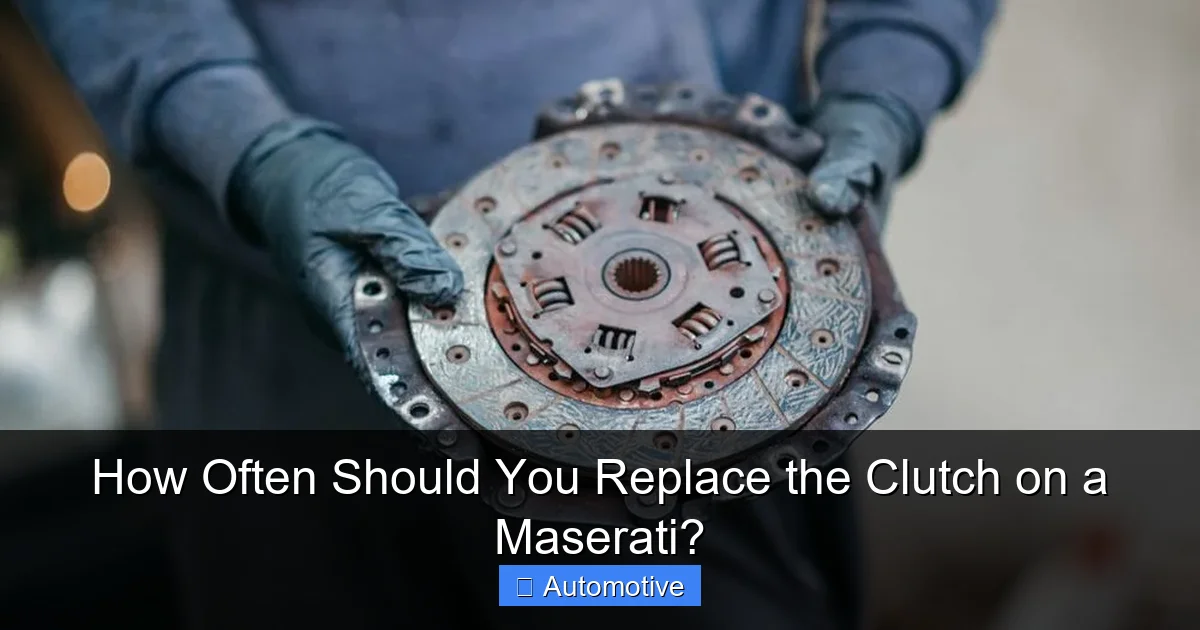
How Often Should You Replace the Clutch on a Maserati?

Contents
- 1 Key Takeaways
- 2 📑 Table of Contents
- 3 How Often Should You Replace the Clutch on a Maserati?
- 4 Understanding the Maserati Clutch: What Makes It Different?
- 5 Factors That Affect Clutch Lifespan in a Maserati
- 6 Signs Your Maserati Clutch Needs Replacement
- 7 How to Extend the Life of Your Maserati Clutch
- 8 Clutch Replacement: What to Expect
- 9 Final Thoughts: Protect Your Investment
- 10 Frequently Asked Questions

Solar Car Battery Maintainer
Foam Cannon

Torque Wrench Set

Car Ambient Light Kit
Replacing the clutch on a Maserati isn’t something you’ll need to do every year—but it’s not a lifetime part either. Depending on driving habits, model, and conditions, most Maserati clutches last between 60,000 and 100,000 miles. Regular maintenance and mindful driving can significantly extend its life.
Key Takeaways
- Typical lifespan: Most Maserati clutches last 60,000 to 100,000 miles, but this varies widely based on usage.
- Driving style matters: Aggressive driving, frequent launches, and stop-and-go traffic accelerate clutch wear.
- Early warning signs: Slipping, burning smells, grinding noises, and difficulty shifting are red flags.
- Maintenance helps: Regular inspections and fluid checks can prevent premature failure.
- Cost considerations: Clutch replacement on a Maserati can range from $3,000 to $7,000 due to labor and premium parts.
- DIY vs. professional: This job requires specialized tools and expertise—best left to certified technicians.
- Preventive habits: Smooth shifting, avoiding “riding the clutch,” and proper warm-up routines extend clutch life.
📑 Table of Contents
- How Often Should You Replace the Clutch on a Maserati?
- Understanding the Maserati Clutch: What Makes It Different?
- Factors That Affect Clutch Lifespan in a Maserati
- Signs Your Maserati Clutch Needs Replacement
- How to Extend the Life of Your Maserati Clutch
- Clutch Replacement: What to Expect
- Final Thoughts: Protect Your Investment
How Often Should You Replace the Clutch on a Maserati?
Owning a Maserati is more than just driving a car—it’s an experience. The throaty roar of the engine, the buttery-smooth gearbox, and the way it hugs the road make every trip feel like a scene from a luxury film. But behind that Italian elegance lies a high-performance machine with components that demand respect—especially the clutch.
If you’re wondering how often you should replace the clutch on a Maserati, you’re not alone. It’s one of the most common questions among owners of these exotic vehicles. Unlike everyday commuter cars, Maseratis are built for performance, which means their clutches are engineered to handle high torque and rapid shifts. But that also means they can wear out faster under certain conditions.
The short answer? Most Maserati clutches last between 60,000 and 100,000 miles. But that’s just a general range. The real lifespan depends on how you drive, where you drive, and how well you maintain your vehicle. Some owners report getting over 120,000 miles out of their clutch with careful use, while others may need a replacement before hitting 50,000 miles due to aggressive driving or poor habits.
In this guide, we’ll dive deep into what affects clutch longevity, how to spot trouble early, and what you can do to get the most out of your Maserati’s clutch. Whether you drive a Ghibli, Quattroporte, GranTurismo, or MC20, the principles remain the same. Let’s get started.
Understanding the Maserati Clutch: What Makes It Different?
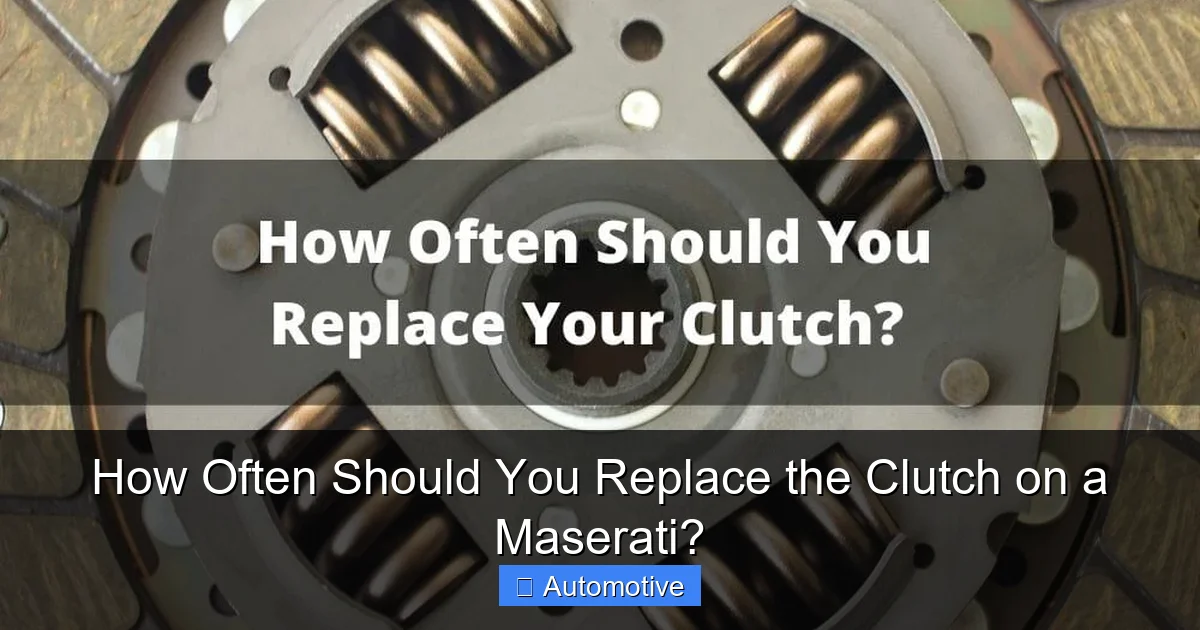
Visual guide about How Often Should You Replace the Clutch on a Maserati?
Image source: vehiclefreak.com
Before we talk about replacement intervals, it’s important to understand what makes a Maserati clutch unique. These aren’t your average family sedan clutches. They’re high-performance components designed to handle the intense power output of Maserati’s turbocharged V6 and V8 engines.
High-Torque Demands
Maserati engines produce serious torque—often over 500 lb-ft in models like the Ghibli Trofeo or Quattroporte SQ4. The clutch must be able to transfer that power smoothly from the engine to the transmission without slipping. To handle this, Maserati uses heavy-duty clutch assemblies with reinforced friction materials, stronger pressure plates, and dual-mass flywheels in some models.
These components are built to last, but they’re also more sensitive to abuse. A sudden launch from a stoplight or repeated hard shifts can generate excessive heat, which degrades the clutch lining over time.
Dual-Clutch vs. Manual Transmissions
It’s also worth noting that not all Maseratis use traditional manual clutches. Many newer models, like the Ghibli and Levante, come equipped with ZF 8-speed automatic transmissions that use a torque converter instead of a clutch pedal. However, performance-oriented models like the GranTurismo and MC20 still offer manual or dual-clutch transmissions (DCT), which do have physical clutches.
Dual-clutch systems are incredibly fast and efficient, but they’re also complex. They use two separate clutches—one for odd gears and one for even gears—to pre-select the next gear and reduce shift times. While this improves performance, it also means more components that can wear out.
Flywheel and Hydraulic Systems
In manual and DCT Maseratis, the clutch system includes not just the clutch disc and pressure plate, but also the flywheel and hydraulic actuation system. The flywheel stores rotational energy and helps smooth out engine pulses, while the hydraulic system uses fluid pressure to engage and disengage the clutch.
Over time, the flywheel can develop hot spots or warping from excessive heat, and the hydraulic system can develop leaks or air bubbles. Both issues can mimic clutch wear, so it’s important to have a proper diagnosis before assuming the clutch itself is bad.
Factors That Affect Clutch Lifespan in a Maserati

Visual guide about How Often Should You Replace the Clutch on a Maserati?
Image source: europeanrepairdetroit.com
Now that we know what makes a Maserati clutch special, let’s look at the real-world factors that determine how long it will last. While 60,000 to 100,000 miles is a good rule of thumb, your actual experience may vary—sometimes dramatically.
Driving Style: The #1 Influence
How you drive has the biggest impact on clutch life. If you treat your Maserati like a race car—launching hard, riding the clutch, and shifting at redline—you’re asking for trouble. Aggressive driving generates heat, and heat is the enemy of clutch longevity.
For example, imagine you’re stuck in heavy city traffic in your Quattroporte. You’re constantly stopping and starting, slipping the clutch to creep forward, and then flooring it when the light turns green. That’s a recipe for premature wear. Each time you partially engage the clutch, you’re creating friction without full engagement, which wears down the friction material.
On the other hand, if you drive smoothly—anticipating stops, shifting early, and avoiding unnecessary rev-matching—you can significantly extend the life of your clutch. Think of it like braking: gentle, predictive driving saves wear on both the clutch and brakes.
Environment and Road Conditions
Where you drive also plays a role. If you live in a hilly area or frequently drive on steep inclines, your clutch will work harder. Starting on a hill requires more clutch slip to prevent stalling, which increases wear.
Similarly, driving in extreme temperatures can affect performance. In cold weather, the clutch may feel stiff or grabby until it warms up. In hot climates, prolonged stop-and-go driving can cause the transmission fluid to overheat, which indirectly affects clutch operation.
Vehicle Load and Towing
Maseratis aren’t designed for towing, but some owners use them for light hauling or carrying heavy loads. Adding extra weight increases the strain on the clutch, especially during acceleration. If you frequently drive with passengers, luggage, or aftermarket accessories that add significant weight, your clutch may wear faster.
Maintenance and Fluid Quality
Regular maintenance is crucial. The clutch hydraulic system relies on clean, properly pressurized fluid to function correctly. Over time, brake fluid (which is often used in the clutch system) can absorb moisture, leading to corrosion and reduced performance.
Most manufacturers recommend flushing the clutch hydraulic fluid every 30,000 to 50,000 miles. Skipping this service can lead to spongy pedal feel, delayed engagement, and even clutch failure.
Model-Specific Differences
Not all Maserati models are created equal when it comes to clutch durability. For instance:
– The **GranTurismo** and **GranCabrio**, with their naturally aspirated V8 engines and manual or automated manual transmissions, tend to have robust clutches but are more sensitive to abuse due to their high-revving nature.
– The **MC20**, with its twin-turbo V6 and dual-clutch transmission, is engineered for track use but may require more frequent attention if driven aggressively.
– The **Ghibli** and **Quattroporte**, while luxurious, are often used as daily drivers in urban environments, which can accelerate wear due to traffic conditions.
Signs Your Maserati Clutch Needs Replacement

Visual guide about How Often Should You Replace the Clutch on a Maserati?
Image source: theelitedental.com
Even with the best care, clutches don’t last forever. Knowing the warning signs can help you avoid a complete failure—and a much more expensive repair.
Clutch Slipping
This is the most common symptom. You’ll notice the engine revving higher than usual without a corresponding increase in speed. It feels like you’re driving in a higher gear than you should be. For example, you might be in third gear at 40 mph, but the engine sounds like it’s in second.
Slipping happens when the clutch disc can no longer grip the flywheel and pressure plate effectively. It’s often caused by worn friction material or oil contamination.
Burning Smell
If you smell a burning odor—similar to burnt toast or overheated brakes—while driving, especially after hard acceleration or hill starts, it could mean your clutch is overheating. This is a serious sign that the clutch is slipping excessively and needs immediate attention.
Difficulty Shifting Gears
If you’re having trouble getting into gear, especially first or reverse, or if the shifter feels stiff or gritty, the clutch may not be fully disengaging. This could be due to a worn clutch, a failing hydraulic system, or a problem with the release bearing.
Grinding or Chattering Noises
A grinding noise when shifting could indicate a worn clutch or damaged synchros in the transmission. A chattering or shuddering sensation when you release the clutch—especially from a stop—suggests the clutch disc is unevenly worn or the flywheel is warped.
Clutch Pedal Feels Different
Pay attention to how the pedal feels. If it’s suddenly softer, harder, or has a different engagement point, something is wrong. A spongy pedal could mean air in the hydraulic system, while a stiff pedal might indicate a mechanical issue.
Vibration or Pulsation
If you feel a vibration through the pedal or floorboard when engaging the clutch, it could be a sign of a warped flywheel or uneven clutch disc. This is often more noticeable when starting from a stop.
How to Extend the Life of Your Maserati Clutch
The good news? You have a lot of control over how long your clutch lasts. With a few smart habits, you can get well over 100,000 miles out of it—even in a high-performance Maserati.
Drive Smoothly
The golden rule: avoid aggressive driving. That means no drag racing from stoplights, no excessive rev-matching, and no “riding” the clutch. Keep your foot off the pedal when you’re not shifting.
When you do shift, do it decisively but gently. There’s no need to slam the pedal to the floor or rush the process. Smooth, deliberate movements reduce wear.
Use the Handbrake on Hills
Starting on a hill is tough on any clutch. Instead of relying solely on the clutch to hold the car, use the handbrake. Engage the handbrake, release the clutch to the bite point, then release the handbrake as you apply throttle. This reduces the amount of slip needed.
Warm Up the Engine
Cold engines and transmissions are less efficient. Let your Maserati idle for 30–60 seconds before driving, especially in cold weather. This allows the oil and transmission fluid to circulate and reach optimal operating temperature.
Avoid “Riding” the Clutch
This is a common mistake. Resting your foot on the clutch pedal while driving—even lightly—can cause the release bearing to stay engaged, leading to premature wear. Keep your foot on the floor or the brake pedal when not shifting.
Shift at Lower RPMs
You don’t need to rev the engine to 7,000 RPM every time you shift. In normal driving, shifting between 2,500 and 4,000 RPM is plenty. Save the high-rev runs for track days or special occasions.
Get Regular Inspections
Have your clutch system inspected during routine maintenance. A technician can check for fluid leaks, measure clutch wear, and test hydraulic pressure. Catching issues early can prevent a full replacement.
Use Quality Fluids
Always use manufacturer-recommended fluids. Cheap or incorrect brake fluid can damage seals and reduce performance. Stick to DOT 4 or DOT 5.1 as specified in your owner’s manual.
Clutch Replacement: What to Expect
If your clutch does need replacing, it’s not a quick or cheap job—especially on a Maserati. Here’s what you should know.
Labor-Intensive Process
Replacing a clutch requires removing the transmission, which is a complex and time-consuming task. On a Maserati, this often means disconnecting the driveshaft, suspension components, and electrical connectors. It’s not a DIY job unless you have a lift, specialized tools, and experience.
Most shops charge 8–15 hours of labor for a clutch replacement on a Maserati. At $150–$250 per hour, that’s already $1,200 to $3,750 in labor alone.
Parts Cost
The clutch kit itself—including the disc, pressure plate, and release bearing—can cost $800 to $2,000, depending on the model and whether you use OEM or aftermarket parts. Flywheel resurfacing or replacement adds another $300 to $800.
Total Cost Estimate
All in, you’re looking at $3,000 to $7,000 for a complete clutch replacement on a Maserati. Prices vary by region, shop, and model. Dealerships tend to be more expensive than independent specialists, but they offer factory-trained technicians and genuine parts.
Should You Replace the Flywheel?
In most cases, yes. The flywheel should be resurfaced or replaced whenever the clutch is changed. A warped or scored flywheel will cause the new clutch to wear unevenly and fail prematurely.
Warranty and Service Plans
If your Maserati is still under warranty or you have an extended service plan, clutch replacement may be covered—especially if the failure is due to a manufacturing defect. Check your contract details.
Final Thoughts: Protect Your Investment
The clutch is a critical—and costly—component in any performance car, and the Maserati is no exception. While you can’t avoid wear forever, you can take steps to maximize its lifespan and avoid unnecessary repairs.
By driving smoothly, maintaining your vehicle, and paying attention to warning signs, you can enjoy your Maserati’s thrilling performance for years to come. Remember: a little care goes a long way. Treat your clutch with respect, and it will reward you with smooth, reliable shifts mile after mile.
Whether you’re cruising the coast in a GranTurismo or navigating city streets in a Ghibli, your Maserati deserves the best. And that starts with understanding how to care for its heart—the engine, the transmission, and yes, the clutch.
Frequently Asked Questions
How often should you replace the clutch on a Maserati?
Most Maserati clutches last between 60,000 and 100,000 miles, but this depends on driving habits, model, and maintenance. Aggressive driving can shorten this range significantly.
Can I drive my Maserati with a slipping clutch?
You can drive short distances, but it’s not recommended. A slipping clutch can overheat and damage other components. Get it inspected as soon as possible.
Is clutch replacement covered under warranty?
It depends on your warranty terms and the cause of failure. Manufacturing defects may be covered, but wear and tear typically isn’t.
Can I replace the clutch myself?
It’s not advisable unless you have advanced mechanical skills and tools. The job requires removing the transmission and precise alignment.
Does a dual-clutch transmission need a clutch replacement?
Yes, dual-clutch systems have physical clutches that wear out over time, especially with aggressive driving. Replacement intervals vary.
What’s the most common cause of clutch failure in Maseratis?
Aggressive driving—like hard launches, riding the clutch, and frequent stop-and-go traffic—is the leading cause of premature clutch wear.