How Often Should I Change the Oil in My 2010 Toyota Corolla?

Contents
- 1 Key Takeaways
- 2 📑 Table of Contents
- 3 Why This Question is More Important Than You Think
- 4 Decoding the Official Recommendations: What Does Toyota Say?
- 5 The Real-World Factors That Shorten Your Interval
- 6 Oil Type Showdown: Conventional vs. Synthetic
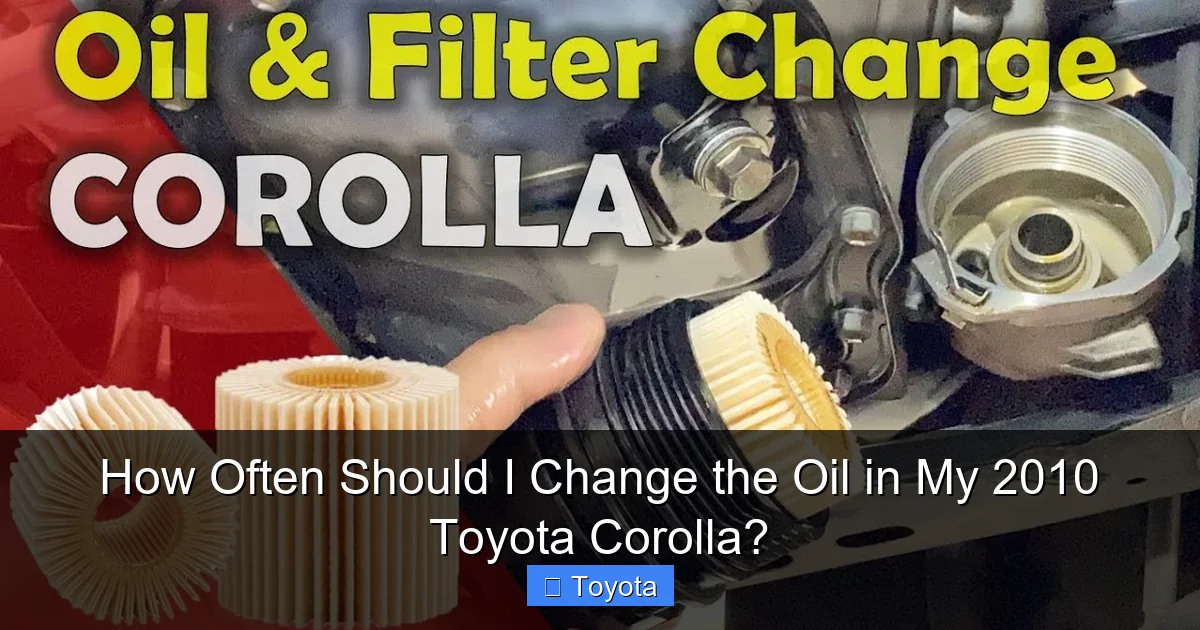
- 7 The Non-Negotiable Partner: Your Oil Filter
- 8 Do-It-Yourself vs. Professional Service: A Practical Guide
- 9 Conclusion: Your Simple Action Plan for a Healthy Corolla
- 10 Frequently Asked Questions


For a 2010 Toyota Corolla, the standard oil change interval is every 5,000 to 7,500 miles with conventional oil, or up to 10,000 miles with full synthetic oil. However, your personal driving conditions—like frequent short trips, extreme temperatures, or dusty environments—can shorten this timeline. Always consult your owner’s manual and monitor your oil life monitor or maintenance light for the most accurate guidance.
Key Takeaways
- Manufacturer Baseline: Toyota’s general recommendation for the 2010 Corolla is an oil change every 5,000 miles when using conventional oil or every 10,000 miles with full synthetic oil under “normal” driving conditions.
- Severe vs. Normal Driving: If your driving habits fall into the “severe service” category (lots of short trips, extreme temps, stop-and-go traffic), you should cut the recommended interval in half, changing oil every 3,000-5,000 miles regardless of oil type.
- Oil Type is Crucial: The single biggest factor you control is your choice of motor oil. Full synthetic oil provides superior protection and longer drain intervals, while conventional oil requires more frequent changes.
- Never Skip the Filter: The oil filter must be replaced at every oil change. A clogged filter restricts oil flow and renders even new oil ineffective. For more on this, see our guide on how often to change your oil filter.
- Heed the Maintenance Light: Your Corolla’s maintenance required light is not just a suggestion; it’s an algorithm-based reminder based on engine revolutions and operating conditions. Reset it after every oil change.
- Check Your Oil Monthly: Between changes, check the oil level and condition. Low oil or oil that looks dark, gritty, or smells burnt indicates it’s time for a change, regardless of mileage.
- Age Matters: Even with low mileage, oil degrades over time due to moisture and fuel dilution. If you drive less than 5,000 miles per year, change the oil at least once a year as a safety precaution.
📑 Table of Contents
- Why This Question is More Important Than You Think
- Decoding the Official Recommendations: What Does Toyota Say?
- The Real-World Factors That Shorten Your Interval
- Oil Type Showdown: Conventional vs. Synthetic
- The Non-Negotiable Partner: Your Oil Filter
- Do-It-Yourself vs. Professional Service: A Practical Guide
- Conclusion: Your Simple Action Plan for a Healthy Corolla
Why This Question is More Important Than You Think
Your 2010 Toyota Corolla is a legend of reliability. It’s the car that just… keeps going. But that legendary reputation doesn’t come from luck; it comes from consistent, proper maintenance. And at the heart of that maintenance is one simple, fluid service: the oil change. Engine oil is the lifeblood of your 1.8L 1ZZ-FE or 2.4L 2AZ-FE engine. It lubricates thousands of moving parts, reduces friction, cools hotspots, seals piston rings, and carries away harmful contaminants. Neglecting it is the single fastest way to turn your dependable Corolla into a costly paperweight.
The question “how often” isn’t just about memorizing a number. It’s about understanding the *why* behind the recommendation. The right interval balances protecting your engine from wear with not wasting money on unnecessary changes. For your specific 2010 model, the answer is a starting point, not a final rule. Let’s break it down.
Decoding the Official Recommendations: What Does Toyota Say?
Your first and most authoritative source is the 2010 Toyota Corolla owner’s manual. It provides two sets of guidelines: one for “Normal” driving and one for “Severe” driving. Understanding the difference is critical.

Visual guide about How Often Should I Change the Oil in My 2010 Toyota Corolla?
Image source: motorverso.com
The “Normal” Driving Schedule
If your driving primarily consists of highway miles, steady speeds, and mild temperatures, you fall into this category. For the 2010 Corolla, Toyota’s baseline recommendation under normal conditions is:
- Using conventional (non-synthetic) oil: Change every 5,000 miles or 6 months, whichever comes first.
- Using full synthetic oil: Change every 10,000 miles or 12 months, whichever comes first.
Many drivers mistakenly believe the old “3,000-mile rule” still applies. That was a safe, conservative estimate for the crude conventional oils and engine designs of decades past. Modern engines and oils are far more efficient. Sticking to a 3,000-mile interval with today’s synthetic oils is an expensive and environmentally wasteful overkill.
The “Severe Service” Reality Check
Here’s where most drivers get it wrong. Toyota defines “severe service” as:
- Driving primarily on trips of less than 5 miles in cold weather.
- Extensive idling and/or driving in stop-and-go traffic.
- Driving in extremely hot (above 90°F) or extremely cold (below 10°F) conditions.
- Dusty, sandy, or off-road conditions.
- Towing a trailer or carrying heavy loads.
If your Corolla sees more than a few of these conditions in a typical week, you are in the severe service category. For severe service, Toyota recommends cutting the normal interval in half. That means:
- Conventional oil: Every 3,000 miles or 4 months.
- Synthetic oil: Every 5,000 miles or 6 months.
Think about your daily life. Do you make multiple short trips to drop kids at school, run to the store, and pick up dry cleaning? Your engine rarely gets fully warmed up. Water vapor from combustion condenses in the oil, forming acids and sludge. This is the #1 cause of oil degradation in urban driving. You can learn more about general oil change principles from our comprehensive guide on how often to change oil in any car.
The Real-World Factors That Shorten Your Interval
Even if you think you’re a “normal” driver, several other variables can push you toward the more frequent end of the spectrum.
Visual guide about How Often Should I Change the Oil in My 2010 Toyota Corolla?
Image source: i.ytimg.com
1. Your Driving Style: The Unseen Wear
Aggressive acceleration, hard braking, and high-RPM driving generate immense heat and stress. Heat is oil’s enemy. It accelerates oxidation, causing the oil to thicken and lose its lubricating properties. If you often find yourself driving with a lead foot, consider adding 1,000 miles to your change frequency as a buffer.
2. Climate and Environment
Living in a desert with scorching summers? Your oil is working overtime to protect your engine from extreme heat. Living in a humid coastal area or the frozen north? Water contamination is a constant threat. Both scenarios warrant being more conservative with your drain interval. Also, driving on gravel roads or in areas with heavy construction means more dust and particulates trying to infiltrate your engine—a great argument for staying on schedule with your oil filter changes.
3. Vehicle Age and Mechanical Health
A 2010 Corolla in 2024 is a 14-year-old vehicle. As engines age, internal seals can become slightly less effective, and general tolerances may change. This can lead to minor oil consumption or increased blow-by (combustion gases leaking past the rings into the oil pan). An older engine might benefit from slightly more frequent oil changes and the use of high-mileage synthetic oil, which contains seal conditioners.
4. The Oil Life Monitor: Your Electronic Co-Pilot
Your 2010 Corolla is equipped with a Maintenance Required (Maint Req) light. This is not a simple mileage counter. It’s an “oil life monitor” that calculates oil degradation based on engine revolutions, engine temperature, and driving time. Short trips that don’t fully warm the engine will cause the system to calculate a faster depletion rate. When the light comes on, change your oil within one to two weeks or 500 miles, whichever comes first. Never ignore it. After the change, you must manually reset the system. The procedure is in your manual, typically involving turning the key to “On” and holding the trip meter reset button until the light blinks.
Oil Type Showdown: Conventional vs. Synthetic
This is the most significant lever you can pull to affect your drain interval. The difference isn’t just marketing; it’s chemistry.
Conventional Oil: The Budget Workhorse
Refined from crude oil, conventional oil has a base stock of hydrocarbon chains of varying lengths. It performs adequately for most daily driving but has a narrower temperature range and degrades faster under thermal stress. It’s perfectly fine for a well-maintained Corolla driven in normal conditions, but you must stick to the 5,000-mile rule. Using conventional oil in severe conditions is a false economy.
Full Synthetic Oil: The Modern Protector
Synthetic oil is engineered from the ground up. Its base stock consists of uniform, precisely designed molecules (like polyalphaolefins or esters). This gives it a huge advantage:
- Superior Temperature Stability: It flows easier in extreme cold (better startup protection) and resists breaking down in extreme heat.
- Greater Purity: It’s free of the impurities found in conventional oil, so it lasts longer and forms less sludge.
- Better Additive Package: It holds its detergents, dispersants, and anti-wear additives longer, keeping your engine cleaner.
For your 2010 Corolla, switching to a full synthetic oil that meets Toyota’s specification (usually API SN or SP and ILSAC GF-6) is one of the best upgrades you can make. It safely extends the drain interval to 7,500-10,000 miles under normal conditions and provides a much larger safety margin for severe driving. The small extra cost per quart is offset by longer intervals and, more importantly, superior engine protection. If you’re considering the switch, our article on how often to change synthetic oil provides deeper insights into its benefits and intervals.
What About Synthetic Blends?
Synthetic blend oils mix conventional and synthetic base stocks. They offer some benefits of synthetics—like better high-temperature protection—at a lower price point. They are a good middle ground for drivers in borderline severe conditions. For a 2010 Corolla, a synthetic blend would typically recommend a 6,000-7,500 mile interval. Always follow the specific interval on the oil bottle you choose.
The Non-Negotiable Partner: Your Oil Filter
Changing oil without changing the filter is like drinking a clean glass of water through a dirty straw. The filter’s job is to trap metal shavings, soot, and other abrasive contaminants that the oil picks up. A clogged filter restricts oil flow, causing dangerous pressure drops and leaving your engine unprotected.
- Always change the filter with the oil. There is no scenario where you skip it.
- Use a high-quality filter. Don’t cheap out. Brands like Toyota OEM (Original Equipment Manufacturer), WIX, Mobil 1, or Bosch are reliable. A poor-quality filter media can collapse or allow bypass, defeating the entire purpose of your fresh oil.
- Check the gasket. Before installing the new filter, dab a little fresh oil on the rubber seal. This ensures a good seal and prevents it from sticking to the engine block next time.
The filter’s replacement interval is tied directly to your oil change. If you’re extending your oil drain to 10,000 miles with synthetic, you must use a filter rated for that extended interval. Most standard filters are designed for 5,000 miles. Look for “extended life” or “synthetic” filters from reputable brands if you’re going long.
Do-It-Yourself vs. Professional Service: A Practical Guide
Changing your own oil is a satisfying, cost-saving task for many Corolla owners. But it’s important to do it right.
The DIY Checklist
- Gather Your Supplies: The correct amount and type of oil (typically 4.2 quarts with filter for the 1.8L, 4.5 quarts for the 2.4L—verify your exact capacity here), a high-quality oil filter, a new drain plug washer, a socket/wrench for the drain plug and filter, an oil drain pan, gloves, and safety glasses.
- Warm the Engine: Run the engine for 5-10 minutes. Warm oil flows faster and carries more sludge out with it.
- Safety First: Ensure the car is on level ground, securely supported by jack stands if you’re under it, and the parking brake is set.
- Drain & Replace: Remove the drain plug, let oil flow completely. Replace the washer and tighten the plug to spec (usually 25-30 ft-lbs—check manual). Remove the old filter (catch any spillage), pre-lube the new filter’s seal, and hand-tighten it plus 3/4 turn.
- Fill & Check: Pour in about 3/4 of the recommended oil, wait a minute, then check the dipstick. Add more until it’s at the full mark. Run the engine for 30 seconds, check for leaks, then re-check the dipstick and top off if needed.
- Dispose Properly: Pour the used oil into a sealed container and take it to any auto parts store or recycling center. Never dump it.
When to Call a Pro
Professional service is ideal if you lack the tools, space, or inclination. A reputable shop will also inspect your car for other issues (leaks, worn belts, low fluids) during the lift. Just be sure to specify the exact oil and filter you want, and ask to see the old filter and oil after the change.
Conclusion: Your Simple Action Plan for a Healthy Corolla
Your 2010 Toyota Corolla will reward you with years of trouble-free driving if you treat its engine with respect. The oil change interval is not a one-size-fits-all number. Start with Toyota’s official guidelines as your baseline:
- Normal Driving + Conventional Oil: 5,000 miles
- Normal Driving + Full Synthetic: 10,000 miles
- Severe Driving (Any Oil): 3,000-5,000 miles
Then, adjust based on your reality. If you live in a harsh climate, tow anything, or make predominantly short trips, lean toward the more conservative end. The single best upgrade you can make is to switch to a high-quality full synthetic oil. It offers unparalleled protection and the convenience of longer intervals. Combine this with a premium oil filter changed every time, and you’ve built a fortress around your Corolla’s heart.
Finally, become familiar with your maintenance light and your dipstick. These are your direct lines of communication with your car. Listen to them. A simple, timely oil change is the cheapest insurance policy you can buy for your engine. Don’t overthink it—just be consistent, be smart, and enjoy the peace of mind that comes with a well-maintained machine.
Frequently Asked Questions
What happens if I go over my oil change interval?
As oil degrades, it loses its ability to lubricate and clean. This leads to increased friction, higher engine temperatures, sludge buildup, and accelerated wear on bearings, pistons, and camshafts. In extreme cases, it can cause catastrophic engine failure. The cost of a new engine far exceeds the cost of regular oil changes.
Can I really go 10,000 miles on synthetic oil in my old Corolla?
Yes, if you drive in “normal” conditions and use a high-quality full synthetic oil rated for extended drain intervals. The oil itself will maintain its protective properties. However, the oil filter must also be rated for that mileage. For a 14-year-old car with potentially minor internal wear, many mechanics recommend a slightly more conservative 7,500-8,000 mile interval as a buffer.
How do I check my oil properly?
Park on level ground, engine off but slightly warm (after a short drive). Pull the dipstick, wipe it clean, reinsert it fully, then pull it out again. Check that the oil level is between the “Min” and “Max” marks. Also, look at the color and feel: clean oil is amber and slippery; used oil is darker and may feel slightly gritty. If the level is low or the oil looks dirty, it’s time for service.
My driving is mostly short trips. What interval should I use?
Short trips (under 5-10 miles) where the engine doesn’t fully warm up are considered “severe service.” The engine accumulates fuel dilution and moisture, which breaks down oil faster. You should follow the severe service schedule: every 3,000-5,000 miles with conventional oil, or 5,000 miles with full synthetic.
My maintenance light is on, but I only have 4,000 miles on my last change. What do I do?
The oil life monitor calculates based on your actual driving, not just miles. Short trips, cold starts, and extreme temperatures cause it to calculate faster degradation. When the light illuminates, you should change your oil within 1-2 weeks or 500 miles. Do not reset the light until the oil and filter are actually changed.
Is it okay to just add oil if the level is low between changes?
Adding oil to top off the level is a temporary fix for low oil, but it does not replace a full oil change. The old oil still contains contaminants, degraded additives, and acids. Topping off dilutes these problems but doesn’t solve them. You must still perform a full drain and fill at the correct interval to maintain engine health.