How Much Does It Cost to Replace a Clutch in a Toyota Hilux?

Contents
- 1 Key Takeaways
- 2 📑 Table of Contents
- 3 Understanding the Clutch System in Your Toyota Hilux
- 4 Recognizing the Signs of a Failing Clutch
- 5 The Complete Cost Breakdown for a Toyota Hilux Clutch Replacement
- 6 Key Factors That Influence Your Final Price
- 7 DIY vs. Professional Replacement: Which is Right for You?
- 8 Prolonging Your Clutch’s Lifespan: Maintenance and Driving Tips
- 9 Conclusion: Making an Informed Decision for Your Hilux
- 10 Frequently Asked Questions



Replacing the clutch in a Toyota Hilux typically costs between $800 and $2,500, depending on parts quality, labor rates, and your specific model. The clutch is a wear item that eventually needs replacement due to friction, with symptoms like slipping or difficulty shifting. While DIY can save money, professional installation is recommended due to the complexity. Factors like transmission type (manual vs. automatic) and vehicle age significantly impact cost. Regular maintenance and proper driving habits can extend clutch life. Always get multiple quotes and use quality parts to ensure longevity.
Key Takeaways
- Average Cost Range: Expect to pay $800–$2,500 for a complete clutch replacement in a Toyota Hilux, with most jobs falling between $1,200–$1,800.
- Parts vs. Labor: The clutch kit (pressure plate, disc, release bearing) costs $300–$800, while labor (2–6 hours) adds $400–$1,500 depending on region and shop.
- Key Cost Factors: Your Hilux’s model year, transmission type (manual/automatic), drivetrain (2WD/4WD), and parts quality (OEM vs. aftermarket) heavily influence the final price.
- Symptoms of Failure: Watch for clutch slippage (engine revs rise without acceleration), hard or noisy shifting, burning smells, or a high clutch pedal engagement point.
- Professional vs. DIY: Clutch replacement is labor-intensive and requires special tools; DIY is possible for experienced mechanics but risks errors that lead to premature failure.
- Maintenance Prolongs Life: Avoid riding the clutch, use proper shifting technique, and ensure timely transmission fluid changes (for manuals) to maximize clutch lifespan.
📑 Table of Contents
- Understanding the Clutch System in Your Toyota Hilux
- Recognizing the Signs of a Failing Clutch
- The Complete Cost Breakdown for a Toyota Hilux Clutch Replacement
- Key Factors That Influence Your Final Price
- DIY vs. Professional Replacement: Which is Right for You?
- Prolonging Your Clutch’s Lifespan: Maintenance and Driving Tips
- Conclusion: Making an Informed Decision for Your Hilux
Understanding the Clutch System in Your Toyota Hilux
Your Toyota Hilux is legendary for its toughness and reliability. But even the most rugged truck has wear points, and the clutch is a prime example. The clutch is the critical link between your engine and transmission. It allows you to engage and disengage power flow so you can shift gears and come to a stop without stalling. It’s a friction-based system, meaning it’s designed to wear out over time. Understanding how it works helps you recognize problems early and make informed repair decisions.
How the Clutch Works
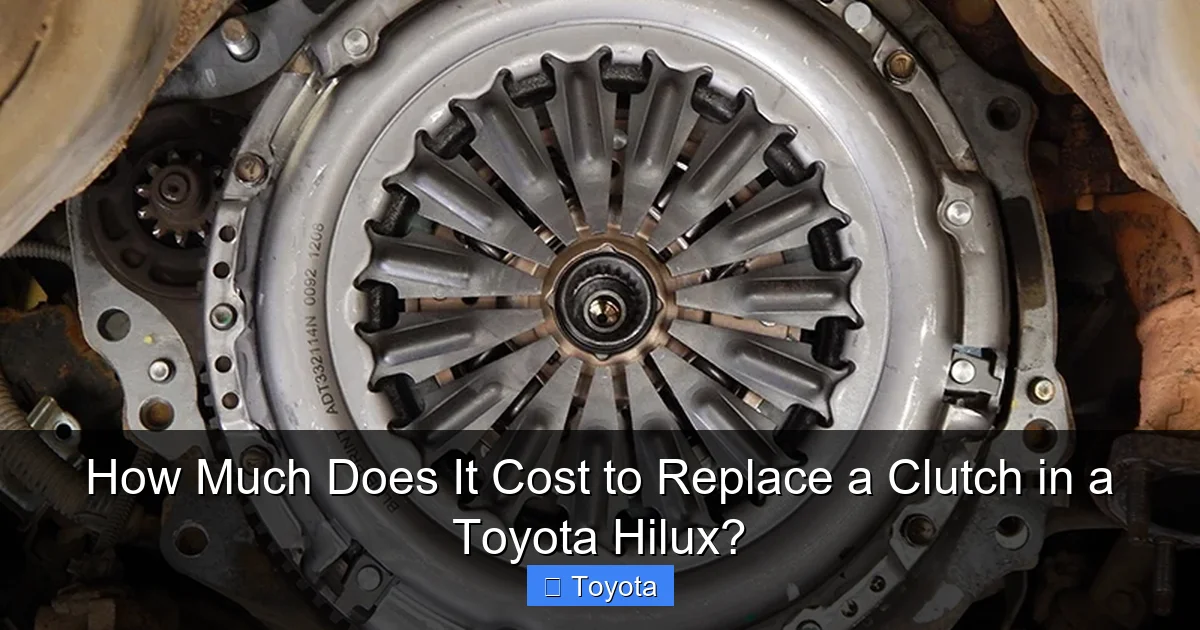
In a manual transmission Hilux, pressing the clutch pedal disengages the clutch. This separates the engine’s flywheel from the transmission’s input shaft. When you release the pedal, a spring-loaded pressure plate pushes the clutch disc against the flywheel, transferring engine power. The main components are:
- Clutch Disc: The friction material that wears down.
- Pressure Plate: Applies force to hold the disc against the flywheel.
- Release (or Throw-out) Bearing: Pushes against the pressure plate fingers to disengage the clutch.
- Flywheel: The heavy steel disc attached to the engine crankshaft. Sometimes it needs resurfacing or replacement.
Automatic transmission Hilux models use a torque converter instead of a traditional clutch, so this article focuses on manual variants, which are common in many Hilux markets, especially for work and off-road use.
Recognizing the Signs of a Failing Clutch
Catching clutch issues early can prevent a complete breakdown and potentially more expensive damage to the transmission. Here are the most common symptoms that indicate your Hilux’s clutch needs attention.
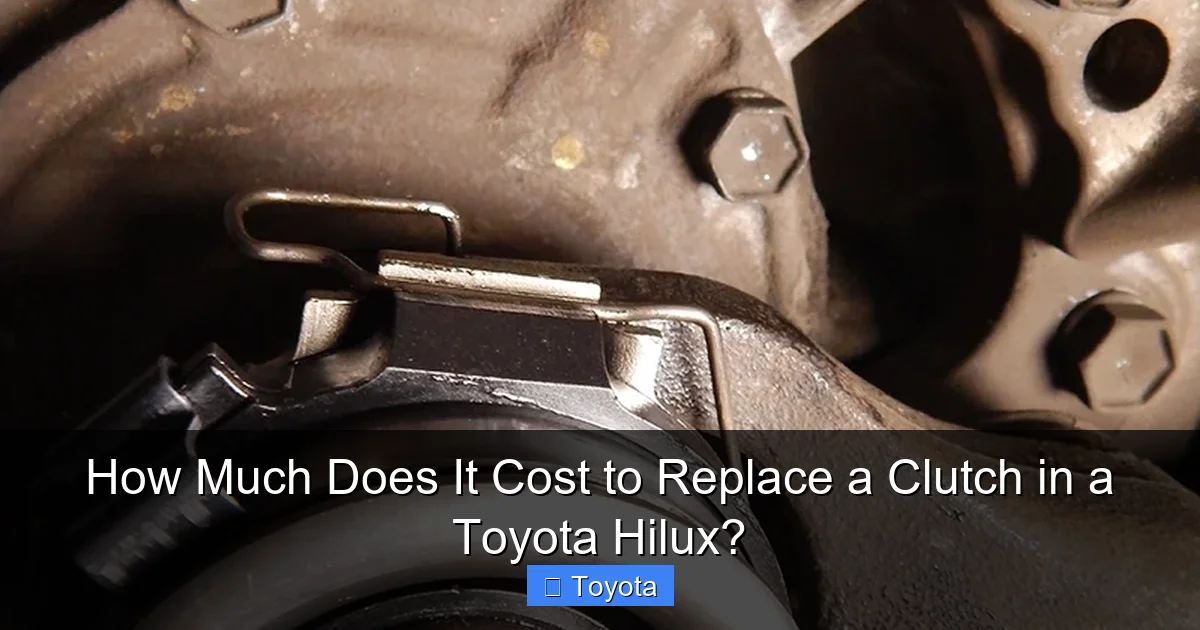
Visual guide about How Much Does It Cost to Replace a Clutch in a Toyota Hilux?
Image source: pmmonline.co.uk
Clutch Slippage
This is the classic sign. You press the accelerator, the engine RPMs surge, but the truck doesn’t accelerate proportionally. It feels like the clutch is “slipping” under load, especially when going uphill or towing. Slippage occurs because the clutch disc friction material is worn thin and can’t grip the flywheel properly.
Difficulty Shifting Gears
You might hear grinding or feel resistance when trying to shift, particularly into first or reverse from a stop. This can mean the clutch isn’t fully disengaging. Causes include a worn release bearing, a misadjusted clutch pedal, or hydraulic system issues (if your Hilux has a hydraulic clutch).
High Clutch Pedal Engagement Point
If you have to release the pedal very little before the clutch engages, it’s a sign the clutch disc is worn. The friction material has thinned, so the pressure plate makes contact sooner. Conversely, a pedal that feels spongy or goes to the floor could indicate air in a hydraulic line or a failing master/slave cylinder.
Burning Smell or Visible Smoke
A strong, acrid burning odor, especially after aggressive driving or hill starts, suggests excessive clutch friction and overheating. You might even see light smoke. This is a clear red flag.
Vibration or Chatter
When engaging the clutch from a stop, you feel a shudder or vibration through the pedal and cab. This can be caused by oil contamination on the clutch disc (from a rear main seal leak), a warped flywheel, or a failing clutch disc itself.
The Complete Cost Breakdown for a Toyota Hilux Clutch Replacement
Now, the big question: how much will this set you back? The total cost is a sum of parts and labor. Prices vary widely based on where you live, the shop’s rates, and your Hilux’s specifics. Let’s break it down.
Visual guide about How Much Does It Cost to Replace a Clutch in a Toyota Hilux?
Image source: ph-test-11.slatic.net
Parts Cost: The Clutch Kit and More
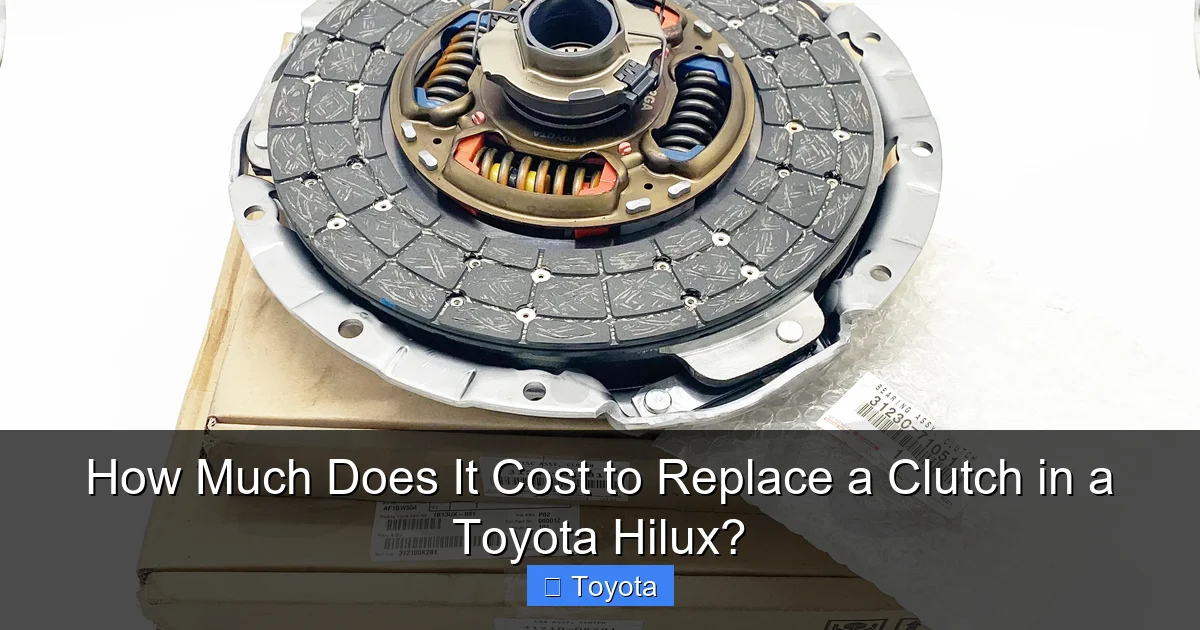
A complete clutch kit is the most cost-effective way to go, as it includes all wearable components. For a Toyota Hilux, a quality aftermarket kit (brands like Exedy, Aisin, or Sachs) typically costs $300 to $600. OEM (Original Equipment Manufacturer) parts from a Toyota dealer will be more expensive, often $500 to $900. The kit usually includes:
- Clutch disc
- Pressure plate
- Release bearing
Additional Parts That May Be Needed:
- Flywheel: If your flywheel is cracked, warped, or has hot spots, it must be replaced. A new flywheel adds $200 to $500. Resurfacing a reusable flywheel costs $50 to $150.
- Pilot Bearing/Bushing: This supports the transmission input shaft. It’s cheap ($10–$30) but should be replaced with the clutch to avoid future issues.
- Clutch Slave/Master Cylinder: If your Hilux has a hydraulic clutch and these components are leaking or failing, add $100–$300 for parts.
- Seals and Gaskets: Rear main seal (engine to transmission) and input shaft seal are often recommended at this labor-intensive job. Add $30–$100.
Total Parts Estimate: For a standard replacement with a quality aftermarket kit and a resurfaced flywheel, budget $400–$800. With OEM parts and a new flywheel, it could reach $1,000–$1,400.
Labor Cost: The Major Expense
Labor is where the real cost lies. Replacing a clutch requires removing the transmission, which is heavy and awkward. It’s a time-consuming job, typically taking 4 to 8 hours for an experienced mechanic. Labor rates vary dramatically:
- Independent Shop: $80–$120 per hour.
- Dealership: $120–$180+ per hour.
- Regional Differences: Urban areas and coastal states often have higher rates than rural Midwest or Southern regions.
Labor Estimate: At 6 hours and $100/hr, labor alone is $600. At a dealership at $150/hr for 7 hours, it’s $1,050. This is the biggest variable.
Total Cost Scenarios for Different Hilux Models
Your specific Hilux model and year matter. Here are realistic total cost ranges (parts + labor) based on common scenarios:
- Older Hilux (e.g., 2000–2005, 2WD, Basic Model): Aftermarket parts, independent shop. $800–$1,300.
- Mid-Generation Hilux (e.g., 2006–2015, 4WD, Common Trim): Mixed parts (OEM disc, aftermarket pressure plate), independent shop. $1,200–$1,800.
- Newer Hilux (e.g., 2016–Present, 4WD, High Trim): OEM kit, possible new flywheel, dealership or premium shop. $1,800–$2,500+.
Example: A 2012 Toyota Hilux 4×4 with a worn clutch and a slightly warped flywheel. An independent shop quotes $650 for a premium aftermarket kit (disc, plate, bearing) and $150 for flywheel resurfacing. Labor is 6.5 hours at $105/hr ($682.50). Total: $1,482.50.
Always get at least three detailed written quotes. Ensure they specify whether the flywheel will be resurfaced or replaced, and if all related seals are included.
Key Factors That Influence Your Final Price
Beyond parts and labor rates, several factors specific to your vehicle and location will sway the final number. Knowing these helps you interpret quotes intelligently.

Visual guide about How Much Does It Cost to Replace a Clutch in a Toyota Hilux?
Image source: parts.jarvistoyota.com.au
Model Year and Transmission Type
Later model Hiluxes, especially those with advanced emissions systems or complex cab designs, can take longer to repair. A simple regular cab is faster than a double cab. The transmission type is crucial: a standard 5-speed manual is generally simpler than a heavy-duty 6-speed found in some turbodiesel models. Automatic transmission Hiluxes don’t have a clutch in the same way, but if you’re reading this, you likely have a manual. However, some automatics have a “clutch pack” inside the transmission for torque converter lockup, which is a much more involved and expensive transmission rebuild, not a simple clutch job.
Drivetrain: 2WD vs. 4WD
Four-wheel-drive Hiluxes add complexity. The transfer case must be removed along with the transmission, increasing labor time by 1–2 hours. Expect to pay $200–$400 more for a 4WD model compared to a 2WD with otherwise identical specs.
Your Geographic Location
As mentioned, labor rates are tied to local economics. A clutch job in New York City or San Francisco will cost significantly more than in Omaha or Tulsa. Additionally, parts availability can affect price; remote areas might have fewer suppliers and higher shipping costs for parts.
Parts Quality: OEM vs. Aftermarket
OEM parts are guaranteed to meet Toyota’s original specifications and often come with a warranty. They’re typically more expensive. High-quality aftermarket brands (like the ones mentioned) are engineered to match or exceed OEM performance and are a popular, cost-effective choice. Extremely cheap, no-name kits are risky—they may use inferior friction material and fail prematurely. Always choose a reputable brand.
Shop Type and Overhead
Dealerships have higher overhead but offer factory-trained technicians and genuine parts, often with better warranties on the work. Independent shops are usually more affordable and can be just as skilled, especially those specializing in imports or trucks. Mobile mechanics might offer lower rates but ensure they have the specific experience with Hilux transmissions and the proper equipment (like a transmission jack).
Additional Repairs Needed
A good mechanic will inspect related components once the transmission is out. If the rear main seal (where the engine meets the transmission) is leaking, it’s smart to replace it now, as the labor is already being done. This adds parts and a small amount of labor. Similarly, a cracked or severely scored flywheel must be replaced. These “while you’re in there” items can add $100–$600 to the bill but save you from another major repair soon.
DIY vs. Professional Replacement: Which is Right for You?
Given the high labor cost, many handy truck owners consider a DIY clutch replacement to save money. But is it a wise move for your Hilux?
The Case for Professional Installation
Specialized Tools: You need a transmission jack, engine support bar, clutch alignment tool, and various socket extensions. These tools can cost hundreds to buy or rent, and improper use can damage components or cause injury.
Experience Matters: Proper clutch installation requires precise alignment of the disc. An misaligned disc causes vibration and premature failure. Removing and reinstalling a heavy transmission safely requires skill and a helper. One slip can crack the transmission case or damage the bellhousing.
Warranty and Peace of Mind: Reputable shops offer a warranty on parts and labor (often 12 months/12,000 miles). If you DIY and something goes wrong, you’re on the hook for the redo. For most Hilux owners, professional installation is the safest and most economical long-term choice.
When DIY Might Be Feasible
Consider DIY only if:
- You have significant mechanical experience, specifically with transmission removal/installation.
- You have access to all necessary tools and a safe, level workspace.
- Your Hilux is older and simpler (e.g., pre-2005, regular cab, 2WD).
- You’re prepared for the job to potentially take a full weekend or longer, with possible setbacks.
Estimated DIY Cost: You’d only pay for parts ($400–$1,200) and possibly tool rental ($100–$300). The “savings” vs. a $1,500 professional job are clear, but the risk of a botched job that destroys your transmission is real. If you’re unsure, this is not the project to learn on.
Finding a Trustworthy Mechanic
Whether you choose a dealership or independent shop, do your homework. Look for shops with excellent reviews specifically mentioning clutch or transmission work on trucks or Toyotas. Ask if they have experience with Hiluxes. A good shop will provide a clear estimate, explain what’s included, and stand behind their work. Don’t be swayed solely by the lowest quote—value and reputation matter more for a job this critical.
Prolonging Your Clutch’s Lifespan: Maintenance and Driving Tips
A clutch replacement is an expense you’d like to delay as long as possible. While all clutches eventually wear out, you can significantly extend its life with proper care and driving habits. Think of it as an investment in your Hilux’s longevity.
Adjust Your Driving Technique
This is the most impactful factor. Avoid “riding the clutch”—keeping your foot on the pedal while driving, which causes constant partial engagement and friction. Use the clutch only when necessary: to start moving, to shift, and to stop. When starting from a stop, engage the clutch smoothly but promptly. Don’t rev the engine high and slip the clutch excessively to get moving; this burns up friction material quickly. For hill starts, use the handbrake (parking brake) technique to reduce clutch load.
Ensure Proper Clutch Pedal Adjustment
Over time, mechanical linkages or hydraulic systems can fall out of adjustment. A clutch that doesn’t fully disengage will grind gears and wear the disc unevenly. Have your mechanic check the pedal free play during routine service. There should be a small amount of free movement before the clutch begins to disengage.
Address Related Issues Promptly
An oil leak from the rear main seal or transmission input shaft seal will contaminate the clutch disc with oil, causing it to slip and chatter catastrophically. If you notice oil spots under your truck or a burning oil smell, get it diagnosed immediately. Similarly, a failing release bearing will make noise (a high-pitched squeal or rumble) when the clutch is pressed. Replace it with the clutch to avoid being stranded.
Follow Transmission Service Intervals
For manual transmissions, the lubricant (gear oil) degrades over time. Old, contaminated oil can cause gear wear and improper operation, indirectly affecting clutch feel. Follow Toyota’s recommended service schedule for your Hilux’s transmission fluid. Regular maintenance like oil changes, as covered in our general guide, keeps all your vehicle’s systems in harmony and can prevent secondary issues that strain the clutch. How Much Does It Cost To Change Oil In A Car.
Respect the Truck’s Purpose
The Hilux is a workhorse. If you’re regularly towing near maximum capacity or doing severe off-road driving with constant low-speed, high-torque maneuvers, your clutch will wear faster. This is normal operational wear. In such cases, budgeting for a heavier-duty clutch kit (with more robust friction material) might be a wise investment when replacement time comes.
Conclusion: Making an Informed Decision for Your Hilux
A clutch replacement on your Toyota Hilux is a significant but manageable repair. The cost, typically between $800 and $2,500, is primarily driven by labor and parts quality. By understanding the breakdown—what you’re paying for and why—you can approach the repair with confidence. Prioritize a reputable mechanic, use quality parts (OEM or a trusted aftermarket brand), and address any ancillary issues like flywheel condition or seals while the transmission is out.
Remember, the Hilux’s reputation for durability is built on proper maintenance. Extend your clutch’s life with smooth driving habits and timely servicing. If you’re facing this repair, get multiple detailed quotes, ask about warranties, and don’t be afraid to ask questions. Your trusted truck deserves a proper fix, and with the right approach, your Hilux will be back to its reliable self for many more miles to come.
Frequently Asked Questions
How much does a clutch replacement cost for a Toyota Hilux?
On average, a complete clutch replacement for a Toyota Hilux costs between $800 and $2,500. The final price depends on your truck’s model year, whether it’s 2WD or 4WD, your location’s labor rates, and the quality of parts used (OEM vs. aftermarket).
What are the most common signs that my Hilux clutch needs replacing?
The primary signs are clutch slippage (engine revs rise without acceleration), difficulty shifting gears (especially grinding into first/reverse), a burning smell, a high clutch pedal engagement point, or noticeable vibration when engaging the clutch from a stop.
How long should a clutch last in a Toyota Hilux?
There’s no set mileage, as lifespan depends heavily on driving style and conditions. With gentle driving and proper technique, a clutch can last 100,000 miles or more. Under severe use like heavy towing or aggressive off-roading, it may need replacement as early as 60,000 miles.
Can I replace the clutch on my Hilux myself to save money?
While possible for highly experienced DIY mechanics with the right tools (transmission jack, alignment tool), it’s a complex, labor-intensive job. For most owners, professional installation is strongly recommended to avoid misalignment, damage to the transmission, or safety risks. The potential cost of a mistake far outweighs labor savings.
Are there different types of clutch kits for the Hilux, and does it matter which I choose?
Yes. Kits vary by friction material formulation. Standard kits are for everyday use. Heavy-duty or “performance” kits use more robust materials for better durability under high stress (e.g., towing). For most Hilux owners, a high-quality standard kit from a reputable brand (like Exedy or Aisin) is sufficient. Choose based on your typical driving needs.
Does clutch replacement come with a warranty, and what should I expect?
Reputable shops and dealerships typically offer a warranty on both parts and labor, often 12 months or 12,000 miles. Always ask for the warranty details in writing. A good warranty should cover defects in materials and workmanship. Keep your receipt and the shop’s work order as proof of service.