How Much Does a Nissan Titan Weigh?

Contents
- 1 Key Takeaways
- 2 📑 Table of Contents
- 3 How Much Does a Nissan Titan Weigh?
- 4 Understanding Curb Weight vs. Gross Weight
- 5 Nissan Titan Weight by Model Year and Generation
- 6 How Drivetrain and Engine Affect Weight
- 7 Payload and Towing Capacity: Why Weight Matters
- 8 How Weight Affects Performance and Fuel Economy
- 9 Tips for Managing Your Titan’s Weight
- 10 Conclusion
- 11 Frequently Asked Questions

Car Hydraulic Jack

Car Interior LED Light

Car Cup Holder Expander

Windshield Washer Fluid
The Nissan Titan weighs between 5,100 and 6,300 pounds depending on the model year, cab configuration, bed length, and drivetrain. Knowing the exact weight helps with towing, fuel efficiency, and overall performance planning.
Key Takeaways
- Weight varies by model: The Nissan Titan’s weight depends on cab style (King Cab vs. Crew Cab), bed length, engine type, and 4WD vs. 2WD.
- Curb weight ranges from 5,100 to 6,300 lbs: Earlier models (2004–2015) are lighter, while newer models (2017–2024) are heavier due to added features and safety tech.
- Towing capacity is affected by weight: Heavier trucks may have slightly reduced towing ability if payload is maxed out, despite high factory ratings.
- Payload capacity matters: The Titan offers up to 1,610 lbs of payload, which includes passengers, cargo, and accessories.
- Fuel efficiency drops with weight: Heavier Titans consume more fuel, especially in city driving or when towing.
- GVWR is critical for safety: Gross Vehicle Weight Rating (GVWR) ranges from 7,000 to 7,800 lbs—never exceed this limit.
- Weight impacts handling and braking: A heavier truck requires longer stopping distances and may feel less agile in tight spaces.
📑 Table of Contents
- How Much Does a Nissan Titan Weigh?
- Understanding Curb Weight vs. Gross Weight
- Nissan Titan Weight by Model Year and Generation
- How Drivetrain and Engine Affect Weight
- Payload and Towing Capacity: Why Weight Matters
- How Weight Affects Performance and Fuel Economy
- Tips for Managing Your Titan’s Weight
- Conclusion
How Much Does a Nissan Titan Weigh?
If you’re thinking about buying a Nissan Titan—or you already own one—you’ve probably asked yourself: *How much does a Nissan Titan weigh?* It’s a fair question. Weight affects everything from fuel economy and towing power to how the truck handles on the road. Whether you’re hauling equipment, towing a camper, or just commuting to work, knowing your truck’s weight gives you a clearer picture of its capabilities and limitations.
The Nissan Titan isn’t a one-size-fits-all kind of truck. Over the years, it’s come in different shapes and sizes—King Cab or Crew Cab, short bed or long bed, V8 engine or turbo-diesel (in some markets), and two-wheel drive (2WD) or four-wheel drive (4WD). Each of these choices changes the truck’s weight. So, instead of giving you a single number, we’ll break it down by model year, configuration, and key specs so you can find the exact weight for your specific Titan.
In this guide, we’ll explore the average weight of the Nissan Titan across its various generations, explain what factors influence that weight, and show you why it matters for real-world use. We’ll also cover payload, towing capacity, and how weight impacts performance. By the end, you’ll know not just *how much* your Titan weighs—but *why* that number is important.
Understanding Curb Weight vs. Gross Weight

Visual guide about How Much Does a Nissan Titan Weigh?
Image source: motorbiscuit.com
Before we dive into the numbers, let’s clarify two key terms: **curb weight** and **gross vehicle weight** (GVW). These are often confused, but they mean very different things.
What Is Curb Weight?
Curb weight is the weight of the truck when it’s sitting still, with a full tank of gas, all fluids topped off, and standard equipment—but with no passengers, cargo, or trailers. Think of it as the “ready-to-drive” weight. This is the number most people refer to when asking, “How much does a Nissan Titan weigh?”
For example, a 2023 Nissan Titan Crew Cab SV 4WD has a curb weight of about 5,850 pounds. That’s the truck’s baseline weight before you add anything else.
What Is Gross Vehicle Weight (GVW)?
Gross Vehicle Weight (GVW) is the total weight of the truck *including* passengers, cargo, fuel, accessories, and anything else loaded onto it. This number must never exceed the **Gross Vehicle Weight Rating (GVWR)**, which is set by the manufacturer for safety and legal reasons.
The GVWR for most Nissan Titans ranges from 7,000 to 7,800 pounds, depending on the model and configuration. If your GVW exceeds the GVWR, you risk damaging the suspension, brakes, or frame—and you could fail a safety inspection or face legal penalties.
Why the Difference Matters
Let’s say your Titan has a curb weight of 5,800 lbs and a GVWR of 7,200 lbs. That means you have up to 1,400 pounds of payload capacity—space for people, tools, gear, or whatever you’re hauling. But if you load it with 1,500 pounds of cargo, you’re over the limit. That extra weight can strain the engine, reduce braking efficiency, and increase wear on tires and suspension.
Knowing both curb weight and GVWR helps you stay safe and legal. It also helps you plan for towing. For instance, if you’re towing a 9,000-pound trailer, your truck’s weight plus the trailer’s tongue weight (usually 10–15% of trailer weight) counts toward your payload. So, a 1,350-pound tongue weight plus two passengers and gear could easily push you over the payload limit—even if the truck’s towing capacity is higher.
Nissan Titan Weight by Model Year and Generation
Visual guide about How Much Does a Nissan Titan Weigh?
Image source: motorbiscuit.com
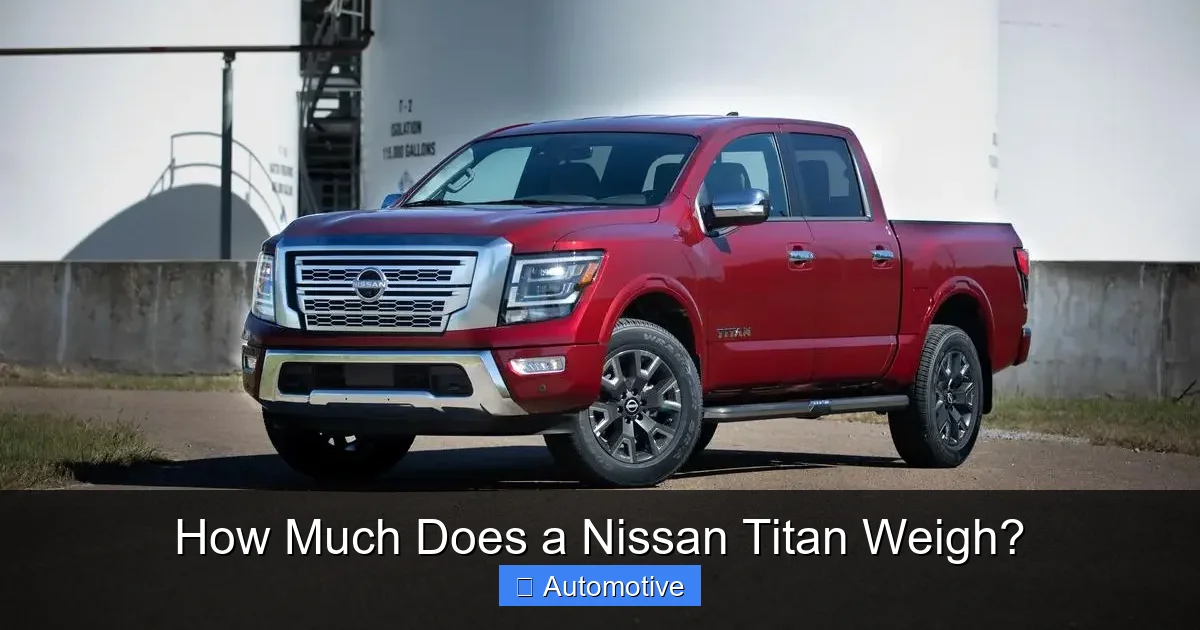
The Nissan Titan has gone through two major generations since its debut in 2004. Each generation brought changes in design, technology, and weight. Let’s break it down by era.
First Generation (2004–2015)
The original Nissan Titan was introduced as a full-size pickup to compete with the Ford F-150, Chevrolet Silverado, and Ram 1500. It featured a 5.6-liter V8 engine and was available in King Cab and Crew Cab styles.
– **Curb weight range:** 5,100 to 5,600 lbs
– **Typical configurations:**
– 2004–2006 King Cab 2WD: ~5,100 lbs
– 2010 Crew Cab 4WD: ~5,500 lbs
– 2015 PRO-4X (off-road trim): ~5,600 lbs
These trucks were relatively lightweight compared to modern full-size pickups. The lower weight helped with fuel economy and made them feel more nimble on the road. However, they lacked some of the advanced safety and comfort features found in newer models.
Second Generation (2017–2024)
After a brief hiatus in 2016, Nissan relaunched the Titan in 2017 with a completely redesigned body, updated interior, and improved towing capacity. This generation is heavier due to added steel in the frame, larger brakes, and more standard tech.
– **Curb weight range:** 5,500 to 6,300 lbs
– **Typical configurations:**
– 2017 Crew Cab S 2WD: ~5,500 lbs
– 2020 Crew Cab SL 4WD: ~6,000 lbs
– 2023 Titan XD (heavy-duty version): ~6,300 lbs
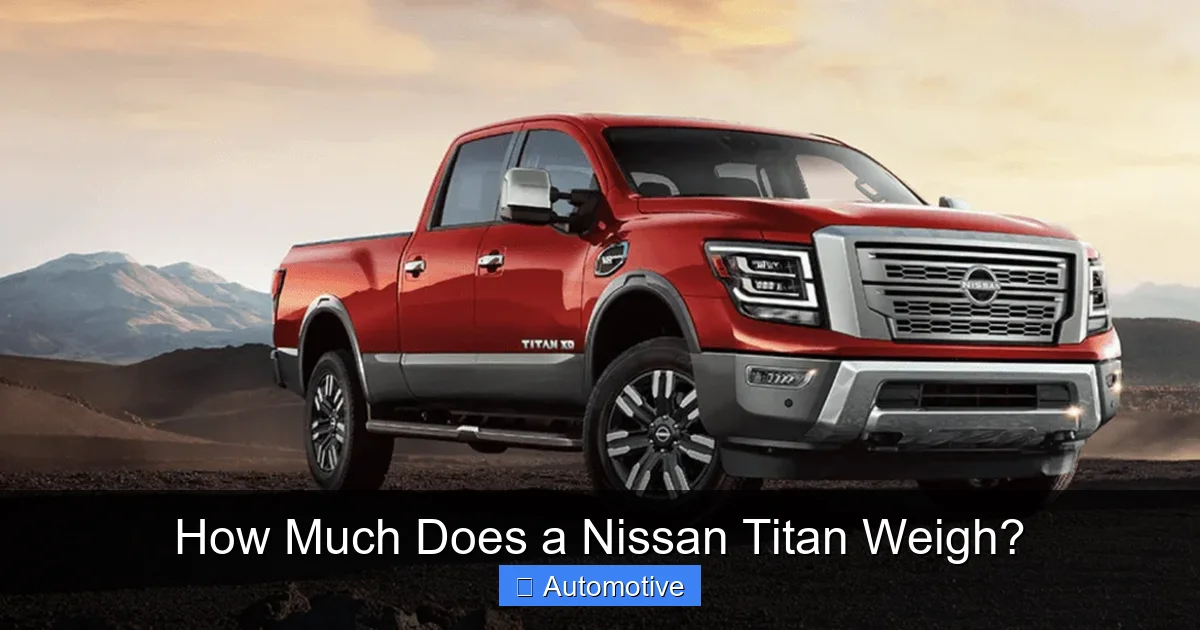
The Titan XD, introduced in 2016 and continued into the second generation, is the heaviest variant. It features a reinforced frame, higher GVWR (up to 7,800 lbs), and is designed for heavier towing and hauling. It’s essentially a half-ton truck with three-quarter-ton capabilities.
Weight Differences by Cab and Bed
Even within the same model year, the Titan’s weight changes based on body style:
– **King Cab (extended cab):** Lighter due to shorter rear passenger area. Typically 100–200 lbs lighter than Crew Cab.
– **Crew Cab (four full doors):** Heavier because of the larger cabin and rear seats. Adds structural weight but improves passenger comfort.
– **Short bed (5.5 ft):** Slightly lighter than long bed (6.5 ft or 8 ft), but the difference is minimal—usually under 50 lbs.
– **Long bed:** Adds a bit of weight due to longer frame and bed materials.
For example, a 2022 Titan King Cab S 2WD with a short bed might weigh 5,550 lbs, while a Crew Cab SL 4WD with a long bed could tip the scales at 6,100 lbs.
How Drivetrain and Engine Affect Weight
Visual guide about How Much Does a Nissan Titan Weigh?
Image source: motorbiscuit.com
The type of engine and drivetrain you choose also impacts the Nissan Titan’s weight. Let’s look at how these components add pounds.
2WD vs. 4WD
Four-wheel drive systems are heavier than two-wheel drive because they include additional components like a transfer case, front differential, and extra driveshafts.
– **2WD models:** Typically 150–250 lbs lighter than 4WD equivalents.
– **4WD models:** Add weight but improve traction and off-road capability.
For instance, a 2021 Titan Crew Cab SV 2WD weighs about 5,700 lbs, while the 4WD version weighs around 5,950 lbs—a 250-pound difference.
Engine Options
All second-generation Titans (2017–2024) use the same 5.6-liter V8 gasoline engine, producing 400 horsepower and 413 lb-ft of torque. However, the Titan XD offered a 5.0-liter Cummins turbo-diesel V8 in 2016–2019, which added significant weight.
– **Gas V8 (5.6L):** Standard on all Titans. Relatively lightweight for a V8.
– **Diesel V8 (5.0L Cummins):** Added ~300–400 lbs due to the heavier engine block, turbocharger, and reinforced components.
The diesel engine improved towing capacity (up to 12,300 lbs) but reduced fuel efficiency in city driving and increased maintenance costs. It was discontinued after 2019 due to low demand.
Transmission and Axle Upgrades
Higher trim levels often come with upgraded transmissions (like the 9-speed automatic introduced in 2020) and heavier-duty axles. These components add a small amount of weight but improve durability and performance.
For example, the Titan PRO-4X off-road package includes skid plates, all-terrain tires, and a locking rear differential—each adding 20–50 lbs. While not huge, these additions can push a truck from 5,800 to 6,000+ lbs.
Payload and Towing Capacity: Why Weight Matters
Knowing how much your Titan weighs isn’t just about curiosity—it directly affects how you can use the truck. Two of the most important metrics are **payload capacity** and **towing capacity**.
Payload Capacity
Payload is the total weight your truck can carry, including passengers, cargo, and accessories. It’s calculated by subtracting the curb weight from the GVWR.
– **Typical payload range:** 1,200 to 1,610 lbs
– **Example:** A 2023 Titan with a curb weight of 5,850 lbs and GVWR of 7,460 lbs has a payload capacity of 1,610 lbs.
That means you can safely carry two adults (300 lbs), a toolbox (100 lbs), and 1,210 lbs of cargo—like construction materials or camping gear.
But remember: **towing also uses payload.** When you hook up a trailer, the tongue weight (the downward force on the hitch) counts toward your payload. A 9,000-pound trailer might have a 900-pound tongue weight. Add two passengers (300 lbs) and gear (200 lbs), and you’ve used 1,400 lbs of payload—leaving only 210 lbs for additional cargo.
Towing Capacity
The Nissan Titan’s towing capacity ranges from 9,200 to 11,040 lbs, depending on configuration.
– **Standard Titan (Crew Cab 2WD):** Up to 9,200 lbs
– **Titan XD (4WD, diesel):** Up to 12,300 lbs (discontinued)
– **Titan with Max Tow Package:** Up to 11,040 lbs
However, **towing capacity assumes optimal conditions**—lightly loaded truck, flat terrain, and proper hitch setup. If your truck is already near its payload limit, your real-world towing ability may be lower.
For example, if your Titan has a 1,610-lb payload and you’re carrying 1,200 lbs of people and gear, you only have 410 lbs left for tongue weight. That limits you to a trailer with a 4,100-pound tongue weight—meaning a max trailer weight of about 41,000 lbs (at 10% tongue weight). But since the Titan’s max towing is only 11,040 lbs, you’re still safe—but you can’t max out both payload and towing at the same time.
Real-World Example: Towing a Travel Trailer
Let’s say you’re planning a family camping trip with a 7,000-pound travel trailer. The trailer has a 700-pound tongue weight.
– Your Titan: 2022 Crew Cab SL 4WD
– Curb weight: 5,950 lbs
– GVWR: 7,460 lbs
– Payload capacity: 1,510 lbs
Load:
– Two adults: 300 lbs
– Kids and pets: 200 lbs
– Gear (cooler, chairs, etc.): 300 lbs
– Tongue weight: 700 lbs
– **Total payload used:** 1,500 lbs
You’re just under the limit—safe to tow. But if you add a rooftop cargo box (100 lbs), you’re over. That extra weight could cause sway, reduce braking power, or damage the suspension.
This is why knowing your truck’s weight and payload is essential. It’s not just about how much you *can* tow—it’s about how much you *should* tow safely.
How Weight Affects Performance and Fuel Economy
A heavier truck doesn’t just carry more—it also drives differently. Weight impacts acceleration, braking, handling, and fuel efficiency.
Acceleration and Power
The Nissan Titan’s 5.6-liter V8 is powerful, but it has to work harder to move a heavier truck. A 6,300-pound Titan XD will feel slower off the line than a 5,500-pound King Cab 2WD, even with the same engine.
– **0–60 mph time:** Approximately 6.5 to 7.5 seconds, depending on weight and drivetrain.
– **Heavier trucks:** Take longer to accelerate, especially when loaded.
This isn’t a dealbreaker, but it’s something to consider if you frequently merge onto highways or drive in hilly areas.
Braking Distance
More weight means more momentum. Heavier trucks take longer to stop, especially when loaded.
– **Average braking distance (60–0 mph):** 140 to 160 feet
– **Loaded or heavy truck:** Can exceed 170 feet
This is why Nissan equips the Titan with large disc brakes and electronic brakeforce distribution (EBD). But even with good brakes, you should always allow extra stopping distance—especially in rain or snow.
Fuel Economy
Weight is one of the biggest factors in fuel consumption. The heavier the truck, the more fuel it burns.
– **EPA estimates (2023 Titan Crew Cab 4WD):**
– City: 15 mpg
– Highway: 21 mpg
– Combined: 17 mpg
Compare that to a lighter 2005 Titan King Cab 2WD, which might get 16 mpg city and 22 mpg highway. The newer truck is heavier and less efficient—even with modern engine tech.
Real-world fuel economy can be even lower, especially when towing or driving in stop-and-go traffic. For every 100 pounds of extra weight, fuel economy can drop by 1–2%.
Handling and Ride Quality
Heavier trucks tend to feel more stable on the highway but less agile in city driving. The Titan’s suspension is tuned for a balance of comfort and capability, but a fully loaded truck will ride lower and feel stiffer.
Off-road, the extra weight can be a benefit—more traction and momentum over obstacles. But it also increases the risk of getting stuck in soft terrain like mud or sand.
Tips for Managing Your Titan’s Weight
Now that you know how much your Titan weighs and why it matters, here are some practical tips to help you manage weight safely and effectively.
1. Weigh Your Truck Regularly
Don’t guess—know your actual weight. Visit a truck scale (often at truck stops or recycling centers) to get an accurate reading. Weigh the truck with your typical load (passengers, gear, fuel) to see if you’re near the GVWR.
2. Distribute Weight Evenly
When loading cargo, place heavier items low and centered over the rear axle. Avoid stacking weight high or too far forward/backward, which can affect handling and increase sway.
3. Use a Weight Distribution Hitch
When towing, a weight distribution hitch helps spread the tongue weight across all axles, improving stability and reducing strain on the rear suspension.
4. Check Tire Pressure
Underinflated tires increase rolling resistance and wear, especially when carrying heavy loads. Always inflate tires to the recommended PSI (found on the driver’s door jamb).
5. Remove Unnecessary Items
That old toolbox, spare parts, or camping gear you never use? It all adds up. Regularly clean out your truck bed and cab to reduce unnecessary weight.
6. Consider Aftermarket Upgrades Wisely
Adding a bed liner, tonneau cover, or roof rack looks great—but each can add 50–100 lbs. If you’re already near your payload limit, think twice before adding more.
Conclusion
So, how much does a Nissan Titan weigh? The answer isn’t simple—it depends on the model year, cab style, bed length, drivetrain, and equipment. But on average, you’re looking at **5,100 to 6,300 pounds** for curb weight, with GVWRs ranging from 7,000 to 7,800 pounds.
Understanding your Titan’s weight helps you make smarter decisions about towing, hauling, and daily driving. It affects fuel economy, braking, handling, and safety. Whether you’re a weekend warrior hauling gear or a full-time contractor towing heavy loads, knowing your truck’s limits keeps you—and others—safe on the road.
The Nissan Titan is a capable, powerful full-size pickup with a lot to offer. But like any truck, it performs best when you respect its weight and payload limits. So next time you load up for a trip or hook up a trailer, take a moment to do the math. Your Titan—and your peace of mind—will thank you.
Frequently Asked Questions
What is the average weight of a Nissan Titan?
The average curb weight of a Nissan Titan ranges from 5,100 to 6,300 pounds, depending on the model year, cab configuration, and drivetrain. Newer models tend to be heavier due to added safety and tech features.
How much does a 2023 Nissan Titan weigh?
A 2023 Nissan Titan Crew Cab SL 4WD has a curb weight of approximately 6,000 pounds. Lighter configurations like the King Cab 2WD may weigh around 5,550 pounds.
Does 4WD make the Titan heavier?
Yes, 4WD models are typically 150 to 250 pounds heavier than 2WD versions due to the added components like the transfer case and front differential.
What is the GVWR of a Nissan Titan?
The Gross Vehicle Weight Rating (GVWR) for most Nissan Titans ranges from 7,000 to 7,800 pounds, with the Titan XD capable of handling up to 7,800 pounds.
Can I tow with a fully loaded Titan?
Yes, but you must account for payload. Towing uses tongue weight, which counts toward your payload limit. Always ensure your total weight (truck + passengers + cargo + trailer) stays under the GVWR.
How does weight affect the Titan’s fuel economy?
Heavier Titans consume more fuel. For every 100 pounds of added weight, fuel economy can drop by 1–2%. A fully loaded or towing Titan may see significantly lower mpg than EPA estimates.