
How Much Does a Jeep Rubicon Weigh

Contents
- 1 Key Takeaways
- 2 📑 Table of Contents
- 3 How Much Does a Jeep Rubicon Weigh? A Complete Guide
- 4 Understanding Curb Weight: What It Means and Why It Matters
- 5 Jeep Rubicon Weight by Model Year and Configuration
- 6 Why Weight Matters: Performance, Fuel Economy, and Off-Road Capability
- 7 The Impact of Aftermarket Modifications on Weight
- 8 How the Rubicon Compares to Other Off-Road Vehicles
- 9 Tips for Managing Your Rubicon’s Weight
- 10 Conclusion: Weight Is More Than a Number
- 11 Frequently Asked Questions


The Jeep Rubicon’s weight varies by model year, engine, and configuration, typically ranging from 4,000 to 5,300 pounds. Understanding this weight helps drivers assess performance, fuel efficiency, and off-road capability. Whether you’re towing, off-roading, or commuting, knowing your Rubicon’s weight is essential for safety and performance.
Key Takeaways
- Weight Range: The Jeep Rubicon weighs between 4,000 and 5,300 pounds depending on the model, engine, and options.
- Model Year Impact: Newer Rubicons (2020–2024) tend to be heavier due to added tech, safety features, and larger components.
- Engine Choice Matters: V6 and turbocharged 4-cylinder engines affect weight, with the 3.6L Pentastar V6 adding bulk compared to the 2.0L turbo.
- Off-Road vs. On-Road Trade-Offs: Heavier builds improve durability but reduce fuel economy and agility on pavement.
- Payload and Towing Capacity: Despite its weight, the Rubicon can tow up to 3,500 lbs and carry a payload of around 1,000–1,200 lbs.
- Weight Distribution: The Rubicon’s balanced weight distribution enhances off-road traction and stability on uneven terrain.
- Customization Increases Weight: Aftermarket parts like bumpers, winches, and armor can add 300–800+ pounds, affecting performance and handling.
📑 Table of Contents
- How Much Does a Jeep Rubicon Weigh? A Complete Guide
- Understanding Curb Weight: What It Means and Why It Matters
- Jeep Rubicon Weight by Model Year and Configuration
- Why Weight Matters: Performance, Fuel Economy, and Off-Road Capability
- The Impact of Aftermarket Modifications on Weight
- How the Rubicon Compares to Other Off-Road Vehicles
- Tips for Managing Your Rubicon’s Weight
- Conclusion: Weight Is More Than a Number
How Much Does a Jeep Rubicon Weigh? A Complete Guide
If you’re considering buying a Jeep Rubicon—or you already own one—you’ve probably asked: *How much does a Jeep Rubicon weigh?* It’s a smart question. Weight affects everything from fuel economy and handling to off-road performance and towing capacity. Whether you’re planning weekend trail adventures, daily commuting, or hauling gear, knowing your Rubicon’s weight helps you make informed decisions.
The Jeep Rubicon is one of the most capable off-road vehicles on the market, built for rugged terrain and extreme conditions. But that capability comes with a cost—literally and figuratively. The Rubicon is heavier than many other SUVs, especially when compared to lighter crossovers or even base-model Wranglers. This weight isn’t just a number on a spec sheet; it influences how the vehicle behaves on the road, how much it costs to fuel, and how well it performs when the pavement ends.
In this guide, we’ll break down the weight of the Jeep Rubicon across different models, engines, and configurations. We’ll explore why weight matters, how it impacts performance, and what you can do to manage it—especially if you’re customizing your ride. By the end, you’ll have a clear understanding of what to expect and how to get the most out of your Rubicon, no matter where your adventures take you.
Understanding Curb Weight: What It Means and Why It Matters

Visual guide about How Much Does a Jeep Rubicon Weigh
Image source: vehiclebright.com
When we talk about how much a Jeep Rubicon weighs, we’re usually referring to its *curb weight*—the total weight of the vehicle with all standard equipment, a full tank of gas, and essential fluids, but without passengers or cargo. This is the baseline number manufacturers provide and the one most useful for comparing models.
Curb weight is crucial because it sets the foundation for everything else. It affects acceleration, braking distance, fuel efficiency, and even tire wear. A heavier vehicle requires more energy to move, which means lower miles per gallon and more strain on the engine and transmission. On the flip side, weight can improve stability, especially in windy conditions or on uneven terrain.
For the Jeep Rubicon, curb weight varies significantly based on the model year, drivetrain, and optional features. For example, a 2-door Rubicon from 2018 might weigh around 4,000 pounds, while a 4-door Rubicon Unlimited from 2023 could tip the scales at over 5,200 pounds. That’s a difference of more than a thousand pounds—equivalent to carrying two full-grown adults in added weight.
Why the variation? It comes down to size, engine, and technology. The 4-door Unlimited models are longer and have more interior space, which adds structural weight. Newer models include advanced safety systems, larger infotainment screens, and more robust suspension components—all of which contribute to a higher curb weight.
Understanding curb weight also helps when calculating payload capacity—the amount of weight your Rubicon can safely carry, including passengers, gear, and cargo. Most Rubicons have a payload capacity of around 1,000 to 1,200 pounds. That means if your Rubicon weighs 4,800 pounds and has a gross vehicle weight rating (GVWR) of 5,800 pounds, you can safely add up to 1,000 pounds of people and stuff.
Jeep Rubicon Weight by Model Year and Configuration

Visual guide about How Much Does a Jeep Rubicon Weigh
Image source: fourwheeltrends.com
Let’s dive into the numbers. The weight of a Jeep Rubicon isn’t one-size-fits-all. It changes with each model year and configuration. Here’s a breakdown of typical curb weights across recent generations.
2018–2020 Jeep Rubicon (JL Generation)
The JL generation marked a major redesign for the Wrangler lineup, including the Rubicon. These models introduced a lighter chassis, improved aerodynamics, and more efficient engines. Despite these improvements, the Rubicon remained a heavy-duty off-roader.
– **2-door Rubicon (2018–2020):** Approximately 4,000–4,200 pounds
Equipped with the 3.6L Pentastar V6 engine, this model is the lightest in the lineup. It’s ideal for serious off-roaders who want agility and lower weight.
– **4-door Rubicon Unlimited (2018–2020):** Around 4,700–4,900 pounds
The longer wheelbase and extra doors add significant weight. This model is better for families or those needing more cargo space.
2021–2024 Jeep Rubicon (Updated JL)
Recent model years have seen incremental updates, including new engine options and enhanced tech. The introduction of the 2.0L turbocharged 4-cylinder engine and the optional 3.0L EcoDiesel V6 has added complexity—and weight.
– **2-door Rubicon (2021–2024):** 4,100–4,300 pounds
Slightly heavier than earlier models due to added safety and tech features. The 2.0L turbo engine is lighter than the V6, but the overall package is bulkier.
– **4-door Rubicon Unlimited (2021–2024):** 4,900–5,300 pounds
This is where the weight really climbs. The EcoDiesel engine alone adds about 150–200 pounds compared to the gas V6. Plus, the larger frame and optional equipment push the weight higher.
Special Editions and Trims
Jeep often releases special editions like the Rubicon 392 (V8-powered) or the Rubicon FarOut (diesel-focused). These models are significantly heavier:
– **Rubicon 392 (2021–2024):** Approximately 5,200–5,400 pounds
The 6.4L HEMI V8 engine is a beast—and it weighs like one. This model is built for power, not lightness.
– **Rubicon FarOut (2022):** Around 5,100 pounds
Designed for diesel enthusiasts, this trim includes the 3.0L EcoDiesel and extra comfort features, adding to the weight.
Engine and Drivetrain Impact
The engine you choose plays a big role in overall weight:
– **3.6L Pentastar V6:** Standard on most Rubicons, this engine is reliable but adds bulk. It’s heavier than the 2.0L turbo but offers more low-end torque.
– **2.0L Turbocharged 4-Cylinder:** Lighter and more fuel-efficient, this engine shaves off about 50–70 pounds compared to the V6. Great for daily driving, but some off-roaders prefer the V6’s torque.
– **3.0L EcoDiesel V6:** Adds around 150–200 pounds but delivers excellent torque and fuel economy. Ideal for towing and long-distance travel.
– **6.4L HEMI V8 (Rubicon 392):** Adds over 300 pounds but delivers 470 horsepower. This is for performance enthusiasts, not weight watchers.
Why Weight Matters: Performance, Fuel Economy, and Off-Road Capability
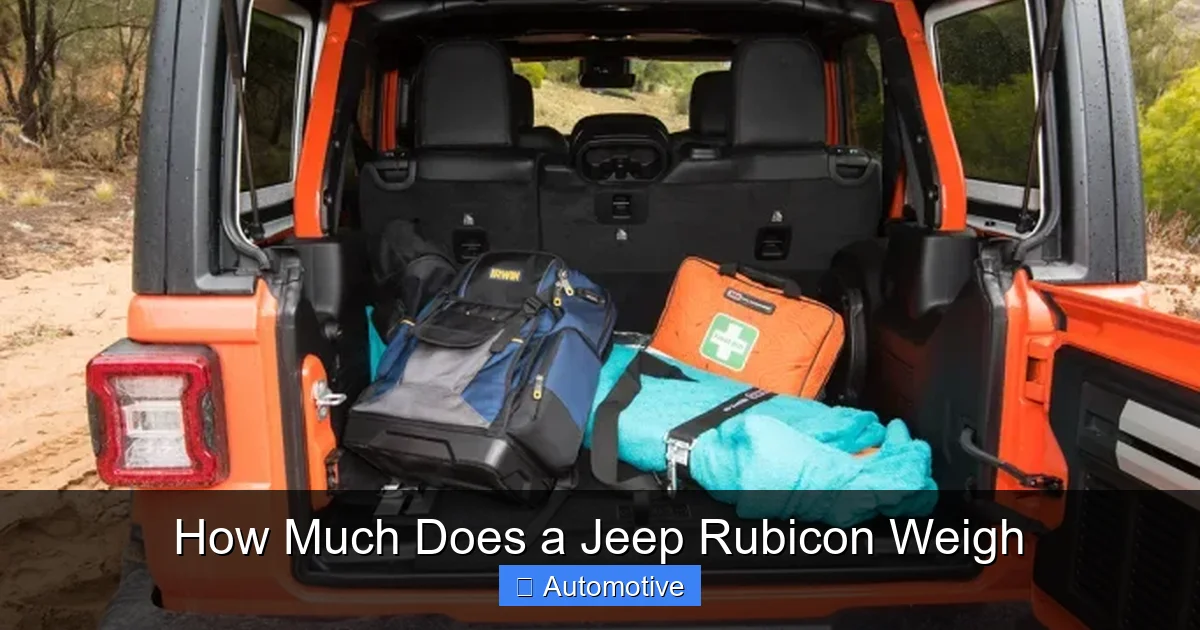
Visual guide about How Much Does a Jeep Rubicon Weigh
Image source: carsguide-res.cloudinary.com
So, why should you care about how much your Jeep Rubicon weighs? Because weight directly impacts how your vehicle performs in real-world situations. Let’s break it down.
Acceleration and Handling
Heavier vehicles take longer to accelerate and require more distance to stop. A Rubicon weighing 5,200 pounds will feel sluggish compared to one at 4,100 pounds, especially when merging onto highways or climbing hills. The added mass also affects cornering—heavier vehicles tend to understeer more, meaning they push outward in turns.
However, the Rubicon’s suspension and 4×4 system are designed to handle this weight. The heavy-duty Dana 44 axles, locking differentials, and electronic sway bar disconnect help maintain control, even with a higher curb weight.
Fuel Economy
Weight is one of the biggest factors in fuel efficiency. Every extra pound requires more energy to move. The EPA estimates that a 100-pound reduction in vehicle weight can improve fuel economy by 1–2%.
For the Rubicon, this means:
– A 2-door V6 Rubicon might average 17–19 mpg combined.
– A 4-door EcoDiesel Rubicon could reach 22–25 mpg combined—thanks to the diesel engine’s efficiency, despite the added weight.
– The Rubicon 392, with its V8, averages around 13–15 mpg—partly due to weight, partly due to power.
If fuel economy is a priority, consider the 2.0L turbo or EcoDiesel models, and avoid heavy aftermarket modifications.
Off-Road Performance
Here’s where weight can be both a pro and a con.
On one hand, a heavier vehicle has more momentum, which can help it power through mud, sand, or snow. The weight also improves traction—especially with the Rubicon’s aggressive tires and 4×4 system.
On the other hand, too much weight can be a liability. It increases the risk of getting stuck, puts more stress on components like axles and suspension, and reduces agility on tight trails. A lighter Rubicon can navigate narrow paths and rock crawls more easily.
The Rubicon’s design strikes a balance. Its weight is distributed evenly between the front and rear axles (roughly 50/50), which helps maintain stability on uneven terrain. The low center of gravity—thanks to the solid axles and flat body—also prevents rollovers, even with a higher curb weight.
Towing and Payload Capacity
Despite its weight, the Rubicon is capable of towing and carrying heavy loads.
– **Towing Capacity:** Most Rubicons can tow up to 3,500 pounds when properly equipped. The EcoDiesel and V6 models perform best here, thanks to high torque output.
– **Payload Capacity:** Typically 1,000–1,200 pounds. This includes passengers, gear, and cargo. For example, if you’re carrying four adults (600 lbs), camping gear (300 lbs), and a cooler (100 lbs), you’re still within safe limits.
Keep in mind: adding aftermarket parts like steel bumpers, winches, or roof racks eats into your payload. A 200-pound winch and 150-pound bumper mean you have 350 pounds less capacity for people and gear.
The Impact of Aftermarket Modifications on Weight
One of the joys of owning a Jeep Rubicon is the ability to customize it. But every modification adds weight—sometimes a lot of it.
Common Mods and Their Weight Impact
Here’s a look at how popular upgrades affect your Rubicon’s weight:
– **Steel Bumpers:** Add 80–150 pounds. Front bumpers are heavier, especially if they include winch mounts.
– **Winch:** A typical 9,500-lb winch adds 70–90 pounds. Mounting it on the front bumper shifts weight forward.
– **Roof Rack:** Adds 30–60 pounds, plus whatever you load on top (gear, kayaks, etc.).
– **Skid Plates:** Full underbody protection can add 100–200 pounds, depending on material (aluminum is lighter than steel).
– **Larger Tires:** Swapping from 33-inch to 35-inch tires can add 20–30 pounds per tire—up to 120 pounds total.
– **Suspension Lift:** A 2.5–3.5 inch lift kit adds 50–100 pounds, mostly from heavier springs and shocks.
Managing Added Weight
If you’re modifying your Rubicon, keep these tips in mind:
– **Choose lightweight materials:** Aluminum bumpers and skid plates save weight compared to steel.
– **Balance the load:** Avoid putting too much weight on the front or rear. A front-heavy vehicle can understeer; a rear-heavy one can lose traction.
– **Upgrade your suspension:** Heavier components require stronger shocks and springs to maintain ride quality and control.
– **Monitor payload:** Use a tire pressure monitoring system (TPMS) and check your GVWR sticker (usually on the driver’s door jamb) to avoid overloading.
Real-World Example: A Modified Rubicon
Imagine a 2022 Rubicon Unlimited with:
– Steel front and rear bumpers (+120 lbs)
– 9,500-lb winch (+80 lbs)
– Full aluminum skid plates (+100 lbs)
– 35-inch tires (+120 lbs)
– Roof rack with gear (+100 lbs)
Total added weight: ~520 pounds.
That’s like carrying an extra passenger everywhere you go. It will reduce fuel economy, slow acceleration, and increase wear on brakes and suspension. But for serious off-roaders, the trade-off is worth it for the added protection and capability.
How the Rubicon Compares to Other Off-Road Vehicles
To put the Rubicon’s weight in perspective, let’s compare it to other popular off-road SUVs.
– **Toyota 4Runner TRD Pro:** Weighs around 4,900–5,100 pounds. Similar to the 4-door Rubicon, but with a more traditional SUV layout.
– **Ford Bronco Raptor:** Approximately 5,300–5,500 pounds. Heavier due to the high-output EcoBoost engine and reinforced frame.
– **Land Rover Defender:** Ranges from 5,000–5,800 pounds. More luxury-focused, with added weight from tech and comfort features.
– **Chevrolet Colorado ZR2:** Around 5,200 pounds. A midsize pickup with off-road chops, but less capable than the Rubicon in extreme terrain.
The Rubicon holds its own in terms of capability, but it’s not the lightest option. Its weight is a reflection of its rugged construction, solid axles, and off-road-focused design. If you prioritize agility and fuel economy, a lighter vehicle might be better. But if you need maximum trail performance, the Rubicon’s weight is a necessary trade-off.
Tips for Managing Your Rubicon’s Weight
Whether you’re buying new or modifying an existing Rubicon, here are some practical tips to manage weight effectively:
– **Choose the right model:** If you don’t need the extra space, go for the 2-door. It’s lighter, more agile, and cheaper to fuel.
– **Opt for lighter engines:** The 2.0L turbo is a great balance of power and efficiency. Avoid the V8 unless you need the performance.
– **Limit heavy mods:** Only add what you truly need. A winch is essential for recovery, but do you really need a full steel bumper?
– **Use a weight distribution hitch:** If towing, this helps balance the load and improves handling.
– **Check tire pressure:** Properly inflated tires reduce rolling resistance and improve fuel economy.
– **Remove unnecessary items:** Don’t carry tools, gear, or cargo you don’t need. Every pound counts.
Conclusion: Weight Is More Than a Number
So, how much does a Jeep Rubicon weigh? The answer isn’t simple—it depends on the model, engine, and how you configure it. But one thing is clear: weight plays a critical role in how your Rubicon performs, handles, and consumes fuel.
From the nimble 2-door V6 at 4,100 pounds to the burly Rubicon 392 at over 5,400 pounds, there’s a Rubicon for every need. Understanding the weight helps you choose the right one and use it safely and efficiently.
Whether you’re crawling over rocks, towing a trailer, or just driving to work, knowing your Rubicon’s weight empowers you to make smarter decisions. And when it comes to customization, remember: every pound added is a pound that affects performance.
In the end, the Rubicon’s weight is a testament to its strength. It’s built to handle the toughest terrain, and that doesn’t come without a little extra mass. Embrace it, manage it, and let your Rubicon take you wherever adventure calls.
Frequently Asked Questions
What is the average weight of a Jeep Rubicon?
The average weight of a Jeep Rubicon ranges from 4,000 to 5,300 pounds, depending on the model year, engine, and configuration. Two-door models are lighter, while four-door Unlimited and V8-powered versions are heavier.
Does the engine affect the Rubicon’s weight?
Yes, the engine significantly impacts weight. The 3.6L V6 is heavier than the 2.0L turbo, while the 3.0L EcoDiesel and 6.4L V8 add even more mass due to larger components and cooling systems.
How much can a Jeep Rubicon tow?
Most Jeep Rubicons can tow up to 3,500 pounds when properly equipped. The EcoDiesel and V6 models offer the best towing performance due to high torque output.
Can aftermarket parts make my Rubicon too heavy?
Yes, heavy modifications like steel bumpers, winches, and roof racks can add 300–800+ pounds. This affects fuel economy, handling, and payload capacity, so it’s important to balance upgrades with performance needs.
Is a heavier Rubicon better for off-roading?
Not necessarily. While weight can improve traction, too much can reduce agility and increase the risk of getting stuck. A balanced setup with proper modifications is key to off-road success.
How does weight affect fuel economy in a Rubicon?
Heavier Rubicons consume more fuel because the engine must work harder to move the vehicle. Every 100 pounds of added weight can reduce fuel economy by 1–2%, so lighter builds are more efficient.