How Much Can a Mazda Cx-50 Tow

Contents
- 1 Key Takeaways
- 2 📑 Table of Contents
- 3 Understanding Towing Capacity: What It Really Means
- 4 Mazda CX-50 Engine Options and Towing Performance
- 5 Required Towing Equipment for Maximum Capacity
- 6 Real-World Towing Scenarios: What Can You Actually Haul?
- 7 Driving Tips and Safety Considerations When Towing
- 8 Comparing the CX-50 to Competitors
- 9 Maintenance and Long-Term Care for Towing
- 10 Is the Mazda CX-50 Right for Your Towing Needs?
- 11 Conclusion
- 12 Frequently Asked Questions


The Mazda CX-50 can tow up to 3,500 pounds when properly equipped, making it a capable compact SUV for small trailers, boats, and campers. With available turbocharged engines and advanced towing features, it balances performance and practicality for weekend adventurers and daily drivers alike.
If you’re eyeing the Mazda CX-50 as your next adventure companion, you’re probably wondering: *How much can a Mazda CX-50 tow?* It’s a fair question. After all, this rugged-looking compact SUV blends Mazda’s signature driving dynamics with off-road-ready styling and a more adventurous spirit than its CX-5 sibling. But looks can be deceiving—just because it looks tough doesn’t automatically mean it can pull a boat or camper with ease.
The good news? The CX-50 *can* tow, and it does so with surprising competence—especially when equipped with the right engine and towing gear. But like any vehicle, its towing capacity isn’t one-size-fits-all. It depends on the engine, trim level, and whether you’ve added the optional towing package. Whether you’re planning weekend getaways with a small trailer, hauling a jet ski to the lake, or towing a lightweight pop-up camper, understanding the CX-50’s capabilities will help you make the most of your adventures without overloading your ride.
In this guide, we’ll break down everything you need to know about how much a Mazda CX-50 can tow, from engine options and towing specs to real-world tips and safety considerations. We’ll also compare it to competitors and help you decide if it’s the right SUV for your towing needs. So grab a coffee, settle in, and let’s dive into the details.
Key Takeaways
- Towing capacity varies by engine: The standard 2.5L four-cylinder engine offers 1,500 lbs, while the turbocharged 2.5L delivers up to 3,500 lbs.
- Proper equipment is essential: A factory-installed towing package, hitch receiver, and wiring harness are required to reach maximum towing capacity.
- Front-wheel drive vs. all-wheel drive: All-wheel drive (AWD) is standard on all CX-50 models and improves traction and stability when towing.
- Payload and curb weight matter: The CX-50 has a payload capacity of around 1,100–1,200 lbs, which affects how much gear and passengers you can carry while towing.
- Fuel efficiency drops when towing: Expect a noticeable decrease in MPG when hauling heavy loads, especially in stop-and-go traffic or on hills.
- Safety features enhance towing: Available i-Activsense safety tech, including blind-spot monitoring and trailer sway control, helps keep towing safer.
- Not for heavy-duty hauling: While impressive for its class, the CX-50 isn’t designed for large RVs or construction equipment—stick to light to moderate loads.
📑 Table of Contents
- Understanding Towing Capacity: What It Really Means
- Mazda CX-50 Engine Options and Towing Performance
- Required Towing Equipment for Maximum Capacity
- Real-World Towing Scenarios: What Can You Actually Haul?
- Driving Tips and Safety Considerations When Towing
- Comparing the CX-50 to Competitors
- Maintenance and Long-Term Care for Towing
- Is the Mazda CX-50 Right for Your Towing Needs?
- Conclusion
Understanding Towing Capacity: What It Really Means
Before we get into the numbers, let’s clarify what “towing capacity” actually means. Simply put, it’s the maximum weight your vehicle can safely pull behind it, including the trailer, cargo, passengers, and fluids. This number isn’t arbitrary—it’s determined by the manufacturer based on the vehicle’s frame strength, engine power, transmission durability, cooling systems, and braking capability.
It’s important to note that towing capacity isn’t just about how strong the engine is. A powerful motor helps, but if the transmission can’t handle the heat or the brakes aren’t up to the task, you’re in trouble. That’s why Mazda engineers test every component under real-world conditions to arrive at a safe, reliable towing rating.
Another key term is **Gross Combined Weight Rating (GCWR)**, which is the total weight of your vehicle, passengers, cargo, and the trailer combined. Exceeding this limit can damage your vehicle and create dangerous driving conditions. Always stay within both the towing capacity and GCWR limits.
For the Mazda CX-50, the towing capacity ranges from 1,500 to 3,500 pounds—a significant spread that depends largely on which engine you choose. Let’s explore those options next.
Mazda CX-50 Engine Options and Towing Performance
Visual guide about How Much Can a Mazda Cx-50 Tow
Image source: trailerjacks.com
The Mazda CX-50 comes with two engine choices, and this is the biggest factor in determining how much it can tow. Let’s break them down.
Standard 2.5L Skyactiv-G Four-Cylinder Engine
The base engine is a naturally aspirated 2.5-liter four-cylinder that delivers 187 horsepower and 186 lb-ft of torque. It’s paired with a smooth-shifting six-speed automatic transmission and standard all-wheel drive. This engine is efficient, refined, and perfect for daily commuting and light-duty driving.
However, when it comes to towing, it’s on the lighter side. With this engine, the CX-50 has a towing capacity of **1,500 pounds**. That’s enough for small utility trailers, a couple of ATVs, or a lightweight motorcycle trailer. But if you’re planning to tow anything heavier—like a small camper or a boat—you’ll want to upgrade.
One advantage of this engine is fuel economy. You’ll get around 24 mpg in the city and 30 mpg on the highway, which is excellent for a compact SUV. But remember: towing will reduce that number significantly, especially if you’re climbing hills or driving in traffic.
Turbocharged 2.5L Skyactiv-G Four-Cylinder Engine
Now, here’s where the CX-50 shines. The available turbocharged version of the same 2.5-liter engine bumps output to **256 horsepower and 320 lb-ft of torque**—a massive increase that transforms the SUV’s towing capabilities.
With this engine and the proper towing equipment, the CX-50 can tow up to **3,500 pounds**. That’s a 133% increase over the base model and puts it in line with some midsize SUVs. This makes it suitable for towing small travel trailers, pop-up campers, jet skis, small fishing boats, or even a compact utility trailer loaded with gear.
The turbo engine is available on higher trims like the CX-50 Turbo and Turbo Premium. It’s not just about raw power—the turbo also improves low-end torque, which is crucial for getting a loaded trailer moving from a stop. You’ll feel the difference immediately when merging onto highways or climbing inclines.
Keep in mind that the turbo engine does come with a slight fuel economy penalty. Expect around 22 mpg city and 27 mpg highway—still respectable, but a drop from the base engine. However, the trade-off in towing power is well worth it for many buyers.
Required Towing Equipment for Maximum Capacity
Visual guide about How Much Can a Mazda Cx-50 Tow
Image source: motorbiscuit.com
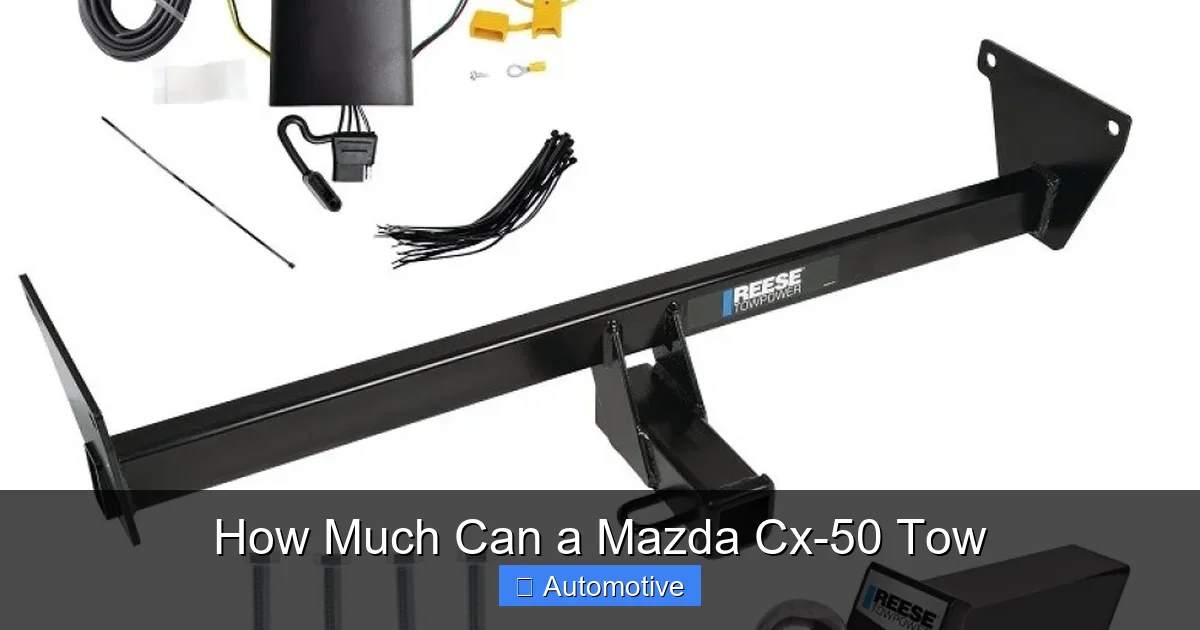
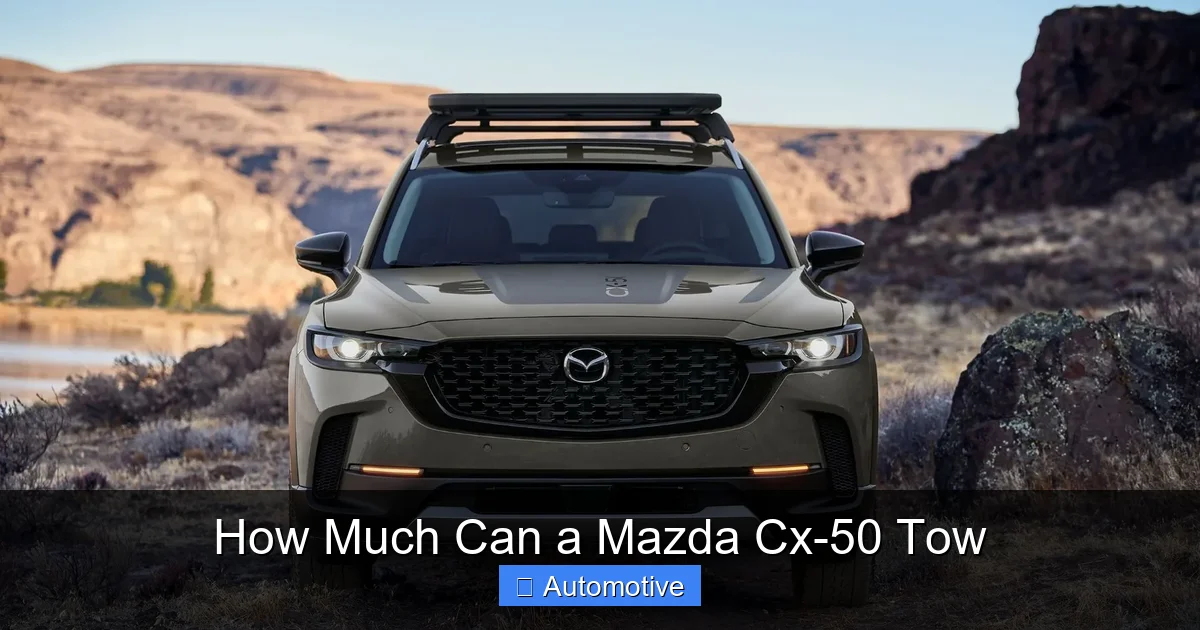
Here’s a critical point: **you can’t reach the 3,500-pound towing capacity without the right equipment.** Mazda doesn’t just hand you that number and say, “Go for it.” You need to equip your CX-50 properly.
Factory-Installed Towing Package
To achieve the maximum towing capacity, you’ll need the **Mazda Genuine Towing Package**, which is available as an option on most trims (and standard on some higher-end models). This package includes:
– A Class II hitch receiver (rated for up to 3,500 lbs)
– Wiring harness for trailer lights
– Transmission cooler (to prevent overheating under load)
– Upgraded cooling system for the engine and transmission
The transmission cooler is especially important. Towing puts extra strain on your transmission, and without proper cooling, you risk overheating—especially in hot weather or on long climbs. Mazda’s system helps maintain safe operating temperatures, protecting your investment.
Aftermarket vs. Factory Equipment
While you *can* install an aftermarket hitch and wiring, Mazda recommends using the factory towing package for several reasons:
– It’s engineered specifically for the CX-50’s frame and suspension.
– It maintains your warranty coverage.
– It integrates seamlessly with the vehicle’s electronics and safety systems.
Aftermarket hitches might save you a few hundred dollars upfront, but they could void parts of your warranty or not handle the load as safely. For peace of mind and maximum reliability, go with the factory package.
Hitch and Ball Mount Compatibility
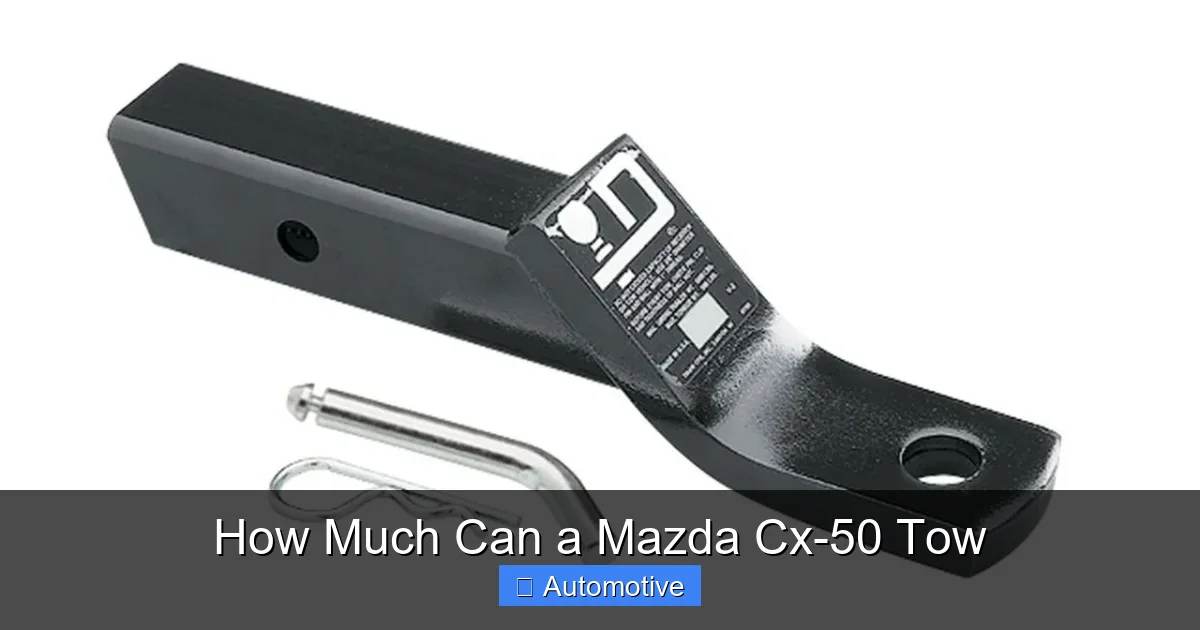
Once you have the towing package, you’ll need a compatible ball mount and hitch ball. The CX-50 uses a 2-inch receiver, so make sure your ball mount fits that size. For a 3,500-pound trailer, a 2-inch ball is standard.
Also, check the **tongue weight**—the downward force the trailer exerts on the hitch. Mazda recommends keeping tongue weight between 10% and 15% of the total trailer weight. For a 3,500-pound trailer, that’s 350 to 525 pounds. Too much tongue weight can cause the rear of the CX-50 to sag, affecting handling and braking.
Real-World Towing Scenarios: What Can You Actually Haul?
Visual guide about How Much Can a Mazda Cx-50 Tow
Image source: carlogos.org
Now that we know the numbers, let’s put them into practice. What can you realistically tow with a Mazda CX-50?
Small Trailers and Utility Loads
With the base engine (1,500 lbs capacity), you’re limited to light-duty tasks. Think:
– A small utility trailer carrying lawn equipment, firewood, or camping gear
– A motorcycle trailer with one or two bikes
– A jet ski on a single-axle trailer
These are perfect for weekend projects or trips to the lake. Just remember to distribute weight evenly and secure your load properly.
Boats and Watercraft
With the turbo engine and towing package, the CX-50 can handle small to mid-sized boats. For example:
– A 16- to 18-foot aluminum fishing boat with a 50–90 hp outboard motor (total weight: ~2,500–3,200 lbs)
– A pontoon boat under 3,000 lbs (check the dry weight plus fuel and gear)
– Personal watercraft (jet skis) on a dual trailer
Always check the **dry weight** of the boat and add fuel, gear, and trailer weight to ensure you’re under the limit.
Travel Trailers and Campers
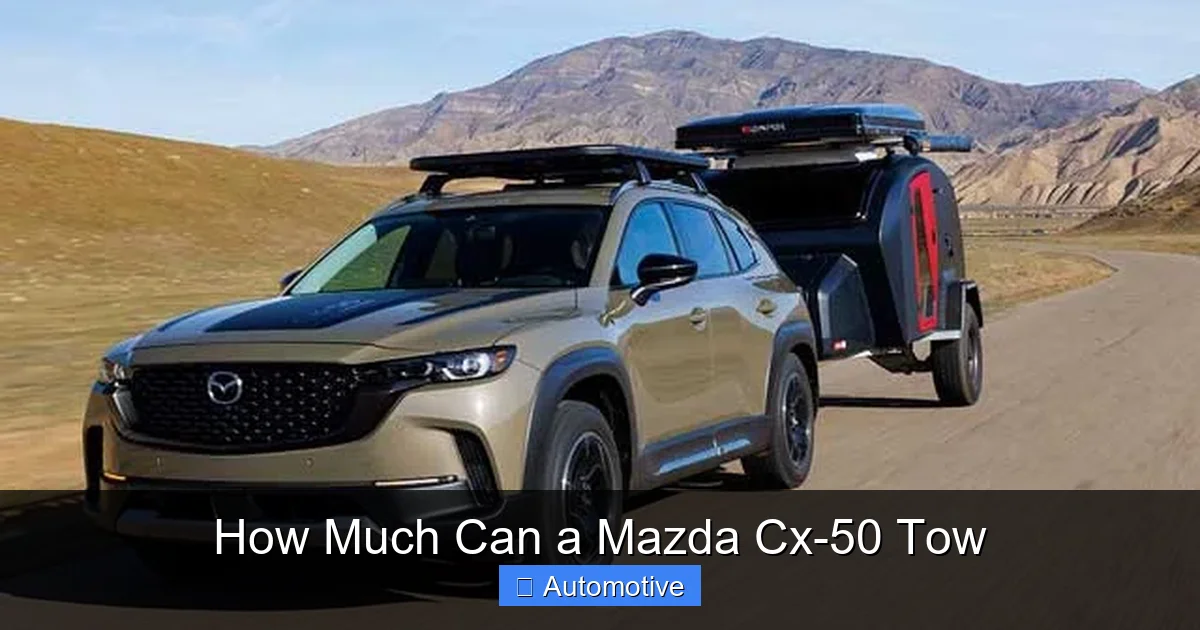
This is where the CX-50 really earns its adventure badge. Many lightweight travel trailers fall within the 3,500-pound range, including:
– Pop-up campers (typically 1,500–2,500 lbs)
– Small teardrop trailers (1,000–2,000 lbs)
– Compact fiberglass campers like the Casita or Scamp (2,000–3,000 lbs)
For example, a 2023 Casita Spirit Deluxe weighs around 2,800 lbs fully loaded. That’s well within the CX-50’s capacity, leaving room for passengers and cargo.
However, avoid larger travel trailers—anything over 3,500 lbs or with a high center of gravity (like some A-frame models) is better suited for a truck or larger SUV.
ATVs and Side-by-Sides
Recreational vehicles like ATVs and UTVs are also fair game. A typical 4×4 ATV weighs 600–800 lbs, so you can easily tow two or three on a small trailer. A Polaris RZR or Can-Am Maverick (side-by-side) might weigh 1,500–2,000 lbs, so one or two on a trailer should be fine—just watch the total weight.
Driving Tips and Safety Considerations When Towing
Towing isn’t just about hooking up and going. It changes how your vehicle handles, brakes, and accelerates. Here’s how to stay safe and confident on the road.
Pre-Tow Checklist
Before you hit the road, do a quick inspection:
– Check tire pressure on both the CX-50 and the trailer
– Ensure all lights (brake, turn, tail) are working
– Secure all cargo and use tie-downs
– Confirm the hitch is locked and safety chains are crossed under the tongue
– Test the trailer brakes (if equipped)
Driving Dynamics
With a trailer in tow, your CX-50 will feel heavier and less responsive. Here’s what to expect:
– **Slower acceleration:** Especially from stops or when merging.
– **Longer braking distances:** Allow extra space between you and the car ahead.
– **Reduced fuel economy:** Expect a 20–30% drop in MPG, depending on load and terrain.
– **Increased sway in wind or on uneven roads:** Use a weight-distribution hitch if needed.
Use the Right Driving Mode
The CX-50 offers multiple drive modes, including Sport and Off-Road. When towing, **Sport mode** can help by keeping the transmission in lower gears longer, providing better engine braking and responsiveness. Avoid Eco mode, as it prioritizes fuel economy over power.
Trailer Sway Control
The CX-50 comes with **Trailer Sway Control** as part of its i-Activsense safety suite. If the system detects trailer sway (often caused by wind or improper loading), it can apply brakes to individual wheels and reduce engine power to stabilize the vehicle.
This feature is a lifesaver, especially on highways or in crosswinds. But it’s not a substitute for proper loading—always keep tongue weight in the 10–15% range.
Parking and Maneuvering
Backing up with a trailer takes practice. Remember: turn the steering wheel in the opposite direction you want the trailer to go. Go slow, use your mirrors, and consider installing a backup camera with dynamic guidelines (available on higher trims).
For tight spaces, use the CX-50’s available 360-degree camera system to see all around the vehicle.
Comparing the CX-50 to Competitors
How does the Mazda CX-50 stack up against other compact SUVs in towing?
| SUV | Max Towing Capacity | Engine Options |
|——|———————|—————-|
| Mazda CX-50 | 3,500 lbs | 2.5L or 2.5L Turbo |
| Honda CR-V | 1,500 lbs | 1.5L Turbo |
| Toyota RAV4 | 1,500–3,500 lbs | 2.5L or 2.5L Hybrid |
| Subaru Forester | 1,500 lbs | 2.5L |
| Ford Bronco Sport | 2,200 lbs | 1.5L or 2.0L Turbo |
As you can see, the CX-50 is among the top performers in its class. Only the RAV4 (with the optional tow package) matches its 3,500-pound capacity. The CR-V and Forester are limited to 1,500 lbs, while the Bronco Sport falls in the middle.
What sets the CX-50 apart is its combination of towing power, driving dynamics, and upscale interior. Mazda doesn’t just offer capability—it delivers a premium experience, even when hauling a trailer.
Maintenance and Long-Term Care for Towing
Towing puts extra stress on your vehicle, so regular maintenance is crucial.
Transmission and Cooling System
After towing, especially in hot weather or on long trips, let the engine idle for a few minutes before turning it off. This allows the transmission and engine to cool down gradually.
Check coolant levels regularly and consider a transmission fluid change every 30,000–50,000 miles if you tow frequently.
Brake Inspection
Towing increases brake wear. Have your brakes inspected annually, and replace pads and rotors as needed. If you notice longer stopping distances or a spongy pedal, get it checked immediately.
Tire Care
Towing adds weight, which can cause tires to wear faster. Rotate tires every 5,000–7,000 miles and check for uneven wear. Consider upgrading to all-terrain or load-range tires if you tow often.
Battery and Electrical System
The trailer wiring harness draws power from your CX-50’s electrical system. If you notice dimming lights or slow starts, have the battery and alternator tested.
Is the Mazda CX-50 Right for Your Towing Needs?
So, should you choose the CX-50 if you plan to tow?
If you’re looking for a compact SUV that can handle light to moderate towing—like a small camper, boat, or trailer—the CX-50 is an excellent choice. Its turbo engine, standard AWD, and available towing package make it one of the most capable vehicles in its class.
But if you regularly tow heavy loads—like large RVs, horse trailers, or construction equipment—you’ll want something with a higher capacity, such as a midsize truck or full-size SUV.
For weekend warriors, outdoor enthusiasts, and families who want a stylish, fun-to-drive SUV with real towing chops, the Mazda CX-50 strikes a perfect balance.
Conclusion
The Mazda CX-50 proves that you don’t need a bulky truck to enjoy the freedom of towing. With up to 3,500 pounds of towing capacity when properly equipped, it opens the door to a world of adventures—from lakeside fishing trips to mountain camping getaways.
Remember, the key to safe and successful towing is understanding your vehicle’s limits, using the right equipment, and driving with care. Whether you’re hauling a jet ski or a pop-up camper, the CX-50 delivers the power, precision, and peace of mind you need.
So, how much can a Mazda CX-50 tow? Enough to make your weekends unforgettable—without sacrificing the driving joy Mazda is known for.
Frequently Asked Questions
What is the maximum towing capacity of a Mazda CX-50?
The Mazda CX-50 can tow up to 3,500 pounds when equipped with the turbocharged 2.5L engine and the factory towing package. The base engine model is limited to 1,500 pounds.
Do I need a special package to tow with the CX-50?
Yes, to reach the maximum towing capacity, you need the Mazda Genuine Towing Package, which includes a hitch receiver, wiring harness, and transmission cooler.
Can the Mazda CX-50 tow a travel trailer?
Yes, the CX-50 can tow lightweight travel trailers, pop-up campers, and teardrop trailers up to 3,500 pounds, such as a Casita or Scamp model.
Does towing reduce fuel economy in the CX-50?
Yes, towing significantly reduces fuel efficiency. Expect a 20–30% drop in MPG, especially when hauling heavy loads or driving in hilly terrain.
Is all-wheel drive standard on the CX-50?
Yes, all-wheel drive is standard on every Mazda CX-50 trim, which improves traction and stability when towing.
Can I install an aftermarket hitch on my CX-50?
You can, but Mazda recommends using the factory towing package to maintain warranty coverage and ensure optimal safety and performance.