How Much Can a Dodge Journey Tow?

Contents
- 1 Key Takeaways
- 2 📑 Table of Contents
- 3 How Much Can a Dodge Journey Tow? A Complete Guide
- 4 Understanding Towing Capacity: What It Really Means
- 5 Real-World Towing Scenarios: What Can You Actually Tow?
- 6 Safety Tips for Towing with a Dodge Journey
- 7 Maintenance and Upkeep for Towing
- 8 Alternatives If You Need More Towing Power
- 9 Conclusion: Is the Dodge Journey Right for Your Towing Needs?
- 10 Frequently Asked Questions

Car Tissue Holder

Portable Air Pump

Car Vacuum Cleaner (Portable)

Car Fog Light Bulb
The Dodge Journey has a maximum towing capacity of 2,500 pounds when properly equipped, making it suitable for small trailers, pop-up campers, and lightweight boats. While not the most powerful SUV in its class, it offers reliable towing for everyday recreational needs with the right setup and precautions.
Key Takeaways
- Maximum Towing Capacity: The Dodge Journey can tow up to 2,500 pounds when equipped with the optional tow package and the 3.6L V6 engine.
- Engine Matters: Only the 3.6L Pentastar V6 engine supports towing; the 2.4L four-cylinder does not have a rated towing capacity.
- Tow Package Required: To reach the max towing limit, you must install the optional towing package, which includes a transmission cooler, wiring harness, and hitch receiver.
- Payload and Weight Limits: The Journey’s payload capacity is around 1,000–1,200 pounds, so factor in passenger and cargo weight when towing.
- Safe Towing Practices: Always distribute weight evenly, use sway control, and avoid overloading—even within the rated limit.
- Real-World Use Cases: Ideal for towing small pop-up campers, jet skis, or utility trailers—not for large RVs or heavy boats.
- Maintenance Is Key: Regular checks on brakes, tires, transmission, and cooling systems are essential when towing frequently.
📑 Table of Contents
- How Much Can a Dodge Journey Tow? A Complete Guide
- Understanding Towing Capacity: What It Really Means
- Real-World Towing Scenarios: What Can You Actually Tow?
- Safety Tips for Towing with a Dodge Journey
- Maintenance and Upkeep for Towing
- Alternatives If You Need More Towing Power
- Conclusion: Is the Dodge Journey Right for Your Towing Needs?
How Much Can a Dodge Journey Tow? A Complete Guide
If you’re considering the Dodge Journey for your next family SUV and have plans to tow a small trailer, camper, or boat, you’re probably wondering: How much can a Dodge Journey tow? It’s a fair question—especially since not all SUVs are created equal when it comes to towing power.
The Dodge Journey is a midsize crossover that’s long been praised for its affordability, spacious interior, and family-friendly features. But when it comes to towing, it’s not the heavyweight champion of the segment. That said, it’s more than capable of handling light to moderate towing tasks—especially if you’re towing a pop-up camper for a weekend getaway or hauling a couple of jet skis to the lake.
In this comprehensive guide, we’ll break down everything you need to know about the Dodge Journey’s towing capacity. We’ll cover engine options, required equipment, real-world towing scenarios, safety tips, and maintenance advice. By the end, you’ll have a clear picture of whether the Journey fits your towing needs—and how to get the most out of it safely and efficiently.
Understanding Towing Capacity: What It Really Means

Visual guide about How Much Can a Dodge Journey Tow?
Image source: thetowcarawards.com
Before we dive into the numbers, let’s clarify what “towing capacity” actually means. Towing capacity is the maximum weight your vehicle can safely pull behind it, as determined by the manufacturer. This number isn’t arbitrary—it’s based on the vehicle’s engine power, transmission strength, cooling systems, suspension, and frame design.
It’s important to note that towing capacity isn’t just about how strong the engine is. It’s a combination of engineering factors that ensure the vehicle can pull a load without overheating, losing control, or damaging critical components. Exceeding this limit—even by a small amount—can lead to brake failure, transmission damage, or even accidents.
For the Dodge Journey, the towing capacity varies significantly depending on the engine and equipment. So, while some online sources might list a single number, the reality is more nuanced. Let’s break it down.
Engine Options and Their Towing Impact
The Dodge Journey has been offered with two main engine options over its production years (2009–2020):
– 2.4L inline-4 engine
– 3.6L Pentastar V6 engine
The 2.4L four-cylinder engine, found in base models, produces around 173 horsepower and 166 lb-ft of torque. While it’s fuel-efficient and adequate for daily driving, it does not have a rated towing capacity. That means if your Journey has this engine, you should not attempt to tow anything—even a small trailer.
On the other hand, the 3.6L V6 engine is where the Journey earns its towing stripes. With 283 horsepower and 260 lb-ft of torque, this engine provides the necessary power to pull a trailer. When properly equipped, the V6-powered Journey can tow up to 2,500 pounds.
So, if you’re serious about towing, make sure your Journey has the V6 engine. You can usually identify it by the “3.6” badge on the rear or by checking the vehicle’s specifications in the owner’s manual or on the window sticker.
The Importance of the Tow Package
Even with the V6 engine, you can’t reach the full 2,500-pound towing capacity without the optional towing package. This package is essential—it’s not just a suggestion.
The Dodge Journey’s towing package typically includes:
– A Class III trailer hitch receiver
– A 4-pin wiring harness for trailer lights
– A transmission oil cooler to prevent overheating
– Heavy-duty cooling system components
– Upgraded suspension (in some models)
Without these components, the vehicle isn’t designed to handle the stress of towing. For example, the transmission cooler is critical because towing puts extra strain on the transmission, causing it to heat up. Without a cooler, you risk overheating and costly repairs.
If you’re buying a used Journey, always check whether the tow package was installed. You can often tell by the presence of a hitch receiver or by reviewing the vehicle’s build sheet (available through services like Carfax or by contacting a Dodge dealer with the VIN).
Real-World Towing Scenarios: What Can You Actually Tow?
Visual guide about How Much Can a Dodge Journey Tow?
Image source: shunauto.com
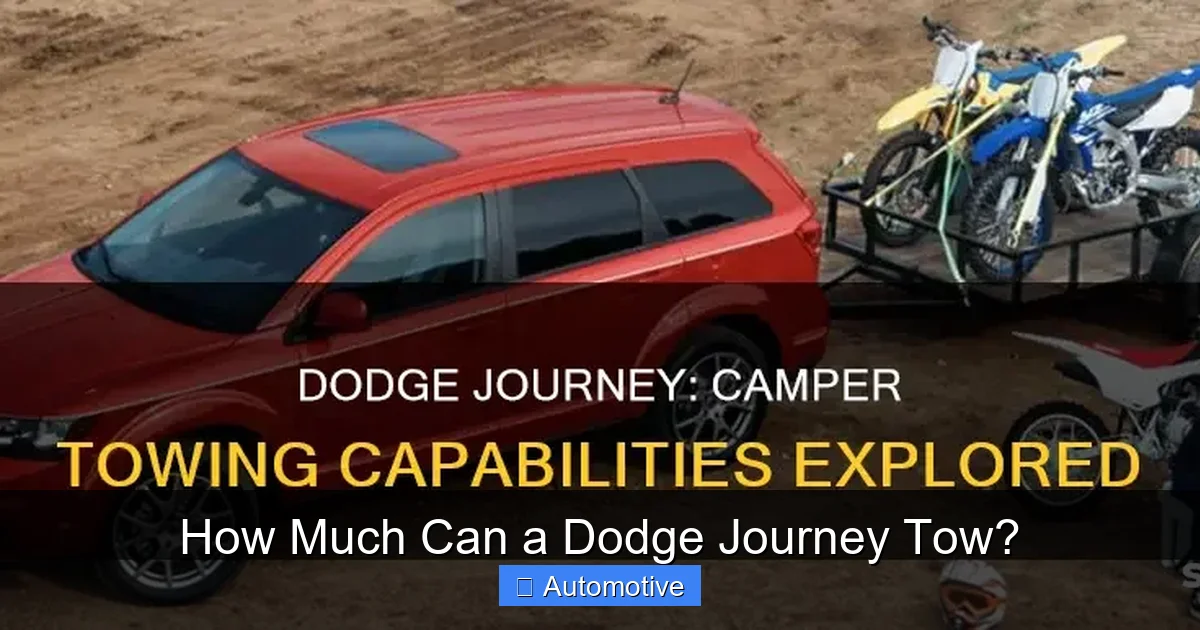
Now that we know the Journey can tow up to 2,500 pounds with the right setup, let’s look at what that means in practical terms. What kinds of trailers and loads fall within this range?
Pop-Up Campers and Small Travel Trailers
One of the most common uses for the Journey’s towing capacity is hauling a pop-up camper. These lightweight campers typically weigh between 1,500 and 2,500 pounds when loaded, making them a perfect match for the Journey’s capabilities.
For example, a Coleman Sundome or a Forest River Rockwood pop-up camper usually weighs around 2,000 pounds with gear, bedding, and supplies. That’s well within the Journey’s limit—especially if you pack light and distribute weight evenly.
Smaller hard-sided travel trailers, like the Airstream Basecamp or the Winnebago Micro Minnie, can also be towed by the Journey, but you’ll need to check the exact weight. Some of these models exceed 3,000 pounds, so they’re too heavy. Stick to sub-2,500-pound options.
Jet Skis, ATVs, and Utility Trailers
The Journey is also great for towing recreational vehicles like jet skis or ATVs. A typical two-person jet ski weighs around 800–1,000 pounds, and a small trailer adds another 300–500 pounds. That puts the total well under 2,500 pounds, leaving room for gear and fuel.
Similarly, a single ATV (like a Honda FourTrax or Yamaha Grizzly) weighs about 600–800 pounds. With a lightweight trailer, you can easily tow one—or even two—ATVs for off-road adventures.
Utility trailers are another common use case. A 5×8 foot enclosed trailer can carry up to 2,000 pounds of cargo, such as lawn equipment, furniture, or camping gear. Just make sure the total weight (trailer + load) doesn’t exceed 2,500 pounds.
What You Should Avoid Towing
While the Journey is capable, it’s not built for heavy-duty towing. Avoid attempting to tow:
– Large travel trailers (over 2,500 lbs)
– Boats over 2,000 lbs (including trailer)
– Horse trailers or livestock carriers
– Large cargo trailers with heavy loads
For example, a 16-foot fishing boat with a trailer can easily weigh 3,000 pounds or more—far beyond the Journey’s capacity. Similarly, a small pontoon boat might seem light, but with fuel, gear, and the trailer, it can quickly exceed safe limits.
Always check the Gross Trailer Weight (GTW) and the tongue weight (typically 10–15% of GTW) before hitching up. Overloading can cause swaying, poor braking, and loss of control.
Safety Tips for Towing with a Dodge Journey

Visual guide about How Much Can a Dodge Journey Tow?
Image source: auction.pro-tow.com
Towing safely isn’t just about staying under the weight limit—it’s about how you prepare, drive, and maintain your vehicle. Here are some essential tips to keep you and your cargo safe.
Proper Weight Distribution
One of the most common towing mistakes is improper weight distribution. If too much weight is on the rear of the trailer (high tongue weight), it can cause the rear of the Journey to sag, affecting steering and braking. If too little weight is on the hitch (low tongue weight), the trailer can sway dangerously.
Aim for a tongue weight of 10–15% of the total trailer weight. For a 2,000-pound trailer, that’s 200–300 pounds on the hitch. Use a tongue weight scale or bathroom scale to measure it.
Also, load heavier items over the trailer’s axles, not at the back. This helps maintain balance and reduces sway.
Use a Weight Distribution Hitch (If Needed)
For trailers over 1,500 pounds, consider using a weight distribution hitch. This device spreads the tongue weight across all axles of the Journey and the trailer, improving stability and ride quality.
While not always required for lighter loads, it’s a smart upgrade if you plan to tow frequently or carry heavy loads. Pair it with a sway control device for even better handling.
Brake Controller and Trailer Brakes
The Dodge Journey does not come with a built-in brake controller. If your trailer has electric brakes (common on trailers over 1,500 pounds), you’ll need to install an aftermarket brake controller.
This device allows you to adjust brake force from the driver’s seat, ensuring the trailer brakes engage smoothly and in sync with the Journey’s brakes. Without it, stopping distances increase dramatically—especially on hills.
Popular options include the Tekonsha Prodigy P3 and the Redarc Tow-Pro Elite. Installation is usually straightforward and can be done by a professional or DIYer with basic tools.
Driving Tips for Towing
Towing changes how your vehicle handles. Here’s how to adapt:
– Accelerate and brake gradually: Sudden movements can cause sway or jackknifing.
– Increase following distance: You’ll need more space to stop.
– Take wider turns: The trailer will swing into the opposite lane if you cut corners too sharply.
– Use lower gears on hills: This reduces strain on the transmission and improves control.
– Check mirrors frequently: Use extended towing mirrors if needed to see around the trailer.
Also, avoid highways with steep grades or high winds if possible. These conditions can make towing more challenging, especially for a vehicle like the Journey that isn’t designed for heavy loads.
Maintenance and Upkeep for Towing
Towing puts extra stress on your vehicle, so regular maintenance is crucial—especially if you tow frequently.
Transmission and Cooling System
The transmission is one of the most vulnerable components when towing. The added load causes it to work harder and generate more heat. That’s why the tow package includes a transmission cooler—don’t ignore it.
Check your transmission fluid regularly. It should be clean and at the proper level. If it smells burnt or looks dark, have it serviced immediately.
Also, monitor your engine temperature. If the coolant light comes on or the gauge climbs into the red, pull over and let the engine cool. Overheating can cause severe engine damage.
Brake and Tire Inspection
Towing increases wear on brakes and tires. Inspect brake pads, rotors, and fluid levels before each towing trip. If you notice squeaking, grinding, or reduced stopping power, get them checked.
Tires should be inflated to the recommended pressure (found on the driver’s door jamb). Underinflated tires can overheat and fail, especially when carrying extra weight. Consider upgrading to higher-load-range tires if you tow often.
Regular Inspections
Before every towing trip, do a quick walk-around:
– Check trailer lights and connections
– Ensure the hitch is secure and the safety chains are crossed
– Verify that the trailer is level and properly loaded
– Test the brake controller (if equipped)
These small steps can prevent big problems on the road.
Alternatives If You Need More Towing Power
If you find that the Dodge Journey’s 2,500-pound limit isn’t enough for your needs, it might be time to consider a more capable SUV or truck.
Mid-Size SUVs with Higher Towing
Vehicles like the Toyota Highlander, Ford Explorer, or Honda Pilot offer towing capacities of 5,000 pounds or more—especially with V6 or turbocharged engines. These are better suited for larger campers, boats, or multiple ATVs.
Full-Size SUVs and Trucks
For serious towing, consider a full-size SUV like the Chevrolet Tahoe, Ford Expedition, or a pickup truck like the Ford F-150 or Ram 1500. These can tow 7,000–10,000 pounds or more, depending on configuration.
While they cost more upfront and use more fuel, they offer the power and stability needed for heavy-duty towing.
Used Market Considerations
If you’re set on a Journey but need more towing, you might find older models with the V6 and tow package at a lower price. Just be sure to have a mechanic inspect it, especially the transmission and cooling system.
Alternatively, consider trading up to a more capable vehicle if your towing needs grow.
Conclusion: Is the Dodge Journey Right for Your Towing Needs?
So, how much can a Dodge Journey tow? The answer is clear: up to 2,500 pounds when equipped with the 3.6L V6 engine and the optional tow package. That’s enough for pop-up campers, jet skis, ATVs, and small utility trailers—perfect for weekend adventures and light recreational use.
However, it’s not built for heavy-duty towing. If you’re planning to haul large boats, travel trailers, or multiple vehicles, you’ll want a more powerful SUV or truck.
The key to safe and successful towing with a Journey is preparation. Make sure you have the right engine, the tow package, proper weight distribution, and a well-maintained vehicle. Follow safe driving practices, and never exceed the rated capacity—even if it seems like you “could get away with it.”
For families who need occasional towing and value affordability and space, the Dodge Journey remains a solid choice. Just know its limits—and respect them. With the right setup and care, your Journey can be a reliable partner for years of safe, enjoyable towing.
Frequently Asked Questions
Can a Dodge Journey with a 2.4L engine tow anything?
No, the 2.4L four-cylinder engine does not have a rated towing capacity. It’s not designed to pull trailers, and attempting to do so could damage the transmission or cause safety issues.
Do I need a special license to tow with a Dodge Journey?
In most states, no special license is required to tow a trailer under 2,500 pounds with a standard passenger vehicle like the Journey. However, check your local laws, as requirements vary.
Can I install a tow package on a Journey that didn’t come with one?
Yes, you can add a tow package aftermarket. A Class III hitch, wiring harness, and transmission cooler can be installed by a professional. However, ensure your engine is the 3.6L V6, as the 2.4L still won’t support towing.
What happens if I exceed the towing capacity?
Exceeding the towing limit can cause transmission failure, brake overheating, loss of control, and increased risk of accidents. It may also void your warranty and insurance coverage in the event of a claim.
How do I check if my Journey has the tow package?
Look for a hitch receiver, a 4-pin wiring connector, and a transmission cooler. You can also check the vehicle’s build sheet using the VIN at a Dodge dealer or through a service like Carfax.
Can I tow a small boat with a Dodge Journey?
Yes, as long as the total weight of the boat, trailer, and gear is under 2,500 pounds. Small fishing boats or inflatable dinghies are good options, but larger boats may exceed the limit.