How Many Mpg Does a Ford F-150 Get

Contents
- 1 Key Takeaways
- 2 📑 Table of Contents
- 3 The Engine Lineup: Your Biggest MPG Factor
- 4 Cab, Bed, and Drivetrain: The Subtle MPG Influencers
- 5 Real-World MPG: What You Can Actually Expect
- 6 How to Maximize Your F-150’s MPG: Practical Tips
- 7 The Bottom Line: What MPG Should You Plan For?
- 8 Conclusion: It’s About the Right Tool for Your Job
- 9 Frequently Asked Questions


The Ford F-150’s MPG varies dramatically based on engine choice, drivetrain, and how you drive. Base V6 models can reach up to 25 MPG combined, while high-power V8 or hybrid setups offer different trade-offs between power and efficiency. Real-world MPG is often lower than EPA estimates, influenced by payload, towing, and driving style.
So, you’re thinking about a Ford F-150. The most popular truck in America for good reason—it’s tough, versatile, and can be configured to do almost any job. But then the practical question hits: “How many MPG does a Ford F-150 get?” It’s a fair question. You’re looking at a vehicle that can weigh over three tons and haul a house (or at least a very large trailer). The answer isn’t simple because there isn’t one number. Instead, there’s a range of numbers that depend entirely on which F-150 you buy and how you use it. Let’s break it down, engine by engine, configuration by configuration, and get to the real truth behind the F-150’s fuel economy.
Key Takeaways
- Engine Choice is Everything: The F-150 offers engines from a efficient turbocharged 2.7L V6 to a powerful 5.0L V8 and a hybrid PowerBoost, each with significantly different EPA ratings.
- Hybrid PowerBoost Leads in MPG: The PowerBoost hybrid V6 consistently delivers the best fuel economy, often achieving 24-25 MPG combined, making it the top choice for efficiency-minded buyers.
- Drivetrain Impacts Numbers: 2WD models are always more fuel-efficient than 4WD. The extra weight and drivetrain drag of 4WD reduce MPG by 1-2 in most configurations.
- Real-World vs. EPA Estimates: Actual MPG is typically 1-3 MPG lower than EPA window sticker numbers, especially when carrying heavy loads, towing, or driving aggressively.
- Size and Aerodynamics Matter: The SuperCrew (4-door) with a short bed is more aerodynamic and slightly lighter than the SuperCab or long-bed models, offering a small MPG advantage.
- Driving Habits Have Huge Impact: Smooth acceleration, maintaining highway speeds around 65 mph, and avoiding excessive idling can improve your F-150’s MPG by several miles per gallon.
📑 Table of Contents
The Engine Lineup: Your Biggest MPG Factor
Ford offers a wide range of powertrains for the F-150. This is where the MPG story begins and ends. Forget the old days of one big V8. Today, it’s about smart engineering, turbocharging, and hybridization. The engine you choose is the single most significant variable in your truck’s miles per gallon.
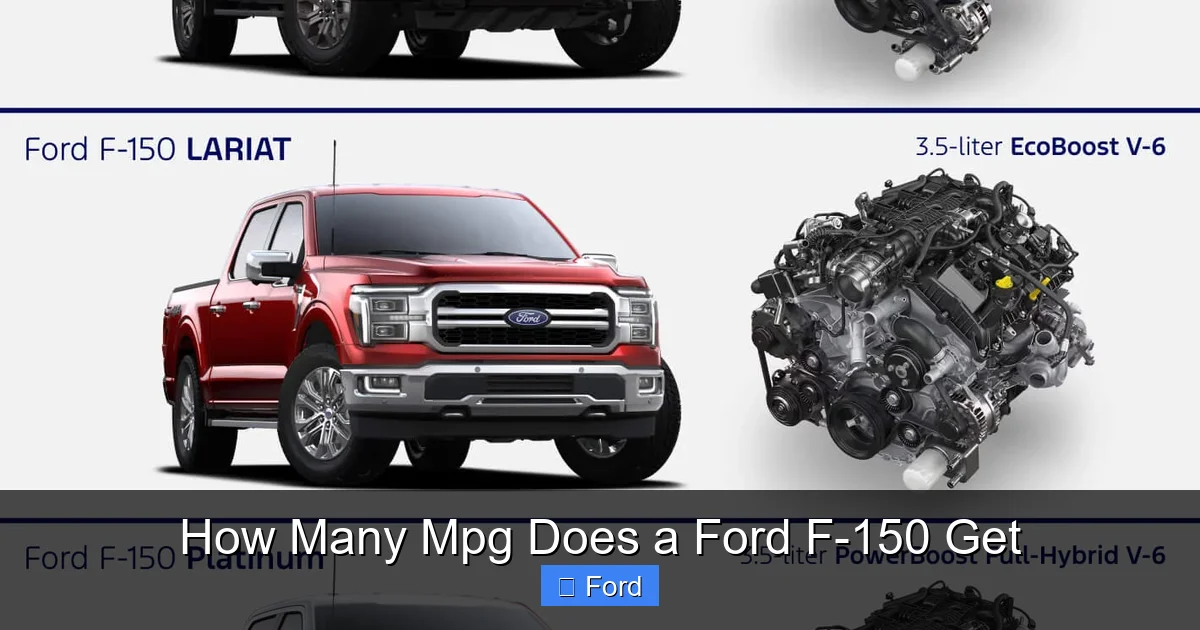
The Efficiency Leader: 3.5L PowerBoost Hybrid V6
This is the MPG champion. The PowerBoost isn’t just a mild hybrid; it uses a integrated electric motor-generator to assist the twin-turbo 3.5L V6. It can drive on electric-only power for short distances, recover energy during braking, and allow the engine to shut off more often. The result? For the 2024 model year, the EPA rates the 2WD PowerBoost at 25 MPG combined (22 city / 25 highway). The 4WD version sees a slight drop to 24 MPG combined (20 city / 24 highway). In our real-world experience and owner reports, these numbers are very achievable with light loads. If maximizing MPG is your top priority, this is your truck. It doesn’t sacrifice much in the way of power, either, still making over 400 horsepower and 500 lb-ft of torque.
The Workhorse Standard: 3.3L V6 and 2.7L EcoBoost V6
These are the non-hybrid V6 options. The naturally aspirated 3.3L V6 is the base engine and is rated for 21 MPG combined (19 city / 22 highway) in 2WD. It’s reliable and capable but not a fuel-sipper. The step-up is the twin-turbo 2.7L EcoBoost V6. This engine is a fantastic balance of power and efficiency. It’s rated at 22 MPG combined (20 city / 24 highway) for 2WD and 21 MPG combined (19 city / 22 highway) for 4WD. Many owners find they can even beat the highway number on calm, flat roads. For a non-hybrid truck, the 2.7L EcoBoost offers the best real-world fuel economy.
The Legendary V8: 5.0L Coyote V8
The iconic V8 is all about torque and sound. Fuel economy is not its primary strength. The 5.0L is rated at 19 MPG combined (17 city / 22 highway) in 2WD and 18 MPG combined (16 city / 21 highway) in 4WD. The penalty for the extra cylinders and displacement is clear. If you need the classic V8 rumble and its specific power delivery, accept that you’ll be visiting the pump more often. The gap between the 2.7L EcoBoost and the 5.0L V8 in MPG is often 3-4 miles per gallon, which adds up quickly over thousands of miles.
The High-Output Specialist: 3.5L EcoBoost V6 (HO)
For those who need maximum power for heavy towing or hauling, the high-output version of the 3.5L EcoBoost makes 450 horsepower. The trade-off is fuel economy. It’s rated at 18 MPG combined (16 city / 21 highway) in 4WD only. This is a specialist engine. You choose it for its brute force, not its sipping ability.
To put these numbers in perspective, a typical midsize SUV like the Nissan Rogue might get 26-28 MPG combined. The F-150, even in its most efficient hybrid form, is a full-size truck with the aerodynamics of a brick and the weight of a small elephant, so its MPG numbers will always reflect that reality. You’re buying capability first, efficiency second.
Cab, Bed, and Drivetrain: The Subtle MPG Influencers
Once you’ve chosen your engine, other factory choices tweak the number. They don’t cause massive swings, but they matter.

Visual guide about How Many Mpg Does a Ford F-150 Get
Image source: trailandsummit.com
Cab and Bed Configurations
The F-150 comes in Regular Cab (2-door), SuperCab (2+2 doors), and SuperCrew (4 full doors). Bed lengths are 5.5′, 6.5′, and 8′. Aerodynamics and weight are the key. Generally, the SuperCrew with the 5.5′ bed is the most aerodynamic and often the lightest of the full-size cab/bed combos. The longer bed and the extra structural weight of the SuperCab (with its rear-hinged doors) can add a few pounds and drag. The difference between the most and least aerodynamic body style on the same engine might be 0.5 to 1 MPG on the highway. If MPG is a critical concern, the lighter, shorter, more “coupe-like” SuperCrew is the slight winner.
Two-Wheel Drive vs. Four-Wheel Drive
This is a straightforward penalty. Engaging 4WD adds significant weight (transfer case, front axle, driveshafts) and creates permanent drivetrain drag, even when not in 4WD mode (due to the front axle components still turning). You can expect a 1-2 MPG drop across the board when moving from 2WD to 4WD on the same engine. For daily driving on paved roads where you rarely need extra traction, 2WD is the clear efficiency choice. The hybrid PowerBoost shows the smallest relative drop because its baseline is so high.
Axle Ratio and Maximum Payload/Towing
The final drive axle ratio is chosen based on your intended use. A numerically higher ratio (e.g., 3.73 vs. 3.31) is for heavy towing and hauling. It gives you more grunt off the line but makes the engine rev higher at highway speeds, hurting fuel economy. The difference can be 0.5 to 1 MPG. Ford’s window sticker will reflect the specific ratio for that truck’s configuration. Also, a truck built for maximum payload (often with heavier-duty suspension) will weigh more than a similarly configured truck with a standard suspension, hurting MPG.
Real-World MPG: What You Can Actually Expect
Here’s the crucial part. The EPA numbers are obtained in a lab under specific, ideal conditions. Your real-world results will vary, often on the lower side. Why?

Visual guide about How Many Mpg Does a Ford F-150 Get
Image source: onestopracing.com
- Vehicle Weight: An empty F-150 is one thing. Add 1,000 lbs of tools, a camper, or a heavy trailer? Your MPG will plummet. Towing is the single biggest MPG killer. You can easily see a 30-50% drop in fuel economy when towing a maxed-out trailer. The engine has to work exponentially harder.
- Driving Style: This cannot be overstated. The F-150 is a heavy vehicle. Jackrabbit starts from a stoplight are brutally inefficient. Maintaining a steady 65-70 mph on the highway is far more efficient than 75-80 mph, where aerodynamic drag increases dramatically. Aggressive driving can easily cost you 3-5 MPG.
- Terrain and Traffic: Hilly, mountainous terrain forces constant acceleration and braking, killing MPG. Stop-and-go city traffic is also a fuel sieve due to constant acceleration from a dead stop. The EPA’s combined number is a weighted average of city and highway cycles. If your commute is 90% city, you’ll be on the low end of the range.
- Weather and Accessories: Cold weather reduces fuel efficiency because the engine runs richer until warm. Using the A/C compressor constantly, especially in a large cab, puts a noticeable load on the engine. Roof racks and cargo carriers add aerodynamic drag.
So, what’s a realistic expectation? For a typical owner with a mid-level trim (like an XLT or Lariat), a common configuration (SuperCrew, 6.5′ bed, 2WD), and the 2.7L EcoBoost or PowerBoost engine:
- City Driving: Expect 16-19 MPG.
- Highway Driving (65-70 mph): You might see 22-25 MPG, potentially even 26+ with the PowerBoost on a flat, calm road.
- Combined (Mixed Driving): A realistic combined number is 1-3 MPG below the EPA estimate. For a PowerBoost 2WD (EPA 25 MPG combined), plan on 22-24 MPG in real-world use. For a 2.7L EcoBoost (EPA 22 MPG combined), plan on 19-21 MPG.
If you frequently tow or carry heavy payloads, subtract another 5-10 MPG from those numbers depending on the load. It’s a different vehicle at that point.
How to Maximize Your F-150’s MPG: Practical Tips
You’ve bought the truck. Now, how do you get the most miles from each gallon? It’s mostly about driving habits and maintenance.

Visual guide about How Many Mpg Does a Ford F-150 Get
Image source: onestopracing.com
Driving Habits You Control
- Accelerate Slowly and Brake Gently: This is the #1 rule. Imagine there’s an egg under your foot. Smooth inputs save massive amounts of fuel.
- Use Cruise Control on Flat Highways: Maintaining a constant speed is far more efficient than constantly varying your speed. Set it around 65 mph for best results.
- Plan Your Trips and Combine Errands: A warm engine is more efficient than a cold one. Doing all your chores in one trip saves fuel compared to multiple short, cold-starts.
- Don’t Idle Excessively: Modern engines use very little fuel at idle, but it’s still zero MPG. If you’re stopped for more than 30-60 seconds (not in traffic), consider turning it off. The hybrid PowerBoost is exceptional here, as it shuts off the engine more often and can move on electric power at low speeds.
- Remove Unnecessary Weight: Clean out the bed and cab. Every 100 lbs of extra cargo reduces MPG by about 1%.
- Check Your Tire Pressure: Under-inflated tires create more rolling resistance. Keep them inflated to the manufacturer’s recommended PSI (often on the driver’s door jamb sticker), not the max on the tire sidewall.
Maintenance for Efficiency
- Regular Oil Changes: Use the correct oil viscosity. Thicker oil than recommended makes the engine work harder.
- Replace Air Filters: A clogged air filter starves the engine of air, making it run less efficiently. Check it at every oil change.
- Ensure Proper Alignment: Misaligned wheels cause tire scrub, increasing rolling resistance.
- Use the Right Fuel: For most F-150s, regular 87-octane is perfectly fine. The high-output and some higher-trim models require or recommend premium. Using the correct fuel ensures optimal performance and efficiency.
If you’re comparing trucks and MPG is a top concern, you might also look at competitors. For instance, the Ram 1500 with its eTorque mild hybrid system also offers excellent real-world numbers, often trading blows with the F-150 PowerBoost. Meanwhile, a heavy-duty truck like the Dodge Charger (though a sedan) or a full-size SUV like the Toyota Venza (a hybrid) occupy very different segments, but their MPG stories highlight the efficiency gains possible with hybrid tech, which Ford has successfully brought to the full-size truck segment.
The Bottom Line: What MPG Should You Plan For?
Let’s cut to the chase. If you are buying an F-150 primarily as a daily driver with occasional light hauling, and you want the best possible MPG:
- Choose the PowerBoost Hybrid. It’s the clear winner. Plan for 22-24 MPG in real-world mixed driving.
- Choose 2WD. Unless you regularly face snow, mud, or serious off-road situations, 4WD is an MPG penalty you don’t need.
- Choose the SuperCrew with the 5.5′ bed. It’s the most aerodynamic and often lightest body style.
- Drive gently. Your right foot controls up to 30% of your fuel economy.
If your priority is maximum towing capacity and you tow heavy often, the 3.5L EcoBoost (non-hybrid) or the 5.0L V8 might be your tools, but accept that your MPG will suffer, especially when working. In that case, you might be getting 12-15 MPG while towing a large trailer. That’s the trade-off for the capability.
For the average buyer looking at a well-equipped F-150 for family and light work, the 2.7L EcoBoost in 2WD is a fantastic, balanced choice that will likely deliver 19-21 MPG in real life—respectable for a truck of this size. The PowerBoost is worth the extra upfront cost if you drive a lot of miles annually and want to minimize fuel stops.
Conclusion: It’s About the Right Tool for Your Job
So, how many MPG does a Ford F-150 get? The answer is: it depends. The range spans from a low of mid-teens (when towing heavy with a V8) to a high of mid-twenties (the hybrid with no load). The F-150 isn’t a hybrid sedan; it’s a purpose-built tool. Its fuel economy reflects its mission. You don’t buy a full-size truck for its Prius-like efficiency. You buy it for its unmatched versatility, capability, and presence.
The modern F-150, especially with the PowerBoost hybrid, represents a massive leap in efficiency compared to trucks of just a decade ago. You can now have a truck that can tow 14,000 pounds and still achieve 20+ MPG on the highway when empty—a remarkable feat of engineering. Your job is to honestly assess how you’ll use the truck 90% of the time. If that’s commuting with a toolbox in the bed, prioritize the hybrid and 2WD. If it’s towing a large boat every weekend, prioritize the towing package and accept the fuel bill as part of the hobby.
Test drive the specific engine and configuration you’re considering. Pay attention to the power delivery and, if possible, note the instantaneous MPG readout on the dash during your drive. That real-time feedback is the best education you’ll get. The Ford F-150’s MPG story is one of choice and compromise. Choose wisely based on your needs, and you’ll be happy with your truck and its fuel bills.
Frequently Asked Questions
Is the Ford F-150 PowerBoost hybrid worth the extra cost?
For most buyers who drive average or high annual mileage, yes. The fuel savings over a non-hybrid V6 can offset the initial premium over time, especially if you drive in city conditions where the hybrid system shines most. You also gain a bit of low-end electric torque.
What is the worst MPG you can get from a new F-150?
The lowest EPA ratings are on the high-output 3.5L EcoBoost with 4WD and the 5.0L V8 with 4WD, both at 18 MPG combined. In real-world heavy towing scenarios with either of these engines, it’s not uncommon for drivers to see 10-14 MPG.
Does using 4WD all the time hurt MPG?
Yes, significantly. Even on dry pavement, engaging 4WD adds permanent drivetrain drag and weight. Only use 4WD when necessary for traction on slippery surfaces or off-road. For normal driving, keep it in 2WD (Auto mode on some models engages 4WD only when wheel slip is detected).
How does the F-150’s MPG compare to a Ram 1500 or Chevy Silverado?
It’s very competitive. The Ram 1500 with its eTorque mild hybrid offers similar real-world MPG to the F-150’s 2.7L EcoBoost. The Chevrolet Silverado’s 2.7L turbo is also a strong competitor. The F-150 PowerBoost generally holds a slight edge over non-hybrid competitors in combined MPG.
Will adding a tonneau cover or running boards improve MPG?
A tight-fitting, low-profile tonneau cover can improve aerodynamics slightly, potentially gaining 0.5-1 MPG on the highway. Large, bulky accessories like roof racks or large running boards will hurt MPG by increasing drag. The effect is most noticeable at highway speeds.
What’s the single biggest thing I can do to improve my F-150’s MPG?
Change your driving style. Practicing smooth, gradual acceleration and braking, and using cruise control on the highway, will improve your MPG more than any modification or accessory. It’s free and immediately effective.