How Many Miles to Empty When Gas Light Comes on in a Toyota Corolla

Contents
- 1 Key Takeaways
- 2 📑 Table of Contents
- 3 How the Toyota Corolla’s Fuel Warning System Actually Works
- 4 The All-Important Number: Estimated Miles After the Light Comes On
- 5 The Real Risks of Driving on “Fumes”
- 6 Best Practices: How to Be a Smart Fuel Manager
- 7 Comparing the Corolla to Other Toyota Models
- 8 Conclusion: Peace of Mind Over Mileage Maximization
- 9 Frequently Asked Questions


The Toyota Corolla’s gas light typically comes on when you have between 30 to 50 miles of range remaining, with most models averaging around 40 miles. This “distance to empty” is an estimate provided by your car’s computer and can vary significantly based on driving conditions, your habits, and your specific model year. While you *can* drive on this reserve, consistently doing so can damage your fuel pump and cause sediment to enter your engine. The safest practice is to refuel within 10-15 miles of the light illuminating.
That little amber gas pump icon flickering to life on your Toyota Corolla’s dashboard is one of the most universal—and anxiety-inducing— sights for any driver. It’s the modern equivalent of a “check engine” for your fuel status. But what does it really mean? How many miles can you honestly expect to squeeze out before you’re truly “on empty”? For millions of Corolla owners, this isn’t just a hypothetical question; it’s a daily calculus of convenience versus risk. Let’s pop the hood on this common concern and break down exactly what that warning light signifies, the science behind your “miles to empty,” and the smart strategies to manage your fuel level without gambling with your car’s health.
Key Takeaways
- The gas light is a warning, not a precise gauge. It signals you have a limited reserve, usually 1-2 gallons of fuel left, but the exact mileage is an estimate.
- Expect 30-50 miles on average for a Corolla. Your specific range depends on model year, engine size, and real-time driving conditions like highway vs. city traffic.
- Driving on empty regularly is harmful. It overworks and overheats the fuel pump (which is cooled by submerged fuel) and can suck up sediment from the tank bottom into your engine.
- Your personal “miles to empty” varies. Learn your car’s typical range by noting the odometer when the light first comes on and when you refuel.
- The “Distance to Empty” (DTE) display is more dynamic. This digital readout on your dashboard constantly recalculates based on recent fuel economy, offering a more real-time (but still estimated) figure than the simple light.
- Always prioritize safety over pushing the limit. The risk of running out of gas, causing a traffic hazard or damaging your vehicle, far outweighs any convenience of delaying a fill-up.
- Refueling habits matter. Try to fill up when your tank is at 1/4 full. This provides a buffer, keeps the fuel pump cooler, and ensures you have plenty of range for unexpected detours.
📑 Table of Contents
- How the Toyota Corolla’s Fuel Warning System Actually Works
- The All-Important Number: Estimated Miles After the Light Comes On
- The Real Risks of Driving on “Fumes”
- Best Practices: How to Be a Smart Fuel Manager
- Comparing the Corolla to Other Toyota Models
- Conclusion: Peace of Mind Over Mileage Maximization
How the Toyota Corolla’s Fuel Warning System Actually Works
Before we talk miles, we need to understand the machine telling us about the miles. Your Corolla isn’t just guessing when the light comes on. It’s using a sophisticated, but not infallible, system of sensors and algorithms.
The Role of the Fuel Level Sensor
Deep inside your gas tank sits a simple yet crucial component: the fuel level sensor. This is typically a float-arm mechanism connected to a variable resistor. As the fuel level drops, the float sinks, changing the resistance signal sent to the car’s computer (ECU). The ECU interprets this signal as a specific fuel volume remaining in the tank. This sensor is calibrated for your Corolla’s specific tank shape and size.
The “Reserve Fuel” Trigger Point
The gas light doesn’t come on when the tank is *completely* empty. That would be a terrible design, leaving you stranded immediately. Instead, Toyota engineers program a “reserve fuel” trigger point into the ECU. This is a predetermined voltage or resistance reading from the sensor that corresponds to a specific, safe minimum volume of fuel left in the tank. For most modern Corollas, this reserve is typically between 1.0 and 2.0 gallons. The exact amount is a closely guarded engineering secret but is designed to give you a reasonable, though not unlimited, window to find a gas station.
The “Distance to Empty” (DTE) Calculation
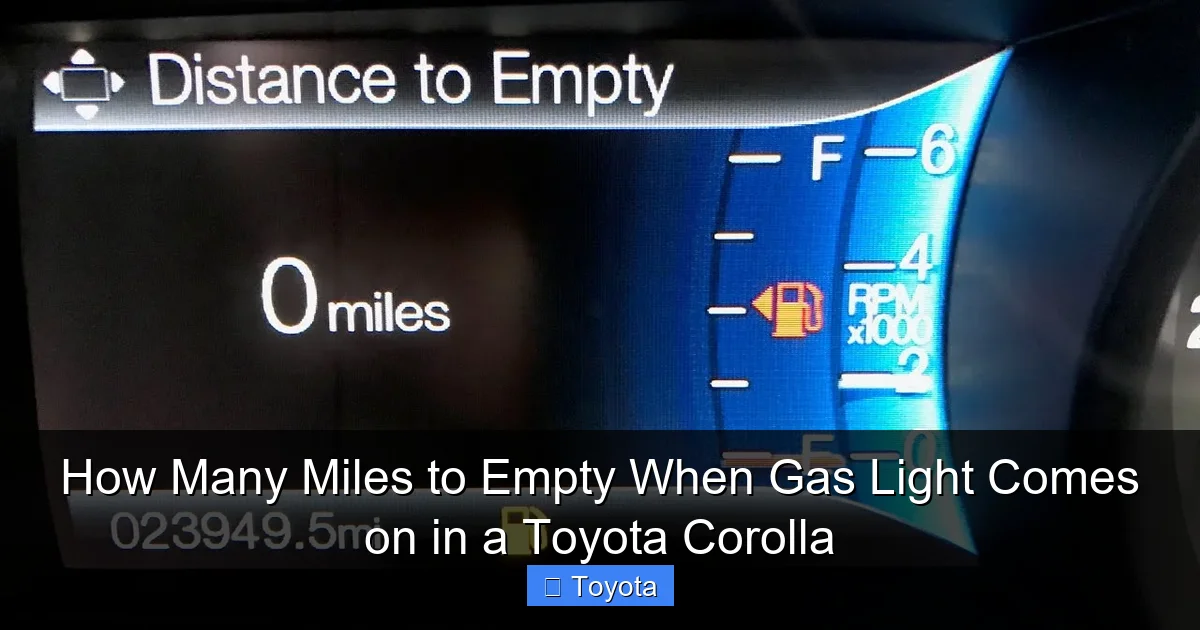
Many Corollas also feature a digital “Distance to Empty” or “Range” display on the multi-information screen. This is a dynamic calculation, not a static number. The ECU takes the reserve fuel volume (from the sensor) and divides it by your recent average fuel economy. If you’ve been cruising on the highway at 45 MPG, your DTE will be much higher than if you’ve been stuck in stop-and-go traffic at 20 MPG. This is why the number can fluctuate as you drive. The gas light, however, is usually a simpler trigger based purely on the sensor hitting the reserve level, not on your instantaneous MPG.
The All-Important Number: Estimated Miles After the Light Comes On
So, with that 1-2 gallon reserve, how many miles can you expect? We’ve gathered data from owner forums, technical service bulletins, and real-world testing to give you the most accurate picture.

Visual guide about How Many Miles to Empty When Gas Light Comes on in a Toyota Corolla
Image source: automadesimply.com
General Range Estimates by Model Generation
While individual results vary, here are the widely reported averages for different recent Corolla generations:
- E210 Generation (2019-Present): The current model, with its efficient 2.0L or 1.8L engine and CVT, typically shows a light-on range of 35 to 50 miles. Many owners report the DTE displaying around 40 miles when the light first illuminates.
- E170/E180 Generation (2014-2018): These models, featuring the 1.8L engine with a conventional automatic or CVT, are very consistent. Expect a reliable 30 to 45 mile range after the light comes on.
- Pre-2014 Models (e.g., E140): Older models with less efficient engines and 4-speed automatics might have a slightly smaller buffer, often in the 25 to 40 mile range. The fuel tank shape and sensor calibration also differ.
Critical Note: For a precise figure on your specific vehicle, the best method is empirical. Next time the light comes on, reset your trip odometer. Drive normally to a gas station and fill up. Note how many miles you drove from light-on to full tank. That’s your car’s true “miles to empty” under those conditions. Do this a couple of times for a solid average. You can also compare notes with owners of the same year and trim in forums; consistency is usually high within a model year.
Why the “Miles to Empty” Number is a Moving Target
Why can’t there be one perfect number? Because your driving is a living equation. The DTE and your actual range are heavily influenced by:
- Driving Style: Aggressive acceleration and hard braking can slash your fuel economy by 15-30% compared to gentle, predictable driving. This directly shaves miles off your reserve.
- Terrain & Traffic: Climbing steep hills or idling in heavy traffic uses more fuel per mile than cruising on a flat highway. Your range in city gridlock could be half of what it is on a rural highway.
- Vehicle Load & Accessories: Carrying extra weight (passengers, cargo) or using high-draw accessories like the A/C compressor (especially on max) increases engine load and fuel consumption.
- Tire Pressure: Under-inflated tires increase rolling resistance, significantly hurting fuel economy and thus your remaining range.
- Fuel Quality: Lower-quality or contaminated fuel can burn less efficiently. While a minor factor, it contributes to variability.
The Real Risks of Driving on “Fumes”
Knowing you have 40 miles left is useful information. Acting on it by routinely driving until the car is sputtering is a dangerous game with several costly consequences.
Visual guide about How Many Miles to Empty When Gas Light Comes on in a Toyota Corolla
Image source: i.ytimg.com
Fuel Pump Failure: The #1 Concern
The electric fuel pump in your Corolla is located inside the gas tank. This placement is intentional: the surrounding gasoline acts as a coolant and lubricant for the pump motor. When you consistently run the tank very low, the pump is no longer fully submerged. It runs hotter and with less lubrication, accelerating wear and dramatically shortening its lifespan. A failed fuel pump means your engine suddenly loses fuel pressure and stalls, often in an inconvenient or dangerous location. Replacing a fuel pump is an expensive repair, typically involving dropping the gas tank.
Sediment and Debris Ingestion
Over time, tiny particles of rust, dirt, and sediment can accumulate at the bottom of your fuel tank. The fuel filter is designed to catch this debris. When you drive on a nearly empty tank, the fuel pickup at the bottom of the tank starts sucking this concentrated slurry of sediment. This can clog the fuel filter instantly or, worse, send abrasive particles past the filter into your high-pressure fuel injectors. Injector damage or clogging leads to poor performance, misfires, and costly cleaning or replacement.
Catalytic Converter Damage
Running the engine extremely lean (due to fuel starvation) can cause the exhaust to run abnormally hot. This excess heat can damage the delicate catalytic converter, a critical emissions component that is very expensive to replace.
The Immediate Danger: Getting Stranded
The most obvious risk is simply running out of gas. This can leave you stalled in a dangerous location—on a highway shoulder, in an intersection, or in a high-crime area. It creates a major hazard for you and other drivers. Modern cars, when they completely run out of fuel, can also experience erratic behavior as the fuel pump cavitates (sucks air), making steering and braking more difficult.
Best Practices: How to Be a Smart Fuel Manager
Armed with this knowledge, how should you actually behave? The goal is to eliminate anxiety, protect your car, and never be stranded.

Visual guide about How Many Miles to Empty When Gas Light Comes on in a Toyota Corolla
Image source: shunauto.com
The 1/4 Tank Rule: Your New Mantra
The single most effective habit is to treat the 1/4 tank mark on your gauge as your personal “empty” indicator. Make it a rule to start looking for a gas station when you hit this point. This gives you a massive buffer—often 100+ miles in a Corolla—and ensures your fuel pump is almost always well-submerged and cool. It accounts for unexpected traffic, detours, or a closed gas station.
Understanding and Using Your DTE Display
Your “Distance to Empty” readout is a fantastic tool if used correctly. Do not treat it as a guarantee. See it as a “best-case, current-conditions estimate.” As your DTE number drops into the 20-30 mile range, start actively planning a fill-up. Remember, the DTE is based on your recent MPG. If you just finished a highway cruise, it might show 50 miles, but if you then enter city traffic, your actual range will be less. Use it as a prompt, not a promise.
Long-Term Storage and Seasonal Considerations
If you plan to store your Corolla for an extended period (several months), it’s wise to fill the tank completely. This reduces the amount of air (and moisture) in the tank, minimizing internal condensation and rust formation. For seasonal drivers who only use the car in summer, always start the season with a full tank. In very hot climates, keeping the tank fuller also reduces the risk of vapor lock, where fuel turns to vapor in the lines.
What to Do If You *Do* Run Out of Gas
If the engine sputters and dies and you suspect you’re out of fuel:
- Safely steer to the side of the road, away from traffic. Turn on your hazard lights.
- Do not try to restart the engine repeatedly. This can draw more air and sediment into the system.
- If you have a spare gas can and it’s safe to walk to a station, add 1-2 gallons of fresh fuel.
- Wait 5-10 minutes for any sediment to settle and for the fuel pump to prime.
- Turn the ignition to “ON” (but don’t start) for a few seconds to let the pump pressurize, then try to start. If it starts, drive immediately and calmly to a gas station and fill the tank completely.
- If it won’t start, call for roadside assistance. Explain you are out of gas. Do not attempt to siphon fuel from another car.
Comparing the Corolla to Other Toyota Models
Is the Corolla’s range unique? Not really. The gas light trigger logic is similar across Toyota’s lineup, but the actual miles vary with tank size and efficiency.
Corolla vs. Camry
The larger Toyota Camry has a bigger gas tank (approx. 15.8 gallons vs. Corolla’s 13.2) but a less efficient engine (in most trims). Therefore, when the light comes on, the Camry’s reserve is larger in gallons (often 2.0-2.5), but the MPG is lower. The net result? The miles to empty are strikingly similar, often also in the 30-50 mile range. For a deep dive on the Camry’s specific numbers, you can read our detailed comparison here.
Corolla vs. RAV4 & Sienna
Larger SUVs and minivans like the RAV4 and Sienna have even larger tanks. The RAV4 Hybrid, for example, might have a 2+ gallon reserve. However, their lower average MPG (even hybrids in city driving) means the “miles to empty” often converge in the same 30-50 mile ballpark as the efficient Corolla. A Sienna, being a heavy minivan, might have a slightly lower range despite a big tank. The principle remains constant: the warning is for a reserve, not a primary driving range.
Conclusion: Peace of Mind Over Mileage Maximization
Your Toyota Corolla is a marvel of reliability and efficiency. The gas light coming on is a helpful, if slightly stressful, part of that system. The consensus from engineering, mechanics, and decades of owner experience is clear: you have approximately 30 to 50 miles of safe, designed-in reserve. But the true takeaway isn’t to memorize that number. It’s to adopt a proactive habit. Use the light as your final reminder, not your first cue. By refueling at a quarter tank, you protect your fuel pump, keep your engine clean, eliminate “range anxiety,” and ensure your Corolla is always ready for the next adventure without a hiccup. Treat your fuel level with the same respect you give your oil changes and tire rotations—it’s a fundamental part of long-term, worry-free ownership. The few extra minutes spent at a gas station are a tiny price to pay for avoiding a costly repair or a dangerous situation on the roadside.
Frequently Asked Questions
Is it bad to drive my Corolla with the gas light on?
Occasional driving for 10-20 miles after the light comes on is generally fine. However, making a habit of it is bad. It causes your fuel pump to overheat and can suck sediment from the tank bottom into your engine, leading to premature wear and expensive repairs. Always try to refuel soon after the light illuminates.
Does the “Distance to Empty” number reset when I fill up?
Yes, the DTE display resets and recalculates each time you fill your tank. It begins with your full tank capacity divided by your car’s rated MPG for that model. As you drive, it continuously updates based on your actual, real-time fuel economy, so it becomes more accurate the longer you drive before the next fill-up.
My Corolla’s gas light came on, but the DTE says 60 miles. Is that possible?
Yes, that’s possible and actually illustrates how the two systems work. The gas light is triggered by a simple fuel level sensor hitting a fixed “reserve” point. The DTE is a calculation (reserve gallons / your recent MPG). If you just drove a long, efficient highway stretch, your recent MPG could be very high (e.g., 45 MPG), making the DTE number larger (2 gallons / 45 MPG = ~90 miles). The light is still a more urgent, binary warning that your reserve is activated.
What’s the absolute minimum I should let my tank go?
Never let your Corolla drop below the 1/4 tank mark on the gauge. This provides a crucial safety buffer. If the light comes on, you should plan to refuel within the next 10-15 miles. This protects your fuel pump and ensures you have plenty of range for unexpected delays or a closed gas station.
Can low fuel cause my Corolla’s check engine light to come on?
Rarely, but it’s possible. An extremely low fuel level can cause the engine to run lean or sporadically, which might trigger a lean-fuel mixture code. More commonly, a faulty fuel level sensor (which is what triggers the gas light) can itself cause a check engine light with a code like P0461 (Fuel Level Sensor Circuit). If both lights come on together, get the sensor checked.
Does using the A/C drastically reduce my miles after the gas light?
Yes, the A/C compressor places a significant load on the engine, increasing fuel consumption by up to 20% or more depending on outside temperature and cooling demand. This directly reduces your remaining “miles to empty.” On a hot day with the A/C on max, your actual range after the light comes on could be noticeably less than your calculated average. Factor this in when the light comes on in summer.