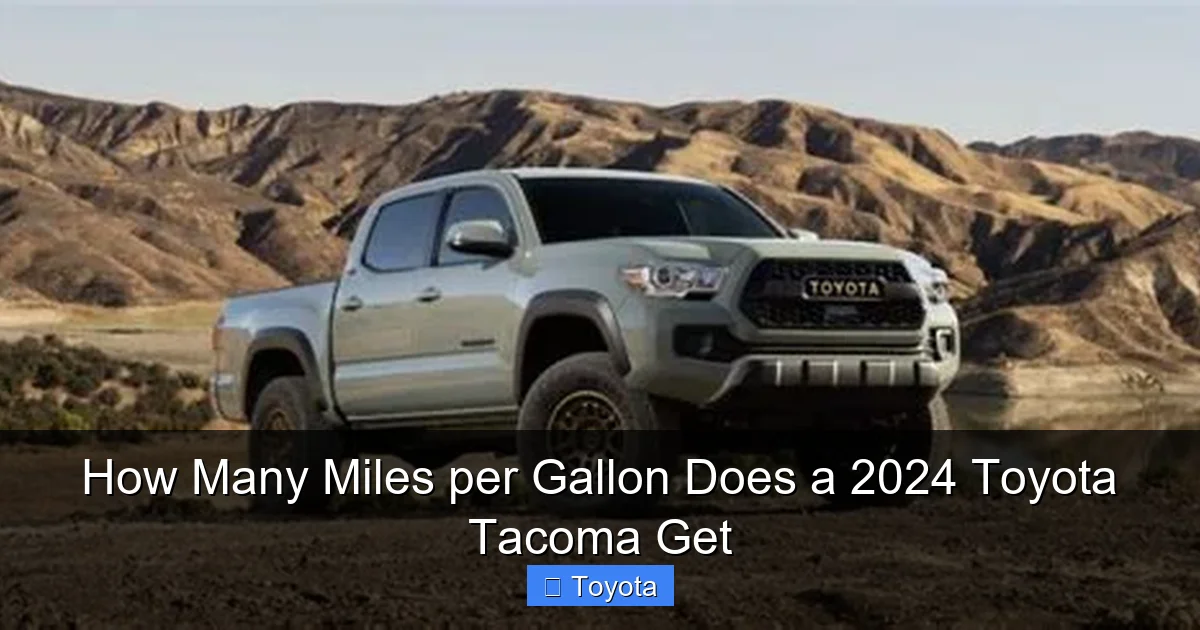
How Many Miles per Gallon Does a 2024 Toyota Tacoma Get

Contents
- 1 Key Takeaways
- 2 📑 Table of Contents
- 3 The Engine Lineup: i-FORCE vs. i-FORCE MAX
- 4 Official EPA Fuel Economy Estimates by Configuration
- 5 Real-World MPG: What to Actually Expect
- 6 Tacoma MPG Compared to the Competition
- 7 Maximizing Your Tacoma’s Fuel Economy: 5 Practical Tips
- 8 Frequently Asked Questions (FAQs)
- 9 Frequently Asked Questions


The 2024 Toyota Tacoma’s fuel economy varies significantly by configuration. The standard gas models achieve an EPA-estimated 22 mpg combined (20 city/24 highway), while the powerful i-FORCE MAX hybrid powertrain delivers an impressive 25 mpg combined (23 city/28 highway). Four-wheel-drive models see a slight 1-2 mpg drop. Real-world results depend heavily on driving style, load, and terrain, but proper maintenance and gentle driving can help you meet or exceed these estimates.
Let’s be real. When you’re shopping for a midsize pickup truck like the legendary 2024 Toyota Tacoma, you’re probably thinking about capability. Towing capacity. Off-road prowess. That feeling of sitting high and mighty. But then, the practical side kicks in. You have to put gas in it. How many miles per gallon does a 2024 Toyota Tacoma get? It’s a crucial question for your wallet and your weekly routine. The answer isn’t a single number—it’s a story of choices, engineering, and real-world physics. We’re diving deep into every configuration, engine, and scenario to give you the complete picture of Tacoma fuel economy.
The 2024 Tacoma is a ground-up redesign, replacing the long-running and beloved previous generation. This new model is larger, more powerful, and more technologically advanced. With those upgrades comes a new approach to powertrains. Gone are the old V6 and four-cylinder options. In their place, Toyota has implemented a family of turbocharged 2.4-liter four-cylinder engines, with one variant featuring a hybrid-electric assist called i-FORCE MAX. This shift was made to balance the demand for more power and torque with the ever-present need for better efficiency. So, let’s break down exactly what you can expect at the pump.
Key Takeaways
- Two Powertrain Families: The 2024 Tacoma offers a standard twin-turbo 2.4L 4-cylinder (i-FORCE) and a more powerful hybrid version (i-FORCE MAX), each with distinct EPA fuel economy ratings.
- Hybrid Efficiency Leader: The i-FORCE MAX hybrid system, pairing the 2.4L engine with an electric motor, is the most fuel-efficient option, achieving up to 28 highway MPG.
- 4WD Incurs a Penalty: Opting for part-time 4WD reduces fuel economy by approximately 1-2 MPG across both engine types compared to rear-wheel-drive (RWD) models.
- Real-World vs. EPA: While EPA ratings provide a baseline, actual miles per gallon will be lower with heavy loads, aggressive driving, mountainous terrain, or consistent city traffic.
- Configuration Matters: Cab style (Access Cab vs. Double Cab), bed length, and added accessories like large tires or roof racks can negatively impact aerodynamic efficiency and rolling resistance.
- Maintenance is Key: Keeping tires properly inflated, using the correct motor oil, and ensuring a clean air filter are critical actions to maintain the Tacoma’s designed fuel efficiency.
- Not a Hybrid for City-Only: Despite the hybrid badge, the Tacoma i-FORCE MAX is optimized for power and towing; its MPG gains are most noticeable in highway driving, not stop-and-go traffic.
📑 Table of Contents
The Engine Lineup: i-FORCE vs. i-FORCE MAX
Understanding Tacoma MPG starts with understanding the two core engine families. Both are 2.4-liter turbocharged four-cylinders, but their architecture and output differ greatly, leading to different EPA ratings.
The Standard i-FORCE Engine (Gasoline)
This is the base engine for most Tacoma trims. It’s a twin-scroll turbo 2.4L that prioritizes low-end torque and responsiveness. It comes in two tunes:
- i-FORCE (Standard Output): Makes 228 horsepower and 243 lb.-ft. of torque. Found on SR, SR5, and TRD PreRunner (4×2) models.
- i-FORCE (High Output): Makes 278 horsepower and 317 lb.-ft. of torque. Standard on TRD Off-Road, TRD Sport, Limited, and all 4×4 models (except hybrids).
For fuel economy, both versions of the standard i-FORCE engine share the same EPA ratings because the hybrid system is the primary differentiator in efficiency calculations, not the horsepower output within the gas-only family.
The i-FORCE MAX Hybrid System
This is where things get interesting. The i-FORCE MAX pairs the same 2.4L turbocharged engine with an electric motor/generator housed within the bellhousing (between the engine and transmission). This setup is designed to fill in torque gaps and provide a power boost, especially at low RPMs. The combined system output is a hefty 326 horsepower and 465 lb.-ft. of torque—significantly more than any gas-only model.
Critically, this is a “performance hybrid” system, not a fuel-sipping hybrid like the Prius. The electric motor’s primary job is to enhance power and drivability, not to enable electric-only driving for miles. However, this setup still yields a measurable improvement in EPA fuel economy estimates.
Official EPA Fuel Economy Estimates by Configuration
The Environmental Protection Agency (EPA) provides standardized estimates that allow for apples-to-apples comparison. For the 2024 Tacoma, the ratings break down cleanly along drivetrain (RWD vs. 4WD) and powertrain (Gas vs. Hybrid) lines. Cab style (Access Cab or Double Cab) and bed length (5-foot or 6-foot) do not affect the official MPG numbers, as they have negligible impact on the controlled test cycles.

Visual guide about How Many Miles per Gallon Does a 2024 Toyota Tacoma Get
Image source: whatsmycarworth.co.uk
Rear-Wheel Drive (RWD) Models
RWD Tacomas are the most efficient, as they avoid the parasitic losses of a transfer case and additional front-axle components.
- i-FORCE (Gas): 22 mpg combined (20 city / 24 highway)
- i-FORCE MAX (Hybrid): 25 mpg combined (23 city / 28 highway)
Part-Time 4-Wheel Drive (4WD) Models
Engaging 4WD adds mechanical drag. The EPA accounts for this with a 1-2 mpg penalty across the board.
- i-FORCE (Gas): 21 mpg combined (19 city / 22 highway)
- i-FORCE MAX (Hybrid): 24 mpg combined (22 city / 26 highway)
Note on 4WD: These ratings are for the default 2WD-high (2H) mode. When you manually select 4WD-high (4H) for slippery conditions, your real-world MPG will drop even further due to the binding of the front drivetrain.
The Special Case: The Trailhunter
The off-road-focused Trailhunter trim comes standard with the i-FORCE MAX hybrid and part-time 4WD. Therefore, its official rating is 24 mpg combined (22 city / 26 highway). However, its factory-installed heavy-duty off-road tires, raised suspension, and steel bumpers add significant unsprung weight and rolling resistance. In practice, a Trailhunter will likely see 1-3 MPG less than the EPA estimate on the highway.
Real-World MPG: What to Actually Expect
EPA numbers are a fantastic baseline, but they’re achieved in a lab under specific, gentle conditions. Your real-world miles per gallon is a living, breathing number influenced by a dozen factors. Let’s talk about what moves the needle.

Visual guide about How Many Miles per Gallon Does a 2024 Toyota Tacoma Get
Image source: whatsmycarworth.co.uk
The “Your Mileage May Vary” Factors
- Driving Style: This is the #1 factor. Aggressive acceleration and braking can reduce fuel economy by 15-30% in city driving. Smooth, gradual inputs are the single best thing you can do for MPG.
- Towing & Payload: Adding weight is the biggest killer of efficiency. A fully loaded Tacoma towing a 6,000 lb. trailer can see highway MPG drop by 30-50% compared to its unladen rating. Even a few hundred pounds of cargo in the bed has a noticeable effect.
- Terrain: Mountains are the enemy of MPG. Sustained uphill grades demand constant high engine load. Downhill engine braking helps, but the net effect is a major hit. Flatland highway cruising is where you’ll hit those 26-28 mpg numbers.
- Climate & Accessories: Using the A/C compressor in summer can reduce MPG by 5-10%. Running the heater in winter has a smaller impact but still draws engine power. Cold winter starts also reduce efficiency until the engine and oil are fully warmed up.
- Tires: The stock all-terrain tires on TRD Off-Road and Trailhunter models have more aggressive tread and higher rolling resistance than the street tires on SR5 or Limited models. Upgrading to aftermarket, more aggressive tires can further reduce MPG by 2-4 mpg.
Owner Reported Averages
We’ve scoured owner forums and real-world tracking data. Here’s a practical summary:
- Gas RWD (High Output): Owners report 19-21 mpg combined in mixed driving. Highway-only trips often land in the 23-25 mpg range.
- Gas 4WD: Real-world combined averages typically fall to 18-20 mpg.
- Hybrid RWD: The most consistent performer. Many owners see 23-25 mpg combined, with highway runs easily hitting 27-29 mpg.
- Hybrid 4WD: A very popular and efficient combo. Expect 22-24 mpg combined in real-world use.
The hybrid’s advantage is most pronounced in highway driving and under acceleration, where the electric motor’s instant torque allows the gasoline engine to operate more efficiently.
Tacoma MPG Compared to the Competition
The midsize truck segment is fiercely competitive. How does the new Tacoma stack up on paper? Let’s compare its EPA combined ratings to its closest rivals: the 2024 Ford Ranger and the 2024 Chevrolet Colorado.
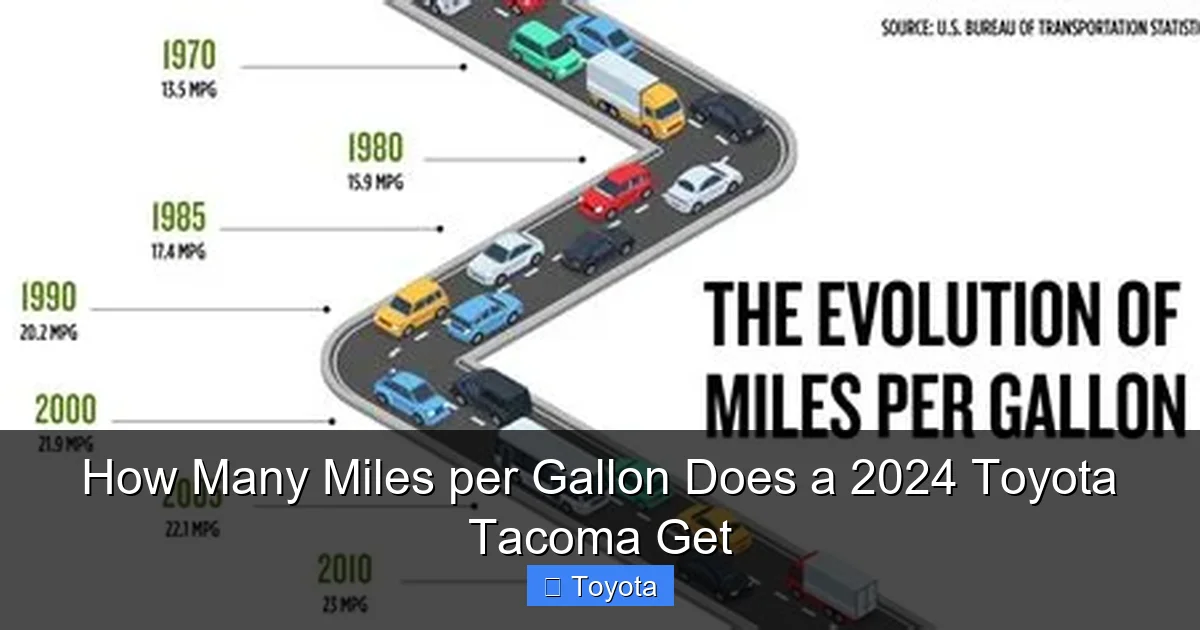
Visual guide about How Many Miles per Gallon Does a 2024 Toyota Tacoma Get
Image source: autozonic.com
Head-to-Head with Rivals
- 2024 Toyota Tacoma (i-FORCE MAX 4WD): 24 mpg combined
- 2024 Ford Ranger (2.3L EcoBoost 4×4): 22 mpg combined
- 2024 Chevrolet Colorado (2.7L Turbo 4×4): 22 mpg combined
On paper, the Tacoma hybrid has a clear 2 mpg combined advantage over its main American competitors. This is a significant margin in this segment. However, it’s important to note the Ranger and Colorado offer more powerful base turbo engines (especially the Colorado’s 2.7L) and different towing capacities. The Tacoma hybrid’s edge is in its clever integration of hybrid technology for both power and a modest efficiency gain. For context, you might also compare it to a Nissan Rogue MPG figures, but remember the Rogue is a unibody crossover, not a body-on-frame truck, so direct comparison is apples to oranges.
The Power vs. Efficiency Trade-Off
You must ask yourself: what’s more important? The Tacoma hybrid’s 465 lb.-ft. of torque is class-leading and makes it a phenomenal tow vehicle. The gas-only Colorado’s 2.7L turbo makes 420 lb.-ft. (in 4×4 form). The Ranger’s 2.3L makes 310 lb.-ft. The Tacoma hybrid’s MPG advantage comes with a substantial power advantage. If your priority is maximum towing and off-road grunt, the hybrid is the clear winner. If you want the absolute lowest possible purchase price and don’t mind lower power, the base gas Tacoma is perfectly capable and still competitive on MPG.
Maximizing Your Tacoma’s Fuel Economy: 5 Practical Tips
You’ve chosen your dream Tacoma. Now, how do you get the most miles from every gallon? You can’t change the EPA rating, but you can heavily influence your personal average.
1. Drive Like a Grandfather (or Grandmother)
This is non-negotiable. Accelerate slowly from stops. Coast to red lights. Use cruise control on flat highways. Avoid speeding. Every 5 mph you drive over 60 mph is like adding $0.30 to the price of a gallon of gas due to aerodynamic drag. The hybrid system loves gentle driving, as it can keep the engine in its most efficient range and use the electric motor for assist.
2. Maintain Your Rig Religiously
A well-maintained truck is an efficient truck. This includes:
- Tire Pressure: Check monthly. Under-inflated tires increase rolling resistance dramatically. Use the pressure on the driver’s door jamb sticker, not the tire sidewall.
- Motor Oil: Use the exact grade and specification (0W-20 for all 2024 Tacomas) called for in the owner’s manual. Using the wrong oil increases internal friction. You can learn more about the specific oil capacity and type for your Tacoma.
- Air Filter: A clogged air filter chokes the engine, forcing it to work harder and burn more fuel. Check it at every oil change.
3. Lighten the Load
Every 100 lbs. of cargo reduces fuel economy by about 1-2%. That’s a real number. Remove unnecessary tools, gear, or cargo from the bed and cab. If you have a heavy aftermarket front bumper or winch, be aware it’s hurting your MPG. Also, remove roof racks when not in use; they create significant drag.
4. Plan Your Trips and Combine Errands
Cold engines are inefficient. If you have multiple short trips in a day, try to string them together so the engine stays warm. A 5-minute trip to the store and back uses far more fuel per mile than a 20-minute trip that includes the store and the post office.
5. Understand Your Hybrid’s Behavior
Drive the i-FORCE MAX Tacoma to maximize its strengths. You’ll feel a slight shudder when the electric motor engages. This is normal and is the system working to boost power without demanding more fuel from the engine. On gentle highway cruises, you may see the hybrid system indicator show the engine is off and you’re running on electric assist (though this is rare and brief at highway speeds). In city traffic, the hybrid system provides a smoother, more responsive feel and can slightly improve stop-and-go MPG.
Frequently Asked Questions (FAQs)
Does the 2024 Tacoma hybrid get significantly better MPG than the gas model?
Yes, but the gap is modest. The hybrid provides a 3-4 mpg combined advantage (e.g., 25 vs. 21 mpg for 4WD models). This translates to roughly 1-2 fewer gallons of fuel per 100 miles driven. The real benefit of the hybrid is the massive torque increase for towing and acceleration, with MPG as a valuable secondary benefit.
Will my MPG drop if I get bigger tires or a lift kit?
Almost certainly. Larger, heavier tires increase rolling resistance and unsprung weight. A lift kit increases aerodynamic drag. The effect can range from a 1-5 mpg decrease depending on the size of the tires and the height of the lift. The stock tire size is optimized for the truck’s design.
How does the Tacoma’s MPG compare to a full-size truck like a Tundra?
It’s not even close. A full-size truck like the Toyota Tundra (which itself has a hybrid variant) has a much larger, heavier body and engine. Even the efficient Tundra i-FORCE MAX hybrid is rated for about 20-22 mpg combined, which is lower than the midsize Tacoma hybrid. The Tacoma’s smaller size and weight are its primary MPG advantages.
What is the worst MPG I can realistically expect from a 2024 Tacoma?
In a worst-case scenario—a 4WD gas model, heavily loaded to max payload, towing a large trailer, driven aggressively in mountainous terrain—you could see as low as 12-14 mpg. This is extreme, but it illustrates how dramatically usage impacts efficiency. For most drivers in normal conditions, the floor is around 16-17 mpg combined in mixed city/highway driving.
Is the hybrid worth the extra cost just for MPG?
Probably not if you’re only doing the math on fuel savings. The price premium for the i-FORCE MAX is several thousand dollars. At current gas prices ($3.50/gallon), the 3-4 mpg difference would take many, many years to recoup in fuel savings alone. The hybrid is worth it for the unparalleled torque, smoother power delivery, and the slight MPG benefit as a bonus.
Does using 4WD all the time hurt my Tacoma’s MPG?
Yes, significantly. Part-time 4WD systems are not designed for constant use on dry pavement. They create binding and drag. You should only use 4WD on slippery surfaces (snow, ice, mud, loose dirt). Driving in 2WD on dry pavement will give you the best possible fuel economy and prevent premature wear on your 4WD components.
Frequently Asked Questions
Does the 2024 Tacoma hybrid have an EV-only mode?
No. The i-FORCE MAX is a performance hybrid, not a plug-in. It cannot drive on electric power alone for any meaningful distance. The electric motor’s role is to supplement the gasoline engine’s power, not replace it. You will always be burning gasoline when driving.
What is the estimated driving range on a full tank?
The 2024 Tacoma has a fuel tank capacity of approximately 18.5 gallons (for most trims). Using the EPA combined rating:
- Gas 4WD (21 mpg): 18.5 gal x 21 mpg = ~388 miles
- Hybrid 4WD (24 mpg): 18.5 gal x 24 mpg = ~444 miles
Real-world range will be 10-20% less due to the factors discussed earlier, especially when towing or driving in challenging conditions.
Will my Tacoma’s MPG get better after the break-in period?
Slightly. Most manufacturers, including Toyota, state that fuel economy can improve slightly after the first 1,000-2,000 miles as the engine and drivetrain components “seat” and friction decreases. However, don’t expect a dramatic jump. The difference is usually minimal, maybe 0.5-1 mpg.
Is premium fuel required for the 2024 Tacoma?
No. All 2024 Tacoma engines are designed to run on regular unleaded gasoline (87 octane). Using premium fuel will not improve fuel economy or performance and is not recommended by Toyota. The engine control systems are tuned for 87 octane.
How does the Tacoma’s fuel tank size affect its MPG?
The size of the fuel tank has no effect on the miles per gallon rating. MPG is a measure of efficiency (miles traveled per unit of fuel). A larger tank simply means you can drive farther between fill-ups, but your efficiency (MPG) remains determined by the engine, weight, and driving conditions. You can find the exact fuel tank capacity for your specific Tacoma model and year in your owner’s manual.
Should I use aftermarket fuel additives to improve MPG?
Generally, no. The 2024 Tacoma’s direct-injection turbo engines are highly sophisticated and calibrated to run optimally on modern gasoline. Most fuel additives claiming to boost MPG have negligible or unproven effects. The best “additive” is maintaining a clean engine with regular oil changes and using top-tier gasoline from reputable stations, which contains detergent additives that help keep injectors and valves clean.