How Many Miles Does a Toyota Camry Get on a Full Tank?

Contents
- 1 Key Takeaways
- 2 📑 Table of Contents
- 3 Understanding the Fuel Range Formula: Tank Size x MPG
- 4 The Reality Check: Why Your Real-World Range Will Be Lower
- 5 The Gas Light: Your Final Warning and How Far You Can Still Go
- 6 Model Year Deep Dive: How Specifications Have Evolved
- 7 Maximizing Your Camry’s Range: Practical, Actionable Tips
- 8 Conclusion: Your Camry’s Range is a Personal Metric
- 9 Frequently Asked Questions


The number of miles a Toyota Camry can travel on a full tank depends primarily on its gas tank size (14.0 to 15.8 gallons) and its fuel efficiency (up to 53 MPG for hybrids). A typical modern Camry with a 15.8-gallon tank and a combined 32 MPG rating can theoretically cover about 506 miles. However, real-world range varies significantly based on driving habits, terrain, vehicle load, and weather conditions. The gas light typically comes on with 30-50 miles of reserve fuel remaining.
So, you’re planning a road trip or just wondering how far you can go before needing to stop for gas. It’s one of the most practical questions a Camry owner—or buyer—can ask. The short answer is: it depends. While we can give you solid estimates, the true “miles on a full tank” for your Toyota Camry is a personal number shaped by your specific car, your driving style, and your environment. Let’s pop the hood and break down every single factor that determines your range, from the size of the metal box under your car to the weather outside your window.
Key Takeaways
- Tank Size is Key: Modern Toyota Camry gas tanks hold between 14.0 and 15.8 gallons, with hybrids often using the larger tank.
- MPG Varies Widely: Fuel efficiency ranges from 21 MPG (V6) to 53 MPG (Hybrid LE), drastically changing your potential range per tank.
- Hybrids Offer Superior Range: The Camry Hybrid’s exceptional MPG means a single tank can potentially take you over 800 miles under ideal conditions.
- The Gas Light is a Warning, Not Empty: You typically have 1.0 to 1.5 gallons (30-50 miles) of reserve fuel after the low fuel indicator illuminates.
- Real-World ≠ EPA Estimates: Your actual miles per tank will be lower than EPA calculations due to city driving, AC use, altitude, and cargo weight.
- Model Year Matters: Tank capacity and engine options have changed slightly across generations, so always check your specific model’s specifications.
📑 Table of Contents
- Understanding the Fuel Range Formula: Tank Size x MPG
- The Reality Check: Why Your Real-World Range Will Be Lower
- The Gas Light: Your Final Warning and How Far You Can Still Go
- Model Year Deep Dive: How Specifications Have Evolved
- Maximizing Your Camry’s Range: Practical, Actionable Tips
- Conclusion: Your Camry’s Range is a Personal Metric
Understanding the Fuel Range Formula: Tank Size x MPG
At its core, calculating your maximum potential range is simple math: Gas Tank Capacity (in gallons) multiplied by Your Average Miles Per Gallon (MPG). If your tank holds 15 gallons and you average 30 MPG, that’s a theoretical 450 miles. But this is where things get interesting—and where those two variables become moving targets.
The First Variable: How Big is the Camry’s Gas Tank?
This seems straightforward, but tank size isn’t identical across all Camry models and years. For the current (2024) model generation, here’s the breakdown:
- Gasoline-Only Models (LE, SE, XLE, XSE, TRD): These typically have a 15.8-gallon tank.
- Hybrid Models (LE, SE, XLE): Interestingly, the hybrid versions also use a 15.8-gallon tank to maximize their incredible range potential.
- Previous Generations (2018-2021): Most trims also featured a 15.8-gallon tank, though some early hybrid models of prior gens had a slightly smaller 14.5-gallon tank. You can always find your exact tank size by searching for your VIN or checking how many gallons a Toyota Camry holds in your specific model year.
So, for our calculations, we’ll primarily use the standard 15.8-gallon figure unless specifying an older model. It’s the most common size for the last decade.
The Second Variable: What MPG Does Your Camry Actually Get?
This is the bigger variable. Toyota advertises EPA-estimated MPG, which is a useful baseline but not a guarantee. Your real-world MPG is a dance between your engine and your right foot. Let’s look at the official EPA ratings for the current model year to establish the ceiling:
- Camry 2.5L 4-Cylinder (Most Common): Up to 28 MPG City / 39 MPG Highway / 32 MPG Combined.
- Camry 3.5L V6: Up to 22 MPG City / 33 MPG Highway / 26 MPG Combined.
- Camry Hybrid 2.5L: This is the star. Up to 51 MPG City / 53 MPG Highway / 52 MPG Combined for the LE trim. The XLE is rated at 47/47/47 MPG.
Using the EPA combined rating and a 15.8-gallon tank, here are the theoretical maximum ranges:
- 4-Cylinder (32 MPG): 15.8 gal x 32 MPG = ~506 miles.
- V6 (26 MPG): 15.8 gal x 26 MPG = ~411 miles.
- Hybrid LE (52 MPG): 15.8 gal x 52 MPG = ~822 miles.
Those hybrid numbers are staggering, aren’t they? It’s why the Camry Hybrid is a legend for long-distance commuters and road trippers. But before you start planning an 800-mile non-stop journey, we must talk about reality.
The Reality Check: Why Your Real-World Range Will Be Lower
Those EPA numbers are achieved in controlled lab conditions on a treadmill, not on I-95 with the AC blasting and a roof rack full of luggage. Your actual MPG—and thus your miles per tank—is influenced by dozens of daily factors. Understanding these helps you set realistic expectations and maybe even improve your range.

Visual guide about How Many Miles Does a Toyota Camry Get on a Full Tank?
Image source: autozonic.com
Driving Style: The #1 Fuel Hog
How you drive matters more than almost anything else. Aggressive acceleration and hard braking can slash your fuel economy by 15-30% in city driving. Jackrabbit starts from a stoplight burn precious fuel. The Camry is designed for smooth, efficient cruising. Gentle acceleration, anticipating traffic flow, and using cruise control on flat highways are the secrets to getting closer to that EPA number. If you drive with a lead foot, your 32 MPG combined could easily drop to 26 or 27, turning a 500-mile theoretical range into a 410-mile reality.
City vs. Highway: The Great Divide
Stop-and-go traffic is the enemy of efficiency. Your engine works hardest at low speeds, and you’re constantly using energy to move from 0 to 30 mph. The EPA’s combined rating is a weighted average (usually 55% city, 45% highway for older tests, now a more realistic 50/50 split). If your commute is 90% city, your effective MPG could be 4-6 points below the combined rating. Conversely, a long, flat highway cruise at a steady 65-70 mph is where the Camry shines, often exceeding its EPA highway number. A mixed commute will land you somewhere in between.
Weather and Terrain: The Hidden Range Killers
Cold weather is a double whammy. Your engine takes longer to reach its optimal operating temperature, running richer (using more fuel) during warm-up. Winter fuel blends are also less energy-dense. Plus, you’re likely using the heater and defroster constantly, which puts a load on the engine (in gas models) or the hybrid battery. Hot weather means relentless air conditioning, which can reduce MPG by 5-10%. Hills and mountains force your engine to work against gravity, significantly increasing fuel consumption on inclines and not fully recovering on descents. Driving from Denver to Aspen will give you a much lower MPG than driving across Kansas.
Vehicle Load and Maintenance
That 100 lbs of gear in the trunk? It matters. Every extra 100 pounds reduces MPG by about 1-2%. A fully loaded Camry with 5 people and a rooftop carrier is a different vehicle than an empty sedan. Proper maintenance is non-negotiable for range. Under-inflated tires (even 5 PSI low) increase rolling resistance. Dirty air filters restrict airflow. Old spark plugs misfire. Stale oil increases friction. A well-maintained Camry will consistently perform closer to its potential. You might also wonder how your specific model’s capacity compares to other Toyotas. For instance, the larger Toyota RAV4’s gas tank size is similar, but its MPG is lower, affecting its overall range.
The Gas Light: Your Final Warning and How Far You Can Still Go
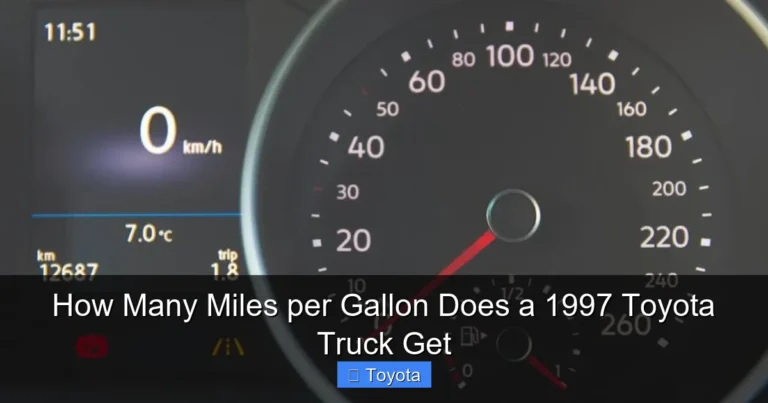
This is a point of immense curiosity and often, anxiety. That little orange fuel pump icon illuminates on your dashboard. How long do you have? Toyota doesn’t publish an exact “reserve distance” because it depends on your recent driving efficiency. However, we can rely on owner consensus and engineering principles.
Visual guide about How Many Miles Does a Toyota Camry Get on a Full Tank?
Image source: i.ytimg.com
Decoding the Reserve
When the gas light comes on, you are not running on fumes. There is a deliberate reserve. Most estimates from owners and mechanics suggest the Camry’s low fuel light activates when there is approximately 1.0 to 1.5 gallons of fuel remaining in the tank. This is a safety buffer to prevent you from being stranded due to fuel gauge inaccuracy or unexpected detours.
The Million-Dollar Question: Miles After the Light
So, how many miles is 1.0 to 1.5 gallons? It’s a direct function of your current MPG. Using our earlier examples:
- At 30 MPG: 1.25 gallons (average reserve) x 30 MPG = ~37-38 miles.
- At 25 MPG (poor city driving): 1.25 gal x 25 MPG = ~31 miles.
- At 50 MPG (Hybrid on highway): 1.25 gal x 50 MPG = ~62 miles.
Therefore, a safe, general rule of thumb for a standard gas Camry is to assume you have 30 to 50 miles after the light comes on. For the hybrid, that buffer could be 50-70 miles. This is not an invitation to test your luck. It’s a margin for error to find a station. Consistently driving until you’re nearly empty can strain your fuel pump (which is cooled by gasoline) and risk sediment from the tank bottom entering your fuel system. If you frequently push this limit, you should read how many miles you can really drive when the gas light comes on to understand the risks and mechanics better.
Model Year Deep Dive: How Specifications Have Evolved
While the current generation (2018+) has largely standardized on the 15.8-gallon tank, it wasn’t always the case. If you own or are shopping for an older Camry, here’s what you need to know.
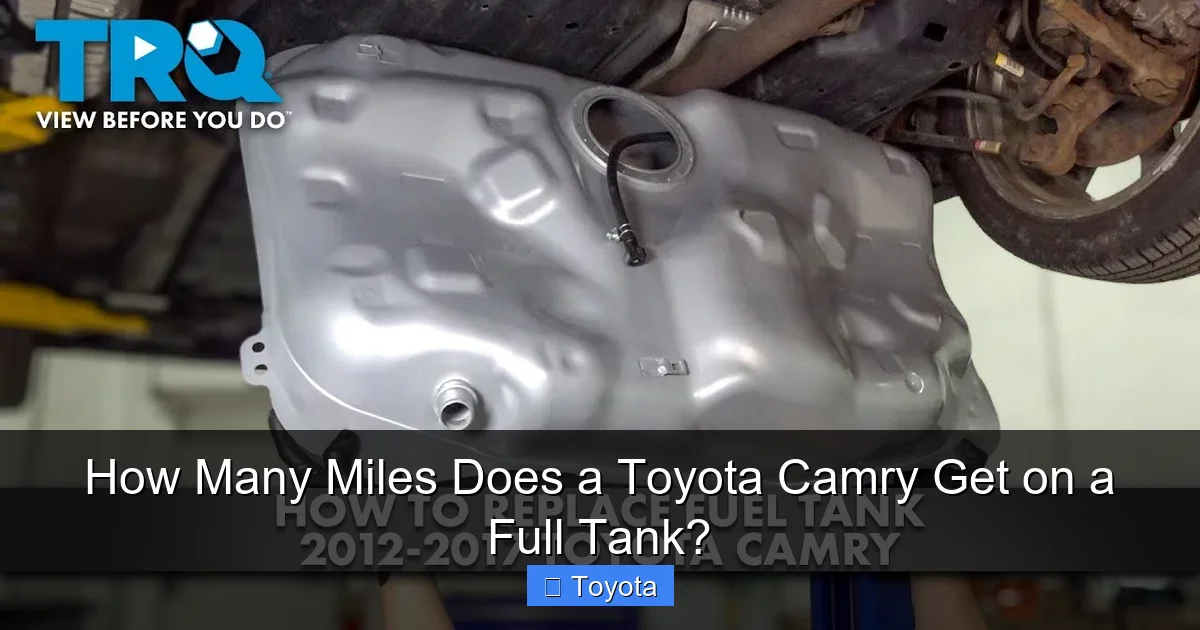
Visual guide about How Many Miles Does a Toyota Camry Get on a Full Tank?
Image source: vehiclerides.com
Seventh Generation (2007-2011)
These models commonly had a 17.0-gallon tank! That’s significantly larger than today’s. With a 4-cylinder engine rated at about 21-23 MPG combined, the theoretical range was similar to or slightly less than a modern 4-cylinder Camry, despite the bigger tank, because the engines were less efficient. The V6 models of this era had abysmal MPG (around 19-20 combined), so the large tank was a necessary evil to avoid constant refueling.
Sixth Generation (2002-2006)
Tank sizes varied by trim, but many were around 17.0 gallons as well. Fuel economy was generally worse across the board. The introduction of the first Camry Hybrid in 2006 for the 2007 model year started the efficiency revolution, but the early hybrid’s tank was smaller at 17.0 gallons.
The Shift to Efficiency
The move to the current eighth-generation platform brought a focus on weight reduction and efficiency. Engineers found they could meet range requirements with a slightly smaller, lighter tank (15.8 gal) because the engines were so much more efficient. The hybrid’s incredible MPG means it doesn’t need a giant tank to achieve massive range. So, when comparing an old Camry to a new one, don’t just look at tank size—look at the MPG delta. A 2024 Hybrid with a 15.8-gallon tank will utterly dominate a 2008 V6 with a 17-gallon tank in terms of miles between fill-ups.
Maximizing Your Camry’s Range: Practical, Actionable Tips
You can’t change your tank size or your engine, but you can absolutely control your real-world MPG. Here is your actionable checklist to squeeze every last mile from your full tank.
Driving Techniques That Save Fuel
- Drive Smoothly: This is the golden rule. Accelerate slowly, brake gently, and maintain a steady speed. Imagine there’s a glass of water on your dashboard—don’t spill it.
- Use Cruise Control on Flat Highways: Maintaining a constant speed is far more efficient than the tiny speed fluctuations your foot creates.
- Observe the “Sweeper” Rule: On hilly roads, maintain momentum. Speed up slightly before a hill so you don’t have to heavily accelerate on the incline. Coast down the other side in gear (with a manual or in “D” for an automatic) instead of braking.
- Reduce Idling: If you’re stopped for more than 60 seconds (not in traffic), turn the engine off. Modern engines use minimal fuel on startup.
Vehicle Setup for Efficiency
- Check Tire Pressure Monthly: Inflate to the pressure listed on your driver’s door jamb sticker, not the max on the tire sidewall. Proper inflation is one of the easiest, cheapest ways to improve MPG.
- Use the Recommended Oil: Use the exact viscosity grade (e.g., 0W-20) specified in your owner’s manual. Thicker oil increases internal friction.
- Remove Roof Racks When Not in Use: Even an empty rack creates significant aerodynamic drag, especially at highway speeds.
- Travel Light: Clean out your trunk. Every 100 lbs costs about 1-2% in fuel economy.
- Use the “Eco” Mode (If Equipped): This softens throttle response, adjusts the A/C, and may tweak shift points to prioritize efficiency.
Plan Your Trips Strategically
Combine errands. A series of short trips with a cold engine uses more fuel per mile than one longer trip where the engine stays warm. Use navigation apps that show real-time traffic to avoid stop-and-go congestion. If you have a hybrid, learn to drive in a way that maximizes electric-only operation at low speeds (smooth, gentle acceleration).
Conclusion: Your Camry’s Range is a Personal Metric
So, how many miles does a Toyota Camry get on a full tank? The engineering answer is a clean calculation based on tank size and EPA MPG. The human answer is a story about your daily drive. For the vast majority of drivers with a modern 4-cylinder Camry, you can realistically expect 350 to 450 miles between fill-ups under mixed driving conditions. The hybrid owner? You’re in a different league, often seeing 600 to 750 miles on a single tank, sometimes more on long highway hauls.
Your best tool is awareness. Know your car’s approximate tank size. Track your own MPG over a few fill-ups (most cars calculate this in the trip computer). Respect the gas light as a 30-50-mile warning, not a countdown to zero. And remember, the most reliable way to know your range is to simply drive efficiently and fill up when you have a comfortable buffer—say, at a quarter tank. Your Camry is designed to be a reliable, long-distance companion. By understanding these variables, you can partner with it to achieve the maximum, stress-free range it was built for, mile after mile, tank after tank.
Frequently Asked Questions
Does using premium gasoline increase my Camry’s range?
For the standard 4-cylinder and V6 Camry, Toyota recommends regular 87-octane gasoline. Using premium provides no measurable benefit in fuel economy or power unless your specific model has a turbocharged engine that requires it. For the hybrid, premium is also not required and offers no range benefit. Stick with the manufacturer’s recommendation to save money without sacrificing range.
How does the Camry’s range compare to a Toyota Venza?
The Toyota Venza is a hybrid-only crossover SUV. While it has a similar 15.8-gallon tank, its MPG ratings are slightly lower than the Camry Hybrid (around 40 MPG combined) due to its heavier weight and different aerodynamics. This means its real-world range per tank is typically a bit less than a Camry Hybrid, often in the 500-600 mile range. You can see the exact Toyota Venza MPG figures here for direct comparison.
Will towing a small trailer drastically reduce my Camry’s range?
Yes. Towing adds significant aerodynamic drag and weight, forcing your engine to work much harder. You can expect a 20-30% reduction in MPG when towing a modest trailer. This means your 500-mile range could drop to 350-400 miles. The hybrid will also see a substantial hit, though its low-end electric torque can help somewhat with initial pull. Always check your owner’s manual for towing capacity limits and recommendations.
My Camry is 10 years old. Should I expect less range than when it was new?
Potentially, yes, but it may be minor. An older engine can lose a small percentage of efficiency due to wear, but proper maintenance is the bigger factor. If your fuel system is clean, tires are properly inflated, and all scheduled maintenance is up to date, the drop should be negligible (1-2 MPG). Major losses are usually due to neglected maintenance (clogged filters, bad oxygen sensors, worn spark plugs) rather than age itself.
Is the ” Miles to Empty” reading on my dashboard accurate?
It’s a useful estimate, but not gospel. The computer calculates it based on your recent average MPG and the estimated fuel level. If you’ve just been driving on the highway, it will project a longer distance. If you’ve been in heavy city traffic, it will project a shorter distance. It’s best used as a relative guide (“I have about 100 miles left, same as last week”) rather than an exact figure. Don’t push your luck based solely on this number.
How does cold winter weather impact my Camry’s miles per tank?
Significantly. You can expect a 15-25% drop in MPG during very cold weather. The engine runs longer to warm up, winter fuel has less energy, and you’re using the heater and defroster constantly. For a 4-cylinder Camry that normally gets 32 MPG, you might see 24-27 MPG in winter. This could reduce your per-tank range from 500 miles to 380-430 miles. Using synthetic oil (as recommended) and ensuring your cooling system is in top shape can help mitigate this loss.