How Many Miles Can a Toyota Camry Go Without an Oil Change

Contents
- 1 Key Takeaways
- 2 📑 Table of Contents
- 3 Introduction: The Heartbeat of Your Camry
- 4 The Official Stance: What Does Toyota Say?
- 5 The Modern Variable: Intelligent Oil Life Systems
- 6 The Real-World Impact: What Happens If You Go Too Far?
- 7 Special Considerations for Your Camry
- 8 Practical Tips: Never Get Caught Off Guard
- 9 Conclusion: Respect the Interval, Enjoy the Ride
- 10 Frequently Asked Questions


The standard recommendation for a Toyota Camry is an oil change every 7,500 to 10,000 miles when using synthetic oil, or every 3,000 to 5,000 miles with conventional oil. However, this is a general guideline. Your specific driving habits, climate, and vehicle age significantly impact the safe interval. Pushing beyond these limits risks severe engine damage from sludge and wear, leading to costly repairs. Always prioritize your owner’s manual and consider your driving conditions for the true “safe” mileage.
Key Takeaways
- Standard Intervals Vary: Expect 7,500-10,000 miles for synthetic oil and 3,000-5,000 miles for conventional oil under normal conditions.
- Your Manual is Law: Your Toyota Camry’s owner’s manual provides the definitive interval for your specific model year and engine type.
- Driving Conditions Matter: “Severe” driving (short trips, extreme temps, dusty roads) can cut the recommended interval in half.
- Oil Type is Crucial: Synthetic oil lasts longer and provides better protection, allowing for longer intervals than conventional oil.
- Risk Increases with Miles: The danger of engine sludge, increased wear, and failure rises exponentially after the recommended mileage.
- Modern Cars Have Sensors: Many newer Camrys have an oil maintenance reminder system; don’t ignore it, but understand it’s based on algorithms, not a fixed mileage.
- Age & Condition Play a Role: An older Camry with higher mileage may benefit from more frequent changes, even with synthetic oil.
📑 Table of Contents
- Introduction: The Heartbeat of Your Camry
- The Official Stance: What Does Toyota Say?
- The Modern Variable: Intelligent Oil Life Systems
- The Real-World Impact: What Happens If You Go Too Far?
- Special Considerations for Your Camry
- Practical Tips: Never Get Caught Off Guard
- Conclusion: Respect the Interval, Enjoy the Ride
Introduction: The Heartbeat of Your Camry
Your Toyota Camry is renowned for its reliability, comfort, and longevity. It’s the sedan that just seems to keep going and going. But that legendary durability isn’t magic—it’s the result of consistent, proper maintenance. At the very core of that maintenance is one simple, non-negotiable fluid: engine oil. Oil is the lifeblood of your engine, lubricating thousands of moving parts, reducing friction, cooling components, and cleaning away harmful contaminants. So, the big question every Camry owner faces is: how many miles can a Toyota Camry go without an oil change? It’s a critical question with a nuanced answer that blends manufacturer guidelines with real-world driving.
The short, safe answer is to follow your owner’s manual. But life happens. Schedules get busy. You might glance at the odometer and realize you’ve crept past the recommended interval. This article dives deep into the specifics for your Camry. We’ll explore the official recommendations, break down what “normal” vs. “severe” driving really means, examine the role of modern oil technology, and most importantly, explain the very real—and expensive—consequences of waiting too long. By the end, you’ll have a clear, personalized understanding of your Camry’s true oil change limits.
The Official Stance: What Does Toyota Say?
Toyota, like all modern automakers, engineers its vehicles with specific maintenance schedules based on extensive testing. For the Camry, these schedules have evolved significantly over the years, largely due to advances in engine design and synthetic lubricants. The golden rule is to consult your vehicle’s owner’s manual. It contains the schedule tailored for your exact model year, engine size (2.5L 4-cylinder, 3.5L V6, or the hybrid system), and the type of oil specified.

Visual guide about How Many Miles Can a Toyota Camry Go Without an Oil Change
Image source: cararac.com
Breaking Down the Intervals
For most modern Toyota Camrys (roughly 2010 model year and newer) that specify the use of synthetic oil, the factory recommended oil change interval under normal driving conditions is typically 10,000 miles or 12 months. Some earlier models or those using conventional oil may list 5,000 to 7,500 miles. It’s vital to note the “or 12 months” part. Time degrades oil too, even if you don’t drive much. If you only put 3,000 miles on your Camry in a year, you should still change the oil annually.
For vehicles that still use conventional mineral oil (less common in newer Camrys), the interval is usually 5,000 miles or 6 months. However, Toyota’s move to requiring synthetic oil in most of its newer models (starting around 2011-2012 for many engines) was a game-changer, extending these intervals dramatically. Using the correct oil type specified by Toyota is the first step in determining your safe mileage gap.
The “Severe Service” Schedule: What It Really Means
Your owner’s manual will also have a “severe service” schedule. This isn’t just for taxi drivers or race car operators. Many of us fall into this category more often than we think. Conditions that define “severe service” for a Camry include:
- Driving primarily on short trips (less than 5 miles) where the engine never fully warms up.
- Extremely cold (below 0°F) or extremely hot (above 100°F) climates.
- Consistent stop-and-go traffic in heavy commuting.
- Driving in dusty, sandy, or heavily polluted areas.
- Frequent towing or carrying heavy loads.
- Extended idling.
If your driving matches even a few of these, you should follow the severe service interval, which is typically 5,000 miles or 6 months—even if your manual says 10,000 miles for normal driving. This shorter interval accounts for the increased thermal stress, contamination, and dilution (from fuel) that occurs under these harsh conditions. For a deeper dive into how different driving patterns affect all vehicles, not just the Camry, you can read our general guide on how long a car can go without an oil change.
The Modern Variable: Intelligent Oil Life Systems
If you drive a Camry from the last decade, you likely have a helpful little light or message on your dashboard: the “Oil Maintenance Required” or “Service Engine Soon” indicator. This isn’t a random guess; it’s an Intelligent Oil Life System (or similar name).

Visual guide about How Many Miles Can a Toyota Camry Go Without an Oil Change
Image source: takeuroil.com
How It Works: More Than a Mileage Counter
This system is sophisticated. It doesn’t just count miles. It monitors engine revolutions, engine temperature, operating hours, and even ambient temperature. It uses an algorithm to calculate the actual degradation of the oil’s lubricating properties in your specific driving style. A person who does all highway miles will see the light come on much later than someone who does constant city driving with a cold engine. The system’s goal is to tell you when the oil’s ability to protect your engine is diminished, not when it hits a arbitrary number.
Should You Trust It Implicitly?
Yes, with a caveat. These systems are excellent and generally reliable. However, they are calibrated based on using the correct oil specification (usually Toyota Genuine Motor Oil or an API-certified equivalent of the right viscosity and type). If you or a previous owner used a subpar oil, the system’s calculations could be off. Furthermore, the system doesn’t test the oil; it predicts its life. In extreme cases of severe service not fully captured by the sensors, the oil could degrade faster than the system predicts. The safest practice is to use the system as your primary reminder but never exceed the maximum interval listed in your owner’s manual (e.g., don’t go 15,000 miles because the light hasn’t come on yet if your manual caps it at 10,000).
The Real-World Impact: What Happens If You Go Too Far?
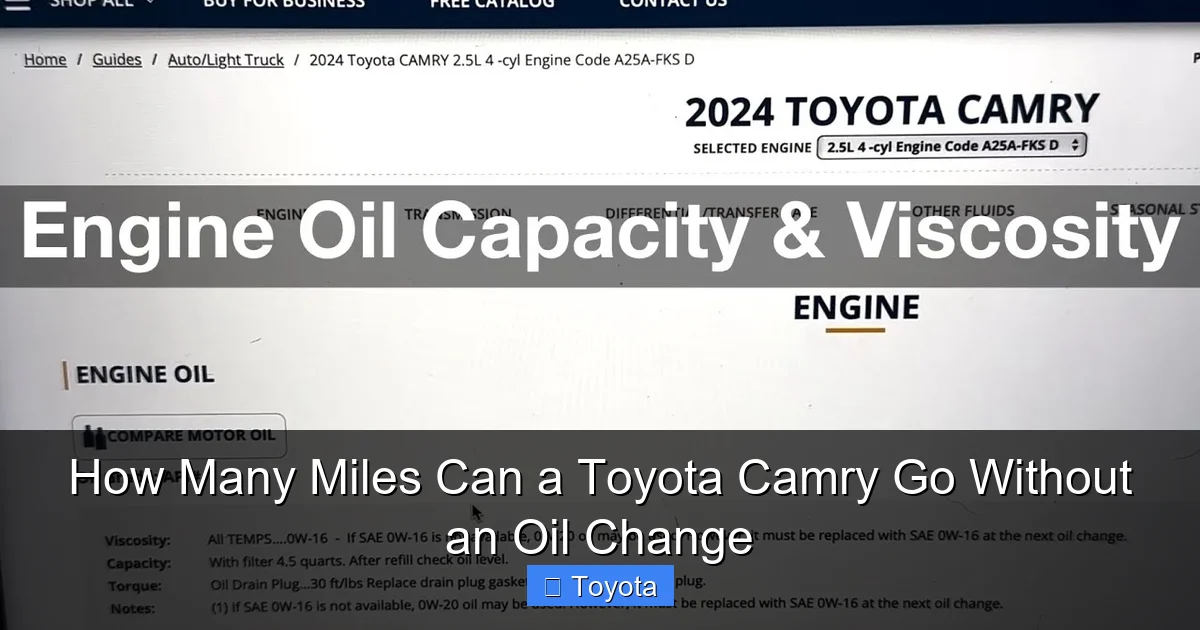
This is the most important section. Knowing the “recommended” miles is one thing, but understanding the consequences of exceeding them is what truly motivates action. Oil doesn’t just get “dirty”; it chemically breaks down and becomes a hazard to your engine.
Visual guide about How Many Miles Can a Toyota Camry Go Without an Oil Change
Image source: i.ytimg.com
The Sludge Monster: Your Engine’s Silent Killer
As oil ages and is subjected to heat and combustion byproducts, it begins to oxidize and thicken. It turns into a tar-like substance called sludge. Sludge clogs oil passages, prevents oil from reaching critical components like the camshaft and crankshaft bearings, and acts like a sponge, soaking up fresh oil you add during top-offs. A sludge-clogged engine can suffer from low oil pressure, rapid wear, and eventually, catastrophic failure. Once sludge forms, it’s incredibly difficult to remove without a complete engine teardown. This is the most common and expensive result of neglected oil changes.
Increased Friction and Wear
Fresh oil has additives that keep it slippery and protective. As these additives deplete, the oil’s ability to form a protective film between metal parts diminishes. This leads to metal-on-metal contact. You get increased wear on piston rings, cylinder walls, bearings, and valve train components. This wear is permanent and cumulative. An engine that has been run on degraded oil will have lower compression, burn more oil, and have a significantly shorter overall lifespan, even if it doesn’t fail outright.
Other Critical Risks
- Fuel Dilution: Short trips don’t allow fuel to fully evaporate, which can wash down cylinder walls and dilute the oil, reducing its viscosity and protection.
- Cooling Loss: Oil helps cool the engine. Degraded oil loses its ability to transfer heat effectively.
- Corrosion: Old oil can become acidic, leading to internal engine corrosion.
- Clogged Filters: A severely overdue oil change means the oil filter is also long past its capacity, turning into a restrictor and causing oil starvation.
The financial risk is enormous. A timing chain or bearing job can cost $3,000-$5,000. An engine replacement or rebuild can easily exceed $6,000 for a Camry. A $60-$100 oil change is the ultimate insurance policy against that. For more on the specific warning signs and progression of damage, see our article on what happens when your car needs an oil change.
Special Considerations for Your Camry
Not all Camrys are created equal, and certain factors demand a more personalized approach to your oil change schedule.
Model Year and Engine Type
Older Camrys (Pre-2010): These often used conventional oil and had recommended intervals of 3,000-5,000 miles. While some owners pushed them further, these engines were not designed for extended intervals. Sticking to the 5,000-mile mark is a safe bet for longevity.
Modern Camrys (2010+) with 2.5L 4-Cylinder: This is the most common engine. It almost universally requires synthetic oil (0W-20 is standard) and is designed for 7,500-10,000 mile intervals under normal conditions. The system is very efficient.
V6 Models (3.5L): While also using synthetic oil, the higher-revving V6 can experience slightly higher stress. Some technicians recommend 7,500 miles as a more conservative target, though the factory schedule is often the same 10,000 miles. If you tow or drive spiritedly, lean towards the shorter interval.
Hybrid Camry: The gasoline engine in a Hybrid Camry operates differently, often running at optimal efficiency and temperature. However, it also experiences more frequent start-stop cycles. Toyota’s schedule for hybrids is typically the same as conventional models (10,000 miles with synthetic), but the “severe service” definition applies even more readily if your trips are very short.
High-Mileage and Older Engines
If your Camry has over 150,000 miles, the engine has some wear. Piston rings and seals may not be as tight, which can lead to oil consumption (burning oil). For these high-mileage engines:
- Check the oil level at least once a month.
- Consider using a high-mileage synthetic oil. These contain seal conditioners and additives designed to reduce consumption and leaks.
- You might benefit from changing the oil slightly more frequently, say every 6,000-8,000 miles, to combat the increased contaminants and ensure fresh additives are always present.
- Pay extra attention to any signs of leaks or blue smoke from the exhaust.
The question of longevity is paramount for high-mileage vehicles. Understanding how many miles a Toyota Camry can last with proper care shows why consistent oil changes are non-negotiable for reaching 300,000+ miles.
Practical Tips: Never Get Caught Off Guard
Knowing the theory is great, but what practical steps can you take to ensure your Camry’s oil is always fresh?
1. Read Your Manual and Stick It on Your Visor
Find the maintenance schedule section. Highlight or bookmark the oil change interval for your car. If you’re unsure about “normal” vs. “severe” driving, err on the side of caution and use the severe schedule.
2. Set Up Digital and Physical Reminders
Don’t rely solely on the dashboard light, especially if you drive less than 10,000 miles a year. Use your phone’s calendar to set a recurring alert for “Check Camry Oil Change Mileage” every 5,000 miles. Keep a small notebook in your glove compartment to log the date, mileage, and type of oil/filter used at every service.
3. Check the Oil Yourself Monthly
This is the single best habit you can develop. Once a month, park on level ground, let the engine cool for 5-10 minutes, pull the dipstick, wipe it clean, reinsert it fully, and pull it out again. Check:
- Level: Is it between the “Low” and “Full” marks?
- Color: Fresh synthetic oil is amber and translucent. If it’s dark brown or black, it’s dirty. If it’s milky or frothy, you have a coolant leak—stop driving and get it diagnosed immediately.
- Smell: A strong smell of gasoline indicates fuel dilution.
4. Choose the Right Oil and Filter
Use only oil that meets Toyota’s specification (usually API SP and ILSAC GF-6, with viscosity 0W-20 for most modern Camrys). Don’t be tempted by cheaper, off-brand oils. For the filter, a premium OEM (Toyota) filter or a respected brand like Mobil 1, Wix XP, or K&N is worth the few extra dollars. A cheap filter can bypass dirty oil or fail early, negating the benefit of a fresh oil change. To understand exactly what goes into your engine, review our guide on how many quarts of oil a Toyota Camry takes for your specific generation.
5. Document Everything
Keep all receipts. If you ever sell your Camry, a complete, documented service history—especially consistent oil changes—is a huge selling point that proves the car was well-cared for and can significantly increase its resale value.
Conclusion: Respect the Interval, Enjoy the Ride
Your Toyota Camry is a remarkably durable machine, but it’s not indestructible. The question how many miles can a Toyota Camry go without an oil change doesn’t have a single heroic number to brag about. The responsible answer is a range: 5,000 miles for severe driving with conventional oil, up to 10,000 miles for gentle, highway driving with full synthetic. The modern Camry’s Intelligent Oil Life System is an excellent tool, but it works best when paired with an informed owner who understands their driving conditions.
Ultimately, there is no reward for pushing your luck. The minimal cost and slight inconvenience of a scheduled oil change are a tiny price to pay to protect an engine that can easily cost thousands to replace. By following the guidelines in your manual, monitoring your oil level, and being honest about your driving habits, you ensure your Camry remains the reliable, long-lasting companion it was built to be. Don’t gamble with the one fluid that keeps your engine alive. Change the oil on time, every time, and your Camry will reward you with years—and hundreds of thousands of miles—of smooth, dependable service.
Frequently Asked Questions
Can I go 10,000 miles without an oil change in my Camry?
Yes, but only if your owner’s manual specifies a 10,000-mile interval for your model, you exclusively use the recommended full synthetic oil, and your driving is exclusively “normal” (mostly highway, moderate temperatures). For most drivers, especially those with shorter trips or in extreme climates, a 5,000-7,500 mile interval is safer.
What happens if I go 15,000 miles without an oil change?
This is extremely dangerous. By 15,000 miles, the oil has almost certainly turned into sludge, lost all its protective additives, and is causing accelerated internal engine wear. You risk severe engine damage, low oil pressure, and catastrophic failure, which can mean a costly engine replacement.
Is it okay to add oil instead of changing it?
No. Adding fresh oil to old, dirty oil only dilutes the contaminants and does nothing to remove sludge, metal particles, and broken-down additives. The oil filter is also long past its capacity. Topping off is an emergency measure for low oil levels between changes, not a substitute for a full drain and replace.
How do I know if my driving is “severe service”?
If you frequently make trips under 5 miles, drive in heavy traffic with lots of idling, live in very hot or cold areas, drive on dusty roads, or regularly tow a trailer, you are likely in the “severe service” category. When in doubt, use the more conservative (shorter) interval.
My oil light came on, but I’m only at 6,000 miles. What should I do?
Change the oil immediately. The oil pressure light is a serious warning that indicates a potential immediate risk of engine damage due to low oil pressure. Do not wait. Check the oil level first, but plan for an oil and filter change as soon as possible, regardless of mileage.
Does the oil change interval change for a hybrid Camry?
The recommended mileage interval is often the same (e.g., 10,000 miles with synthetic). However, because the gasoline engine in a hybrid starts and stops more frequently and may run at less-than-optimal temperatures for short periods, the “severe service” schedule (5,000-7,500 miles) is often more appropriate for hybrid owners with primarily short, urban trips.