How Many Gallons of Gas Does a 2016 Toyota Corolla Hold?

Contents
- 1 Key Takeaways
- 2 📑 Table of Contents
- 3 Introduction: Why Tank Size Matters for Your Corolla
- 4 The Official 13.2-Gallon Specification: Facts and Figures
- 5 Real-World Range: How Far Can You Really Go?
- 6 How the 2016 Corolla Compares to Other Vehicles
- 7 Practical Tips to Maximize Your Corolla’s Range and Tank Life
- 8 The Great Mystery: The Fuel Light and Your Final Reserve
- 9 Conclusion: The Simple, Smart Engineering of the Corolla’s Tank
- 10 Frequently Asked Questions


The 2016 Toyota Corolla comes equipped with a fuel tank that holds 13.2 gallons of gasoline. This capacity is consistent across most trims, contributing to its excellent driving range of over 400 miles on a single tank under optimal conditions. Understanding your tank’s size helps with trip planning and maximizing fuel economy.
Key Takeaways
- Standard Capacity: The 2016 Toyota Corolla has a manufacturer-rated fuel tank capacity of 13.2 gallons for nearly all trim levels.
- Trim Consistency: Unlike some models, the LE, SE, and Eco trims all share the same 13.2-gallon tank; there is no larger or smaller option.
- Fuel Economy Dictates Range: With EPA ratings of up to 30 mpg city/40 mpg highway, the Corolla’s practical driving range typically falls between 350 and 450 miles per tank.
- The “Reserve” is Real: The fuel light illuminates with roughly 1-2 gallons remaining, giving a final warning range of about 30-70 miles before empty.
- Competitor Comparison: The Corolla’s 13.2-gallon tank is very similar to its main rival, the Honda Civic, but smaller than larger sedans like the Toyota Camry.
- Practical for Daily Use: The tank size is a key reason for the Corolla’s “set-it-and-forget-it” reputation for commuting, requiring fewer stops than smaller tanks and offering better weight distribution than larger ones.
[FEATURED_IMAGE_PLACEHOLDER]
📑 Table of Contents
- Introduction: Why Tank Size Matters for Your Corolla
- The Official 13.2-Gallon Specification: Facts and Figures
- Real-World Range: How Far Can You Really Go?
- How the 2016 Corolla Compares to Other Vehicles
- Practical Tips to Maximize Your Corolla’s Range and Tank Life
- The Great Mystery: The Fuel Light and Your Final Reserve
- Conclusion: The Simple, Smart Engineering of the Corolla’s Tank
Introduction: Why Tank Size Matters for Your Corolla
You’re planning a road trip, or maybe you’re just curious about your daily driver’s inner workings. One of the most practical—and often overlooked—specs of any car is its fuel tank capacity. For a 2016 Toyota Corolla owner, this number isn’t just trivia; it’s the key to understanding your car’s true range, planning refueling stops, and even diagnosing potential issues. The short answer is that your Corolla holds 13.2 gallons. But let’s pop the hood on that number and see what it really means for you behind the wheel.
This capacity figure, provided by Toyota and certified by the EPA, is a cornerstone of the Corolla’s legendary practical ownership experience. It’s a Goldilocks number—not so big that it adds excessive weight and hurts fuel economy, and not so small that you’re constantly hunting for a gas station. In this deep dive, we’ll explore the official specs, what “13.2 gallons” looks like in real-world driving, how it stacks up against family cars and crossovers like the Toyota RAV4, and even the science behind that mysterious fuel light. Get ready to become an expert on your own gas tank.
The Official 13.2-Gallon Specification: Facts and Figures
Let’s start with the hard data. According to Toyota’s official specifications for the 2016 model year, every single 2016 Toyota Corolla—from the base L model to the top-tier SE—is equipped with a fuel tank that has a total capacity of 13.2 US gallons. This is not a range that varies by trim. You won’t find a “premium” trim with a bigger tank or an “Eco” model with a smaller one. This consistency is a hallmark of the Corolla’s design philosophy: provide a supremely reliable and predictable package.
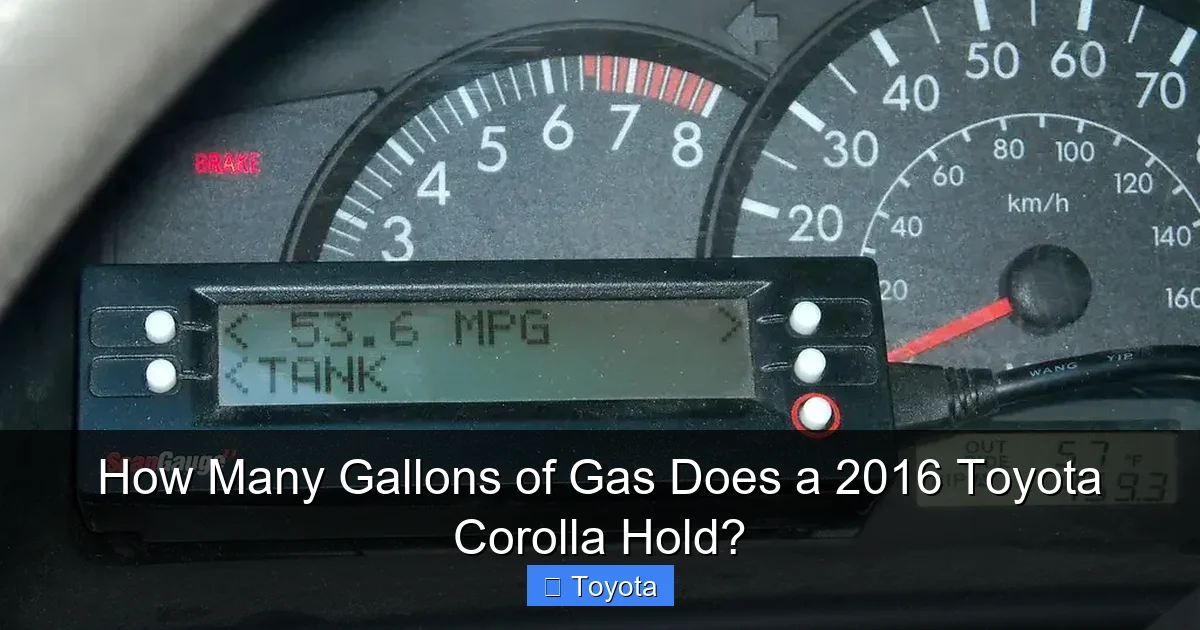
Visual guide about How Many Gallons of Gas Does a 2016 Toyota Corolla Hold?
Image source: thecarhow.com
Sourcing the Data: Where Does 13.2 Come From?
This number comes from multiple authoritative sources. First, the Toyota owner’s manual for the 2016 Corolla lists the tank capacity as 13.2 gallons (50 liters). Second, the Environmental Protection Agency (EPA) fuel economy testing and certification documents, which all automakers must submit, confirm this same figure. It’s a regulatory and engineering standard. When you see a window sticker on a new 2016 Corolla, it will state “Fuel Tank Capacity: 13.2 gal.” There is no ambiguity here.
Understanding “Capacity” vs. “Usable” Fuel
Here’s a crucial nuance: the 13.2-gallon figure is the total, geometric capacity of the tank from empty to the very top of the filler neck. However, you cannot—and should not—fill it to this absolute brim. Several factors create a small “ unusable” volume:
- Manufacturing Tolerances: No tank is perfectly uniform; there’s a tiny variance in shape.
- Thermal Expansion: Gasoline expands as it gets warmer. Filling to 100% of geometric capacity on a hot day can lead to pressure issues and fuel spillage when the gas expands further. Pump nozzles are designed to automatically shut off before this absolute top is reached to prevent overfill.
- The “Reserve” or “Dead Head” Volume: The very bottom of the tank has an irregular shape where the pickup tube (which sucks fuel to the engine) cannot reach. This is typically 0.5 to 1 gallon of fuel that is physically present but inaccessible to the engine. Your fuel gauge and computer are calibrated for this.
So, while the tank *holds* 13.2 gallons, the amount you can *pump in* from “empty” on the gauge is usually around 12.5 to 13.0 gallons. This is perfectly normal and accounts for the slight discrepancy you might notice if you meticulously track fill-ups.
Real-World Range: How Far Can You Really Go?
Knowing the tank size is only half the equation. The other half is your car’s fuel efficiency, measured in miles per gallon (mpg). The 2016 Corolla is praised for its efficiency. The EPA rates it at:

Visual guide about How Many Gallons of Gas Does a 2016 Toyota Corolla Hold?
Image source: thecarhow.com
- City Driving: 30 mpg (for most automatic trims; the manual was 29 mpg city)
- Highway Driving: 40 mpg
- Combined: 34 mpg
To calculate your theoretical maximum range, you multiply the usable fuel capacity by your average mpg. Let’s do the math with the optimistic usable capacity of 13.0 gallons.
- Highway-Only Range: 13.0 gal x 40 mpg = 520 miles (This is a best-case scenario on a perfectly flat, windless highway at steady speed).
- City-Only Range: 13.0 gal x 30 mpg = 390 miles (Stop-and-go traffic reduces efficiency).
- Realistic Combined Range: 13.0 gal x 34 mpg = 442 miles (A good average for mixed driving).
The Variables That Change Your Actual Mileage
Those EPA numbers are achieved in controlled laboratory conditions. Your real-world range will vary based on:
- Driving Style: Aggressive acceleration and heavy braking can drop your mpg by 15-20% or more. Gentle, anticipatory driving is the single biggest factor you control.
- Climate Control: Using the A/C compressor is a significant engine load, especially in city driving. In extreme heat or cold, expect a 1-3 mpg penalty.
- Terrain and Load: Driving in mountains or carrying a full car of passengers and luggage increases weight and engine strain, reducing efficiency.
- Tire Pressure: Under-inflated tires increase rolling resistance. Keeping them at the recommended 32-33 psi (for a 2016 Corolla) is critical for optimal mpg and safety.
- Fuel Blend: In some regions, gasoline contains up to 10% ethanol (E10). Ethanol has about 33% less energy density than pure gasoline, which can reduce mpg by 1-3% compared to ethanol-free fuel.
A realistic, achievable range for most drivers in a 2016 Corolla under normal conditions is 350 to 420 miles per tank. Many owners report being able to drive 400+ miles on the highway before the low fuel light even flickers.
How the 2016 Corolla Compares to Other Vehicles
Is a 13.2-gallon tank big or small? It’s all about context. Let’s see how it stacks up against some popular competitors and different vehicle classes.
Visual guide about How Many Gallons of Gas Does a 2016 Toyota Corolla Hold?
Image source: thecarhow.com
Head-to-Head with the Honda Civic
The perennial rival to the Corolla is the Honda Civic. For the 2016 model year, the Civic also held 12.4 gallons (for most trims) or 13.2 gallons (for the EX and above). This means the two are virtually identical in tank size. Their real-world range is also very similar, as both cars boast nearly identical EPA ratings. The choice between them often comes down to driving feel and interior preference, not fuel capacity.
Upgrading to a Midsize Sedan: The Toyota Camry
If you’re considering moving up to a midsize sedan like the Toyota Camry, you’ll find a larger tank. The 2016 Camry held 15.8 or 17.0 gallons depending on the engine. This larger tank, combined with similar or slightly better highway mpg, gives the Camry a much longer absolute range—potentially 550+ miles on the highway. However, the Corolla’s smaller tank and lighter weight contribute to its slightly better city mpg and nimbler feel.
Stepping into an SUV: The Toyota RAV4
For families needing more space, the compact SUV segment is a popular choice. The 2016 Toyota RAV4 has a fuel tank capacity of 14.5 or 15.9 gallons (depending on the model). While it holds more fuel, its EPA ratings are lower than the Corolla’s (around 24-26 mpg combined). This means the RAV4’s range is often comparable to, or only slightly better than, the Corolla’s, despite the bigger tank. You’re paying for space and capability, not necessarily longer distances between fill-ups.
Even Bigger: The Toyota Highlander
Looking at a three-row family hauler like the Toyota Highlander shows the other end of the spectrum. The 2016 Highlander’s tank capacity is a massive 18.5 gallons. But with V6 power and all-wheel-drive capability, its combined mpg drops to the low 20s. Its range is similar to the RAV4 and Corolla, but you’re carrying far more fuel and weight. The Corolla’s efficiency-focused tank size is a perfect match for its efficient engine.
Practical Tips to Maximize Your Corolla’s Range and Tank Life
Now that you know your tank holds 13.2 gallons and can theoretically take you 400+ miles, let’s talk about how to consistently achieve that. These are actionable tips you can start using today.
Driving Habits That Save Gallons
Your right foot is the most powerful fuel-saving tool. Practice “hypermiling” techniques without going to extremes:
- Accelerate Smoothly: Pretend there’s an egg under your pedal. Gradual acceleration uses far less fuel than slamming the gas.
- Maintain Steady Speeds: Use cruise control on flat highways. Constant speed is more efficient than constant acceleration and braking.
- Look Ahead: Anticipate traffic lights and stop signs. Easing off the throttle early and coasting saves fuel that would be wasted braking.
- Limit Idling: If you’re stopped for more than 60 seconds (not in traffic), turn the engine off. Modern starters are efficient.
Maintenance is Non-Negotiable
A well-maintained Corolla will hit its EPA numbers. Neglect will destroy efficiency.
- Oil Changes: Use the recommended 0W-20 synthetic oil. Clean oil reduces internal friction.
- Air Filter: A clogged air filter chokes the engine, making it work harder and burn more fuel. Check it every 15,000 miles.
- Spark Plugs: Worn plugs cause misfires. The 2016 Corolla uses long-life iridium plugs, but they still need replacement around 120,000 miles.
- Tire Pressure: Check monthly. Under-inflation by just 5 psi can reduce fuel economy by 2-3%.
The Myth of “Premium” Fuel
The 2016 Corolla (with its 1.8L 4-cylinder engine) is designed to run perfectly on regular unleaded gasoline (87 octane). Using higher-octane “premium” fuel provides zero benefit in terms of power or fuel economy. It’s a complete waste of money. The only exception is if you are in a region where the only available fuel is below 87 octane, which is extremely rare in the US. For maximum savings, stick to the good stuff from the regular pump.
The Great Mystery: The Fuel Light and Your Final Reserve
That ominous amber light on your dashboard. For many drivers, it’s a source of anxiety. But for the knowledgeable Corolla owner, it’s just a helpful reminder. Let’s demystify it.
When Does the Light Actually Come On?
The fuel level sensor in your tank sends a signal to the car’s computer. That computer is programmed to illuminate the low fuel warning lamp when the fuel level drops to a pre-determined threshold. For the 2016 Corolla, this typically happens when you have approximately 1.0 to 1.5 gallons of usable fuel remaining. This is a safe, conservative buffer set by Toyota engineers.
How Far Can You Drive After the Light Comes On?
This is the million-dollar question. Using our range calculation: 1.5 gallons x your current mpg (let’s use a conservative 32 mpg) equals about 48 miles. 1.0 gallon x 32 mpg equals 32 miles. Therefore, a safe, realistic estimate is that you can drive 30 to 50 miles after the light first illuminates before you risk running out of fuel. Important: This is a reserve for emergencies only—to find the next gas station. Consistently driving until the tank is bone empty can overheat the in-tank fuel pump (which is cooled by the gasoline surrounding it) and potentially suck up sediment from the tank bottom.
For a more precise answer specific to your driving habits and Corolla’s condition, you can perform a simple test. Fill the tank completely, reset your trip odometer, drive normally until the light comes on, then immediately fill the tank again. The gallons you add (minus the 13.2 total) is your true reserve. Divide the miles driven by that reserve gallon amount to get your exact post-light mpg. Many owners find their true reserve is closer to 1.2 gallons, giving them about 40 miles of warning.
Why You Should NEVER Ignore It
Running completely out of fuel is more than an inconvenience. It can cause serious damage. The fuel pump, located inside the tank, relies on gasoline for both lubrication and cooling. Running it dry for even a short time can lead to premature pump failure. Additionally, if you run out in traffic, you create a dangerous hazard. The fuel light is your friend. Heed it and find a station within the next 30-40 miles.
Conclusion: The Simple, Smart Engineering of the Corolla’s Tank
So, how many gallons does a 2016 Toyota Corolla hold? The definitive, engineering-approved answer is 13.2 US gallons. This number represents a perfect balance in Toyota’s design equation. It’s large enough to provide a generous, hassle-free driving range of 350-450 miles for most owners, eliminating the need for frequent fuel stops on long journeys. Yet, it’s not so large that the weight of a full tank significantly penalizes the car’s excellent fuel economy in city driving.
This 13.2-gallon capacity, paired with the reliable 1.8-liter engine, is a fundamental reason the Corolla has been a top choice for commuters, families, and first car buyers for decades. It’s predictable, efficient, and utterly dependable. By understanding your tank’s true capacity, the meaning of the fuel light, and adopting a few efficient driving habits, you can extract every last mile from each fill-up and enjoy the worry-free motoring that the Corolla promises. It’s not just a number on a sticker; it’s a key part of the car’s legendary value and practicality. Now, next time you’re at the pump, you can fill up with the confidence of an expert, knowing exactly what that 13.2 gallons represents for your journey.
Frequently Asked Questions
Does the 2016 Toyota Corolla have different tank sizes for different trims?
No. All 2016 Corolla trims—including the L, LE, SE, and Eco—use the same 13.2-gallon fuel tank. The capacity is uniform across the lineup.
Is the 13.2-gallon rating the exact amount I can pump in when the gauge reads empty?
Not exactly. The 13.2 gallons is the tank’s total geometric capacity. Due to manufacturing tolerances, thermal expansion space, and an inaccessible “dead head” volume at the bottom, you will typically pump in around 12.5 to 13.0 gallons from a “empty” gauge reading. This is normal.
How many miles can I realistically drive on a full tank?
For most drivers, a realistic range is between 350 and 420 miles. This assumes mixed city/highway driving. On a long, steady highway trip with ideal conditions, you might approach 450-480 miles. Aggressive city driving can reduce this to around 350 miles.
What happens if I use a fuel with higher ethanol content, like E15?
Ethanol has less energy per gallon than pure gasoline. Using E15 (15% ethanol) instead of E10 (10% ethanol) can reduce your fuel economy by an additional 1-2%. Your Corolla is certified for up to E15, so it’s safe to use, but you may notice a slight drop in mpg. The tank capacity in gallons remains the same.
My fuel light came on. How soon should I refuel?
You should refuel as soon as reasonably possible. The light typically means you have about 1.0 to 1.5 gallons left, giving you a safe reserve of 30 to 50 miles. Do not push beyond this limit regularly to avoid potential fuel pump damage.
Can I check the tank capacity myself without a manual?
The most accurate way is to completely fill the tank from a known “empty” (after driving until the light is on and then a few more miles if safe), then check the receipt for gallons dispensed. You can also calculate it by filling from “empty” and comparing the gallons added to the miles driven on your trip odometer, using your average mpg. However, the official spec is 13.2 gallons.