How Many Catalytic Converters Are in a Ford F-150

Contents
- 1 Key Takeaways
- 2 📑 Table of Contents
- 3 Understanding the Catalytic Converter: Your Truck’s Invisible Filter
- 4 The Big Question: How Many Does My Specific F-150 Have?
- 5 Where Are They Located? A Visual Guide to Your F-150’s Exhaust
- 6 Signs Your Catalytic Converter Is on Its Last Legs
- 7 The Cost of Replacement: A Significant Investment
- 8 Protecting Your Investment: Maintenance Tips to Extend Converter Life
- 9 Conclusion: Knowledge is Power (and Savings)
- 10 Frequently Asked Questions



The number of catalytic converters in a Ford F-150 is not one-size-fits-all. It depends heavily on the specific model year and engine configuration. Most modern F-150s (2015+) with V6 or V8 engines have either two or four converters, while older models may have one or two. Knowing your truck’s exact setup is crucial for maintenance, repairs, and passing emissions tests.
So, you own a Ford F-150, the best-selling truck in America for decades. It’s a workhorse, a family hauler, and an icon. But have you ever looked under your truck and wondered about that complex network of pipes and canisters? Specifically, how many of those crucial catalytic converters are strapped to your F-150’s frame? It’s not just trivia; this number directly impacts your repair bills, your truck’s performance, and its ability to pass a smog check. The short answer is: it’s complicated. The long answer depends on your truck’s birth year and what’s kicking under the hood. Let’s pop the hood and the undercarriage to get the full story.
Think of catalytic converters as your truck’s environmental cleanup crew. They take the nasty, toxic gases your engine creates—like carbon monoxide, hydrocarbons, and nitrogen oxides—and, using a catalyst usually made of platinum, palladium, and rhodium, transform them into much less harmful carbon dioxide, nitrogen, and water vapor. Without them, our air would be far more polluted, and your F-150 would be illegal to drive on public roads. But because emissions standards have tightened dramatically over the years, Ford has had to add more of these “cats” to the F-150’s exhaust system to keep up. That’s why a 1999 model and a 2023 model are worlds apart in their converter count.
Our goal here is to give you a clear, model-year-by-model-year breakdown. We’ll talk about where they hide, what happens when they fail, and what you can do about it. By the end, you’ll know exactly what you’re dealing with, whether you’re facing a repair, planning a modification, or just satisfying your curiosity. Let’s get into the exhaust pipe.
Key Takeaways
- Count varies significantly: Your F-150 likely has 1, 2, or 4 catalytic converters depending on its model year and engine size (V6, V8, or EcoBoost).
- Modern trucks usually have more: Post-2015 models with larger engines often use a dual converter system (2) or a quad system (4) for stricter emissions.
- Location matters: Converters are located in the exhaust system, with “front” converters near the engine and “rear” or “underbody” converters further back.
- Failure symptoms are clear: Listen for a rattling noise, notice poor fuel economy, or get a check engine light with codes like P0420.
- Replacement is expensive: Costs range from $1,000 to over $3,000+ per converter due to precious metals, with labor adding significant time.
- Prevention is key: Regular maintenance, avoiding short trips, and fixing engine misfires immediately can dramatically extend converter life.
- Always verify for your specific truck: The only surefire way to know is to check a factory service manual, a trusted mechanic, or visually inspect your own exhaust.
📑 Table of Contents
- Understanding the Catalytic Converter: Your Truck’s Invisible Filter
- The Big Question: How Many Does My Specific F-150 Have?
- Where Are They Located? A Visual Guide to Your F-150’s Exhaust
- Signs Your Catalytic Converter Is on Its Last Legs
- The Cost of Replacement: A Significant Investment
- Protecting Your Investment: Maintenance Tips to Extend Converter Life
- Conclusion: Knowledge is Power (and Savings)
Understanding the Catalytic Converter: Your Truck’s Invisible Filter
Before we count them, we need to understand what we’re counting. A catalytic converter isn’t just a metal can. It’s a precision emissions-control device. Inside that sturdy stainless steel shell is a ceramic or metallic substrate coated with the precious metal catalyst. As hot exhaust gases blast through its honeycomb structure, a chemical reaction occurs, cleaning the exhaust. This process requires the converter to reach a specific “light-off” temperature, usually between 400-600°F, to work efficiently.
Why So Many? The Evolution of Emissions Standards
The reason the count changes so much is simple: the law. The Clean Air Act and subsequent EPA regulations have forced automakers to continually reduce tailpipe emissions. For a massive, heavy-duty truck like the F-150 with powerful engine options, meeting these standards requires more sophisticated exhaust after-treatment. One large converter often isn’t enough to clean the high volume of exhaust gas efficiently across all engine RPM ranges.
Manufacturers like Ford use two main strategies. First, they add more converters. A “dual” system (two converters) might have one close to the engine (“pre-cat” or “front cat”) that starts cleaning quickly during cold starts, and a second larger one further down (“main cat” or “underbody cat”) that handles the bulk of the work at operating temperature. Second, they make converters more efficient with advanced catalyst formulations and better insulation. This evolution explains the jump from one converter in older trucks to two or even four in the latest models.
The Big Question: How Many Does My Specific F-150 Have?
Now for the meat of the matter. There is no single answer. We must break it down by the two most critical factors: the generation of the truck and the type of engine under the hood. Ford has used several engine families in the F-150 over the years, each with different exhaust requirements.

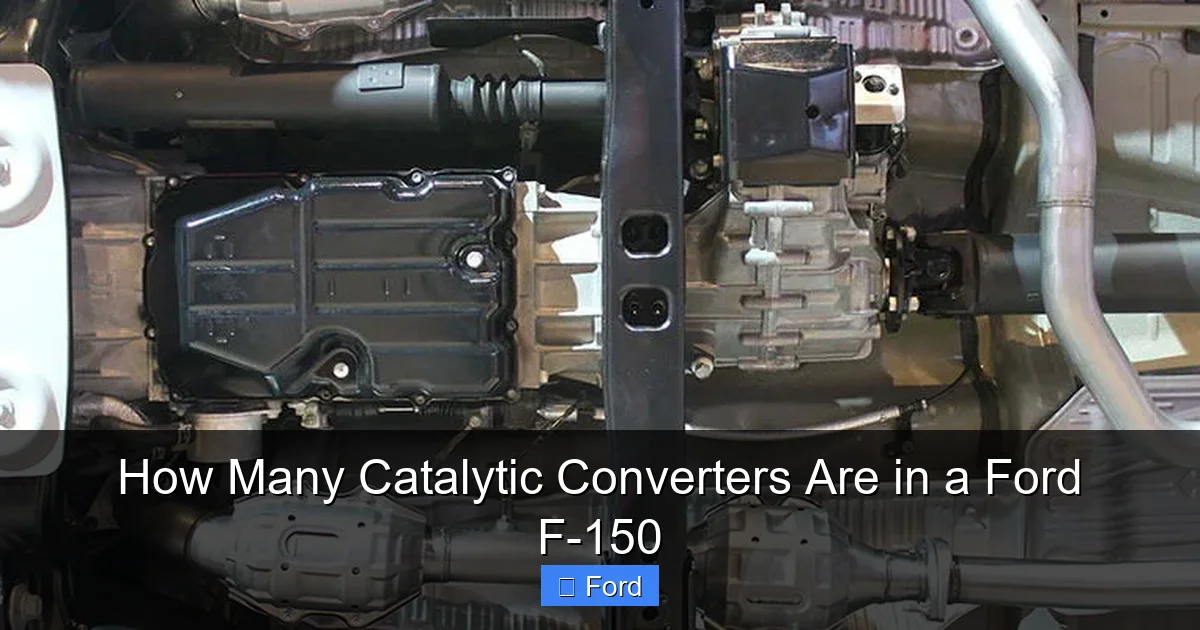
Visual guide about How Many Catalytic Converters Are in a Ford F-150
Image source: automotiveguider.com
By Generation and Model Year
The F-150 has gone through numerous redesigns. The most significant shift in catalytic converter count happened with the switch to the aluminum-intensive, radically redesigned 13th generation for the 2015 model year. This platform, with its more efficient EcoBoost engines and stricter LEV III/ULEV2 standards, necessitated more converters for most V6 and V8 applications.
- 1997-2004 (10th/11th Gen, PN-96/PN-98 Platform): These older trucks, especially with the popular 4.6L V8 or 5.4L V8, almost universally have two catalytic converters. They are typically a dual inlet/dual outlet (DIDC) design, often called a “Y-pipe” converter, where the two exhaust pipes from the engine merge into one converter shell before splitting again or continuing as one. Some early 4.2L V6 models might have a single converter.
- 2004-2014 (12th Gen, P-212 Platform): This era saw more variation. The 4.6L and 5.4L V8s still generally used two converters. However, the introduction of the powerful 6.2L V8 in the SVT Raptor and later SuperCrew models often required four catalytic converters—two per bank of cylinders—to meet standards. The 3.5L EcoBoost V6, introduced in 2011, also moved to a four-converter system (two per turbocharged bank) to control emissions from its unique exhaust flow.
- 2015-Present (13th Gen, P-554 Platform): This is where things get most consistent but still vary. The standard 3.5L EcoBoost V6 and 5.0L V8 (Coyote) in most trims use a two-catalyst system (one front, one rear). However, the high-performance 3.5L EcoBoost in the Raptor and the 5.2L V8 in the limited-run Raptor (2021+) and some F-150 Limited models use a four-catalyst system. The 2.7L EcoBoost V6 typically uses two converters. The return of the 4.6L in some fleet models early in this generation was rare but would have been two.
By Engine Type (The Most Reliable Way to Guess)
Since model years can overlap with different engines, focusing on the engine is often the quickest way to estimate your converter count. Here’s a practical guide:
- 4.6L V8 (Modular): Found in 1997-2014 models. Almost always 2 converters (a dual-in/dual-out unit).
- 5.4L V8 (Triton): Found in 1997-2014 models. Almost always 2 converters (a dual-in/dual-out unit). Note: The 2004-2008 5.4L 3-valve had a unique “split” manifold with the converter closer to the head, but it’s still one unit per bank, totaling two.
- 6.2L V8 (Boss): Found in 2011-2014 Raptor, 2017-2020 Super Duty (though not F-150), and some high-output F-150s. Requires 4 converters (two per bank).
- 3.5L EcoBoost V6 (Twin-Turbo): Found in 2011-present. In standard F-150s, it’s 2 converters (front and rear). In Raptor models (2017+), it’s 4 converters.
- 2.7L EcoBoost V6 (Twin-Turbo): Found in 2015-present. Uses 2 converters.
- 5.0L V8 (Coyote): Found in 2011-present. Standard models have 2 converters. High-output versions in Raptor or Limited may have 4.
- 3.3L V6 (Atkinson Cycle): Found in 2021-present base models. Uses a single, large converter due to its hybrid-friendly, efficiency-focused design.
Pro Tip: Your Vehicle Identification Number (VIN) is the ultimate key. A dealership or a reputable online VIN decoder can tell you your exact engine code and emissions equipment package, which specifies the catalytic converter setup. Never guess on a critical repair; verify with your VIN.
Where Are They Located? A Visual Guide to Your F-150’s Exhaust
Knowing how many you have is step one. Knowing where to find them is step two, especially if you’re looking underneath for damage or leaks. The location is fairly logical but varies with the count.

Visual guide about How Many Catalytic Converters Are in a Ford F-150
Image source: video-thumbnails-1a.s3.amazonaws.com
The Standard Two-Converter Setup
For the vast majority of F-150s with two converters, the system is split into a “front” and “rear” cat.
- Front/Pre-Cat: This one is bolted directly to the engine’s exhaust manifold(s). On V8s, you’ll find one on each side of the engine block (bank 1 and bank 2). On V6s, there may be one central unit or one per bank. It’s the hottest, most exposed converter. It’s responsible for cleaning emissions during the critical cold-start phase before the main cat heats up.
- Rear/Main/Underbody Cat: This larger converter is further down the exhaust system, usually located near the middle of the truck’s underbody, ahead of the muffler and resonator. It handles the bulk of the cleaning once the exhaust is fully hot. You’ll see it as a larger, often oval-shaped canister on the passenger side (in most models) or centrally mounted.
The Four-Converter Setup
For high-performance or heavy-duty engines like the 6.2L V8 or Raptor’s 3.5L EcoBoost, the system is more complex. It uses a “true dual” exhaust from the manifold back.
- Bank-Specific Pairs: Each side of the engine (each cylinder bank) has its own independent exhaust path. On each side, you will find a smaller, close-coupled converter right at the manifold (the pre-cat) and then a second, larger underbody converter further down that specific pipe before it joins the other side at the muffler, if at all. So, looking under the truck, you’ll see two distinct pipes running from the engine heads back, each with its own converter(s).
The Single Converter Exception
The newest base-model 3.3L V6 (2021+) uses a single, large, advanced converter placed further down the exhaust. It’s designed to be incredibly efficient, eliminating the need for a front cat. You’ll find one large canister in the traditional “rear cat” location.
How to Visually Identify Yours
Safely jack up your truck (use jack stands!) and look at the exhaust from the engine back. Count the number of major converter housings. The front cats are often smaller and integrated with the exhaust manifold assembly. The rear cats are larger and clearly separate. If you see two distinct pipes from the engine all the way to the muffler, you likely have a four-cat system. If the pipes merge into one shortly after the headers, you have a two-cat system. Remember, the muffler and resonator are not converters; they are for sound deadening. Converters are always before the muffler.
Signs Your Catalytic Converter Is on Its Last Legs
Catalytic converters are durable, but they can and do fail. Failure usually means it’s clogged, melted, or the catalyst has been contaminated. Here are the classic symptoms you need to watch for. Catching these early can save you from a catastrophic and expensive failure.

Visual guide about How Many Catalytic Converters Are in a Ford F-150
Image source: res.cloudinary.com
The Audible Clue: The Rattling Sound
This is the most common and obvious sign. If you hear a metallic rattling or tinkling noise coming from under your truck, especially when idling or at low RPMs, it’s likely the ceramic substrate inside the converter has broken apart. The honeycomb structure can crumble due to age, thermal stress, or impact damage. This debris can eventually clog the exhaust, causing severe performance issues. If you hear this, inspect the converter housings for dents or impact marks from road debris or speed bumps.
The Performance Problem: Loss of Power and Poor Fuel Economy
A clogged converter acts like a cork in a bottle. Exhaust can’t flow freely out of the engine. The engine has to work much harder to push exhaust gases through, leading to a noticeable drop in power, sluggish acceleration, and a feeling that the truck is “struggling” or has no power, especially under load (like going uphill). Simultaneously, the engine’s computer will dump more fuel to compensate for the poor breathing, destroying your miles per gallon. If your F-150 suddenly feels weak and drinks gas like a sports car, a clogged cat is a prime suspect.
The Electronic Warning: Check Engine Light and Diagnostic Codes
Your truck’s oxygen (O2) sensors are constantly monitoring the efficiency of the catalytic converters. They are placed before and after each converter. If the after-sensor readings don’t show the expected drop in hydrocarbons and oxygen, the Engine Control Module (ECM) knows the converter isn’t working. This triggers the dreaded Check Engine Light.
The most common code is P0420 – “Catalyst System Efficiency Below Threshold.” Other related codes might be P0430 (Bank 2), or codes for O2 sensor activity that are out of range. While a P0420 *can* sometimes be a faulty O2 sensor, on a high-mileage F-150, it points directly to a failing converter 80% of the time. A proper diagnosis with a scan tool that reads live O2 sensor data is needed to confirm.
The Smell Test: Rotten Eggs or Burning
A failing converter might not be processing sulfur properly (from fuel), leading to a strong smell of rotten eggs (hydrogen sulfide) from the exhaust. You might also smell a faint, acrid, burning smell (like bad brakes or overheated electronics) if the converter is overheating due to excessive unburned fuel entering it (often from misfiring spark plugs or a leaking fuel injector).
The Cost of Replacement: A Significant Investment
Let’s be blunt: replacing a catalytic converter on an F-150 is not a cheap DIY job. It’s expensive due to the parts and the labor. Understanding the cost breakdown helps you budget and avoid scams.
Why So Expensive? The Precious Metal Factor
The core reason for the high cost is the catalyst itself. Platinum, palladium, and rhodium are rare, expensive precious metals. The amount used in each converter is small but valuable. Market prices for these metals fluctuate wildly, directly impacting the cost of a new converter. An OEM (Original Equipment Manufacturer) converter from Ford will have the precise catalyst formulation and meet the strictest emissions standards, making it the most expensive option. Aftermarket converters vary wildly in quality and precious metal loading, which affects both price and longevity.
Parts Cost: OEM vs. Aftermarket
For a standard two-converter system on a 2015+ F-150 5.0L:
- OEM (Ford) Parts: Expect to pay $1,200 – $2,500+ *per converter* for the part alone. A full front and rear set could be $2,500 to $5,000+.
- High-Quality Aftermarket (e.g., MagnaFlow, AP Exhaust): These are often direct-fit replacements that meet CARB/EPA standards. They might run $800 – $1,800 *per converter*. They are a good middle ground for non-warranty repairs.
- Universal/Cheap Aftermarket: You might find converters for $400-$700 each. Be extremely cautious. These often have minimal catalyst material, may not pass emissions in strict states, and can fail prematurely. They might also require welding, increasing labor cost.
For a four-converter system (like a Raptor), multiply these costs accordingly. You are looking at a total parts bill of $3,000 to $8,000+ for a complete set of high-quality converters.
Labor Cost: It’s Not Just a Bolt-On Job
Labor is where the bill really soars. Access is difficult. Converters are often rusted solid after years of exposure. Mechanics may need to cut them off with a sawzall, requiring new flanges or piping to be welded in. They must also ensure all O2 sensor ports are intact and sensors are transferred correctly. For a two-converter system, expect 3-6 hours of labor at $100-$150/hour. For a four-converter system with difficult access (like on some EcoBoosts), it could be 6-10+ hours. Total installed cost for a full replacement on a modern F-150 easily ranges from $2,500 to over $5,000, and can hit $7,000+ for Raptor models or if extensive welding is needed.
Protecting Your Investment: Maintenance Tips to Extend Converter Life
Since replacement is so costly, prevention is the best strategy. Catalytic converters fail for three main reasons: contamination, meltdown, and age/thermal stress. Here’s how to fight each one.
Fix Engine Misfires Immediately
This is the #1 cause of premature converter death. If your engine is misfiring (causing a rough idle, shaking, and check engine light with codes P0300-P0308), raw, unburned gasoline is being sprayed into the exhaust. This fuel enters the converter and burns inside the ceramic honeycomb, causing it to melt and clog. A single serious misfire can destroy a converter in minutes. Never ignore a misfire code. Diagnose the spark plugs, ignition coils, fuel injectors, or compression issue right away.
Use the Correct Fuel and Oil
Using lower-octane fuel than your truck’s manual recommends can cause pre-ignition or “knock,” which can overstress the converter. Similarly, using the wrong oil (wrong viscosity or low-quality oil that burns easily) can lead to oil ash contaminating the catalyst. Always follow Ford’s specifications. For EcoBoost engines, using high-quality, Top Tier-rated detergent gasoline is especially important to keep intake valves clean, which helps with combustion efficiency.
Avoid Short Trips and Excessive Idling
Catalytic converters need to get hot to work and to burn off light carbon deposits. If you only drive your F-150 for very short distances (less than 5-10 minutes), the converter never reaches its optimal operating temperature. Moisture and contaminants can accumulate inside, leading to premature clogging. If you have a work truck that idles for hours, that’s also not ideal—it creates a rich condition and can lead to converter overheating. Occasionally take your truck on a longer highway drive (20+ minutes at steady speed) to allow the converter to thoroughly “regen” and clean itself.
Address Exhaust Leaks Promptly
An exhaust leak *before* the front oxygen sensor (usually in the manifold or downpipe) allows extra oxygen into the exhaust stream. This confuses the O2 sensors, causing the engine computer to miscalculate the air/fuel ratio. The engine will often run rich (too much fuel) as a result, dumping unburned fuel into the converter and risking contamination or meltdown. A leak *after* the front O2 sensor but before the converter can also cause issues. Any exhaust leak should be repaired to protect the converter and ensure accurate sensor readings.
Maintain a Healthy Electrical System
Your O2 sensors and engine computer rely on a stable voltage supply. A weak or failing battery can cause voltage drops that lead to erroneous sensor data and poor engine management, potentially creating conditions that harm the converter. If you’re having electrical gremlins or a failing battery, replace it. For specific battery recommendations for your F-150 model year, check out our guides on the best battery for a 2018 Ford F-150 or best battery for a 2010 Ford F-150.
Furthermore, a clogged converter creates massive backpressure, which strains the engine. A well-maintained exhaust system, including quality components like those discussed in our best exhaust for Ford F-150 5.0 guide, promotes healthy flow and can complement your factory converter’s function.
Conclusion: Knowledge is Power (and Savings)
So, we’ve journeyed from the basic question—”how many?”—to a full understanding of why the answer is a spectrum. Your Ford F-150’s catalytic converter count is a direct reflection of its engineering era and emissions mission. A late-90s 4.6L V8 proudly wears two. A modern Raptor’s twin-turbo 3.5L EcoBoost flexes four. Most 2015+ everyday F-150s settle comfortably with two.
This knowledge is your first line of defense. If you’re facing a repair, you can now have an informed conversation with your mechanic. You won’t be surprised by a quote for four converters when you only expected two. You can also proactively inspect your truck, listen for rattles, and heed the check engine light. Remember, a failing converter is rarely an isolated event—it’s usually the final symptom of another problem (misfires, rich condition, leaks) that needs to be fixed first to protect your new investment.
Ultimately, your F-150 is a marvel of modern engineering, balancing brute strength with environmental responsibility. Its catalytic converters are a tiny but vital part of that balance. Treat them well with proper maintenance, and they’ll serve your truck silently for hundreds of thousands of miles. Ignore them, and they’ll remind you—with a rattling sound, a sluggish feel, and a hefty repair bill—exactly why they’re there.
Frequently Asked Questions
Does a 2018 Ford F-150 with a 5.0L V8 have two or four catalytic converters?
Standard 2018 F-150 models with the 5.0L V8 Coyote engine have a two-catalytic converter system (one front, one rear). The four-converter setup is reserved for the high-output versions found in the Raptor and Limited trims for that year.
Can I drive my F-150 with a rattling catalytic converter?
You can drive it for a short distance to a repair shop, but you should not delay. A rattling means the internal substrate is breaking apart, and these chunks can eventually clog the exhaust, causing severe power loss and potentially leading to a complete blockage that could damage the engine.
Will a clogged catalytic converter cause my F-150 to fail an emissions (smog) test?
Absolutely, and it’s a guaranteed fail. A clogged or inefficient converter will trigger a P0420 code and will not properly clean the exhaust gases. The test measures tailpipe emissions, and a bad converter will show high levels of hydrocarbons and other pollutants.
Is it legal to replace my F-150’s catalytic converter with a cheaper “high-flow” aftermarket one?
It depends on your location and the converter’s certification. In all 50 states, it is illegal to install a converter that does not meet the same emissions standards as the original. Look for converters that are CARB (California) and EPA certified for your specific vehicle. “High-flow” performance cats that are legally certified can be used, but cheap universal cats often are not legal and will cause a smog check failure.
What’s the difference between a “direct fit” and a “universal” catalytic converter?
A “direct fit” converter is designed to bolt directly into your F-150’s existing exhaust system using the original flanges and O2 sensor locations. It’s the easiest and most reliable replacement. A “universal” converter is a generic piece that requires cutting, welding, and fabrication to fit. It’s often cheaper but increases labor cost and risk of improper installation or exhaust leaks.
Can I use fuel additives to clean a clogged catalytic converter?
Most additives are ineffective for a truly clogged or melted converter. They might help with light carbon deposits on a mildly inefficient converter, but they cannot repair a physically broken or melted substrate. If your converter is severely clogged, the only fix is replacement. Additives are best used as a preventative maintenance measure, not a cure.