How Many Ah in a Car Battery
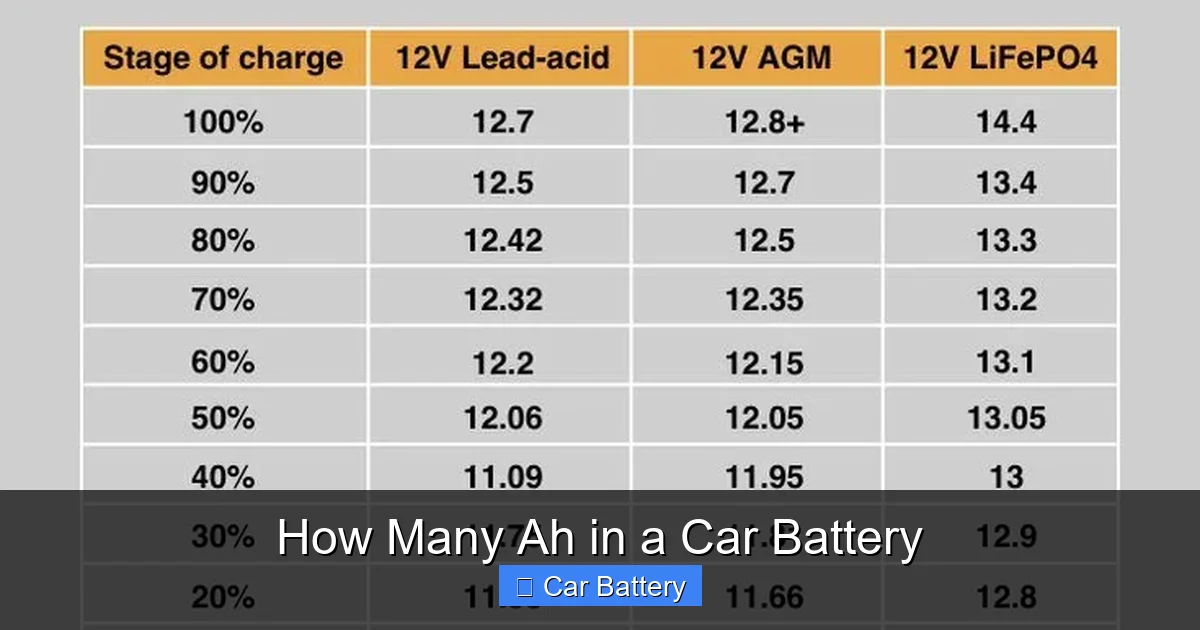
Understanding how many Ah (amp-hours) are in a car battery is essential for knowing its capacity and performance. Most standard car batteries range from 40Ah to 100Ah, but the right size depends on your vehicle’s electrical needs and usage patterns.
In This Article
- 1 Key Takeaways
- 2 📑 Table of Contents
- 3 How Many Ah in a Car Battery: The Complete Guide
- 4 What Does Ah Mean in a Car Battery?
- 5 Typical Ah Ratings for Car Batteries
- 6 Ah vs. Other Battery Ratings: CCA and Reserve Capacity
- 7 Types of Car Batteries and Their Ah Ratings
- 8 How to Check Your Car Battery’s Ah Rating
- 9 Tips for Maintaining Battery Health and Maximizing Ah
- 10 Conclusion: Choosing the Right Ah for Your Car
- 11 Frequently Asked Questions
Key Takeaways
- Ah measures battery capacity: Amp-hours (Ah) tell you how much electrical charge a battery can deliver over time—higher Ah means longer runtime.
- Typical range is 40–100Ah: Most passenger car batteries fall between 40Ah and 100Ah, with 50–70Ah being the most common for daily drivers.
- Engine size and accessories matter: Larger engines and vehicles with power-hungry features (like heated seats or sound systems) often need higher Ah batteries.
- Ah isn’t the only factor: Cold cranking amps (CCA) and reserve capacity (RC) are also crucial for starting power and backup runtime.
- Battery type affects Ah: Flooded, AGM, and lithium-ion batteries store and deliver power differently, impacting usable Ah.
- Maintenance impacts performance: A well-maintained battery delivers closer to its rated Ah; neglect can reduce capacity over time.
- Check your owner’s manual: Always refer to your vehicle’s specifications to choose the correct Ah and battery type.
📑 Table of Contents
- How Many Ah in a Car Battery: The Complete Guide
- What Does Ah Mean in a Car Battery?
- Typical Ah Ratings for Car Batteries
- Ah vs. Other Battery Ratings: CCA and Reserve Capacity
- Types of Car Batteries and Their Ah Ratings
- How to Check Your Car Battery’s Ah Rating
- Tips for Maintaining Battery Health and Maximizing Ah
- Conclusion: Choosing the Right Ah for Your Car
How Many Ah in a Car Battery: The Complete Guide
If you’ve ever popped the hood of your car and stared at the battery, wondering what all those numbers and letters mean, you’re not alone. One of the most common questions drivers ask is: “How many Ah in a car battery?” It’s a great question—because understanding amp-hours (Ah) helps you choose the right battery, avoid breakdowns, and get the most out of your vehicle’s electrical system.
At first glance, the battery might just look like a heavy black box with two terminals. But inside, it’s a powerhouse that keeps your engine running, your lights on, and your radio playing. And the Ah rating is like the battery’s “fuel tank size”—it tells you how much energy it can store and deliver over time. Whether you’re replacing an old battery or just curious about how your car works, knowing the Ah rating gives you valuable insight into performance and reliability.
In this guide, we’ll break down everything you need to know about how many Ah are in a car battery. We’ll explain what Ah means, why it matters, how it compares to other battery ratings, and how to pick the right one for your vehicle. No technical jargon—just clear, practical info you can use.
What Does Ah Mean in a Car Battery?
Visual guide about How Many Ah in a Car Battery
Image source: 5.imimg.com
Let’s start with the basics: Ah stands for amp-hours, a unit that measures electrical charge. In simple terms, it tells you how much current (in amps) a battery can deliver over a one-hour period. For example, a 50Ah battery can supply 50 amps for one hour, or 25 amps for two hours, or even 5 amps for 10 hours—before it’s fully drained.
Think of it like a water tank. The Ah rating is like the size of the tank—how much water it can hold. The bigger the tank, the longer you can run a hose (or power your car’s electronics) before refilling. In the same way, a higher Ah battery can power your car’s systems longer without recharging.
But here’s the catch: car batteries aren’t designed to be fully drained. Unlike deep-cycle batteries used in RVs or boats, most car batteries are starter batteries. Their job is to deliver a big burst of power quickly to start the engine, then let the alternator recharge them while driving. So while Ah tells you about capacity, it’s not the whole story.
Why Ah Matters for Your Car
You might be thinking, “I just need my car to start—why do I care about Ah?” Great question. Here’s why it matters:
First, a higher Ah battery can support more electrical accessories. If you’ve got a powerful sound system, heated seats, fog lights, or a dash cam running all the time, your battery needs to keep up. A low-Ah battery might struggle, especially if the engine isn’t running.
Second, Ah affects how long your battery can keep essential systems running if the alternator fails. For example, if your alternator dies on the highway, your battery has to power the ignition, lights, and electronics until you can get help. A battery with a higher Ah rating gives you more time—and peace of mind.
Third, in cold weather, batteries lose efficiency. A higher Ah battery has more “buffer” to handle the increased demand of starting a cold engine and powering heated defrosters and seats.
So while you don’t need to become a battery engineer, knowing the Ah rating helps you make smarter decisions about maintenance, upgrades, and replacements.
Typical Ah Ratings for Car Batteries
Visual guide about How Many Ah in a Car Battery
Image source: 5.imimg.com
Now that you know what Ah means, let’s talk numbers. How many Ah are actually in a typical car battery?
For most standard passenger vehicles—like sedans, hatchbacks, and small SUVs—the battery Ah rating ranges from 40Ah to 70Ah. That’s the sweet spot for daily driving. Here are some common examples:
– A compact car like a Honda Civic or Toyota Corolla might use a 45Ah to 55Ah battery.
– A midsize sedan like a Ford Fusion or Hyundai Sonata often uses a 60Ah to 70Ah battery.
– Larger vehicles like full-size SUVs (e.g., Chevrolet Tahoe or Ford Expedition) or trucks may need 70Ah to 100Ah batteries.
But keep in mind: these are general ranges. The exact Ah rating depends on the vehicle’s electrical load, engine size, and manufacturer specifications.
Factors That Influence Ah Requirements
Not all cars are created equal—and neither are their batteries. Several factors determine how many Ah your car needs:
Engine Size: Larger engines require more power to start. A V8 engine needs a stronger initial burst than a 4-cylinder, so it often uses a higher Ah battery.
Electrical Accessories: Modern cars are packed with electronics—infotainment systems, climate control, advanced safety features, and more. The more gadgets your car has, the more power it draws, even when the engine is off. This increases the demand on the battery.
Climate: Cold weather reduces battery efficiency. In freezing temperatures, a battery might only deliver 60–70% of its rated Ah. That’s why cars in colder regions often use batteries with higher Ah or better cold-weather performance.
Driving Habits: If you take lots of short trips, your battery doesn’t get fully recharged by the alternator. Over time, this can lead to sulfation and reduced capacity. A higher Ah battery can better handle these conditions.
Battery Type: Different battery chemistries store and deliver power differently. For example, AGM (Absorbent Glass Mat) batteries often have similar or slightly lower Ah ratings than flooded lead-acid batteries, but they deliver power more efficiently and last longer.
So while 50Ah might be perfect for your daily commuter, your neighbor’s off-road truck with a winch and dual batteries might need 100Ah or more.
Ah vs. Other Battery Ratings: CCA and Reserve Capacity

Visual guide about How Many Ah in a Car Battery
Image source: 5.imimg.com
When shopping for a battery, you’ll see more than just Ah on the label. Two other key ratings are Cold Cranking Amps (CCA) and Reserve Capacity (RC). Understanding how these relate to Ah helps you get the full picture.
Cold Cranking Amps (CCA)
CCA measures how many amps a battery can deliver at 0°F (-18°C) for 30 seconds while maintaining at least 7.2 volts. It’s all about starting power in cold weather.
For example, a battery with 600 CCA can deliver 600 amps in freezing conditions—enough to crank a large engine. This is crucial in winter climates, where low temperatures thicken engine oil and reduce battery output.
While Ah tells you about long-term capacity, CCA tells you about short-term power. You need both: enough Ah to keep things running, and enough CCA to start the car when it’s cold.
Reserve Capacity (RC)
Reserve Capacity measures how long (in minutes) a fully charged battery can deliver 25 amps at 80°F (27°C) before dropping below 10.5 volts. It’s essentially how long your car can run if the alternator fails.
For example, a battery with 120 minutes of RC can power essential systems for two hours without recharging. This is especially important for safety and convenience.
Here’s how Ah, CCA, and RC relate:
– A 60Ah battery might have 600 CCA and 120 minutes RC.
– A 45Ah battery might have 500 CCA and 90 minutes RC.
So while Ah gives you the “big picture” of capacity, CCA and RC tell you about real-world performance under stress.
Why You Need All Three Ratings
Imagine you’re choosing a battery for a cold climate. A high Ah rating is good, but if the CCA is too low, your car might not start on a winter morning. Similarly, a high CCA battery with low RC might start the engine but die quickly if the alternator fails.
That’s why experts recommend looking at all three ratings—Ah, CCA, and RC—when selecting a battery. The best battery for your car balances all three based on your driving conditions and vehicle needs.
Types of Car Batteries and Their Ah Ratings
Not all car batteries are the same. The type of battery affects how much Ah it can deliver, how long it lasts, and how it performs under different conditions. Let’s look at the most common types.
Flooded Lead-Acid Batteries
These are the most common and affordable car batteries. They use liquid electrolyte and require periodic maintenance (like checking water levels). Most standard cars use flooded batteries.
– Typical Ah range: 40–70Ah
– Pros: Low cost, widely available, reliable
– Cons: Requires maintenance, can spill if tipped, shorter lifespan
These batteries are great for everyday drivers who want a simple, cost-effective solution.
AGM (Absorbent Glass Mat) Batteries
AGM batteries use a fiberglass mat to hold the electrolyte, making them spill-proof and maintenance-free. They’re more efficient and durable, especially in extreme temperatures.
– Typical Ah range: 45–75Ah (often similar to flooded, but better performance)
– Pros: No maintenance, vibration-resistant, faster recharge, longer lifespan
– Cons: More expensive
AGM batteries are ideal for modern cars with start-stop systems, high electrical loads, or harsh driving conditions.
Enhanced Flooded Batteries (EFB)
EFB batteries are a step up from standard flooded batteries. They’re designed for start-stop vehicles and offer better cycle life and charge acceptance.
– Typical Ah range: 50–70Ah
– Pros: Better performance than flooded, more affordable than AGM
– Cons: Not as durable as AGM
If your car has start-stop technology but doesn’t require AGM, EFB is a solid middle-ground option.
Lithium-Ion Batteries
Lithium-ion batteries are lightweight, compact, and offer high energy density. They’re common in electric and hybrid vehicles but are also used in high-performance cars.
– Typical Ah range: 30–100Ah (but much lighter than lead-acid)
– Pros: Lightweight, long lifespan, fast charging
– Cons: Expensive, requires special charging systems
While not common in traditional gasoline cars, lithium-ion is the future of automotive batteries.
Choosing the Right Type for Your Needs
So which type should you choose? Here’s a quick guide:
– Daily commuter, standard car: Flooded lead-acid (40–60Ah)
– Start-stop vehicle or high electrical load: AGM or EFB (50–70Ah)
– Performance car or extreme conditions: AGM (60–75Ah)
– Electric or hybrid vehicle: Lithium-ion (varies by model)
Always check your owner’s manual or consult a mechanic to ensure compatibility.
How to Check Your Car Battery’s Ah Rating
Now that you know what to look for, how do you find out how many Ah are in your current battery?
Check the Battery Label
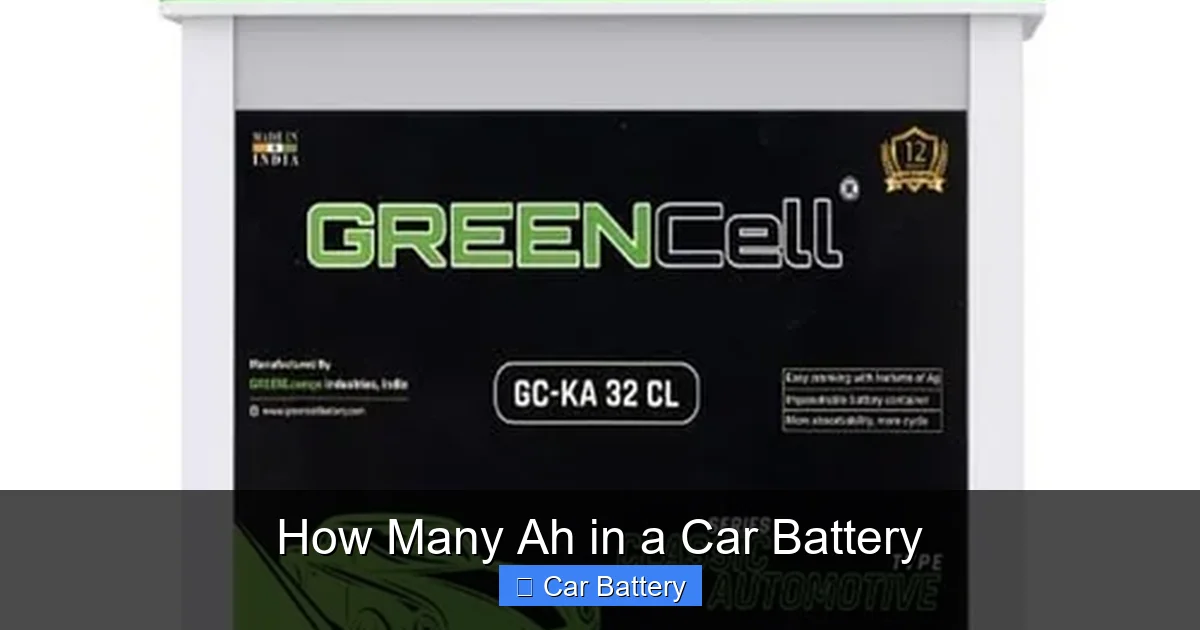
The easiest way is to look at the battery itself. Most batteries have a label with key specs, including Ah, CCA, and RC. Look for a number followed by “Ah” or “A.H.” For example: “60Ah” or “55 A.H.”
If the label is worn or missing, you can still identify the battery model and look up the specs online.
Use a Multimeter (Advanced Method)
If you’re tech-savvy, you can estimate the Ah using a multimeter and a load test. This involves:
1. Fully charging the battery.
2. Applying a known load (e.g., a 10-amp device).
3. Measuring how long it takes to drop to 10.5 volts.
For example, if a 10-amp load runs for 5 hours, the battery delivered 50Ah.
Note: This method is approximate and should only be done by experienced users. Over-discharging can damage the battery.
Consult Your Owner’s Manual
Your car’s manual lists the recommended battery specifications, including Ah, CCA, and group size. This is the most reliable source for choosing a replacement.
Ask a Professional
If you’re unsure, visit an auto parts store or mechanic. They can test your battery and recommend the correct Ah rating based on your vehicle.
Tips for Maintaining Battery Health and Maximizing Ah
Even the best battery won’t last forever—but proper care can help it deliver closer to its rated Ah for years.
Keep It Charged
Avoid deep discharges. Short trips and leaving electronics on can drain the battery. If you don’t drive often, consider a battery maintainer or trickle charger.
Clean the Terminals
Corrosion on the terminals reduces efficiency. Clean them with a baking soda and water solution and apply dielectric grease to prevent buildup.
Check for Parasitic Drain
Some devices (like alarms or dash cams) draw power even when the car is off. If your battery dies frequently, have a mechanic check for excessive drain.
Protect from Extreme Temperatures
Heat accelerates chemical reactions and shortens battery life. Cold reduces performance. Park in a garage when possible, or use a battery insulation kit.
Test Regularly
Most auto shops offer free battery testing. Get it checked once a year, especially before winter.
Replace When Needed
Car batteries typically last 3–5 years. If your battery is old or struggling to start the car, don’t wait—replace it before it leaves you stranded.
Conclusion: Choosing the Right Ah for Your Car
So, how many Ah in a car battery? The answer isn’t one-size-fits-all. Most cars use batteries between 40Ah and 100Ah, with 50–70Ah being the most common. But the right choice depends on your vehicle, driving habits, climate, and electrical needs.
Understanding Ah helps you make informed decisions. It tells you about capacity, runtime, and how well your battery can handle demand. But remember: Ah is just one piece of the puzzle. Cold cranking amps, reserve capacity, and battery type all play a role in performance and reliability.
Whether you’re replacing an old battery or upgrading for better performance, always refer to your owner’s manual and consider your real-world usage. A little knowledge goes a long way—and can save you from a dead battery on a cold morning.
Take care of your battery, and it’ll take care of you. After all, it’s the heart of your car’s electrical system.
Frequently Asked Questions
What does Ah mean in a car battery?
Ah stands for amp-hours, a measure of how much electrical charge a battery can deliver over time. A higher Ah means the battery can power your car’s systems longer before needing a recharge.
Is a higher Ah battery always better?
Not necessarily. While a higher Ah battery offers more capacity, it must fit your vehicle’s specifications. Using a battery with too high or too low Ah can cause compatibility issues or poor performance.
Can I replace a 50Ah battery with a 70Ah one?
Yes, as long as the physical size, terminal type, and voltage match. A higher Ah battery can provide more reserve power, but check your owner’s manual to ensure it’s compatible.
How does temperature affect Ah?
Cold weather reduces a battery’s effective Ah because chemical reactions slow down. In freezing conditions, a battery might only deliver 60–70% of its rated capacity.
Do electric cars use Ah ratings?
Yes, but differently. Electric vehicle (EV) batteries are rated in kilowatt-hours (kWh), which combines voltage and Ah. For example, a 60kWh battery might have a much higher Ah than a standard car battery.
How often should I check my battery’s Ah?
You don’t need to measure Ah regularly, but have your battery tested annually. Mechanics can check its health, charge level, and whether it’s still delivering close to its rated capacity.