How Long Can a 2015 Toyota Corolla Go Without an Oil Change

Contents
- 1 Key Takeaways
- 2 📑 Table of Contents
- 3 The Manufacturer’s Baseline: What Your Owner’s Manual Actually Says
- 4 The Engine’s Best Friend: Why Oil Quality and Type Matter Immensely
- 5 Real-World Factors That Shorten Your Oil Change Interval
- 6 The Warning Signs: Your Car is Begging for an Oil Change
- 7 The Price of Procrastination: What Happens When You Go Too Long
- 8 Your Action Plan: Maintaining Your 2015 Corolla’s Engine
- 9 Conclusion: Your Corolla’s Longevity is in Your Hands
- 10 Frequently Asked Questions


For a 2015 Toyota Corolla, the standard oil change interval is every 7,500 to 10,000 miles when using synthetic oil, or every 5,000 miles with conventional oil, but severe driving conditions can shorten this significantly. Ignoring these recommendations risks severe engine wear, sludge buildup, and catastrophic failure. Always consult your owner’s manual and monitor your oil life monitor or level. Regular changes are the single most important maintenance task to ensure your Corolla’s legendary reliability and longevity.
So, you’re the proud owner of a 2015 Toyota Corolla. Excellent choice. It’s arguably one of the most reliable, fuel-efficient, and sensible cars ever built. You’ve probably heard the old adage: “Change your oil every 3,000 miles.” But that’s a mantra from the era of carburetors and thick, single-grade oils. Your modern Corolla, with its efficient 1.8L or 2.0L engine and advanced computer systems, operates under a different set of rules. The real question isn’t just a number; it’s understanding the “why” behind the interval. How long can it go? The better question is: how long should it go to keep that bulletproof engine purring for 200,000 miles or more? Let’s dive deep into the specifics for your 2015 model year Corolla.
Key Takeaways
- Follow Toyota’s Official Schedule: Your 2015 Corolla’s manual provides the baseline intervals (5k miles for conventional, 7.5k-10k for synthetic), which are the minimum safe guidelines.
- “Severe” Driving is Common: Short trips, stop-and-go traffic, extreme temperatures, and dusty conditions count as severe service and can require changes every 3,000-5,000 miles.
- Oil Type is Critical: Synthetic oil lasts longer and protects better, especially in modern engines. Using the correct oil viscosity (0W-20 for the 2015 Corolla) is non-negotiable.
- Watch for Warning Signs: Don’t rely solely on mileage. Listen for engine noise, check for smoke, monitor oil levels monthly, and heed the oil change light.
- Delaying is Extremely Costly: Skipping an oil change saves pennies now but costs thousands later in engine repairs or replacement. It’s the #1 preventable cause of engine failure.
- Monthly Checks are Essential: Even with long intervals, check your oil level at least once a month. Low oil between changes is a separate, common problem that causes immediate damage.
- Reset Your System: After an oil change, ensure the maintenance light is properly reset. If you need help, guides on resetting the oil light for various models are available.
📑 Table of Contents
- The Manufacturer’s Baseline: What Your Owner’s Manual Actually Says
- The Engine’s Best Friend: Why Oil Quality and Type Matter Immensely
- Real-World Factors That Shorten Your Oil Change Interval
- The Warning Signs: Your Car is Begging for an Oil Change
- The Price of Procrastination: What Happens When You Go Too Long
- Your Action Plan: Maintaining Your 2015 Corolla’s Engine
- Conclusion: Your Corolla’s Longevity is in Your Hands
The Manufacturer’s Baseline: What Your Owner’s Manual Actually Says
Forget generic internet advice. The first and most authoritative source is your vehicle’s owner’s manual. For the 2015 Toyota Corolla, Toyota’s official maintenance schedule provides a clear, but nuanced, recommendation. It’s not a one-size-fits-all number. The manual outlines two primary service schedules: “Normal” driving conditions and “Severe” driving conditions. The vast majority of drivers fall into the “Severe” category, whether they realize it or not.
Normal vs. Severe Driving Conditions
Toyota defines “Normal” driving as mostly highway miles, consistent speeds, and mild ambient temperatures. This is the exception, not the rule. “Severe” driving, which includes:
- Frequent short trips (less than 5 miles) where the engine doesn’t fully warm up.
- Extensive idling or stop-and-go traffic in heavy congestion.
- Driving in extremely hot (above 90°F/32°C) or cold (below 10°F/-12°C) temperatures.
- Driving on dusty, sandy, or muddy roads.
- Repeated towing or carrying heavy loads.
If your Corolla is your daily commuter in city traffic, used for school runs, or sees winter salt and summer heat, you are in the severe service bucket. This distinction is the single biggest factor in determining your true oil change interval.
The Official Mileage Intervals
Based on the manual’s guidance for the 2015 Corolla’s recommended 0W-20 synthetic oil:
- Under Normal Conditions: Every 10,000 miles or 12 months, whichever comes first.
- Under Severe Conditions: Every 5,000 miles or 6 months, whichever comes first.
For models still using conventional oil (less common by 2015, but possible), the severe service interval drops to 3,000-5,000 miles. However, Toyota strongly recommends and most 2015 Corollas from the factory were filled with and recommend synthetic 0W-20 oil. If you’re unsure what oil is in your car right now, check the oil cap or dipstick label. The benefits of synthetic oil—better high-temperature stability, improved cold-flow, and longer life—make the 7,500-10,000 mile interval possible under ideal conditions. But remember, “ideal” is rare. For most owners, a safe, conservative target is every 5,000 to 7,500 miles, especially if your driving is mixed.
The Engine’s Best Friend: Why Oil Quality and Type Matter Immensely
Oil isn’t just a lubricant anymore; it’s a sophisticated fluid that cleans, cools, seals, and protects your engine from corrosive acids and tiny metal particles. The type of oil you use is as important as the change interval itself. Using the wrong oil or poor-quality oil can render even a frequent change ineffective.
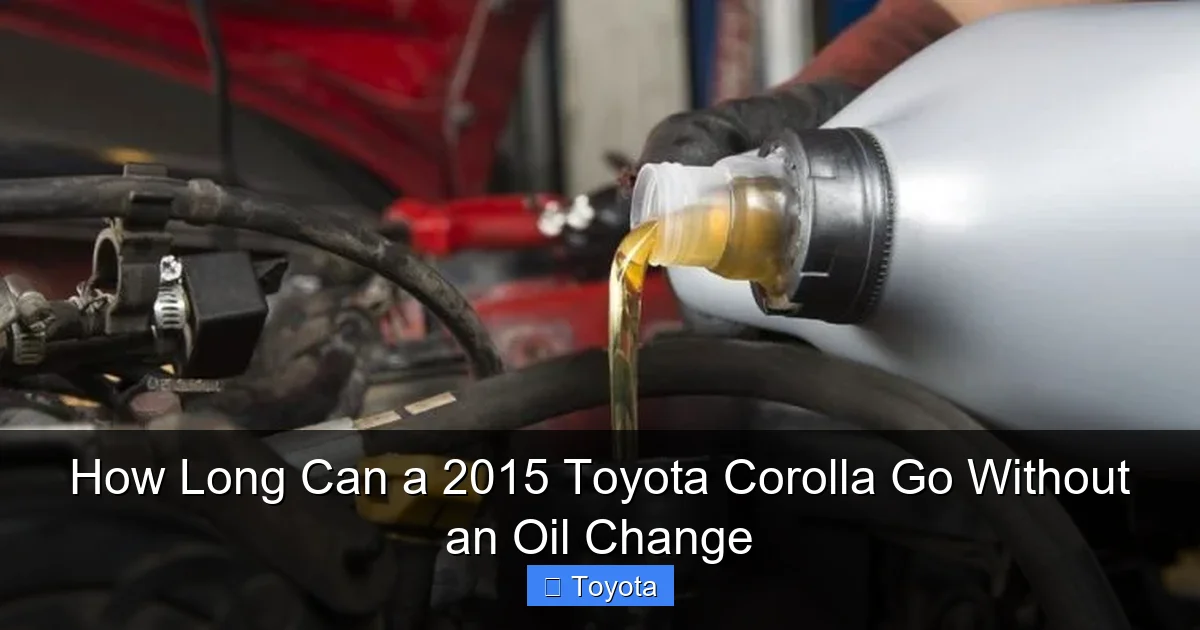
Visual guide about How Long Can a 2015 Toyota Corolla Go Without an Oil Change
Image source: carproper.com
The 0W-20 Mandate
Your 2015 Corolla’s engine is designed around 0W-20 viscosity oil. This “thin” oil is crucial for fuel efficiency, quick cold-start lubrication, and proper function of the engine’s hydraulic timing chain system and other tight tolerances. Using a 5W-30 or 10W-30, while common in older cars, can cause increased wear and potentially trigger check engine lights related to variable valve timing. Always, always use oil that meets Toyota’s specification and the API’s SN or newer standard. High-quality synthetic oils from brands like Mobil 1, Castrol EDGE, or Toyota’s own Genuine Motor Oil are engineered to meet these demands.
Synthetic vs. Conventional: It’s Not Even a Contest for Modern Cars
Conventional oil is refined from crude oil. It has shorter molecular chains, breaks down faster under heat and stress, and leaves more sludge. Synthetic oil is man-made, with uniform, robust molecules designed to resist thermal breakdown. For a 2015 Corolla, synthetic is the only correct choice for extending drain intervals. It provides:
- Superior Protection: Better film strength at high temperatures prevents metal-on-metal contact.
- Cleaner Engine: Superior detergents keep deposits and sludge at bay, which is critical for engine longevity.
- Longer Life: Resists oxidation and thickening, allowing for longer miles between changes without sacrificing protection.
A common question is whether to switch to high-mileage synthetic oil. For a 2015 model with over 100k miles, high-mileage oils contain seal conditioners that can help with minor, age-related leaks. It’s a good option, but sticking with a top-tier full synthetic is perfectly fine. You can find exact capacities and recommendations in our detailed guide on how much oil a Toyota Corolla takes.
Real-World Factors That Shorten Your Oil Change Interval
Let’s be brutally honest. Your driving habits are likely “severe.” That 7,500-10,000 mile number is a best-case scenario under near-perfect conditions. Here are the real-world culprits that turn your oil into Swiss cheese long before the odometer hits the recommended number.
Visual guide about How Long Can a 2015 Toyota Corolla Go Without an Oil Change
Image source: koala.sh
The Culprit: Short Trips and Cold Starts
This is the #1 engine killer for daily drivers. Water is a byproduct of combustion. It condenses inside the engine as vapor. On a long highway drive, the engine reaches full operating temperature, burns off this water vapor, and the oil gets hot enough to evaporate any fuel dilution. On a 2-mile commute to the grocery store, the engine barely warms up. Water and unburned fuel (a gasoline solvent) mix with your oil, diluting it and destroying its lubricating properties. This acidic, watery sludge coats your engine’s internals. If this sounds like your life, you should be changing your oil every 3,000-5,000 miles, regardless of what the manual says for “normal” conditions.
Environmental Stressors: Heat, Cold, and Dust
Extreme heat thins oil, reducing its ability to maintain a protective film. Your Corolla’s cooling system works hard in summer, but oil temperatures can still soar in traffic. Conversely, extreme cold makes oil thick and sluggish. On a cold morning, it takes longer for oil to reach critical engine components, causing initial wear. The 0W-20 rating means it flows like a “0-weight” oil in cold starts, which is vital. Dusty environments are another issue. A clogged air filter allows fine particulate matter into the combustion chamber, which eventually makes its way into the oil as abrasive soot. In dusty, rural areas, more frequent changes are wise.
Towing, Hauling, and High RPMs
Your Corolla isn’t a heavy-duty truck, but many owners use them to tow small utility trailers or carrying bikes/roof racks. Any added load increases engine stress and operating temperature. Consistently high RPM driving (like on spirited mountain roads) also increases thermal stress on the oil. These activities fall squarely under “severe” service and demand shorter intervals.
The Warning Signs: Your Car is Begging for an Oil Change
Modern Corollas have an Oil Maintenance Required light or a message on the multi-information display. This system is based on algorithms that calculate engine revolutions, temperature, and time. It’s a good tool, but it’s a generalized guide. It doesn’t know your driving conditions. Therefore, you must also use your senses. Here are the red flags that your oil is past its prime, regardless of the last change date.
Visual guide about How Long Can a 2015 Toyota Corolla Go Without an Oil Change
Image source: autozonic.com
Listen and Feel: Engine Noise and Performance
Fresh, clean oil provides a cushion between moving parts. As oil degrades, that cushion thins. You might notice:
- A slight increase in engine tick or valvetrain noise, especially on cold starts.
- A general feeling of reduced smoothness or a slight “roughness” at idle.
- Reduced throttle response or a feeling that the engine is working harder.
These are subtle signs of increased friction. Don’t ignore them.
Look and Smell: The Physical Inspection
This is the most important habit you can develop. Check your oil level at least once a month. Park on level ground, wait for the engine to cool (not cold), pull the dipstick, wipe it clean, reinsert fully, and pull again. Look at the color and feel the oil on the rag.
- Color: New oil is amber and translucent. Used oil darkens to a brown or black color. This is normal. However, if it’s milky, foamy, or looks like chocolate milk, you have a serious coolant leak into the oil (head gasket issue) and must stop driving immediately.
- Smell: Oil that smells burnt or acrid is overheating and breaking down.
- Texture: If the oil on the dipstick feels gritty or you see visible sludge, it’s way past time.
Also, look under the car. Any fresh oil drips or puddles indicate a leak that needs fixing. Low oil between changes is a separate problem that causes rapid damage. You can learn more about the causes and solutions in our article on whether a car can leak oil after an oil change.
The Exhaust and The Dipstick
Blueish-gray smoke from the tailpipe, especially during startup or acceleration, can indicate oil is being burned—a sign of internal wear, but also of severely degraded oil that’s finding its way past seals. A very low reading on the dipstick, below the “L” or “Add” mark, means you’re running on critically low oil, which can cause engine seizure in minutes. Top up with the correct oil immediately and find the leak.
The Price of Procrastination: What Happens When You Go Too Long
Let’s talk about the consequences. Think of oil change savings as a high-interest, short-term loan you take from your engine’s future. The “interest” is catastrophic, expensive damage.
Stage 1: Sludge and Varnish
As oil degrades, it loses its ability to suspend contaminants. Oxidized oil turns into a thick, gooey sludge. This sludge clogs oil passages, preventing oil from reaching the camshaft, crankshaft bearings, and valve train. It coats surfaces like varnish, increasing friction and heat. The engine runs hotter and less efficiently. Fuel economy drops. You might start to feel the rough idle mentioned earlier.
Stage 2: Accelerated Wear and Tear
With sludge blocking passages and the oil’s lubricating film weakened, metal components begin to wear directly on each other. This is microscopic at first but permanent. Bearings (main and rod) wear, increasing clearance. Cylinder walls and piston rings score. The engine begins to consume its own oil as the worn rings no longer seal properly. You’ll start needing to add a quart between changes. This stage is often silent but irreversible.
Stage 3: Catastrophic Failure
This is the “throw a rod” or “spun bearing” scenario. A critical bearing, starved of oil due to sludge or simply worn to zero clearance, welds itself to the crankshaft. The sudden, immense friction and mechanical force shatter the bearing, throws a connecting rod through the engine block, and turns your Corolla into a 2,800-pound paperweight. The cost? A used or remanufactured engine starts at $2,500-$4,000 installed, plus labor. A new engine can be $5,000+. This is the ultimate price of a $50 oil change. For context on how other critical systems fail, you might read about how long a car battery lasts without an alternator—another system where neglect leads to a tow bill.
Your Action Plan: Maintaining Your 2015 Corolla’s Engine
Okay, so you’re convinced. Now what? Here is a simple, actionable plan to keep your Corolla’s heart healthy for the long haul.
1. Adopt a Conservative, Realistic Schedule
Forget the “10,000-mile” hype if your driving is anything but pure highway. A safe, smart interval for most 2015 Corolla owners is every 5,000 miles or 6 months with full synthetic oil. This accounts for real-world “severe” driving and provides a huge buffer against sludge and wear. It’s a small, predictable expense for monumental peace of mind and engine life. If you do primarily long-distance highway driving, you could cautiously extend to 7,500 miles.
2. Use Only the Correct, High-Quality Oil and Filter
This is non-negotiable. Use only丰田-approved 0W-20 full synthetic oil that meets API SN or SP and ILSAC GF-6 standards. Don’t cheap out on the filter. A premium filter (like Fram, Wix XP, or Toyota Genuine) has better media and anti-drainback valves to keep oil in the engine for cold starts. A $5 filter saves you pennies and risks your multi-thousand-dollar engine. You can find specifics on the exact how many quarts of oil a Toyota Corolla takes for your specific engine code.
3. Perform Monthly Oil Level Checks
Make this a habit, like checking tire pressure. A low oil level between changes indicates a leak or, more commonly, that the engine is burning oil—a sign of wear that needs diagnosis. Never let it drop below the “Add” mark. Top it up with the correct oil. While you’re checking, look at the color and smell it. This is your earliest warning system.
4. Address the “Maintenance Required” Light Properly
After your oil change, the light will come on. You must reset it. The procedure for a 2015 Corolla is: Turn ignition to “ON” (not start), turn odometer to “Trip A”, turn key off, press and hold the trip/odo reset button while turning key back to “ON”. The display will count down and reset. If you’re unsure, your mechanic will do it, or you can find model-specific guides. A lit light that never gets reset is annoying and defeats the system’s purpose.
5. Keep All Other Fluids and Systems in Check
Engine health is systemic. A cooling system that runs hot accelerates oil degradation. A dirty air filter allows abrasive dust into the oil. Worn spark plugs cause incomplete combustion, leading to fuel dilution. Stick to the full maintenance schedule: inspect/change air filter, cabin filter, coolant, and spark plugs at their recommended intervals. A well-running engine is a happy, long-lasting engine. Understanding the overall how often a car should get an oil change involves seeing it as part of a larger maintenance rhythm.
Conclusion: Your Corolla’s Longevity is in Your Hands
The 2015 Toyota Corolla has the potential to be a 300,000-mile car. It has the engineering, the quality, and the Toyota reliability pedigree. But that potential is a contract between you and the car. The most fundamental clause in that contract is regular, timely oil changes with the correct fluid. The “how long can it go” question has a definitive answer for your specific car: under perfect conditions with synthetic oil, up to 10,000 miles. But the “how long should it go” answer for 95% of real-world drivers is 5,000 to 7,500 miles. The cost of an extra oil change or two per year is trivial compared to the cost of a new engine. It’s the ultimate no-brainer maintenance. Don’t gamble with the heart of your Corolla. Stick to a conservative schedule, use top-tier synthetic oil, check the level monthly, and listen to your car. Your future self, holding a set of keys to a running, reliable Corolla with 200,000 miles on the clock, will thank you.
Frequently Asked Questions
Can I go 10,000 miles without an oil change in my 2015 Corolla?
Only if your driving is almost exclusively steady-speed, long-distance highway travel in mild temperatures and you are using high-quality full synthetic 0W-20 oil. For the vast majority of drivers with mixed or “severe” driving, 10,000 miles is too long and risks engine damage.
What happens if I just add oil instead of changing it?
Adding oil between changes only addresses the level, not the quality. The old, degraded oil full of contaminants, fuel dilution, and acids remains in the engine, slowly destroying it from the inside. You must change the oil and filter to remove these harmful byproducts.
Is it okay to use a different oil viscosity, like 5W-30?
No. Your 2015 Corolla’s engine is specifically engineered for 0W-20 oil. Using a thicker oil can cause increased wear, poor fuel economy, and potential issues with the variable valve timing system. Always use the manufacturer-specified viscosity.
My oil looks dark after 3,000 miles. Is that normal?
Yes, it is. Modern detergent oils are designed to suspend dirt and contaminants, which turns the oil dark. Dark color alone is not an indicator of when to change oil. You must follow the recommended mileage/time interval or the vehicle’s maintenance monitor.
How much does an oil change cost for a 2015 Toyota Corolla at a dealership?
At a Toyota dealership, you can expect to pay between $40 and $70 for a conventional oil change and $60 to $90 for a synthetic oil change (which is recommended). This includes the oil, filter, and labor. Dealerships use OEM filters and Toyota-branded oil, which are high-quality. You can find more detailed pricing information in our article on how much an oil change costs at Toyota.
My “Maintenance Required” light is on. Can I keep driving for a few hundred miles?
The light is a reminder that you’ve reached the recommended interval. It’s safe to drive for a short distance (100-200 miles) to schedule service, but do not ignore it for thousands of miles. The light is based on your driving habits and is a more accurate guide than a generic 3,000-mile sticker. Get the oil changed promptly.