
Is the Graco SlimFit 3-in-1 Convertible Car Seat FAA Approved?

Quick Answer
Yes. The Graco SlimFit 3-in-1 car seat is certified for aircraft use when your child uses its built-in five-point harness. It is not approved for aircraft use in booster mode. Before traveling, confirm the certification label on your particular seat and review the FAA child-restraint guidance.
What parents need to know
- Harness use only: Aircraft certification applies while the internal five-point harness secures the child.
- No booster mode: Aircraft seats normally have lap belts, while booster mode requires a lap-and-shoulder belt.
- Check the label: Look for wording stating that the restraint is certified for motor vehicles and aircraft.
- Use the lap belt: Install the SlimFit with the aircraft belt, not its LATCH connectors or top tether.
- Reserve a seat: Your child needs an assigned aircraft seat to guarantee use of the car seat.
- Call the airline: Ask about seating restrictions and the aircraft seat width before departure.
The Graco SlimFit 3-in-1 convertible car seat can travel from your vehicle into an airplane cabin. However, its approval depends on how you use it.
I’ve found that the confusing part is rarely the word “approved.” Parents usually need to know which mode works, where the label is, and whether this fairly large seat will fit.
In This Guide
- Is the Graco SlimFit 3-in-1 FAA approved?
- Which SlimFit modes can you use on an airplane?
- How do you verify the aircraft certification?
- How do you install the Graco SlimFit on an airplane?
- Will the Graco SlimFit fit in an airplane seat?
- What should you check before flying?
- Frequently asked questions
Is the Graco SlimFit 3-in-1 FAA Approved?
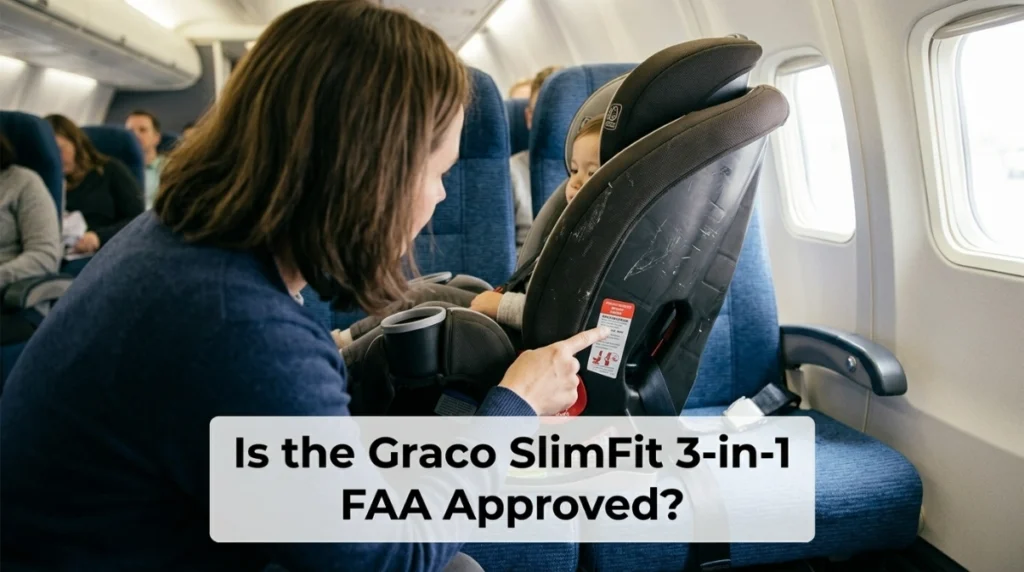
Yes, the U.S. Graco SlimFit 3-in-1 is certified for aircraft use with its internal harness. The manufacturer’s manual says to use it only on forward-facing aircraft passenger seats.
An aircraft-certified child restraint system is a hard-backed safety seat that meets the required labeling and certification rules for use aboard an airplane. The certification does not mean every mode or installation method works in the cabin.
The SlimFit manual provides the controlling instructions for your seat. Graco also advises parents to consult the owner’s manual because aircraft approval can differ among models and modes.
- Rear-facing harness mode: May be used when allowed by the instructions for your child’s size.
- Forward-facing harness mode: May be used while the child remains within the harness limits.
- Highback booster mode: Not certified for aircraft use.
The phrase “forward-facing aircraft seat” describes the airplane’s passenger seat. It does not automatically mean the child restraint must face forward.
Always follow the orientation and size rules printed on your SlimFit. Your seat’s manufacturing date and exact model number matter more than a retailer’s description.
The Graco aircraft-use guidance confirms that most harnessed Graco seats can fly when used according to their manuals.
Section Takeaway: The SlimFit is aircraft-certified in harness mode, but its booster configuration is not suitable for airplane use.
Which SlimFit Modes Can You Use on an Airplane?
The SlimFit has three vehicle-use stages, but only two use its internal harness. Aircraft approval applies to those harnessed configurations.
| SlimFit mode | Typical weight range | Aircraft use | Why |
|---|---|---|---|
| Rear-facing harness | 5–40 pounds | Certified | The built-in harness restrains the child. |
| Forward-facing harness | 22–65 pounds | Certified | The built-in harness restrains the child. |
| Highback booster | 40–100 pounds | Not certified | Booster mode needs a lap-and-shoulder belt. |
These are commonly published limits for the U.S. SlimFit 3-in-1. Check the labels on your own seat because Graco can revise requirements.
Why does booster mode not work?
A booster positions the vehicle’s lap-and-shoulder belt across the child. It does not restrain the child with the SlimFit’s internal harness.
Standard airline passenger seats usually provide only a lap belt. That belt cannot supply the upper-body restraint required for booster use.
The FAA also states that booster seats and backless restraints cannot be used during taxi, takeoff, or landing. Checking the booster or using the airplane belt directly may be the appropriate option for an older child.
Does FAA-approved mean the FAA tested this exact seat?
“FAA approved” is common shorthand, but “certified for aircraft use” is more precise. U.S. car-seat manufacturers certify qualifying restraints under the applicable federal standards and mark them accordingly.
The critical evidence is the certification wording on the physical seat. Airline staff may ask you to show it before allowing installation.
Section Takeaway: Use the SlimFit’s five-point harness on the aircraft. Never try to improvise its booster mode with a lap-only belt.
How Do You Verify the Aircraft Certification?
Inspect the SlimFit before leaving home. Find the statement confirming certification for use in motor vehicles and aircraft.
The required wording commonly appears in red on a label attached to the side or lower shell. Its position may vary by production date.
- Find the model label. Record the model number, manufacturing date, and expiration information.
- Locate the aircraft statement. Look for the sentence certifying use in motor vehicles and aircraft.
- Read the current manual. Match the manual to your exact model number and manufacturing date.
- Confirm harness eligibility. Make sure your child fits the allowed height, weight, age, and orientation rules.
- Photograph the label. Keep a clear photo on your phone, but be ready to show the physical label.
I would also save the aircraft-installation pages on my phone. Airport internet can be unreliable, and the paper manual is easy to lose.
Important: Do not rely on an online listing alone. A similarly named SlimFit model sold outside the United States may carry different certification and installation rules.
The FAA tells travelers to confirm the certification label and read the manufacturer’s instructions. An unlabeled or incompatible restraint may need to be checked as baggage.
How Do You Install the Graco SlimFit on an Airplane?
Install the SlimFit with the aircraft’s lap belt through the correct harness-mode belt path. Do not use the LATCH connectors or top tether aboard a typical commercial aircraft.
Exact routing differs between rear-facing and forward-facing use. Follow the diagram in the manual that came with your seat.
Basic aircraft installation steps
- Choose an allowed location. A window seat usually prevents the restraint from blocking another passenger’s exit.
- Set the correct recline. Use the position permitted for your child’s direction and size.
- Place the SlimFit on the seat. The aircraft passenger seat itself must face forward.
- Open the correct belt path. Use the rear-facing or forward-facing path shown in the manual.
- Route the aircraft lap belt. Keep the belt flat and free from twists.
- Buckle and tighten it. Press into the SlimFit while removing slack from the lap belt.
- Check movement. Test at the belt path, not at the headrest.
- Harness the child. Position the chest clip and straps according to the manual.
Do not attach the top tether to an unapproved part of the aircraft seat. The SlimFit manual specifically says not to use the tether during aircraft installation.
Likewise, leave the lower-anchor connectors stored. Commercial aircraft seats generally do not have the vehicle anchor system known as LATCH.
Ask for help when the buckle is difficult
Some aircraft buckles can land inside or near the SlimFit’s belt path. That position may make tightening or unbuckling awkward.
Ask a flight attendant if you cannot secure the seat properly. Never use a personal belt extender unless the airline provides and authorizes it.
Safety Alert: If the seat remains loose or the belt buckle interferes with installation, do not invent a workaround. Follow the crew’s direction and the Graco manual.
Section Takeaway: Use only the airplane lap belt and the correct harness-mode belt path. Store the LATCH connectors and do not attach the tether.
Will the Graco SlimFit Fit in an Airplane Seat?
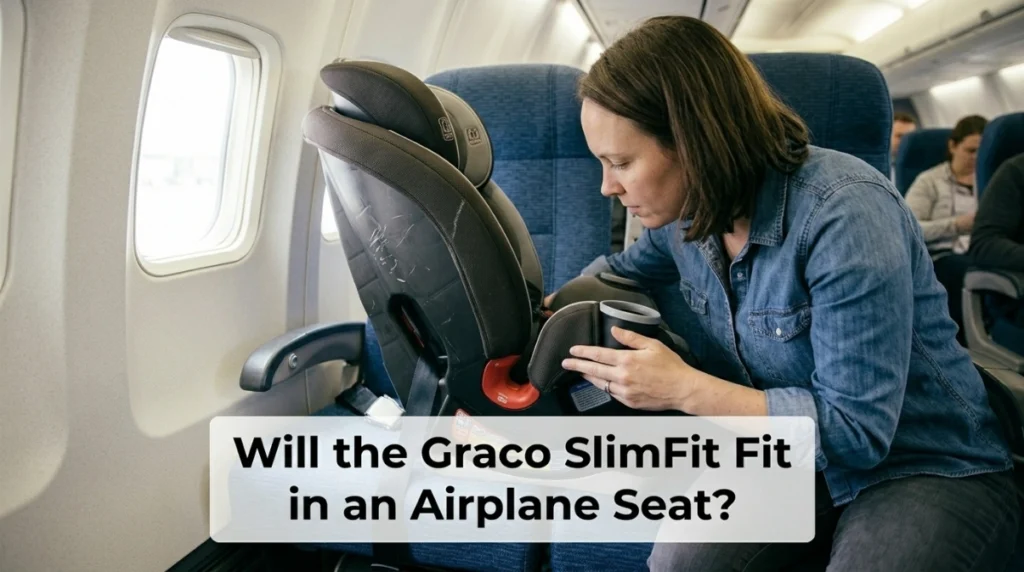
It may fit, but “SlimFit” does not guarantee compatibility with every cabin seat. Current manufacturer specifications list the U.S. model at about 19.9 inches wide and 19.5 pounds.
Aircraft seat width varies by airline, plane, row, and cabin. Fixed armrests can make the usable space narrower.
- Product width: Approximately 19.9 inches.
- Product weight: Approximately 19.5 pounds.
- Travel advantage: Rotating cup holders can reduce its side profile.
- Travel drawback: It remains heavier and bulkier than many dedicated travel seats.
Check the current dimensions on the official Graco SlimFit product page. Then ask the airline for the usable width of your assigned seat.
What if it does not fit the assigned seat?
The FAA says an airline must accommodate a properly labeled restraint in another seat within the same service class when the child has a purchased seat and the restraint does not fit the first location.
Airlines may still control safe placement. Exit rows are prohibited, and the restraint cannot block anyone’s evacuation route.
A window position is usually the easiest choice. On some wide-body aircraft, an approved position in a center seating section may also work.
Is it convenient for airport travel?
The SlimFit offers the convenience of using one familiar seat at your destination. Its weight becomes noticeable during a long connection.
A folding luggage cart or purpose-made car-seat travel cart can make the terminal easier. Remove loose accessories that are not approved for use with the restraint.
Section Takeaway: Verify both the car seat’s dimensions and the aircraft seat width. Certification does not guarantee an easy physical fit in every row.
What Should You Check Before Flying?
A short preflight check prevents most gate-side surprises. Complete it several days before departure.
- Buy the child a ticket: A separate ticket guarantees access to an aircraft seat for the restraint.
- Confirm the label: Make sure the aircraft-certification wording remains readable.
- Pack the manual: Bring the correct manual or save an offline copy.
- Check your child’s fit: Confirm the child remains within the selected harness-mode limits.
- Contact the airline: Ask about approved locations, seat width, and family-seating policies.
- Avoid exit rows: Child restraints cannot be placed where they obstruct evacuation.
- Practice with a lap belt: Review the aircraft installation instructions before travel.
- Inspect the seat: Do not use a crashed, damaged, recalled, or expired restraint.
- Store loose parts: Secure the LATCH connectors, tether, and permitted accessories.
Use the NHTSA car-seat guidance to review correct child fit and general restraint recommendations. You can also check the model for open safety recalls.
Keep the child secured whenever the crew allows it. The FAA recommends using an approved restraint throughout the flight because turbulence can happen without warning.
What should you say if airline staff question the seat?
Stay calm and show the certification statement on the car seat. You can also show the matching aircraft-use section in the Graco manual.
The physical label carries more weight than a screenshot from a store. Allow extra boarding time so the crew can review it without delaying departure.
Section Takeaway: Bring proof, confirm the seating rules, and practice installation before travel day. Preparation makes the cabin installation much easier.
Frequently Asked Questions
Can I use the Graco SlimFit rear-facing on an airplane?
Yes, when your child meets the rear-facing requirements and your exact manual permits that setup. The airplane’s passenger seat must face forward. Follow the SlimFit’s rear-facing belt-path and recline instructions.
Can the Graco SlimFit be used forward-facing on a plane?
Yes. The SlimFit can be installed forward-facing with its internal harness when the child meets the manual’s age, height, and weight requirements. Use the aircraft lap belt and do not use the top tether.
Can I use the Graco SlimFit as a booster on an airplane?
No. The SlimFit’s booster mode requires a lap-and-shoulder belt, while standard aircraft seats normally have lap-only belts. Its aircraft certification applies only when the built-in harness is used.
Does a lap child need a car seat?
U.S. rules may permit a child under two to fly on an adult’s lap. However, the FAA strongly recommends an approved restraint in a separately purchased seat for the entire flight.
Where should I place the SlimFit on the plane?
A window seat is generally preferred because the restraint will not block another passenger’s path. It cannot be placed in an exit row or anywhere it would obstruct an emergency exit.
Can I use LATCH to install the SlimFit on an airplane?
No, not on a standard commercial aircraft seat. Install it using the aircraft lap belt through the correct belt path. Store the lower-anchor connectors and do not attach the top tether.
What if a flight attendant says the seat is not approved?
Show the certification statement attached to the car seat and the aircraft section in its manual. Follow crew instructions while discussing the issue calmly, since the airline controls safe seating assignments aboard its aircraft.
The Bottom Line
The Graco SlimFit 3-in-1 is certified for airplane use when your child is secured with its internal harness. It cannot be used as a booster aboard the aircraft.
Before flying, inspect the certification label, read your model-specific manual, and confirm the airline’s seating rules. A purchased seat for your child gives you the best chance of using the SlimFit throughout the flight.