
Graco Nautilus 65 3-in-1 Harness Booster Car Seat Guide

Quick Answer
The Graco Nautilus 65 is a forward-facing combination car seat with three modes: a five-point harness, highback booster, and backless booster. It does not provide a rear-facing mode, so use it only after your child has outgrown an appropriate rear-facing seat and meets the limits printed on your specific Nautilus label and manual. Review the NHTSA car-seat recommendations before moving your child to the next stage.
What parents should know
- Forward-facing only: The Nautilus 65 cannot carry a child rear-facing.
- Harness mode: Many Nautilus 65 manuals list a 22–65-pound range and a maximum standing height of 49 inches.
- Highback booster: Common limits are 30–100 pounds and 38–57 inches, depending on the model.
- Backless booster: Some later Nautilus 65 versions allow 40–120 pounds and 40–57 inches.
- Model differences: Limits, lower-anchor rules, and expiration periods can vary by manufacture date.
- Best practice: Keep a child harnessed until the harness height or weight limit is reached.
Before using a secondhand seat
- Confirm its complete history, manufacture date, model number, recall status, expiration date, and access to the matching manual.
The Graco Nautilus 65 3-in-1 harness booster car seat was built for the stages between rear-facing travel and an adult seat belt. It combines three forward-facing configurations in one fairly substantial seat.
The name can create confusion. “3-in-1” does not mean rear-facing, forward-facing, and booster modes.
This guide explains its limits, installation choices, booster conversions, and daily fit checks. Because Graco produced several Nautilus 65 versions, your seat’s labels and matching manual always take priority.
In This Guide
- What Is the Graco Nautilus 65 3-in-1?
- What Are the Nautilus 65 Height and Weight Limits?
- When Is a Child Ready for the Nautilus 65?
- How Do You Install the Graco Nautilus 65?
- How Do You Use and Adjust the Harness?
- How Do You Convert It Into a Booster?
- Is a Used Nautilus 65 Still a Good Choice?
- Frequently Asked Questions
What Is the Graco Nautilus 65 3-in-1?
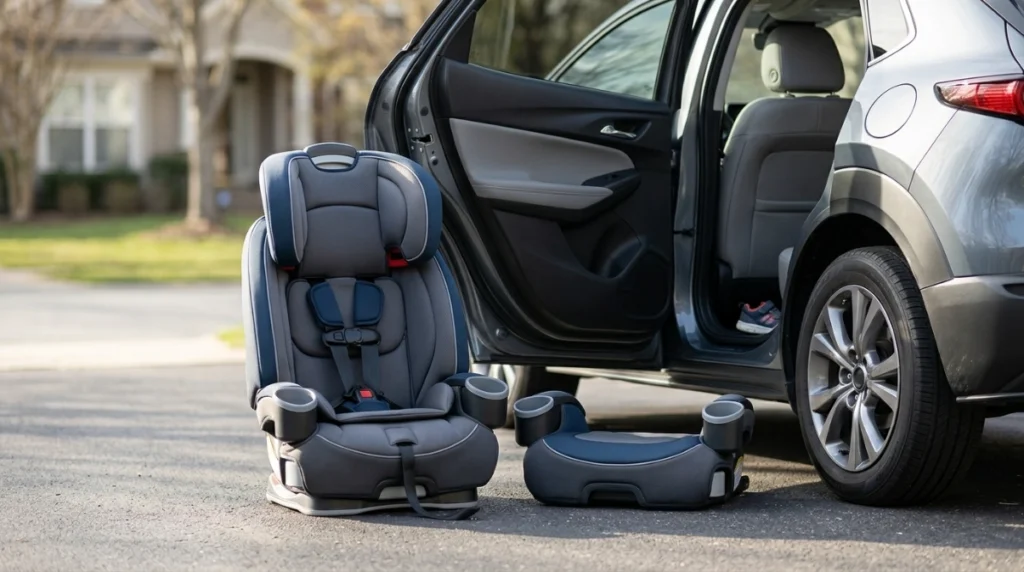
The Graco Nautilus 65 is a combination car seat. That means it begins as a forward-facing harnessed seat and later converts into a belt-positioning booster.
Its three modes are:
- Forward-facing harness: The built-in five-point harness restrains the child.
- Highback booster: The vehicle’s lap-and-shoulder belt restrains the child while the seat’s back guides the belt.
- Backless booster: The lower booster raises the child for better vehicle-belt placement.
It is not an infant seat or rear-facing convertible seat. A younger child should remain rear-facing until reaching the rear-facing limit of a suitable seat.
The original Nautilus 65 family also differs from the newer Nautilus 2.0. Current Nautilus 2.0 specifications should not be applied automatically to an older Nautilus 65.
Common Nautilus 65 features include an adjustable headrest, steel-reinforced frame, cup holder, storage compartments, and multiple recline positions. Trim-dependent features may include upgraded lower-anchor connectors or a seat-belt lockoff.
Section Takeaway: The Nautilus 65 offers three forward-facing stages, but it never replaces a rear-facing car seat.
What Are the Nautilus 65 Height and Weight Limits?
Many Nautilus 65 manuals list a 22–65-pound harness range and a 30–100-pound highback-booster range. Backless limits vary across versions, with some later models allowing up to 120 pounds.
Never rely on the model name alone. Read the labels attached to your seat before choosing a mode.
| Mode | Common Nautilus 65 Limits | Child-Fit Requirement | Restraint Used |
|---|---|---|---|
| Harness | 22–65 lb; 27–49 in | Harness at or above shoulders; ears below the head-support limit | Built-in five-point harness |
| Highback booster | 30–100 lb; commonly 38–57 in | Child must sit correctly for the entire ride | Vehicle lap-and-shoulder belt |
| Backless booster | Often 40–100 or 40–120 lb; commonly 40–57 in | Vehicle seat or head restraint must support the child’s head | Vehicle lap-and-shoulder belt |
These numbers are a reference, not permission to ignore the seat. A child outgrows a mode after reaching any stated height, weight, shoulder, or head-position limit.
For example, a 58-pound child may still outgrow the harness by torso height. The harness straps must remain in an approved position at or above the shoulders.
A booster rider must also meet behavioral requirements. Weight alone does not show that a child can remain upright without leaning or moving the shoulder belt.
Section Takeaway: Use your seat’s lowest applicable limit, including its fit rules—not just the maximum weight printed on the box.
When Is a Child Ready for the Nautilus 65?
A child is ready only after outgrowing a rear-facing seat and meeting every harness-mode requirement printed on the Nautilus. The child must also be developmentally ready to face forward.
NHTSA’s Right Seat guidance recommends keeping children rear-facing until they reach their seat’s rear-facing height or weight limit. Afterward, they should use a forward-facing harness and tether.
Why the minimum weight is not the goal
A listed minimum only describes when a seat permits that mode. It does not mean switching at the minimum provides the best fit for every child.
Keep the child in each safer stage until it is genuinely outgrown. Moving from a harness to a booster early removes the restraint that controls the child’s position.
Signs your child fits the harness mode
- The child meets the seat’s minimum age, weight, and height rules.
- The child has already outgrown an appropriate rear-facing restraint.
- The harness can pass through an approved slot at or above the shoulders.
- The buckle position and crotch strap follow the manual’s instructions.
- The child’s head and ears remain within the allowed head-support area.
Signs your child is ready for booster mode
The child must meet the booster minimums and sit correctly for every trip. Many children need a harness longer than parents initially expect.
- Back and bottom remain against the booster.
- The lap belt stays low across the upper thighs.
- The shoulder belt crosses the center of the chest and shoulder.
- The child does not place the belt behind the back or under an arm.
- The child can maintain this position while sleeping.
Section Takeaway: Readiness depends on physical size, developmental maturity, and correct belt fit—not age or weight alone.
How Do You Install the Graco Nautilus 65?
In harness mode, install the Nautilus 65 with either the vehicle seat belt or lower anchors, plus the top tether. Do not combine the seat belt and lower anchors unless your exact manual expressly permits it.
Installing with lower anchors
- Place the seat forward-facing on an approved vehicle seating position.
- Choose an allowed recline position and confirm full contact with the vehicle seat.
- Route the lower-anchor strap through the forward-facing belt path.
- Remove twists and connect both attachments to the vehicle’s lower anchors.
- Press down on the seat while pulling the adjustment strap tight.
- Connect and tighten the top tether to the correct vehicle tether anchor.
- Test movement at the belt path, not at the headrest.
The seat should move less than one inch from side to side or front to back at the belt path. Movement near the top of the seat does not measure installation tightness.
Installing with the vehicle seat belt
- Store the unused lower-anchor connectors as the manual directs.
- Route the lap-and-shoulder belt through the forward-facing belt path.
- Buckle the belt and remove any twists.
- Lock the seat belt using the method specified by the vehicle manual.
- Apply pressure to the Nautilus while removing belt slack.
- Attach and tighten the top tether.
- Check for less than one inch of belt-path movement.
Some Nautilus trims include a lockoff, while others do not. Never assume that instructions for the LX, DLX, Elite, or newer Nautilus 2.0 apply to your seat.
Why the top tether matters
A tether is the strap extending from the upper rear of a forward-facing seat. It connects to a designated vehicle tether anchor and helps limit forward head movement in a crash.
NHTSA’s forward-facing installation instructions recommend tether use whenever the car-seat and vehicle manufacturers permit it. Check the vehicle manual for the anchor location.
Safety Alert: If you cannot achieve a tight installation, contact a certified Child Passenger Safety Technician rather than improvising with towels, clips, or unsupported accessories.
Section Takeaway: Use one approved installation method, add the top tether, and test tightness directly at the belt path.
How Do You Use and Adjust the Harness?
Correct installation secures the seat to the vehicle. Correct harnessing secures the child to the seat.
Check the harness every ride. Coats, growth spurts, and another caregiver’s adjustments can change the fit.
Harness fit checklist
- Shoulder position: Forward-facing straps should enter the approved slots at or above the shoulders.
- Flat webbing: Remove every twist from the shoulder and hip straps.
- Snug fit: Tighten until you cannot pinch excess webbing vertically at the collarbone.
- Chest clip: Position it at armpit level.
- Buckle location: Use only a crotch-strap position allowed for the child’s size and mode.
Bulky winter coats can create hidden slack. Buckle the child in thin, close-fitting layers and place a blanket over the secured harness if needed.
Cleaning without damaging the seat
Follow the cover-removal and washing directions in the matching manual. Cleaning rules can differ between the removable cover, buckle, harness webbing, and plastic shell.
Avoid bleach, harsh solvents, lubricants, and machine washing the harness unless Graco specifically permits it. These treatments can damage materials even when the damage is not visible.
Do not replace the harness, buckle, padding, or cup holder with a generic substitute. Use parts approved for the exact model number.
How Do You Convert the Nautilus 65 Into a Booster?
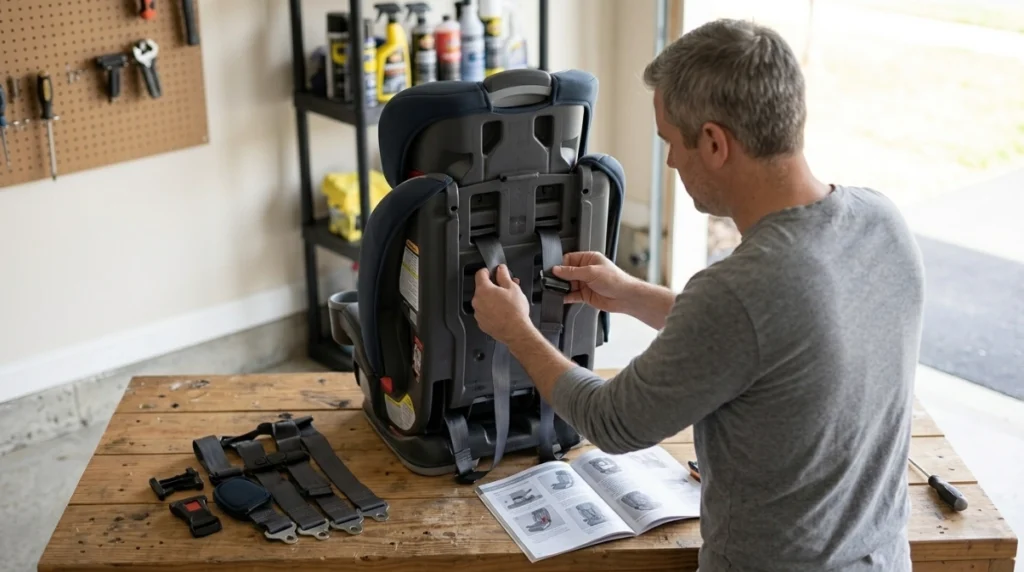
Convert the seat only after the child meets the booster requirements. In booster mode, the vehicle’s lap-and-shoulder belt restrains the child.
Moving to highback-booster mode
- Remove or store the harness components exactly as the manual shows.
- Keep every removed component together for possible future use.
- Place the booster flat against an approved vehicle seatback.
- Adjust the headrest so the shoulder-belt guide sits above the child’s shoulder.
- Route the shoulder belt through the marked guide.
- Confirm that the belt retracts freely and lies flat.
Graco provides model-specific support showing how to transition the Nautilus 65 into highback-booster mode. Compare those instructions with your seat’s manual and labels.
Moving to backless-booster mode
Remove the back only through the approved release procedure. Do not force the hinge or modify the shell.
The vehicle seatback or head restraint must provide adequate support behind the child’s head. A backless booster is unsuitable when the vehicle offers insufficient head support.
Seat-belt fit in either booster mode
- The lap belt lies low and snug across the upper thighs.
- The shoulder belt crosses the center of the shoulder and chest.
- The belt does not touch the neck or slip off the shoulder.
- The child’s knees can bend naturally without encouraging slouching.
- The belt remains flat and retracts after the child leans forward.
Whether lower anchors may hold the empty booster in place depends on the exact model and mode. If they are not permitted, buckle the unused booster when the child is absent so it cannot become a projectile.
Section Takeaway: Booster conversion changes both the restraint system and daily routine; the vehicle belt must fit correctly on every ride.
Is a Used Nautilus 65 Still a Good Choice?
A used Nautilus 65 may be unsuitable in 2026 because many examples are approaching or past their expiration dates. Check the actual manufacture date and useful-life statement on the seat.
Some Nautilus 65 models have a ten-year useful life, but older versions may follow different rules. Never calculate expiration using a newer model’s specifications.
Used-seat inspection checklist
- Known history: The previous owner can confirm every crash, airline trip, and storage condition.
- Readable labels: The model number and manufacture date remain legible.
- Not expired: The seat remains within the useful life stated by Graco.
- Recall check: The model is checked through the NHTSA recall database.
- All parts present: Harness, buckle, tether, padding, guides, and required hardware are original or approved replacements.
- No damage: The shell, webbing, foam, connectors, and adjustment mechanisms show no cracks or unauthorized repairs.
- Matching manual: Instructions correspond to the seat’s exact model and manufacture period.
A seller saying “never in a major accident” is not enough. You need a trustworthy and complete history because crash damage may remain hidden.
Replacement labels, harnesses, and other components may also be unavailable for discontinued seats. Missing safety parts are a reason to reject the seat.
Section Takeaway: A used Nautilus 65 is acceptable only when its history, age, condition, parts, and instructions can all be verified.
Frequently Asked Questions
Can the Graco Nautilus 65 be installed rear-facing?
No. The Nautilus 65 is a forward-facing combination seat. It provides harness, highback-booster, and backless-booster modes but no rear-facing mode. Keep a child in a suitable rear-facing seat until that seat is outgrown.
What is the harness weight limit?
Many Graco Nautilus 65 manuals specify a 22–65-pound harness range. The child can outgrow harness mode earlier through standing height, shoulder height, or head position, so check every limit on your seat.
Can I use LATCH and the seat belt together?
Normally, use either lower anchors or the vehicle seat belt to install the harnessed seat, not both. Always add the top tether when permitted. Follow the instructions for your exact seat and vehicle.
When should I switch from the harness to booster mode?
Keep the child harnessed until reaching a harness limit unless the manufacturer directs otherwise. Switch only when the child meets every booster minimum and can maintain correct vehicle-belt positioning throughout the trip.
Is the Graco Nautilus 65 FAA approved?
The harnessed mode may be certified for aircraft use when the certification label says so. Booster modes require a lap-and-shoulder belt and therefore cannot be used on aircraft seats equipped only with lap belts. Confirm the label and airline requirements.
How long is the Graco Nautilus 65 good for?
Useful life varies by model and manufacture date. Some Nautilus 65 versions specify ten years from manufacture, but you must follow the expiration statement printed on your particular seat or in its matching manual.
Can I use the Nautilus 65 after a crash?
Follow Graco’s replacement instructions for your exact model and the circumstances of the crash. Do not continue using a seat with visible damage or an uncertain crash history. Contact Graco when the instructions are unclear.
Final Takeaway
The Graco Nautilus 65 can cover three useful forward-facing stages when it is unexpired, complete, and correctly installed. Its strongest role is keeping a child in a five-point harness before providing highback and backless booster options.
Start with the model label and matching manual. Then verify the child’s fit, installation method, top tether, harness position, and booster-belt placement before every transition.
If anything remains uncertain, arrange a car-seat inspection through the NHTSA car-seat inspection finder or contact Graco with the model and manufacture information.