
Graco Nautilus 2.0 3-in-1 Harness Booster Car Seat Review

Quick Answer
The Graco Nautilus 2.0 3-in-1 Harness Booster is a strong choice for a child who has outgrown rear-facing travel. It combines a forward-facing harness, highback booster, and backless booster in one seat. Check the official Graco Nautilus 2.0 specifications against your child and vehicle before buying.
Why It Stands Out
- Three riding modes: It converts from a five-point harness to highback and backless booster modes.
- Long harness use: Harness mode supports children from 26.5 to 65 pounds.
- Easy adjustments: The headrest and harness move together without manual rethreading.
- Useful comfort features: Four recline positions and two cup holders improve everyday usability.
- Substantial construction: The seat uses a steel-reinforced frame and weighs about 17.8 pounds.
Important Limitation
- No rear-facing mode: This seat should only be considered after your child is ready for forward-facing travel under the manual and applicable law.
The Graco Nautilus 2.0 3-in-1 Harness Booster Car Seat covers a long stretch of childhood. It starts as a forward-facing harness seat and later becomes two types of booster.
That flexibility sounds appealing, but fit and correct installation matter more than the number of modes. This guide explains its limits, features, drawbacks, and best uses as of 2026.
In This Guide
What Is the Graco Nautilus 2.0?
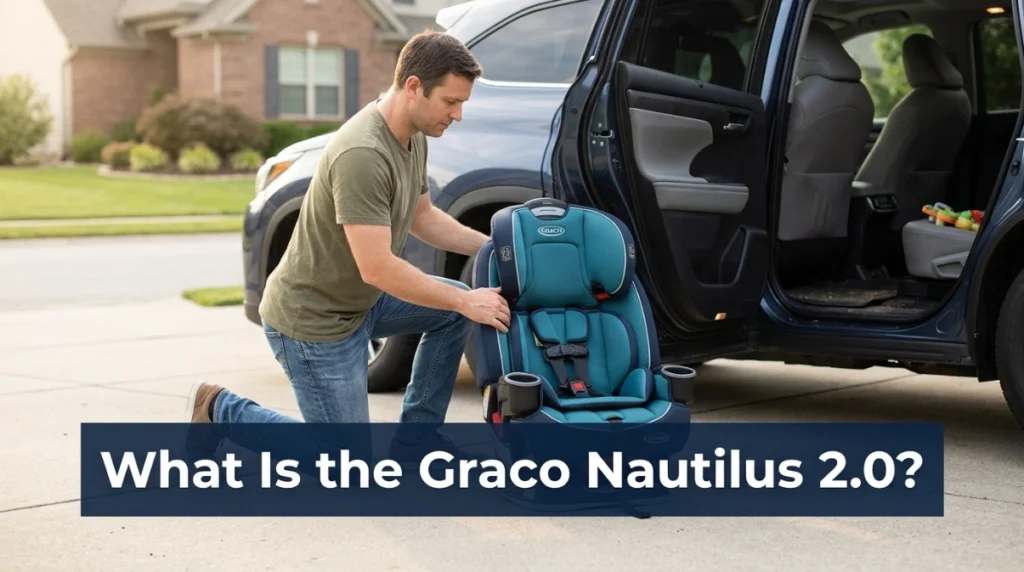
The Graco Nautilus 2.0 is a forward-facing combination car seat. A combination seat uses an internal harness first, then converts into a belt-positioning booster.
It is not an infant seat or rear-facing convertible seat. That distinction is important for younger children who still fit within their rear-facing seat’s limits.
Its three modes explained
The Nautilus 2.0 provides these stages:
- Forward-facing harness: The child is restrained by the seat’s five-point harness.
- Highback booster: The vehicle’s lap-and-shoulder belt restrains the child while the seat provides upper-body support and belt guidance.
- Backless booster: The back is removed, and the lower section raises the child for better seat-belt positioning.
The booster does not restrain the child by itself. It positions the vehicle belt over stronger parts of the body.
Who should consider it?
This model suits families moving an older child from a rear-facing convertible seat into a dedicated forward-facing seat. It can also work for families wanting one seat to cover the later harness and booster years.
It may be especially practical for:
- A primary family vehicle with enough rear-seat space
- Children who still need a five-point harness
- Parents who want a steel-reinforced combination seat
- Families who prefer a no-rethread harness
- Children mature enough for booster use when that stage arrives
It is less suitable when you still need rear-facing capability. A lighter seat may also be easier for frequent transfers between vehicles.
Section Takeaway: The Nautilus 2.0 begins with forward-facing harness use. It does not replace the rear-facing stage.
What Are the Weight and Height Limits?
The Nautilus 2.0 has different eligibility limits for each mode. Your child must satisfy every requirement shown in the manual, not merely the weight range.
| Mode | Weight Range | Height Range | Key Requirement |
|---|---|---|---|
| Forward-facing harness | 26.5–65 lb | Up to 49 in | Child must meet all harness-fit rules |
| Highback booster | 40–100 lb | 43–57 in | At least 4 years old and able to sit correctly |
| Backless booster | 40–120 lb | 43–57 in | Vehicle must provide proper head support |
These published limits describe eligibility, not an automatic transition schedule. A child weighing 40 pounds does not need to move straight into booster mode.
NHTSA’s child passenger guidance recommends keeping children harnessed until they reach the seat manufacturer’s maximum height or weight limit. The child should remain in the back seat through age 12.
When has a child outgrown harness mode?
Weight is only one measurement. Check the manual’s standing-height, seated-fit, shoulder, and ear-position rules before every transition.
A child may outgrow harness mode when one of these events occurs:
- The child exceeds 65 pounds.
- The child exceeds the permitted standing height.
- The shoulders rise above the highest permitted harness position.
- The child no longer meets another fit rule printed in the manual.
Never select a mode from age or weight alone. Check your particular seat’s labels because instructions can change between versions or production dates.
Is a four-year-old ready for booster mode?
Four years is a minimum listed for the booster modes, not a guarantee of readiness. Many four-year-olds cannot maintain correct belt positioning for an entire trip.
A booster-ready child must sit upright without leaning, slouching, or moving the shoulder belt. The child must also leave the buckle and belt alone.
If that behavior is inconsistent, continue using an appropriate harnessed seat. Both the child’s measurements and maturity must support the change.
Section Takeaway: Stay within every stated limit and keep the harness as long as it fits. Booster readiness requires mature behavior as well as size.
Which Graco Nautilus 2.0 Features Matter Most?
The Nautilus 2.0 focuses on adjustability and long-term use. Its most useful features are those parents handle during installation and daily buckling.
No-rethread harness and adjustable headrest
The Simply Safe Adjust system moves the headrest and harness together. You do not need to remove and reroute the harness straps as your child grows.
The seat provides 10 headrest positions. This range helps maintain the fit as a child gains height.
I recommend checking the headrest whenever you notice a growth spurt or change seasonal clothing. A quick fit check can catch an outdated setting before the next long drive.
Four-position recline
The four recline settings help the car seat sit against different vehicle-seat shapes. Recline is still governed by the indicator and instructions on the seat.
This feature does not mean every position works in every vehicle. The car seat must rest securely in the approved position without improper gaps or overhang.
Steel-reinforced frame
The Nautilus 2.0 includes a steel-reinforced frame. Graco lists the seat at approximately 17.8 pounds, making it substantial but still movable.
Its weight is manageable for occasional transfers. However, it is not my first choice for daily removal, air travel, or repeated rideshare use.
Storage and comfort details
Two cup holders provide space for drinks or small items. Harness storage helps keep unused components organized after conversion to booster mode.
Key convenience features include:
- Two removable cup holders
- A machine-washable seat pad
- Integrated harness storage
- Adjustable head support
- Four recline positions
Graco says metal and plastic parts may be cleaned with mild soap and cool water. Always follow the manual for the pad, buckle, and harness because cleaning methods differ.
Do not soak the harness or apply harsh cleaners unless your manual expressly permits it. Chemical damage may not be visible.
Section Takeaway: The no-rethread adjustment offers the greatest daily benefit. The steel frame and recline system add weight but improve the seat’s substantial feel.
How Do You Install and Use It Correctly?
Install the Nautilus 2.0 with an approved method shown in its manual and your vehicle manual. A forward-facing harness installation normally uses either lower anchors or the vehicle belt, plus the top tether.
Do not combine lower anchors and the vehicle seat belt unless both manufacturers specifically allow it. Using two unapproved methods together does not create a safer installation.
Forward-facing harness installation checklist
- Choose a rear seating position: Confirm that the vehicle position supports the selected installation method.
- Set the approved recline: Follow the car seat’s recline indicator and mode instructions.
- Route through the correct path: Use the forward-facing belt path shown in the manual.
- Lock and tighten: Apply pressure while removing slack from the belt or lower-anchor strap.
- Attach the top tether: Connect it to the correct vehicle tether anchor and remove slack.
- Check movement: Test at the belt path, not at the headrest.
NHTSA recommends using the top tether with a forward-facing car seat when both manuals permit it. The tether limits forward head movement during a crash.
Lower anchors also have weight limits. Follow the car seat label and vehicle manual, then switch to an approved seat-belt installation when required.
Installation Tip: Check tightness only where the belt passes through the car seat. Movement at the top of a correctly installed seat can be normal.
How should the harness fit?
For forward-facing use, harness straps generally pass through the approved slots at or above the child’s shoulders. They must lie flat without twists.
Use this quick fit check:
- The child’s back and bottom rest against the seat.
- Harness straps lie flat against the body.
- You cannot pinch excess strap webbing at the shoulder.
- The chest clip sits at armpit level.
- Bulky coats are removed before buckling.
How does booster installation differ?
In booster mode, the vehicle lap-and-shoulder belt restrains the child. Follow the manual when storing or removing the harness and converting the seat.
The lap belt should lie low across the upper thighs. The shoulder belt should cross the center of the chest and shoulder without touching the neck.
Follow NHTSA’s instructions for installing a combination seat as a booster. Confirm whether the empty booster must be secured when unoccupied.
Safety Check: Schedule a free or low-cost inspection with a certified child passenger safety technician if you are unsure about the installation.
Section Takeaway: Correct installation depends on both manuals. Use the approved belt path, observe lower-anchor limits, and attach the top tether during harness use when permitted.
How Does the Nautilus 2.0 Compare?
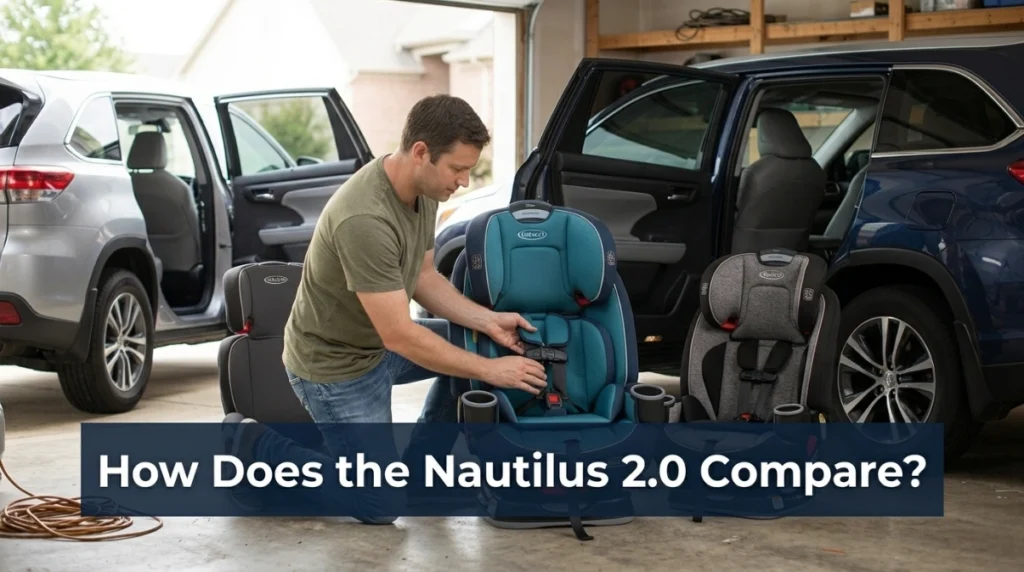
Graco sells the Nautilus 2.0 alongside the lighter-featured Tranzitions and upgraded Nautilus 2.0 LX. Their child-weight ranges overlap, but hardware and convenience differ.
| Feature | Graco Tranzitions | Nautilus 2.0 | Nautilus 2.0 LX |
|---|---|---|---|
| Harness range | 26.5–65 lb | 26.5–65 lb | 26.5–65 lb |
| Backless booster maximum | 100 lb | 120 lb | 120 lb |
| Seat weight | 20 lb | 17.8 lb | 17.4 lb |
| Steel-reinforced frame | No | Yes | Yes |
| Recline positions | None listed | 4 | 4 |
| Lower-anchor connector | Hook | Hook | InRight push-button |
| Headrest positions | 8 | 10 | 10 |
The standard Nautilus 2.0 occupies the middle ground. It adds a steel-reinforced frame and recline positions without charging for the LX connector upgrade.
The LX may justify its higher cost if you move the seat between compatible vehicles. Its push-button lower-anchor connectors are easier to attach and remove than basic hooks.
For a seat that stays installed, the standard model can offer better value. The hook connectors matter less once you achieve a correct installation.
Prices change frequently, so compare current listings instead of relying on a fixed amount. Graco’s official harness-booster comparison provides the clearest feature-by-feature reference.
Section Takeaway: The Nautilus 2.0 offers most LX features at a lower typical price. Choose the LX mainly for its easier InRight lower-anchor connectors and harness covers.
Is the Graco Nautilus 2.0 Worth Buying?
Yes, the Nautilus 2.0 is worth considering when you need a forward-facing harness seat with later booster modes. Its strongest qualities are adjustability, useful limits, and solid everyday features.
Reasons to buy it
- Long usable range: Three modes can reduce the need to buy separate highback and backless boosters.
- Easy growth adjustments: The no-rethread harness reduces the work required after growth spurts.
- Useful booster capacity: Backless mode extends to a listed maximum of 120 pounds.
- Practical cabin features: Two cup holders and a washable pad suit daily family use.
- Middle-tier value: It retains the steel frame and recline system found on the LX.
Reasons to skip it
- No rear-facing mode: It cannot serve babies or children who should remain rear-facing.
- Not especially portable: A 17.8-pound seat can become awkward during frequent transfers.
- Basic hook connectors: The standard model lacks the LX version’s push-button lower-anchor connectors.
- Vehicle fit varies: Recline and dimensions do not guarantee a good fit in every back seat.
- Booster behavior matters: The child must remain correctly positioned throughout each trip.
Final pre-purchase checklist
Measure your child and inspect your vehicle before ordering. Do not assume a high capacity means the seat will fit every child until the stated maximum.
- Confirm your child is ready for a forward-facing-only seat.
- Compare the child’s weight and height with the current manual.
- Check available rear-seat width and front-passenger clearance.
- Locate the correct top-tether anchor.
- Review your vehicle’s lower-anchor limits.
- Verify return options in case the seat and vehicle do not work well together.
- Register the seat after purchase to receive recall and safety notices.
A more expensive seat is not automatically safer in your vehicle. The best choice fits the child, fits the car, and can be installed correctly on every trip.
Section Takeaway: The Nautilus 2.0 is a practical long-term seat for the post-rear-facing years. Confirm child fit, vehicle fit, and installation before committing.
Frequently Asked Questions
Does the Graco Nautilus 2.0 rear-face?
No. The Nautilus 2.0 is a forward-facing combination seat. It provides forward-facing harness, highback booster, and backless booster modes, but no rear-facing mode.
What is the weight limit for the Graco Nautilus 2.0 harness?
The published harness-mode range is 26.5 to 65 pounds, with a listed standing-height maximum of 49 inches. Your child must also meet every harness-fit requirement in the manual.
When can I convert it to a highback booster?
Graco lists highback booster use for children weighing 40 to 100 pounds, measuring 43 to 57 inches, and at least four years old. The child must also sit correctly throughout every ride.
Can I use lower anchors and a seat belt together?
Do not use both installation systems unless the car seat and vehicle manufacturers specifically permit that combination. Use one approved installation method and attach the top tether as directed during forward-facing harness use.
Does the Nautilus 2.0 fit three across?
Three-across compatibility depends on your vehicle, adjacent seats, and installation method. Measure the seating area and test the complete arrangement because published exterior width alone cannot confirm a safe installation.
Is the Graco Nautilus 2.0 approved for aircraft?
Graco states that this seat is certified for aircraft use only with its internal harness on a forward-facing aircraft seat. Booster modes require a lap-and-shoulder belt and cannot be used with an aircraft lap belt alone.
How long can a child use a booster seat?
Continue booster use until the vehicle belt fits correctly without it. The lap belt should remain low on the upper thighs, while the shoulder belt crosses the chest and shoulder away from the neck.
Final Takeaway
The Graco Nautilus 2.0 3-in-1 Harness Booster gives families a practical bridge from forward-facing harness use to an adult seat belt. Its no-rethread adjustment, steel-reinforced frame, and three modes provide useful long-term value.
Still, no specification replaces a real fit check. Read the current manual, inspect the vehicle seating position, and confirm that your child meets every requirement before the first ride.
If anything feels uncertain, use NHTSA’s car seat inspection resources to find qualified installation help.