
Evenflo Chase Plus 2-in-1 Booster Car Seat Manual: Complete Guide

Quick Answer
The Evenflo Chase Plus 2-in-1 is a forward-facing combination seat that changes from a 5-point harness seat to a high-back belt-positioning booster. Before installing yours, check its model number and manufacture date, then match those details to the official Evenflo instruction manual because published limits can differ between versions.
Before You Install
- Check the label: Find the model number and manufacture date on your actual seat.
- Match the manual: Use instructions intended for your specific model and production year.
- Use one installation method: In harness mode, use the lower anchors or vehicle belt as directed, not both together.
- Attach the tether: The Chase Plus manual requires the top tether when the internal harness is used.
- Check movement: A harness-mode installation should move no more than 1 inch at the belt path.
- Use a shoulder belt: Booster mode requires a vehicle lap-and-shoulder belt, not a lap-only belt.
Important
- If this guide and the labels or manual supplied with your seat disagree, follow the instructions for your exact seat.
If you’re searching for an Evenflo Chase Plus 2 in 1 booster car seat manual, you probably need more than a PDF link. You need to know which instructions apply and how to use them without overlooking an important safety step.
That’s how I approach combination seats. I check the seat label first, then work through the manual in the same order I’ll install and buckle the seat.
In This Guide
- Where can you find the correct Evenflo Chase Plus manual?
- What are the Chase Plus age, height, and weight requirements?
- How do you install the Chase Plus with the 5-point harness?
- How should the harness fit your child?
- How do you convert and use the Chase Plus as a booster?
- What Chase Plus installation mistakes should you avoid?
- Frequently Asked Questions
Where Can You Find the Correct Evenflo Chase Plus Manual?
You can find Chase Plus instructions through Evenflo’s official manual library. However, you should verify that the downloadable instructions match the model and manufacture date printed on your seat.
Evenflo specifically tells owners to verify the manufacture date before relying on downloadable instructions. That’s important with a product name that has remained in use across different production periods.
Definition: A combination car seat is a forward-facing child restraint that first uses an internal harness and later functions as a belt-positioning booster.
Check these details before downloading anything
- Product name: Confirm that the label says Chase Plus rather than Chase, Chase LX, or another Evenflo booster.
- Model number: Record the complete model number from the restraint.
- Manufacture date: Use the date printed on the seat rather than its purchase date.
- Seat labels: Read the weight, height, installation, and warning labels attached to the restraint.
- Vehicle manual: Check your vehicle’s child-restraint and tether-anchor instructions too.
Why you may see different Chase Plus limits online
This is one detail I would not gloss over. As of 2026, Evenflo’s live Chase Plus product information and the Chase Plus PDF available through its manual library don’t show identical usage ranges.
| Source | Harness Information | Booster Information | Best Action |
|---|---|---|---|
| Chase Plus PDF currently linked by Evenflo, dated 6/19 | 22–40 lb, 28–50 in, at least age 2 | 40–120 lb, 43.3–57 in, at least age 4 | Use only if it matches your specific seat |
| Current Evenflo Chase Plus product listing | Product description states 30–40 lb | Product description states use up to 100 lb | Verify against your attached labels and manual |
That difference is exactly why I wouldn’t choose a mode based only on a retailer page or search result. The instructions belonging to your actual restraint should determine how you use it.
You can also review the current Chase Plus product information from Evenflo, but don’t let a sales page override the labels on your seat.
Section Takeaway: Match the manual to the restraint in your vehicle. The Chase Plus name alone isn’t enough to determine the correct limits.
What Are the Chase Plus Age, Height, and Weight Requirements?
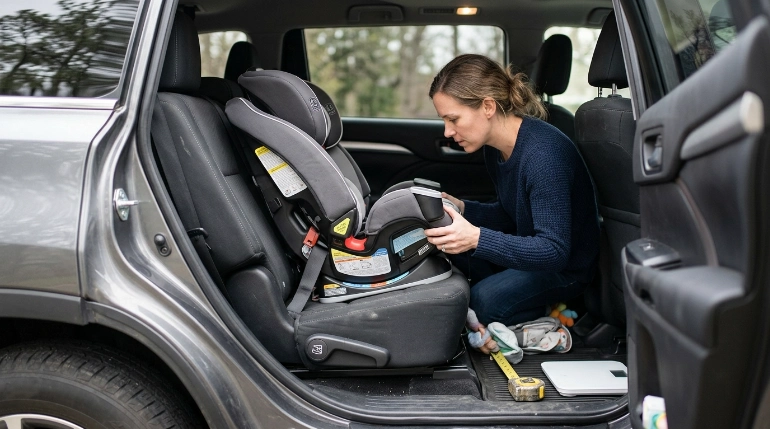
The requirements depend on the production version you own. The Chase Plus PDF currently supplied through Evenflo’s manual library lists separate requirements for harness and booster use.
5-point harness requirements in the linked manual
- Weight: 22 to 40 pounds
- Height: 28 to 50 inches
- Age: At least 2 years old
- Head position: Tops of the child’s ears must remain at or below the top of the restraint headrest.
The seat is forward-facing only. It isn’t designed to function as a rear-facing child restraint.
NHTSA recommends keeping a child in a rear-facing restraint until the child reaches that seat’s rear-facing height or weight limit. Afterward, the agency recommends a forward-facing seat with a harness and tether until its limits are reached.
You can review the agency’s current car seat and booster seat guidance before deciding whether your child is ready to move to another stage.
Booster requirements in the linked manual
- Weight: 40 to 120 pounds
- Height: 43.3 to 57 inches
- Age: At least 4 years old
- Head position: Tops of the child’s ears must stay at or below the restraint headrest.
Physical maturity matters too. A child using a booster must remain seated correctly instead of leaning forward or moving the shoulder belt behind the back.
Again, those numbers come from the PDF currently linked by Evenflo. Use the limits printed on your own Chase Plus if they differ.
How Do You Install the Chase Plus With the 5-Point Harness?
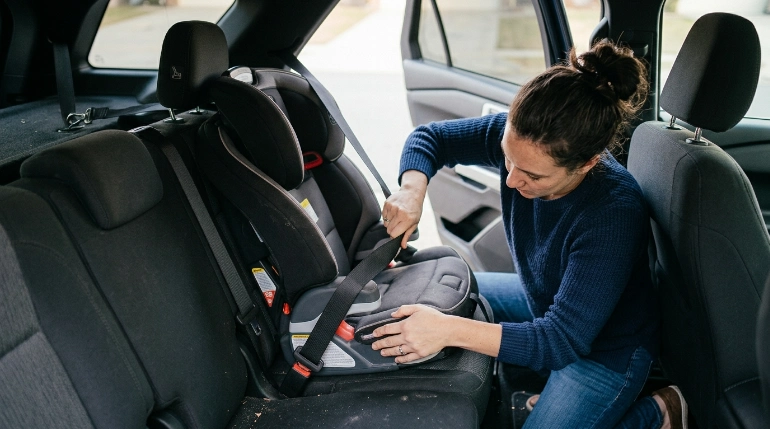
In harness mode, secure the Chase Plus forward-facing with either its lower anchor connectors or the vehicle seat belt. The manual also requires the top tether to be attached and tightened.
NHTSA likewise recommends using the tether on a forward-facing harnessed seat. Its forward-facing installation guidance explains why keeping the tether connected is an important part of installation.
Installation with lower anchors
- Place the Chase Plus forward-facing on an approved vehicle seating position.
- Route the lower anchor connector assembly through the correct belt path.
- Attach each connector to an approved vehicle lower anchor.
- Tighten the lower anchor strap while pressing the restraint into the vehicle seat.
- Attach the top tether hook to the correct tether anchor.
- Tighten the tether according to the manual.
- Test the restraint at the belt path.
Don’t attach two lower-anchor connectors to the same vehicle anchor bar. Always confirm your vehicle’s approved anchor locations first.
Installation with the vehicle seat belt
- Store the lower anchor connectors when they aren’t being used.
- Route the vehicle belt through the Chase Plus forward-facing belt path.
- Buckle the belt.
- Lock or secure the vehicle belt using the method specified by your vehicle manufacturer.
- Remove slack while pressing the restraint firmly into the vehicle seat.
- Connect and tighten the top tether.
- Check movement directly at the belt path.
The manual warns against using the vehicle belt and lower anchor connector assembly together in 5-point harness mode. Choose the installation method permitted for your setup.
Do the 1-inch movement test
Hold the restraint near the belt path and move it side-to-side and front-to-back. The linked manual says movement should not exceed 1 inch in either direction.
Don’t test by grabbing the headrest or top of the seat. Those areas can move even when the belt path itself is secure.
If you can’t obtain a secure installation, try another approved seating position. A certified Child Passenger Safety Technician can also inspect your installation.
Section Takeaway: Use either the lower anchors or vehicle belt in harness mode, attach the top tether, and confirm no more than 1 inch of movement at the belt path.
How Should the Harness Fit Your Child?
The Chase Plus harness should lie flat and snug against the child. For forward-facing use, the harness straps should come through slots at or slightly above the child’s shoulders.
Use this buckle-up sequence
- Place the child’s back and bottom flat against the restraint.
- Bring the harness straps over both shoulders without twists.
- Insert both buckle tongues until they’re fully latched.
- Connect the chest clip.
- Pull the harness adjuster strap until the harness is snug.
- Move the chest clip to armpit level.
- Check for excess harness webbing near the shoulder.
The manual uses the familiar pinch check. You shouldn’t be able to pinch a fold of harness webbing near the child’s shoulder when the harness is properly tightened.
Avoid bulky coats or snowsuits under the harness. Thick clothing can create hidden slack between the child and the harness webbing.
When do you need to move the harness straps?
If the harness slots are below the child’s shoulders, the straps may need to be moved to a higher position. The Chase Plus uses a manual rethread harness rather than a no-rethread adjustment system.
Follow the manual’s routing diagram carefully when rethreading. Both straps must return to the splitter plate correctly and without twists.
How Do You Convert and Use the Chase Plus as a Booster?
Booster mode removes the internal harness from the job of restraining the child. Instead, the Chase Plus positions the vehicle’s lap-and-shoulder belt correctly across the child’s body.
Don’t switch modes merely because booster mode seems easier. NHTSA advises families not to rush the move from a forward-facing harness to a booster.
Before converting the seat
- Confirm your child meets every booster requirement listed for your specific seat.
- Make sure the vehicle position has a lap-and-shoulder belt.
- Check that your child can remain upright and properly positioned for the entire trip.
- Read the Chase Plus conversion instructions before removing or storing harness components.
How the vehicle belt should fit
The lap belt should sit low and snug over the hips, near the upper thighs. It shouldn’t ride high across the soft abdomen.
The shoulder belt should cross the middle of the shoulder between the neck and outside edge. It must not cross the neck or fall off the shoulder.
- Correct lap fit: Low across the hips and upper thighs.
- Correct shoulder fit: Across the center of the shoulder and chest.
- Wrong shoulder position: Under the arm or behind the child’s back.
- Wrong belt type: A lap-only vehicle belt.
If you can’t obtain proper shoulder-belt positioning, try another vehicle seating position. Don’t accept poor belt fit just because the child meets a weight requirement.
Can the lower anchors stay attached in booster mode?
The linked Chase Plus manual allows the tether and lower anchor connectors to secure the booster when doing so doesn’t change the booster position or vehicle-belt fit. Your own manual and vehicle instructions still control.
An unoccupied booster should also remain secured rather than becoming a loose object inside the vehicle.
Section Takeaway: Booster mode depends on both eligibility and belt fit. A lap-and-shoulder belt must stay correctly positioned across the hips, shoulder, and chest.
What Chase Plus Installation Mistakes Should You Avoid?
Most Chase Plus errors aren’t complicated mechanical problems. They’re usually routing, fit, or mode-selection mistakes that are easy to miss during a rushed installation.
- Using the wrong manual: A Chase, Chase LX, and Chase Plus aren’t automatically interchangeable for instructions.
- Ignoring manufacture date: Product specifications can change during a long model run.
- Combining belt and lower anchors: Don’t use both together in harness mode unless your exact instructions specifically allow it.
- Skipping the top tether: The Chase Plus manual requires it during harness installation.
- Testing movement at the headrest: Check installation tightness at the belt path.
- Loose harness straps: Remove slack and keep the chest clip at armpit level.
- Harness below the shoulders: Forward-facing harness straps belong at or slightly above the shoulders.
- Moving to booster mode too soon: A child needs the required size, age, and maturity.
- Using a lap-only belt: Booster mode requires both lap and shoulder portions.
- Poor booster belt fit: The shoulder belt shouldn’t touch the neck or fall off the shoulder.
- Adding unapproved padding: Avoid aftermarket cushions, inserts, or accessories that aren’t approved for the restraint.
Check for recalls and missing parts
Record the model number and manufacture date before checking recalls. NHTSA provides an official recall search for vehicles and child-restraint equipment.
Don’t use a restraint that’s damaged, broken, or missing required parts. The linked Chase Plus manual also instructs owners to replace the restraint after a crash.
What if the seat doesn’t install correctly?
Don’t improvise with towels, hardware, clips, or alternate belt routing unless your manual specifically instructs you to do so. Instead, reread the belt-path section and your vehicle manual.
If the restraint still moves too much, try another permitted seating position. Professional help from a certified Child Passenger Safety Technician is also a sensible next step.
Mechanic Alert: Child-restraint installation is safety-critical. If the manual, vehicle belt, LATCH anchors, or tether setup is unclear, get hands-on help from a qualified Child Passenger Safety Technician rather than guessing.
Frequently Asked Questions
Where can I download the Evenflo Chase Plus 2-in-1 booster car seat manual?
Use Evenflo’s official instruction-manual library and search for Chase Plus 2-in-1 Booster Car Seat. Before using the PDF, compare its model information and requirements with the labels on your own restraint.
Can I use LATCH and the vehicle seat belt together on the Chase Plus?
The linked Chase Plus manual says not to combine the lower anchor connector assembly with the vehicle seat belt for harness installation. Use one permitted installation method and attach the top tether. Always check the instructions for your exact production version.
When can my child use the Chase Plus in booster mode?
The Chase Plus PDF currently linked by Evenflo lists booster use from at least age 4, 40 to 120 pounds, and 43.3 to 57 inches. Your seat may carry different limits, so its labels and matching manual take priority.
Can I use a lap-only belt with the Chase Plus in booster mode?
No. The linked manual requires a lap-and-shoulder belt in booster mode. The lap portion should remain low across the hips while the shoulder portion crosses the middle of the shoulder and chest.
How much should the Chase Plus move after installation?
When installed with the internal harness, the manual says the restraint should move no more than 1 inch side-to-side or front-to-back when checked at the vehicle belt path.
Does the Chase Plus need the top tether?
Yes when using the 5-point harness according to the linked Chase Plus manual. Whether you install with lower anchors or the vehicle seat belt, the manual tells you to connect and tighten the top tether.
Can the Evenflo Chase Plus be used on an airplane?
The linked manual states that the restraint can be certified for aircraft use when installed with its 5-point harness as directed. Booster mode isn’t certified for aircraft use because it depends on a lap-and-shoulder belt system.
The most useful rule with the Evenflo Chase Plus is simple: don’t install from memory. Read the seat label, match the correct manual, read your vehicle instructions, and check every belt path and tether connection before driving.
If anything still looks questionable, have the installation inspected before relying on it for daily travel.
