
Does Toyota Use Metric or Standard Measurements?

Contents
- 1 Key Takeaways
- 2 📑 Table of Contents
- 3 Why Measurement Systems Matter in Automotive Design
- 4 Toyota’s Global Use of Metric Measurements
- 5 Standard Measurements in U.S.-Market Toyotas
- 6 The Hybrid Reality: Why Some Toyotas Use Both Systems
- 7 How to Determine Which System Your Toyota Uses
- 8 Practical Tips for DIY Maintenance and Repairs
- 9 The Future: Is Toyota Moving Toward Full Metric Adoption?
- 10 Conclusion
- 11 Frequently Asked Questions



Toyota primarily uses metric measurements across its global vehicle lineup, especially in manufacturing and engineering. However, in the United States, certain components and tools may still use standard (imperial) units, creating a hybrid system that can confuse DIY mechanics and technicians.
When you pop the hood of your Toyota Camry or take a wrench to your Tacoma’s suspension, one of the first things you might notice is the size of the bolts and fittings. Are they measured in millimeters or inches? Do you need a 10mm socket or a 3/8-inch one? This seemingly small detail can make a big difference when you’re trying to change your oil, rotate your tires, or replace a brake caliper. So, the big question is: Does Toyota use metric or standard measurements?
The short answer is: it depends. Toyota, like most global automakers, primarily uses the metric system—especially in vehicles manufactured for international markets. However, in the United States, where standard (imperial) measurements are still deeply ingrained in tools, hardware, and consumer habits, Toyota has historically adopted a hybrid approach. This means that while many components are metric, some parts—particularly on older models or specific systems—may still use standard measurements.
This blend can be confusing for DIY mechanics and even some professional technicians who aren’t familiar with Toyota’s design philosophy. But understanding the reasoning behind this mix, and knowing how to identify which system your Toyota uses, can save you time, money, and frustration. Whether you’re a weekend warrior under the hood or just trying to buy the right socket set, this guide will walk you through everything you need to know about Toyota’s use of metric and standard measurements.
Key Takeaways
- Toyota uses metric measurements globally: The majority of Toyota vehicles, especially those sold outside the U.S., are designed and built using the metric system for bolts, fluids, and dimensions.
- U.S. models may include standard units: Some Toyota models in the American market feature standard (imperial) fasteners and specifications, particularly in older vehicles or specific components like wheel lug nuts.
- Hybrid system in American Toyotas: Many U.S.-market Toyotas use a mix of metric and standard measurements, requiring both tool sets for maintenance and repairs.
- Impact on DIY maintenance: Knowing which system your Toyota uses helps you choose the right tools and avoid stripped bolts or incorrect part replacements.
- Global standardization trend: As Toyota continues to globalize production, the shift toward full metric adoption is increasing, even in North America.
- Check your owner’s manual: The best way to confirm which measurement system your Toyota uses is to consult the vehicle’s manual or service documentation.
- Professional shops are prepared: Certified Toyota technicians have both metric and standard tools to handle any model, ensuring accurate and safe repairs.
📑 Table of Contents
- Why Measurement Systems Matter in Automotive Design
- Toyota’s Global Use of Metric Measurements
- Standard Measurements in U.S.-Market Toyotas
- The Hybrid Reality: Why Some Toyotas Use Both Systems
- How to Determine Which System Your Toyota Uses
- Practical Tips for DIY Maintenance and Repairs
- The Future: Is Toyota Moving Toward Full Metric Adoption?
- Conclusion
Why Measurement Systems Matter in Automotive Design
Before diving into Toyota’s specific practices, it’s important to understand why measurement systems matter in the first place. The automotive industry relies on precision. A bolt that’s even slightly the wrong size can lead to stripped threads, loose components, or even catastrophic failure. That’s why automakers must standardize their designs around a consistent measurement system.
The two main systems in use today are the metric system (based on millimeters, centimeters, and meters) and the standard or imperial system (based on inches, feet, and yards). Most of the world—over 95% of countries—uses the metric system as the official standard. This includes Europe, Asia, Africa, and South America. The United States, however, remains one of the few countries that still predominantly uses imperial measurements, especially in construction, manufacturing, and consumer tools.
For global automakers like Toyota, this creates a challenge. They design and build vehicles in multiple countries, sell them worldwide, and must ensure that parts are interchangeable and serviceable across markets. Using a single measurement system simplifies production, reduces errors, and lowers costs. That’s why most international automakers, including Toyota, have largely adopted the metric system as their global standard.
But the U.S. market is a unique beast. American consumers are accustomed to imperial tools, and the infrastructure—from hardware stores to repair shops—is built around inches and fractions. As a result, automakers often make concessions to accommodate local preferences, especially in vehicles specifically designed for the North American market.
Toyota’s Global Use of Metric Measurements

Visual guide about Does Toyota Use Metric or Standard Measurements?
Image source: vedantu.com
Toyota Motor Corporation, headquartered in Japan, is a truly global company. It manufactures vehicles in over 25 countries and sells them in more than 170 markets worldwide. To maintain consistency and efficiency, Toyota has standardized its engineering and manufacturing processes around the metric system.
This means that the vast majority of Toyota vehicles—whether a Corolla built in Thailand, a RAV4 assembled in Canada, or a Prius produced in Japan—are designed using metric measurements. Bolts, nuts, hoses, fluid capacities, and even dimensions like wheelbase and track width are specified in millimeters, liters, and kilograms.
For example, a typical Toyota engine might use 10mm, 12mm, and 14mm bolts for key components like the valve cover, intake manifold, and transmission housing. Coolant capacities are listed in liters, tire pressures in kilopascals (kPa) or bar, and torque specifications in Newton-meters (Nm). Even the threads on oil filters and spark plugs are metric.
This global standardization offers several advantages. It allows Toyota to use the same parts and tools across different production facilities, reducing complexity and cost. It also makes it easier for technicians in, say, Germany or Australia to service a Toyota without needing specialized imperial tools. And for consumers, it means that replacement parts are widely available and often interchangeable between models and regions.
Standard Measurements in U.S.-Market Toyotas
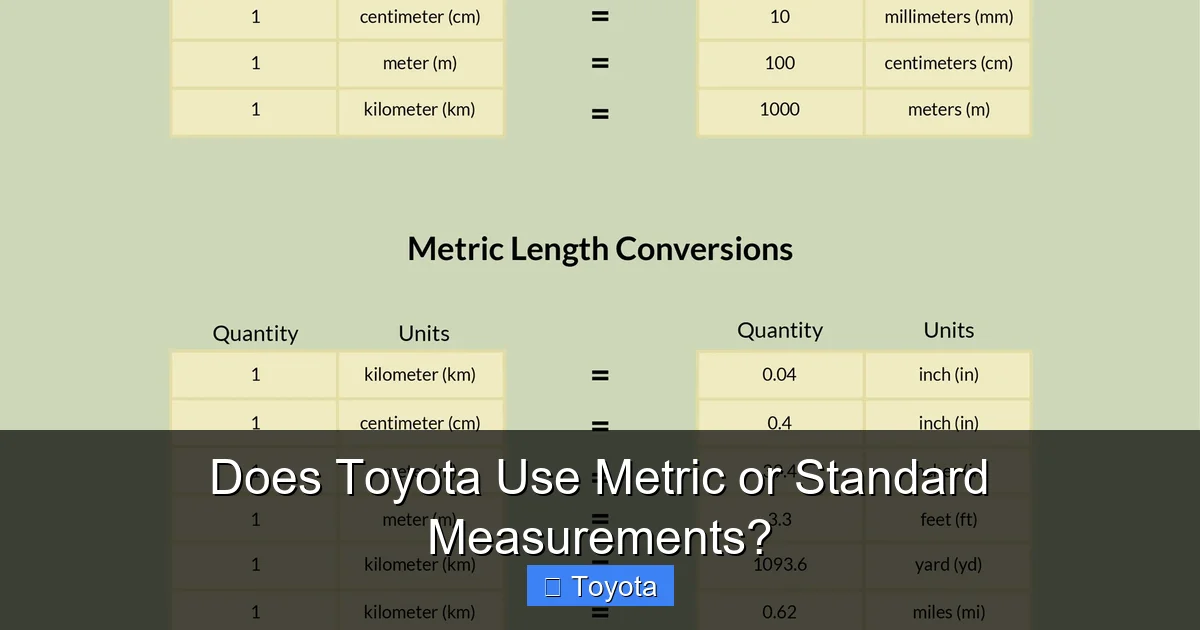
Visual guide about Does Toyota Use Metric or Standard Measurements?
Image source: images.template.net
Despite Toyota’s global preference for metric, the American market has historically required some adaptation. In the U.S., standard measurements are deeply embedded in the culture of DIY repair and professional automotive service. Most American mechanics grow up using inch-based wrenches, sockets, and torque wrenches. Hardware stores stock bolts and fittings in fractions of an inch, and even tire sizes are often listed with both metric and imperial dimensions.
As a result, Toyota has occasionally used standard measurements in vehicles sold in the United States—especially in earlier models. For instance, some older Toyota trucks and SUVs, like the 1980s-era Toyota Pickup or the early 4Runner, featured standard-sized lug nuts and wheel hubs. These vehicles might require a 3/4-inch socket for the lug nuts instead of the 21mm or 22mm sockets common on newer models.
Additionally, certain components—such as fuel lines, brake fittings, or suspension parts—on U.S.-spec vehicles may use imperial thread pitches or diameters. This is often done to align with existing American automotive standards or to simplify integration with aftermarket parts that are predominantly imperial.
However, it’s important to note that this practice has become less common over time. As Toyota has increased its global integration and as the U.S. market has gradually adopted more metric tools and standards, the use of imperial measurements in new Toyotas has declined significantly.
The Hybrid Reality: Why Some Toyotas Use Both Systems

Visual guide about Does Toyota Use Metric or Standard Measurements?
Image source: assets.ltkcontent.com
So, what does this mean for the average Toyota owner? In practice, many U.S.-market Toyotas—especially those from the 1990s to the early 2010s—use a hybrid system that combines both metric and standard measurements. This can be confusing, but it’s a reflection of Toyota’s effort to balance global efficiency with local market needs.
For example, you might find that the engine bolts on your 2005 Toyota Camry are all metric—requiring 10mm, 12mm, and 14mm sockets—while the lug nuts on the wheels are 3/4-inch, needing a standard socket. Similarly, the oil drain plug might be metric (typically 14mm), but the oil filter wrench could be designed for a standard-sized filter.
This hybrid approach can create challenges for DIY mechanics who assume all Toyota parts are metric. Using the wrong socket size can strip bolts, damage tools, or lead to improper torque application—all of which can compromise safety and performance.
The good news is that this trend is shifting. Newer Toyota models, even those sold in the U.S., are increasingly designed with full metric specifications. For instance, the 2023 Toyota Highlander uses metric lug nuts (21mm), metric engine fasteners, and metric fluid capacities. This reflects Toyota’s broader move toward global standardization and the growing availability of metric tools in the American market.
How to Determine Which System Your Toyota Uses
If you’re unsure whether your Toyota uses metric, standard, or a mix of both, there are several ways to find out. The most reliable method is to consult your vehicle’s owner’s manual or service manual. These documents typically list torque specifications, fluid capacities, and fastener sizes—all of which will indicate the measurement system in use.
For example, if your manual specifies torque values in Newton-meters (Nm), it’s a strong indicator that the vehicle uses metric measurements. If it lists torque in foot-pounds (ft-lbs), that’s a sign of imperial influence—though many modern manuals include both units for clarity.
Another practical approach is to inspect the tools and fasteners on your vehicle. If you’re changing your oil, check the size of the drain plug. A 14mm drain plug is metric, while a 9/16-inch plug is standard. Similarly, when rotating your tires, note the size of the lug nuts. A 21mm socket is metric; a 3/4-inch socket is standard.
You can also look at the wrench or socket set that came with your Toyota. Many vehicles include a basic toolkit in the trunk or glove compartment. If the included wrench is labeled in millimeters, your car likely uses metric fasteners. If it’s labeled in inches, you may be dealing with standard measurements.
Finally, consider the model year and market. Newer Toyotas (post-2010) are far more likely to be fully metric, even in the U.S. Older models, especially trucks and SUVs from the 1980s and 1990s, are more likely to have standard components.
Practical Tips for DIY Maintenance and Repairs
Knowing which measurement system your Toyota uses is only half the battle. The other half is being prepared with the right tools and knowledge to work on your vehicle safely and effectively. Here are some practical tips to help you navigate Toyota’s metric and standard mix:
First, invest in a quality socket set that includes both metric and standard sizes. While newer Toyotas are mostly metric, having both sets ensures you’re ready for any situation. Look for sets that include deep sockets, torque wrenches, and universal joints—these will give you the flexibility to tackle a wide range of repairs.
Second, always use the correct torque specifications when tightening bolts. Over-tightening can strip threads or damage components, while under-tightening can lead to loose parts and safety hazards. Your owner’s manual or a repair guide will list the proper torque values, usually in Newton-meters (Nm) for metric systems.
Third, be cautious with aftermarket parts. Some replacement components—especially from American suppliers—may use standard measurements even if your Toyota is metric. Always double-check the specifications before purchasing or installing new parts.
Fourth, consider labeling your tools. If you have both metric and standard wrenches, marking them with colored tape or labels can help you quickly identify the right size in low-light conditions or when working in a hurry.
Finally, when in doubt, consult a professional. Certified Toyota technicians have the training and tools to handle any measurement system. If a repair seems too complex or you’re unsure about fastener sizes, it’s always better to seek expert help than risk damaging your vehicle.
The Future: Is Toyota Moving Toward Full Metric Adoption?
As the automotive industry continues to globalize, the trend toward metric standardization is likely to accelerate. Toyota, like other major automakers, is increasingly designing vehicles with global markets in mind. This means fewer regional variations and more consistent use of metric measurements across all models and regions.
In fact, many newer Toyota vehicles sold in the U.S. are now fully metric, with no standard components. This shift is driven by several factors, including the growing availability of metric tools in American hardware stores, the increasing number of mechanics trained in metric systems, and the cost savings associated with global part standardization.
Additionally, as electric vehicles (EVs) become more prevalent, the need for hybrid measurement systems may decrease. EVs often have simpler mechanical designs with fewer traditional fasteners, reducing the complexity of maintenance and repair.
That said, the transition won’t happen overnight. Older Toyotas will remain on the road for years to come, and many will still require a mix of metric and standard tools. But for new buyers and DIY enthusiasts, the future is clear: metric is becoming the universal language of Toyota engineering.
Conclusion
So, does Toyota use metric or standard measurements? The answer is both—but with a strong lean toward metric, especially in newer models and global markets. Toyota’s use of metric measurements reflects its status as a global automaker committed to efficiency, consistency, and innovation. However, in the United States, where standard measurements remain prevalent, Toyota has historically adopted a hybrid approach to meet local needs.
For Toyota owners, this means being prepared with both metric and standard tools, especially if you drive an older model or a U.S.-spec vehicle. By understanding which system your Toyota uses and following best practices for maintenance and repair, you can keep your vehicle running smoothly for years to come.
As Toyota continues to evolve, the shift toward full metric adoption is inevitable. But until then, knowing how to navigate both systems is a valuable skill for any Toyota enthusiast.
Frequently Asked Questions
Does every Toyota use metric measurements?
No, not every Toyota uses only metric measurements. While most global models are fully metric, some U.S.-market vehicles—especially older ones—may include standard (imperial) fasteners or components.
Are Toyota lug nuts metric or standard?
Most modern Toyota vehicles use metric lug nuts, typically 21mm or 22mm. However, some older U.S. models may have 3/4-inch (standard) lug nuts, so it’s best to check your specific vehicle.
Can I use standard tools on a metric Toyota?
It’s not recommended. Using standard tools on metric fasteners can strip bolts or cause improper torque. Always use the correct tool size for the fastener.
How do I know if my Toyota uses metric or standard bolts?
Check your owner’s manual, inspect the fasteners on your vehicle, or look at the included toolkit. Newer models are almost always metric, while older U.S. models may have standard components.
Do Toyota service manuals use metric or standard units?
Most Toyota service manuals use metric units (mm, Nm, liters), but many also include standard equivalents (inches, ft-lbs, gallons) for U.S. readers.
Will future Toyotas be fully metric?
Yes, the trend is moving toward full metric adoption, even in the U.S. As global standardization increases, newer Toyota models are increasingly designed with metric-only specifications.