Does Toyota Have Adaptive Cruise Control?

Contents
- 1 Key Takeaways
- 2 📑 Table of Contents
- 3 What Is Adaptive Cruise Control?
- 4 Which Toyota Models Have Adaptive Cruise Control?
- 5 How to Use Toyota’s Adaptive Cruise Control
- 6 Benefits of Adaptive Cruise Control in Toyota Vehicles
- 7 Limitations and What to Watch For
- 8 The Future of Adaptive Cruise Control in Toyota
- 9 Conclusion
- 10 Frequently Asked Questions




Yes, Toyota includes adaptive cruise control (ACC) in nearly all of its 2023 and 2024 vehicles, especially those equipped with Toyota Safety Sense (TSS). This advanced driver-assist feature helps maintain a safe following distance and reduces driver fatigue on long trips.
If you’ve ever driven on a long highway stretch and wished your car could just “keep up” with traffic without you constantly tapping the gas or brake, you’re not alone. That’s where adaptive cruise control (ACC) comes in—and yes, Toyota has it. In fact, it’s one of the most widely adopted advanced driver-assistance features in the brand’s lineup.
Toyota has made significant strides in making safety and convenience technologies accessible across its entire range. Gone are the days when adaptive cruise control was a luxury reserved for high-end sedans or SUVs. Today, whether you’re behind the wheel of a fuel-efficient Prius, a rugged Tacoma, or a family-friendly Highlander, chances are you’ve got ACC at your fingertips—especially if your vehicle comes with Toyota Safety Sense (TSS).
But what exactly is adaptive cruise control? How does it work in Toyota vehicles? And which models offer it? In this comprehensive guide, we’ll break down everything you need to know about Toyota’s adaptive cruise control, from how it functions to real-world benefits, setup tips, and what to expect in future models. Whether you’re shopping for a new Toyota or just curious about your current ride’s capabilities, this article will give you the full picture.
Key Takeaways
- Widespread Availability: Adaptive cruise control is standard or available on almost every Toyota model, from the compact Corolla to the full-size Tundra.
- Part of Toyota Safety Sense: ACC is a core feature of Toyota Safety Sense (TSS), the brand’s suite of advanced safety technologies.
- Works at Various Speeds: Modern Toyota ACC systems function in stop-and-go traffic, not just on highways.
- Enhances Safety and Comfort: By automatically adjusting speed and distance, ACC reduces collision risk and driver stress.
- Easy to Use: Activated via steering wheel controls, Toyota’s ACC is intuitive and user-friendly.
- Not Fully Autonomous: Drivers must remain attentive—ACC assists but doesn’t replace active driving.
- Future-Ready: Toyota continues to refine ACC with updates for smoother performance and better integration with other safety features.
📑 Table of Contents
What Is Adaptive Cruise Control?
Adaptive cruise control is an advanced version of traditional cruise control. While standard cruise control lets you set a fixed speed and maintains it until you brake or turn it off, adaptive cruise control goes a step further. It uses sensors—typically radar and sometimes cameras—to detect the speed and distance of the vehicle ahead. Based on that information, it automatically adjusts your speed to maintain a safe following distance.
Think of it as having a co-pilot who’s always watching the road and gently nudging the accelerator or brakes when needed. You still steer, but the system handles speed adjustments, making long drives less tiring and potentially safer.
How Does It Work?
Toyota’s adaptive cruise control primarily relies on a forward-facing radar sensor, usually located behind the front grille or emblem. Some newer models also incorporate camera data from the windshield-mounted camera system used for lane departure warnings and automatic emergency braking.
Here’s a simple breakdown of how it operates:
– You set your desired speed using the cruise control buttons on the steering wheel.
– You then choose a following distance—typically three settings: short, medium, or long.
– The system continuously monitors the vehicle ahead.
– If the car in front slows down, your Toyota will automatically reduce speed, even coming to a complete stop in some cases.
– When traffic clears or the lead vehicle speeds up, your car accelerates back to the set speed.
This seamless coordination happens in real time, often without any input from the driver. It’s especially helpful during rush hour or on long road trips where speed changes are frequent.
Traditional vs. Adaptive Cruise Control
To appreciate what ACC offers, it helps to compare it with regular cruise control:
| Feature | Traditional Cruise Control | Adaptive Cruise Control |
|——–|—————————-|————————–|
| Speed Maintenance | Yes | Yes |
| Adjusts for Traffic | No | Yes |
| Stops in Traffic | No | Yes (in most Toyota models) |
| Requires Driver Input | Frequent braking/accelerating | Minimal |
| Best For | Open highways with steady traffic | Highways, city driving, stop-and-go traffic |
As you can see, adaptive cruise control is far more versatile and intelligent. It doesn’t just maintain speed—it responds to the environment, making it a true advancement in driver assistance.
Which Toyota Models Have Adaptive Cruise Control?
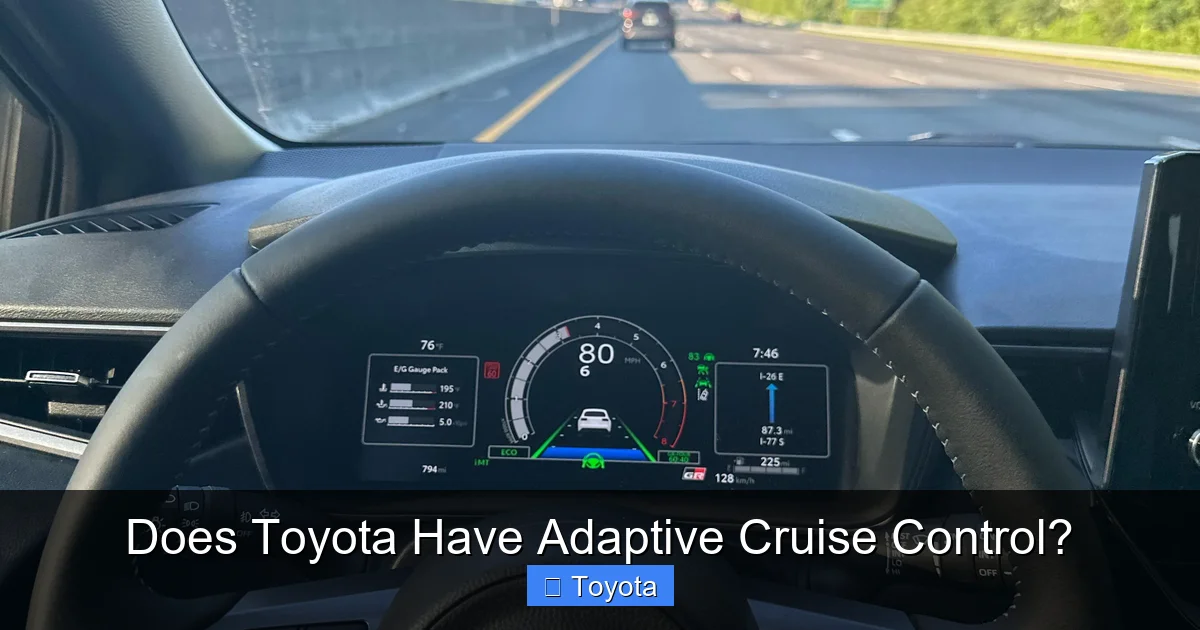
Visual guide about Does Toyota Have Adaptive Cruise Control?
Image source: images.squarespace-cdn.com
One of the biggest advantages of buying a Toyota today is the widespread availability of adaptive cruise control. Unlike some brands that reserve ACC for top-tier trims or luxury models, Toyota has integrated it into nearly every vehicle in its lineup—especially those equipped with Toyota Safety Sense.
Toyota Safety Sense: The Gateway to ACC
Toyota Safety Sense (TSS) is the brand’s comprehensive suite of active safety features. Depending on the model year, it may be labeled as TSS 2.0, TSS 2.5, or the latest TSS 3.0. Regardless of the version, adaptive cruise control is a standard component.
As of 2023 and 2024, TSS is standard on almost all new Toyota vehicles sold in the U.S., including:
– Toyota Corolla (all trims)
– Toyota Camry (all trims)
– Toyota Prius (all trims)
– Toyota RAV4 (all trims)
– Toyota Highlander (all trims)
– Toyota Tacoma (most trims)
– Toyota Tundra (most trims)
– Toyota Sienna (all trims)
– Toyota 4Runner (available on higher trims)
– Toyota Sequoia (standard on most trims)
– Toyota Land Cruiser (standard)
Even base models like the Corolla L or RAV4 LE now come with ACC as part of TSS. This democratization of safety tech is one reason Toyota consistently ranks high in safety and reliability surveys.
Trim-Level Considerations
While ACC is standard on most models, there are a few exceptions—especially in older model years or base trims of certain trucks and SUVs. For example:
– The 2022 Toyota Tacoma SR trim did not include ACC, but it became standard on higher trims like SR5, TRD Off-Road, and TRD Pro.
– The 2021 Toyota 4Runner only offered ACC on Limited and TRD Pro trims.
However, Toyota has been steadily expanding ACC availability. By 2024, even the most basic trims of popular models like the RAV4 and Camry include it. Always check the specific trim and model year when shopping, but rest assured: if your Toyota has Toyota Safety Sense, it almost certainly has adaptive cruise control.
Used Toyota Vehicles: What to Look For
If you’re buying a used Toyota, ACC may not be guaranteed—especially in models from 2017 or earlier. Toyota began rolling out TSS (and thus ACC) more broadly around 2018. Here’s a quick guide:
– 2018 and newer: High likelihood of ACC, especially on mid-to-high trims.
– 2016–2017: Limited availability; mostly on Camry, Avalon, and Lexus models (Toyota’s luxury brand).
– Pre-2016: Rare; only found on select high-end models like the Lexus GS or Toyota Avalon Limited.
When shopping used, look for “Toyota Safety Sense” in the feature list. If it’s there, ACC is likely included. You can also check the vehicle’s window sticker (Monroney label) or use Toyota’s VIN decoder tool online.
How to Use Toyota’s Adaptive Cruise Control
Visual guide about Does Toyota Have Adaptive Cruise Control?
Image source: i.ytimg.com
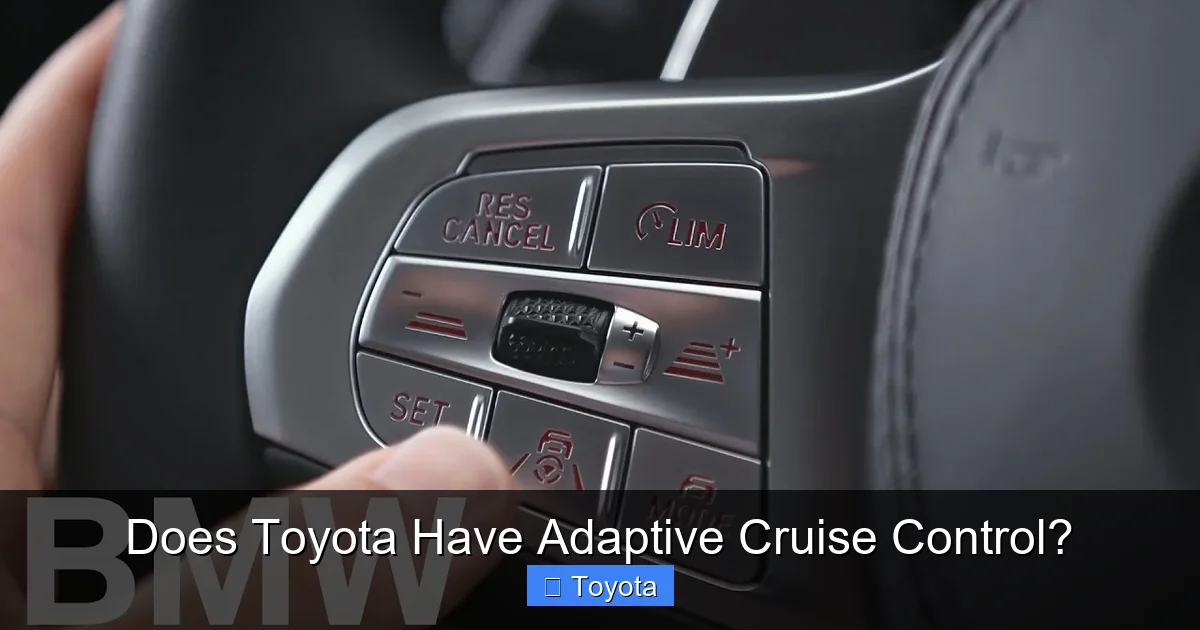
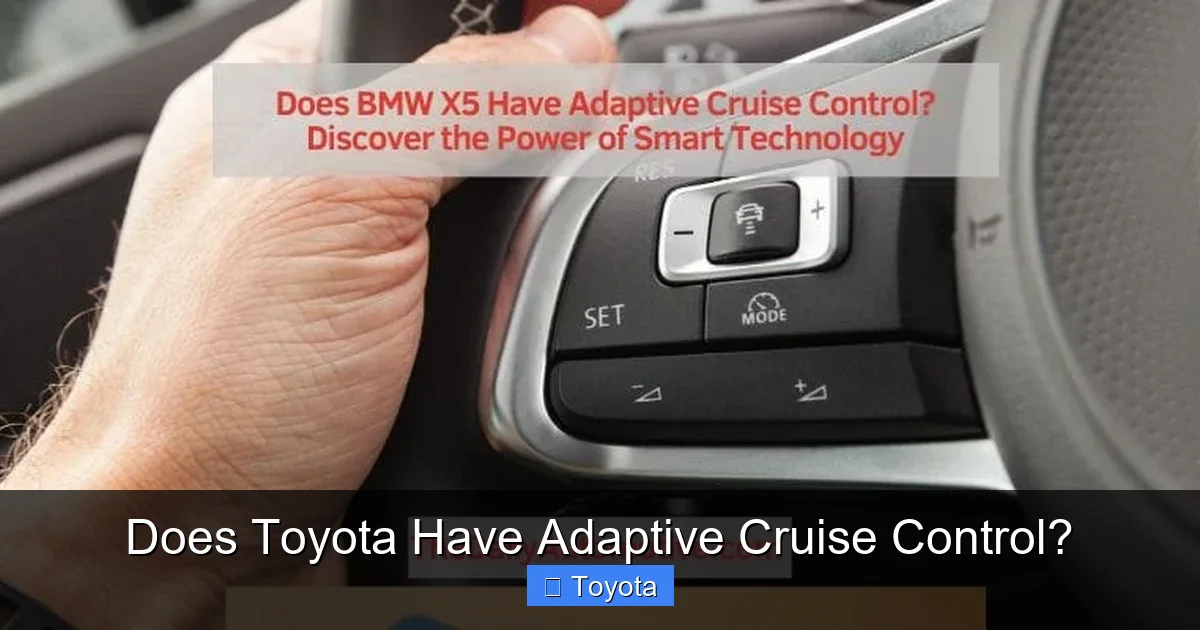
Using adaptive cruise control in a Toyota is straightforward, but it helps to know the steps and settings to get the most out of it. Most models use a similar interface, with controls on the right side of the steering wheel.
Step-by-Step Activation
1. **Turn on the system:** Press the “ON/OFF” button on the cruise control stalk or steering wheel. A green indicator will appear on the dashboard.
2. **Set your speed:** Drive to your desired speed (usually above 25 mph for initial activation), then press the “SET” button.
3. **Adjust following distance:** Use the distance control button (often labeled with car icons or “DIST”) to choose between short, medium, or long gaps.
4. **Resume or cancel:** If you brake, the system will pause. Press “RES” to resume. Press “CANCEL” or tap the brake to deactivate.
Tips for Best Performance
– **Use it in the right conditions:** ACC works best on highways and well-marked roads. Avoid using it in heavy rain, snow, or fog, where sensor visibility may be reduced.
– **Stay alert:** ACC is not self-driving. Keep your hands on the wheel and eyes on the road at all times.
– **Adjust distance based on weather:** In rain or fog, choose a longer following distance for added safety.
– **Practice in light traffic:** If you’re new to ACC, try it during light traffic conditions to get comfortable with how your Toyota responds.
Stop-and-Go Functionality
One of the most impressive features of Toyota’s newer ACC systems is stop-and-go capability. This means the car can come to a complete stop in heavy traffic and resume driving when traffic moves—without you pressing the accelerator.
For example, imagine you’re stuck in a traffic jam on the interstate. Your Toyota slows down as the car ahead brakes, eventually stopping completely. When the traffic starts moving again, your car will accelerate back up to the set speed—provided the stop was less than about 3 seconds. If it’s longer, you may need to tap the accelerator or press “RES” to restart.
This feature is available on most 2020 and newer Toyota models with TSS 2.0 or later, including the RAV4, Camry, and Highlander.
Benefits of Adaptive Cruise Control in Toyota Vehicles
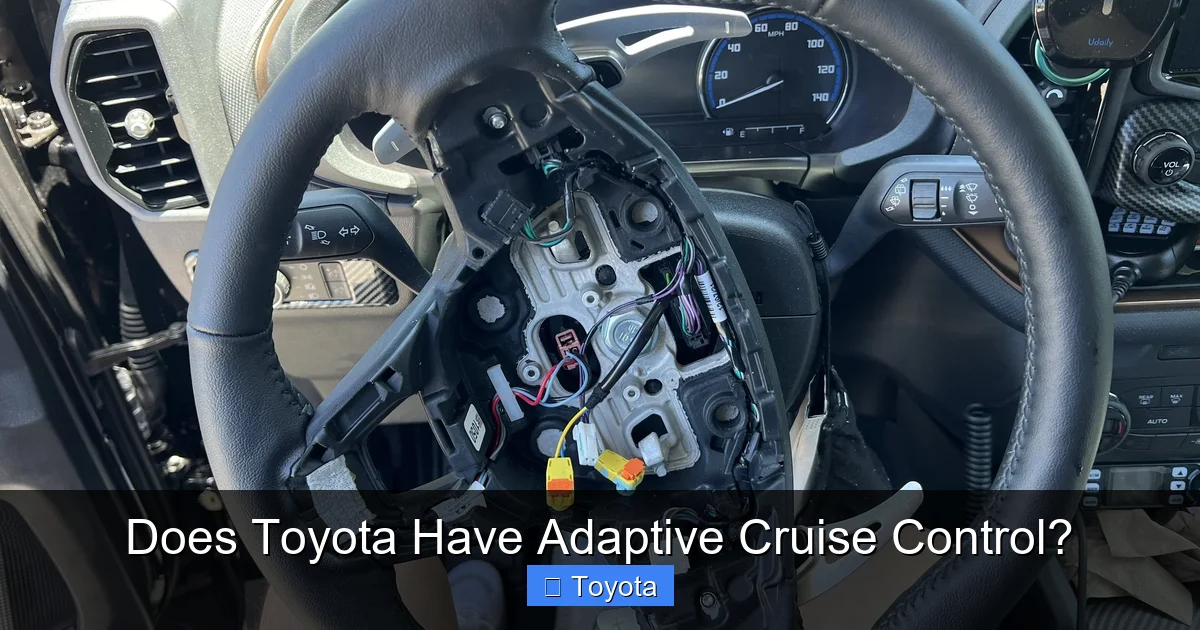
Visual guide about Does Toyota Have Adaptive Cruise Control?
Image source: thedailyautomotive.com
So why should you care about adaptive cruise control? Beyond the cool factor, ACC offers real-world benefits that improve safety, comfort, and driving confidence.
Reduces Driver Fatigue
Long drives can be exhausting, especially when you’re constantly adjusting your speed. ACC takes over the repetitive task of braking and accelerating, letting you focus on steering and situational awareness. This is especially helpful on road trips or during daily commutes on busy highways.
Imagine driving from Los Angeles to San Diego—a 2-hour trip with frequent speed changes. With ACC, your Toyota handles the speed adjustments, so you arrive feeling more relaxed and less fatigued.
Enhances Safety
ACC helps prevent rear-end collisions by maintaining a safe distance from the vehicle ahead. According to the Insurance Institute for Highway Safety (IIHS), vehicles with forward collision warning and automatic braking (which often work alongside ACC) see a 50% reduction in rear-end crashes.
Toyota’s system is designed to react faster than a human in many situations. If the car ahead brakes suddenly, ACC can apply the brakes more quickly and smoothly than most drivers, reducing the risk of a collision.
Improves Fuel Efficiency
Believe it or not, ACC can also help save fuel. By maintaining a consistent speed and avoiding unnecessary acceleration and braking, your Toyota operates more efficiently. Studies have shown that smooth, steady driving can improve fuel economy by up to 15%.
For example, a RAV4 Hybrid with ACC cruising at 65 mph on the highway will use less fuel than one driven manually with frequent speed changes.
Supports Highway Driving Confidence
For drivers who feel anxious on highways—especially in heavy traffic—ACC can be a game-changer. It provides a sense of control and predictability, knowing your car will respond appropriately to traffic flow.
Parents driving with kids in the back, older drivers, or those new to highway driving often appreciate the added reassurance ACC provides.
Works with Other Safety Features
ACC doesn’t work in isolation. In Toyota vehicles, it’s integrated with other TSS features like:
– Lane Departure Alert with Steering Assist
– Pre-Collision System with Pedestrian Detection
– Automatic High Beams
– Road Sign Assist
This creates a cohesive safety net. For instance, if ACC detects a slow-moving vehicle and begins braking, the Pre-Collision System may also prepare for a potential impact, tightening seatbelts or pre-charging brakes.
Limitations and What to Watch For
While adaptive cruise control is a powerful tool, it’s not perfect—and it’s not a substitute for attentive driving.
Sensor Limitations
Toyota’s ACC relies on radar and cameras, which can be affected by:
– Heavy rain, snow, or fog
– Dirt, ice, or debris on the sensor (usually behind the grille or windshield)
– Bright sunlight or glare
If the sensor is blocked, the system may disable ACC and display a warning message like “Cruise Control Unavailable.” Regular cleaning of the front grille and windshield can help prevent this.
Not Foolproof in Complex Situations
ACC works best in predictable traffic. It may struggle with:
– Sudden cut-ins by other vehicles
– Sharp curves or winding roads
– Construction zones with unclear lane markings
– Motorcycles or bicycles in adjacent lanes
In these cases, the system might not react quickly enough, so driver intervention is essential.
Driver Overreliance
One of the biggest risks with any driver-assist technology is overreliance. Some drivers may treat ACC like autonomous driving, taking their hands off the wheel or getting distracted.
Toyota’s system includes alerts to remind you to stay engaged. If you take your hands off the wheel for too long, the dashboard will flash warnings and eventually disengage ACC.
Speed and Activation Limits
Most Toyota ACC systems require a minimum speed to activate (usually around 25 mph). Below that, the system won’t engage unless it has stop-and-go capability. Also, ACC typically won’t accelerate beyond the set speed, even if traffic is moving faster.
The Future of Adaptive Cruise Control in Toyota
Toyota is continuously improving its driver-assistance technologies. With each new version of Toyota Safety Sense, ACC becomes more responsive, accurate, and integrated.
TSS 3.0 and Beyond
The latest Toyota Safety Sense 3.0, introduced in 2023 models like the redesigned Prius and updated RAV4, features enhanced radar and camera systems. This allows for:
– Smoother acceleration and braking
– Better detection of pedestrians and cyclists
– Improved performance in low-light conditions
– More precise lane centering when combined with Lane Tracing Assist
While still not fully autonomous, these updates bring Toyota closer to hands-free driving in certain conditions—especially with the introduction of Toyota’s Advanced Drive system in Japan, which offers Level 2+ autonomy on highways.
Integration with Navigation
Future Toyota models may use GPS and map data to anticipate curves, exits, and speed limits, allowing ACC to adjust speed proactively. For example, the system could slow down before a sharp turn or reduce speed in a school zone.
Expansion to More Vehicles
As technology costs decrease, Toyota is likely to include ACC even in its most basic models globally. The goal is to make advanced safety features standard across the board, not just in premium trims.
Conclusion
So, does Toyota have adaptive cruise control? The answer is a resounding yes—and it’s more accessible than ever. From the compact Corolla to the mighty Tundra, Toyota has made ACC a standard or widely available feature across its lineup, especially when paired with Toyota Safety Sense.
This technology isn’t just a convenience—it’s a meaningful step toward safer, more comfortable driving. By reducing fatigue, preventing collisions, and improving fuel efficiency, adaptive cruise control enhances every journey, whether it’s a daily commute or a cross-country adventure.
While it’s not a replacement for attentive driving, Toyota’s ACC is a reliable co-pilot that helps you stay safe and relaxed on the road. As the technology evolves, we can expect even smarter, more intuitive systems that bring us closer to a future of safer, more connected driving.
If you’re in the market for a Toyota, rest assured: adaptive cruise control is likely already included. And if you’re already driving one, take a moment to explore this feature—it might just transform the way you drive.
Frequently Asked Questions
Does every Toyota have adaptive cruise control?
Not every Toyota has adaptive cruise control, but most new models (2023 and 2024) do, especially those equipped with Toyota Safety Sense. Base trims of older models or certain trucks may not include it.
Can I add adaptive cruise control to my older Toyota?
Generally, no. ACC is integrated into the vehicle’s electronics and sensor systems, so it cannot be easily retrofitted. Upgrading to a newer model with TSS is the best way to get this feature.
Does adaptive cruise control work in the rain?
Yes, but performance may be reduced in heavy rain, snow, or fog. Always keep the radar sensor (usually behind the grille) clean and avoid using ACC in severe weather if visibility is poor.
Will my Toyota stop completely with adaptive cruise control?
Yes, most Toyota models with TSS 2.0 or later can come to a full stop in traffic and resume driving when traffic moves—provided the stop is brief (under 3 seconds).
Do I need to keep my hands on the wheel when using ACC?
Yes. Toyota’s system requires driver attention at all times. If you remove your hands for too long, the car will issue warnings and may disengage ACC.
Is adaptive cruise control the same as self-driving?
No. Adaptive cruise control assists with speed and distance but does not steer or make decisions. It’s a Level 1 driver-assist feature, not autonomous driving.