Does Mileage Matter on a Used Tesla?

Contents
- 1 Key Takeaways
- 2 📑 Table of Contents
- 3 Does Mileage Matter on a Used Tesla?
- 4 Why Mileage Isn’t the Whole Story
- 5 Understanding Battery Degradation
- 6 High-Mileage Teslas: Are They Worth It?
- 7 Model Year vs. Mileage: Which Matters More?
- 8 Tips for Buying a Used Tesla
- 9 Conclusion: Mileage Matters—But It’s Not Everything
- 10 Frequently Asked Questions


Yes, mileage matters on a used Tesla—but not in the same way as gas-powered cars. While high mileage can affect battery range and wear, Tesla’s electric drivetrain is built for longevity. Battery degradation, charging habits, and maintenance history often matter more than odometer reading alone.
Key Takeaways
- Battery health trumps mileage: A Tesla with 80,000 miles but excellent battery health may outperform a low-mileage car with poor charging habits.
- Typical battery degradation is modest: Most Teslas lose only 10–15% of range after 200,000 miles under normal use.
- High mileage isn’t a dealbreaker: Many used Teslas with 100,000+ miles still offer strong performance and reliability.
- Charging behavior impacts longevity: Frequent use of Superchargers or keeping the battery at 100% can accelerate degradation.
- Maintenance is minimal but important: While Teslas require less upkeep, suspension, tires, and HVAC systems still wear over time.
- Model year and software matter: Older models may lack newer features or battery improvements, regardless of mileage.
- Always check the battery report: Use tools like Tesla’s service mode or third-party apps to assess real-world range and health.
📑 Table of Contents
Does Mileage Matter on a Used Tesla?
So you’re thinking about buying a used Tesla. Maybe you’ve seen a Model 3 with 60,000 miles listed for a great price, or a Model Y with 90,000 miles that still looks brand new. Your first instinct might be to worry: “Isn’t that too many miles for an electric car?” After all, with gas cars, high mileage often means worn engines, transmission issues, and looming repair bills.
But here’s the twist: Teslas aren’t gas cars. They don’t have engines, transmissions, or exhaust systems. Their powertrain is simpler, more efficient, and built to last. So while mileage does play a role in a used Tesla’s value and condition, it’s not the only—or even the most important—factor.
In this guide, we’ll break down exactly how mileage affects a used Tesla, what really matters when evaluating battery health, and how to make a smart purchase decision. Whether you’re eyeing a low-mileage Model S from 2018 or a high-mileage Model 3 from 2020, this article will help you understand what to look for—and what to ignore.
Why Mileage Isn’t the Whole Story
Visual guide about Does Mileage Matter on a Used Tesla?
Image source: mechanicask.com
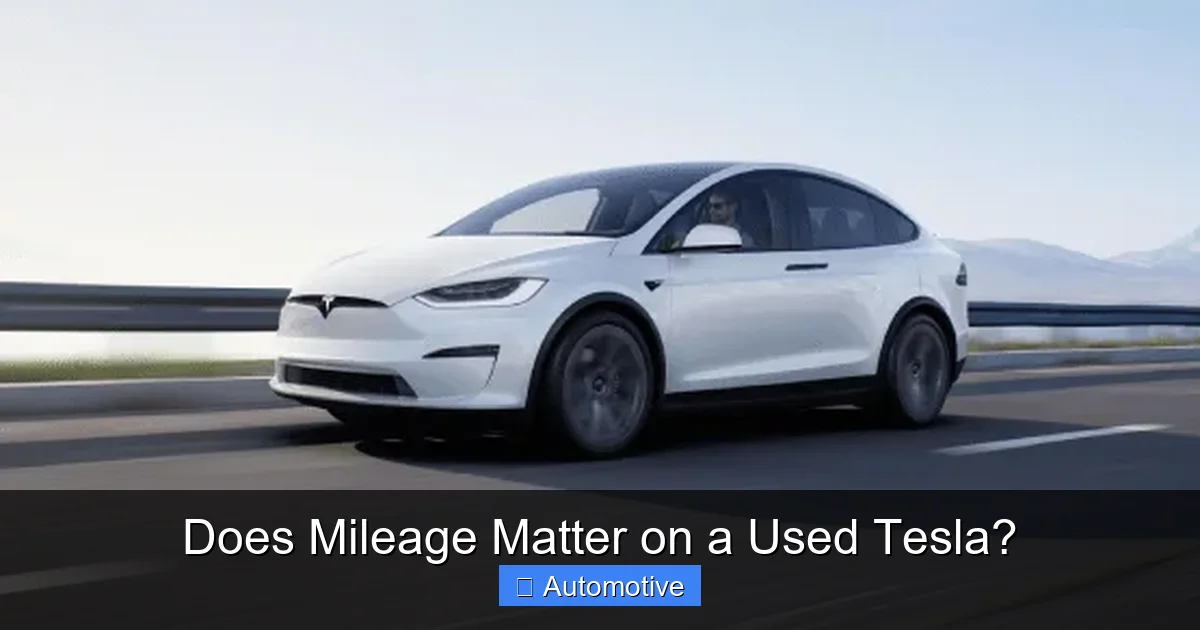
Let’s start with the big question: Does mileage matter on a used Tesla? The short answer is yes—but not as much as you might think.
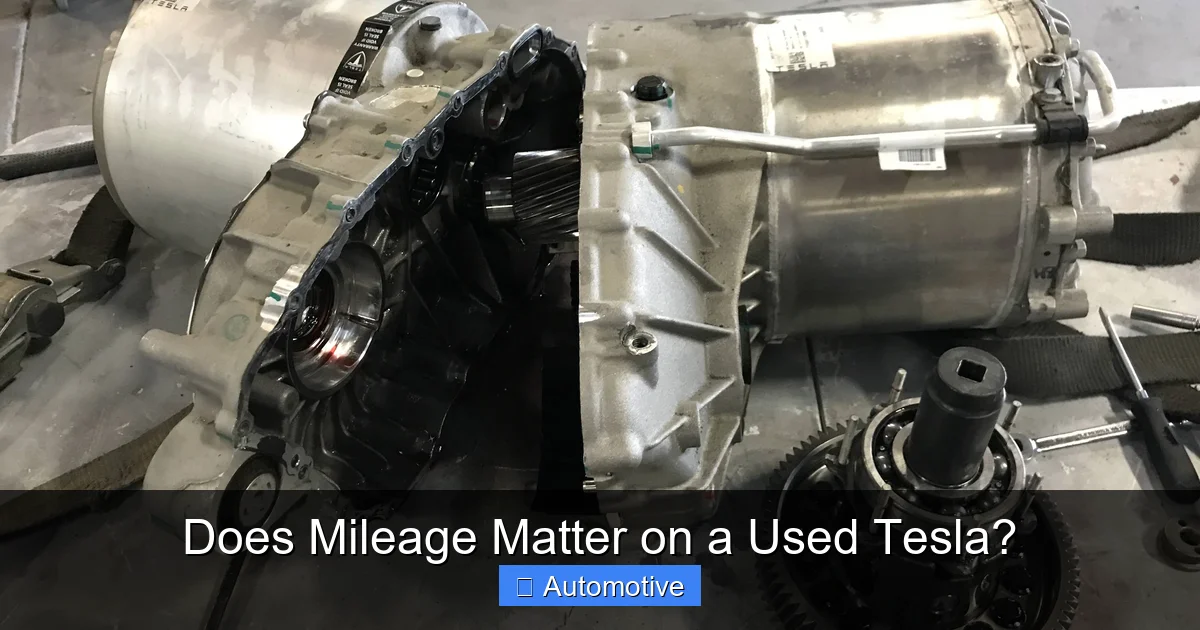
With traditional gasoline vehicles, high mileage often signals mechanical wear. Engines burn oil, transmissions slip, and belts break. But Teslas are electric. They have far fewer moving parts. No oil changes, no spark plugs, no timing belts. The electric motor has just one moving part—the rotor—and it’s designed to last over a million miles.
That said, mileage isn’t irrelevant. Higher mileage means more time on the road, which can lead to wear on components like tires, suspension, brakes (yes, even regenerative braking wears pads over time), and the 12-volt auxiliary battery. It also means more exposure to weather, road conditions, and charging cycles—all of which can affect the car’s overall condition.
But the real wildcard? The battery.
The Battery Is the Heart of the Tesla
In a Tesla, the battery pack is the most critical—and expensive—component. It’s also the part most affected by usage over time. Unlike a gas tank that just holds fuel, a lithium-ion battery degrades with every charge and discharge cycle. The more you use it, the less capacity it holds.
So while a high-mileage Tesla might have driven 100,000 miles, what really matters is how those miles were driven and charged. A car that’s been gently driven and mostly charged at home using a Level 2 charger will likely have a healthier battery than one that’s been Supercharged daily and frequently drained to 0%.
This is why two Teslas with the same mileage can have very different real-world ranges. One might still deliver 90% of its original range, while another struggles to hit 75%. That difference can be worth thousands of dollars—and hundreds of miles of anxiety-free driving.
How Tesla’s Design Reduces Wear
Tesla’s engineering minimizes mechanical wear in ways gas cars can’t match. Regenerative braking, for example, uses the electric motor to slow the car, reducing reliance on friction brakes. This means brake pads last much longer—often 100,000 miles or more.
The single-speed transmission has no gears to wear out. The electric motor produces instant torque without the stress of combustion. And because there’s no engine heat under the hood, components like hoses, gaskets, and belts aren’t exposed to high temperatures that cause degradation.
Even the cooling system is advanced. Tesla uses a sophisticated thermal management system to keep the battery at optimal temperatures, which helps slow degradation. This is a big reason why Teslas in hot climates don’t degrade as quickly as early electric cars might have.
So while mileage gives you a rough idea of usage, it’s the combination of mileage, charging habits, climate, and maintenance that truly determines a Tesla’s condition.
Understanding Battery Degradation
Visual guide about Does Mileage Matter on a Used Tesla?
Image source: i.imgur.com
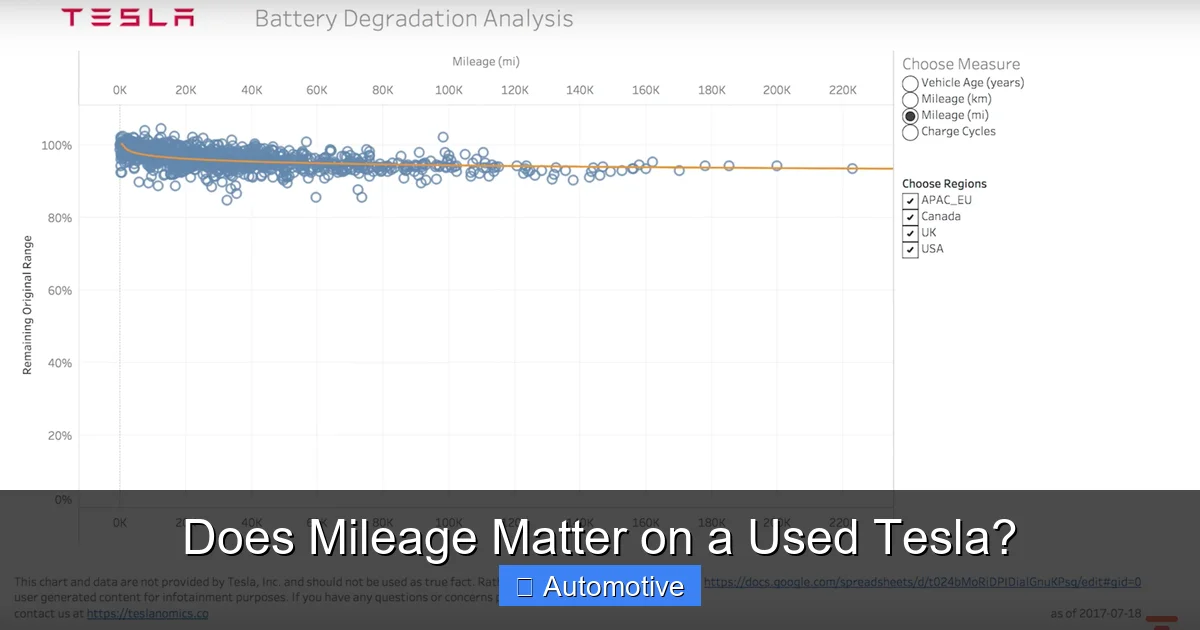
If mileage isn’t the whole story, then what is? The answer lies in battery degradation—the gradual loss of a battery’s ability to hold a charge over time.
All lithium-ion batteries degrade. It’s a natural process. But Tesla has designed its batteries to degrade slowly and predictably. Most owners report losing only 5–10% of their original range after 100,000 miles. After 200,000 miles, that number typically climbs to 10–15%.
To put that in perspective: a 2020 Model 3 Long Range with an EPA-rated 322 miles of range might still deliver around 275–290 miles after 150,000 miles. That’s still excellent range for daily driving and road trips.
What Causes Battery Degradation?
Not all degradation is created equal. Several factors influence how quickly a Tesla’s battery loses capacity:
– **Charging habits:** Frequently charging to 100% or letting the battery drop to 0% stresses the cells. Tesla recommends keeping the charge between 20% and 80% for daily use.
– **Supercharging frequency:** While convenient, frequent use of DC fast chargers (like Superchargers) can generate heat and accelerate degradation. Occasional use is fine, but daily Supercharging isn’t ideal for long-term health.
– **Climate:** Extreme heat or cold can degrade batteries faster. Hot climates, in particular, can accelerate chemical breakdown in the cells.
– **Age:** Even unused batteries degrade over time. A 2017 Model S with only 30,000 miles may have more degradation than a 2021 Model 3 with 60,000 miles due to battery chemistry improvements.
– **Software updates:** Tesla regularly improves battery management through over-the-air updates, which can help slow degradation.
How to Check Battery Health
When shopping for a used Tesla, don’t rely on the odometer alone. Instead, look for signs of battery health:
– **Ask for a battery report:** Use Tesla’s service mode (accessible via the touchscreen) to view the battery’s state of health. Some third-party apps like TeslaFi or ScanMyTesla can also provide detailed data.
– **Check the real-world range:** Take the car for a test drive and note how far it goes on a full charge. Compare that to the EPA rating for that model and year.
– **Review charging history:** If possible, ask the owner about their charging habits. Do they mostly charge at home? Use Superchargers often? Keep the battery topped off?
– **Look for software updates:** A well-maintained Tesla should be up to date with the latest firmware, which includes battery optimizations.
A car with 80,000 miles but excellent battery health and gentle charging habits may be a better buy than a 40,000-mile car that’s been Supercharged daily and rarely maintained.
High-Mileage Teslas: Are They Worth It?
Visual guide about Does Mileage Matter on a Used Tesla?
Image source: i.imgur.com
Let’s face it: seeing a Tesla with 100,000 miles on the odometer can be intimidating. But before you walk away, consider this—many high-mileage Teslas are still excellent buys.
Real-World Examples
Take John, a Tesla owner in California who drove his 2018 Model 3 Long Range for ride-sharing. After 140,000 miles, he still gets 280 miles of range on a full charge—about 85% of the original 334-mile EPA rating. He charges mostly at home, uses Superchargers only when necessary, and keeps the battery between 20% and 80%. His car runs smoothly, and he plans to drive it another 100,000 miles.
Then there’s Maria, who bought a 2016 Model S with 110,000 miles. She was nervous about the mileage, but the previous owner provided a battery report showing only 8% degradation. The car had new tires, a recent brake service, and all software updates. She paid $28,000—less than half the original price—and now enjoys a luxury EV with minimal maintenance.
These stories aren’t rare. Tesla’s durability and low operating costs make high-mileage models appealing, especially for budget-conscious buyers.
What to Watch For in High-Mileage Models
That said, not all high-mileage Teslas are created equal. Here’s what to check:
– **Suspension wear:** High mileage can lead to worn shocks, struts, or bushings. Listen for clunks or feel for a bouncy ride.
– **Tire condition:** Tires wear out every 30,000–50,000 miles. Check tread depth and look for uneven wear.
– **HVAC system:** The air conditioning and heating systems can develop leaks or compressor issues over time.
– **12-volt battery:** This small battery powers the electronics and can fail after 5–7 years. Replacement costs around $200–$300.
– **Paint and interior:** High mileage often means more exposure to sun, rain, and road debris. Check for scratches, fading, or interior wear.
A pre-purchase inspection by a Tesla-certified technician can uncover hidden issues and give you peace of mind.
Model Year vs. Mileage: Which Matters More?
Here’s a surprising truth: for used Teslas, model year can sometimes matter more than mileage.
Why? Because Tesla improves its vehicles every year. Battery chemistry gets better, efficiency increases, and software features evolve. A 2022 Model 3 with 70,000 miles may have a more advanced battery and better range than a 2017 Model S with 50,000 miles.
Key Improvements Over the Years
– **Battery technology:** Newer Teslas use more energy-dense batteries with better thermal management. For example, the 4680 battery cells in newer Model Ys offer longer range and faster charging.
– **Efficiency:** Tesla continuously improves aerodynamics, motor efficiency, and software to squeeze more miles from the same battery.
– **Features:** Older models may lack features like Sentry Mode, Dog Mode, or the latest Autopilot capabilities.
– **Build quality:** Early Model 3s had issues with panel gaps and paint. Later models improved significantly.
So while a low-mileage 2016 Model S might seem like a great deal, it could lack the range, efficiency, and tech of a higher-mileage 2020 Model 3.
When Older Models Still Make Sense
That doesn’t mean older models are bad. A well-maintained 2017 Model S with 60,000 miles can still be a fantastic luxury EV. It may have a larger battery, more interior space, and a smoother ride than a newer Model 3.
The key is balance. Consider both the model year and the mileage, along with the car’s condition, battery health, and price. Sometimes, an older car with low mileage and good maintenance is a better value than a newer one with high usage.
Tips for Buying a Used Tesla
Ready to shop? Here’s how to make a smart purchase:
1. Prioritize Battery Health
Ask for a battery health report. Use apps like TeslaFi or ScanMyTesla to analyze charging patterns and degradation. A car with 10% degradation after 100,000 miles is in great shape. One with 20% degradation after 50,000 miles? Walk away.
2. Check the Warranty
Tesla offers an 8-year, unlimited-mileage battery and drivetrain warranty on most models. If the car is still under warranty, you’re covered for major repairs. Even out of warranty, Tesla’s reliability reduces the risk of costly fixes.
3. Test Drive and Inspect
Take the car for a long test drive. Check acceleration, braking, handling, and noise levels. Inspect the interior, exterior, and undercarriage. Look for signs of accidents or poor repairs.
4. Review Service History
Ask for maintenance records. Has the car had regular tire rotations? Brake fluid changes? HVAC service? A well-documented history is a good sign.
5. Compare Prices
Use tools like Tesla’s used car inventory, CarGurus, or Autotrader to compare prices. Factor in mileage, model year, condition, and location. A $5,000 difference might be worth it for a car with better battery health.
6. Consider Certified Pre-Owned
Tesla’s Certified Pre-Owned (CPO) program offers inspected, warrantied vehicles with clean histories. While they cost more, they come with peace of mind.
Conclusion: Mileage Matters—But It’s Not Everything
So, does mileage matter on a used Tesla? Yes—but not in the way it does for gas cars. High mileage doesn’t automatically mean a failing battery or mechanical issues. In fact, many Teslas with 100,000+ miles are still going strong.
What matters more is battery health, charging habits, maintenance, and model year. A well-cared-for Tesla with higher mileage can be a better buy than a low-mileage car with poor charging practices.
When shopping, focus on the whole picture. Check the battery report, review the service history, and take a thorough test drive. Don’t let the odometer scare you—let the data guide you.
With the right approach, you can find a used Tesla that delivers years of quiet, efficient, and thrilling driving—no matter how many miles are on the clock.
Frequently Asked Questions
Does high mileage reduce a Tesla’s range?
Yes, but only moderately. Most Teslas lose 10–15% of their original range after 200,000 miles. This means a car with 300 miles of range might still deliver 255–270 miles, which is still excellent for daily use.
Is a Tesla with 100,000 miles reliable?
Generally, yes. Tesla’s electric drivetrain is built for longevity. As long as the battery is healthy and the car has been maintained, a high-mileage Tesla can be very reliable.
Should I avoid a used Tesla with high mileage?
Not necessarily. High mileage alone isn’t a red flag. Focus on battery health, maintenance history, and overall condition. A well-maintained high-mileage Tesla can be a great value.
How can I check a used Tesla’s battery health?
Use Tesla’s service mode on the touchscreen, or third-party apps like TeslaFi or ScanMyTesla. These tools show real-world range, charging patterns, and estimated degradation.
Do Teslas need more maintenance as they age?
No, Teslas require less maintenance than gas cars. However, tires, brakes, suspension, and the 12-volt battery still need attention over time. Regular inspections help catch issues early.
Is it better to buy a newer Tesla with higher mileage or an older one with low mileage?
It depends. Newer models often have better batteries, efficiency, and features. But an older, well-maintained Tesla with low mileage and good battery health can still be a smart buy. Compare both options carefully.