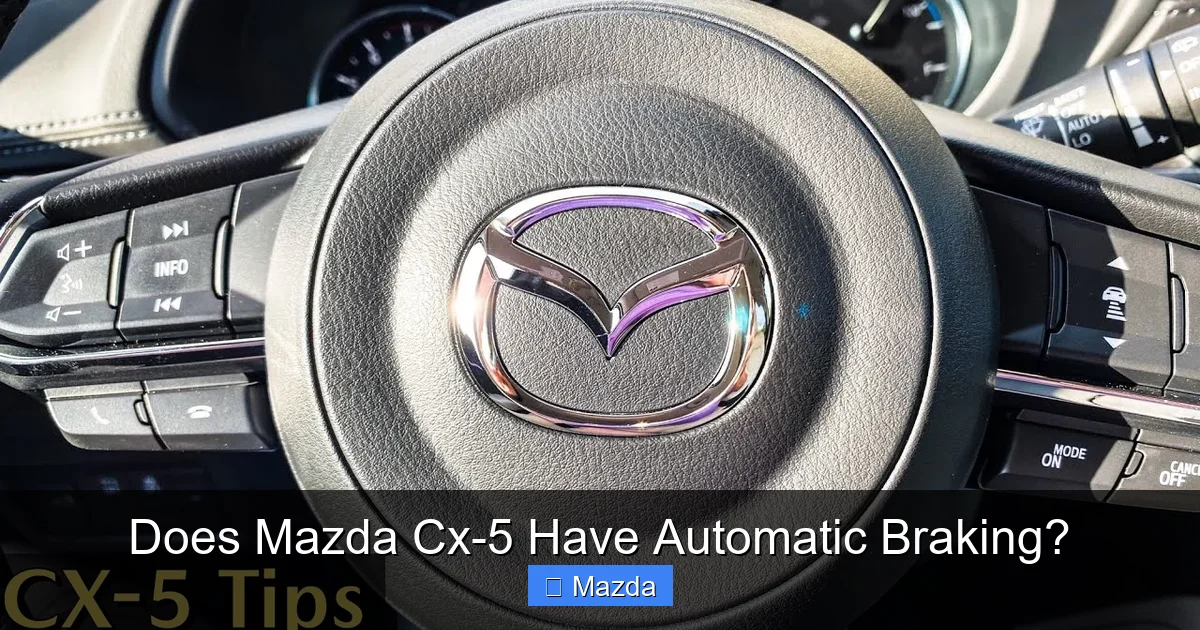
Does Mazda Cx-5 Have Automatic Braking?

Contents
- 1 Key Takeaways
- 2 📑 Table of Contents
- 3 Introduction: The New Standard in Safety
- 4 Decoding i-ACTIVSENSE: Mazda’s Safety Brain
- 5 Smart City Brake Support: Your Urban Guardian
- 6 Beyond City Braking: Adaptive Cruise Control & Stop & Go
- 7 Driver Attention Alert: The First Line of Defense
- 8 How It Stacks Up: CX-5 vs. The Competition
- 9 Practical Tips for CX-5 Owners: Living with AEB
- 10 Conclusion: Peace of Mind as Standard
- 11 Frequently Asked Questions
Foam Cannon

Car Wax Polish

Car Seat Cover (Universal Fit)

OBD2 Scanner Tool
Yes, the 2026 Mazda CX-5 comes standard with automatic emergency braking (AEB) as a core part of its i-ACTIVSENSE safety suite. This system, branded as Smart City Brake Support for low-speed scenarios and integrated with Adaptive Cruise Control for higher speeds, automatically applies the brakes to prevent or mitigate collisions with vehicles, pedestrians, and cyclists. It’s a driver-assistance feature designed to enhance safety, not replace attentive driving, and is available on every CX-5 trim level.
Key Takeaways
- Standard on All Trims: Automatic emergency braking is not an optional extra; it’s a standard safety feature on every 2026 Mazda CX-5, from the Sport to the Premium trims.
- Part of i-ACTIVSENSE: The technology is integrated into Mazda’s holistic i-ACTIVSENSE suite, which uses a combination of radar, camera, and sensor data.
- Two Primary Functions: It operates via Smart City Brake Support (low-speed, urban collisions) and as part of Adaptive Cruise Control with Stop & Go (highway following and braking).
- Detects More Than Cars: The system is engineered to recognize and react to pedestrians and, in many markets, cyclists, especially in daylight conditions.
- Driver Monitoring is Key: The Driver Attention Alert system works in tandem, warning the driver if it detects signs of fatigue or distraction before automatic intervention may be needed.
- Requires Calibration: If the front windshield or grille-mounted radar is replaced, the system must be professionally recalibrated to function correctly, which is a key point to discuss with your technician.
- Competitive Standard: This positions the CX-5 competitively against rivals like the Honda CR-V and Toyota RAV4, which also offer similar AEB systems as standard.
📑 Table of Contents
- Introduction: The New Standard in Safety
- Decoding i-ACTIVSENSE: Mazda’s Safety Brain
- Smart City Brake Support: Your Urban Guardian
- Beyond City Braking: Adaptive Cruise Control & Stop & Go
- Driver Attention Alert: The First Line of Defense
- How It Stacks Up: CX-5 vs. The Competition
- Practical Tips for CX-5 Owners: Living with AEB
- Conclusion: Peace of Mind as Standard
Introduction: The New Standard in Safety
If you’re shopping for a compact SUV in 2026, one question is undoubtedly at the top of your list: “Does the Mazda CX-5 have automatic braking?” The short answer is a resounding yes. But understanding exactly what that means, how it works, and what it can (and cannot) do is crucial for any modern driver. Automatic Emergency Braking (AEB) has rapidly evolved from a luxury add-on to a baseline expectation for vehicle safety. For Mazda, this technology is a cornerstone of their philosophy, woven into the very fabric of the driving experience through their proprietary i-ACTIVSENSE suite.
In the 2026 CX-5, you’re not getting a single, simplistic brake-by-wire gadget. You’re getting a sophisticated, multi-layered network of sensors and software designed to act as a vigilant co-pilot. This system is always monitoring the road ahead, ready to alert you to potential dangers and, if necessary, intervene to avoid or lessen the severity of a collision. It represents a massive leap forward in passive and active safety, and for many, it’s the deciding factor in choosing a family vehicle. Let’s dive deep into exactly what automatic braking looks like in the Mazda CX-5.
Decoding i-ACTIVSENSE: Mazda’s Safety Brain
To understand the CX-5’s automatic braking, you must first understand i-ACTIVSENSE. It’s not just a marketing term; it’s Mazda’s integrated approach to safety that predicts and prevents accidents. The name is a portmanteau of “intelligent” and “active,” and it encompasses a range of technologies that work together seamlessly. At the heart of this system for AEB are two primary sensors:

Visual guide about Does Mazda Cx-5 Have Automatic Braking?
Image source: vehq.com
- A Forward Sensing Camera (FSC): Typically mounted near the rearview mirror, this camera identifies lane markings, traffic signs, pedestrians, and vehicles. It’s the system’s “eyes” for visual recognition.
- A Radar Sensor: Usually housed in the grille or front bumper, this radar unit measures the distance and relative speed of objects ahead, especially in low-visibility conditions where a camera might struggle.
These sensors feed constant data to the vehicle’s computer. The magic happens in the fusion of this data. The radar provides precise distance and closing speed, while the camera classifies the object (is it a car, a person, a bicycle?). This dual-input method drastically reduces false positives—like slamming on the brakes for a shadow or a sign—and increases the system’s reliability and reaction time. When a potential collision is identified, the system follows a graduated response protocol.
The Graduated Response: Alert, Then Act
Mazda’s system is designed to be helpful, not intrusive. It doesn’t just brake out of the blue. Instead, it employs a clear, escalating sequence:
- Pre-Collision Braking Assist: The system first prepares the braking system by increasing hydraulic pressure, so if you do hit the brakes, they respond more powerfully and immediately.
- Driver Alert: You’ll see visual and audible warnings in the instrument cluster and heads-up display (if equipped), telling you to brake immediately.
- Automatic Braking: If you fail to react and a collision is imminent, the system will automatically apply partial or full braking force to either avoid the impact entirely or significantly reduce the collision speed.
This staged approach gives you, the driver, every chance to take control. The system is a backup, not a replacement for your attention.
Smart City Brake Support: Your Urban Guardian
For the dense, stop-and-go environment of city driving, Mazda deploys a specific function called Smart City Brake Support (SCBS). This is the low-speed guardian angel of the CX-5. SCBS is primarily designed for collisions at speeds typically below 30-40 mph (the exact threshold can vary slightly by model year and market).

Visual guide about Does Mazda Cx-5 Have Automatic Braking?
Image source: di-sitebuilder-assets.s3.amazonaws.com
How SCBS Works in the Real World
Imagine you’re driving down a busy street, following a delivery van. Your mind drifts for a second as you check your phone. The van suddenly stops short. Before you even register the brake lights, the CX-5’s system has already detected the rapid decrease in distance. The alert chime sounds, and if you don’t react, the brakes automatically engage. This is the classic and most valuable use case for AEB.
But SCBS is also tuned for vulnerable road users. In daylight conditions, it can detect pedestrians who step unexpectedly into the vehicle’s path. Some model years and regions also extend this capability to cyclists. This is a critical safety net in neighborhoods and near intersections where visibility can be compromised by parked cars or foliage. It’s important to note that SCBS performance can be affected by poor weather (heavy rain, fog, snow) or extreme lighting conditions (direct glare from the sun).
Beyond City Braking: Adaptive Cruise Control & Stop & Go
Automatic braking in the CX-5 isn’t reserved for emergencies alone. It’s also a fundamental component of the available Adaptive Cruise Control (ACC) with Stop & Go feature. This is where the system transitions from a safety net to a convenience assistant on highways and major roads.

Visual guide about Does Mazda Cx-5 Have Automatic Braking?
Image source: texasreliableautoglass.com
The “Follow-Me” Function
Once you set your desired cruising speed and following distance, the radar and camera continuously track the vehicle ahead. If that car slows down, your CX-5 will automatically slow down by modulating the throttle and applying the brakes, maintaining your preset gap. The “Stop & Go” part means it can bring the vehicle to a complete stop in traffic and then automatically resume following when traffic starts moving again, typically within a few seconds. If the stop is longer, a simple tap on the resume button or slight press of the accelerator will re-engage the system. This drastically reduces driver fatigue on long commutes and in congested conditions, seamlessly blending safety and comfort.
Driver Attention Alert: The First Line of Defense
Mazda understands that the best automatic braking is the one you never need. That’s why the i-ACTIVSENSE suite includes the Driver Attention Alert system. This isn’t braking-related directly, but it’s intrinsically linked to the philosophy behind it. Using steering input data, the system learns your driving patterns on a trip. If it detects subtle signs of drowsiness or prolonged, monotonous driving—like slight, corrective steering movements that indicate drifting—it will prompt you with a visual warning and a chime, suggesting a break. This proactive warning aims to address the root cause of many accidents: inattentive or fatigued driving. By alerting you *before* a hazard becomes critical, it works in perfect harmony with the AEB systems, creating a comprehensive safety cocoon.
How It Stacks Up: CX-5 vs. The Competition
In the fiercely competitive compact SUV segment, having a robust AEB system is table stakes. So how does Mazda’s implementation compare to the Honda Sensing in a CR-V or Toyota Safety Sense in a RAV4? The answer is: very favorably, with some nuanced differences.
- Honda Sensing (CR-V): Honda’s system is also very competent, with a similar “Collision Mitigation Braking System.” Both are highly effective at low-speed city braking and pedestrian detection. Mazda’s system is often praised for its smooth, seamless integration and less intrusive alerts.
- Toyota Safety Sense (RAV4): Toyota’s Pre-Collision System is another industry benchmark. It’s extremely reliable. Mazda’s i-ACTIVSENSE is frequently noted for its slightly more aggressive and earlier intervention in some test scenarios, though real-world performance is nearly identical across the board.
Where Mazda often differentiates itself is in the driving feel. The integration of these systems with the steering, throttle, and braking feels exceptionally natural and “Mazda-like”—predictable and smooth. The goal is to assist without ever feeling like a robot is taking over. For a deeper dive into how the CX-5’s overall capabilities stack up, including its impressive towing capacity which complements its safety tech, you can see our analysis on how much a Mazda CX-5 can tow.
Practical Tips for CX-5 Owners: Living with AEB
Knowing the system exists is one thing; understanding how to live with it is another. Here are essential tips for any CX-5 owner or potential buyer.
1. Keep Your Sensors Clean and Clear
The forward-facing camera and radar need a clear view. This means keeping the windshield area (behind the rearview mirror) and the grille/ front bumper clean of mud, snow, ice, bird droppings, and aftermarket accessories like large frame-less license plates or poorly fitted bug deflectors. A dirty sensor can cause malfunctions or warnings. If you ever need windshield replacement, the calibration of these sensors is a critical step—a job for professionals. You can learn more about the specifics and costs involved in our guide on how to replace a Mazda CX-5 windshield.
2. Understand the Limitations
No system is perfect. AEB is primarily designed for *forward* collisions with *moving* or *stationary* vehicles ahead. It will not detect objects coming from the side (like a T-bone collision), debris in your lane (like a tire tread), or vehicles cutting sharply in front of you at very close range. It also has reduced effectiveness in severe weather. It is a driver-assistance system, not an autopilot. Your eyes on the road and hands on the wheel are still the most important safety systems.
3. The “Off” Switch: When and Why
There is a way to temporarily disable certain i-ACTIVSENSE functions, including the audible and pre-braking alerts, through the vehicle’s settings menu on the infotainment screen. This might be useful for very technical off-road driving or in a situation where you anticipate the system might be overly sensitive (e.g., a narrow, winding country lane with many close hedges). However, Mazda strongly recommends keeping it enabled for all normal on-road driving. Disabling it removes a vital safety layer.
4. Maintenance and Service
If you see a persistent warning light or message on your dash indicating that the “Smart City Brake Support” or “Pre-Collision” system is disabled or malfunctioning, do not ignore it. The issue could be as simple as a dirty sensor or as complex as a misalignment from a minor bumper impact. Have it diagnosed by a Mazda-trained technician using specialized equipment. For general maintenance reminders, knowing how to reset your service light after an oil change is always handy, which you can find in our article on how to reset a Mazda CX-5 service light.
Conclusion: Peace of Mind as Standard
So, does the Mazda CX-5 have automatic braking? Absolutely, and it’s a well-executed, comprehensive system. By making the full i-ACTIVSENSE suite standard across all 2026 CX-5 trims, Mazda democratizes advanced safety. You get a capable Smart City Brake Support for urban chaos, an integrated Stop & Go function for highway relief, and a watchful Driver Attention Alert—all working in concert. It embodies Mazda’s “Jinba Ittai” (horse and rider as one) philosophy by providing assistance that feels intuitive and natural, not robotic or alarming.
While it’s crucial to remember its limits and maintain your sensors properly, the presence of this technology provides tangible, real-world peace of mind. It acts as an ever-present second set of eyes, ready to act in the fractions of a second it takes for a situation to turn critical. For families, commuters, and anyone who values safety, the standard-fit automatic emergency braking in the Mazda CX-5 is not just a feature—it’s a fundamental reason to consider this standout SUV.
Frequently Asked Questions
Is the automatic braking system on the Mazda CX-5 always active?
Yes, the Smart City Brake Support and the braking function of Adaptive Cruise Control are always on and monitoring when the vehicle is turned on and driving forward. You can temporarily disable the alerts via the vehicle settings, but the underlying system remains powered.
Will the Mazda CX-5’s automatic braking work at night or in bad weather?
The system is designed to work in various conditions, including nighttime. However, its effectiveness can be reduced by severe weather like heavy rain, fog, or snow that obstructs the camera or radar sensors. Always drive with extra caution in such conditions and do not rely solely on the system.
Can the system cause false braking events?
While sophisticated, no system is perfect. False positives are rare but can happen, often triggered by unusual shadows, steep hill shapes, or certain metallic objects. Mazda’s sensor fusion technology is designed to minimize these events, and the graduated response (alert first) usually gives the driver time to override an unnecessary automatic brake application.
What happens if my CX-5’s front windshield is replaced?
The forward-facing camera is typically mounted near the rearview mirror on the windshield. If the windshield is replaced, the camera’s alignment and calibration are almost certainly disrupted. The system will likely disable itself and display a warning. A professional technician must perform a specific calibration procedure using specialized tools to restore full functionality. This is a critical step often discussed when considering windshield replacement costs.
Does the 2026 CX-5 have automatic braking that works on cyclists?
Yes, in most major markets, the Smart City Brake Support system includes pedestrian detection and, in many regions, cyclist detection during daylight hours. It’s important to check your specific owner’s manual for your region’s exact capabilities, as regulations and software calibrations can vary slightly.
Will having this system lower my insurance premiums?
It potentially can. Many insurance companies offer discounts for vehicles equipped with validated safety features like AEB, as they statistically reduce the frequency and severity of claims. Contact your insurance provider directly to inquire about their specific discount programs for vehicles with advanced driver-assistance systems (ADAS).