
Did Toyota Buy the 5.7 Engine from Gm?

No, Toyota did not buy the 5.7 engine from GM. The Toyota 5.7L V8 (1UR-FE) is an in-house design developed independently for trucks and SUVs like the Tundra and Sequoia.
Key Takeaways
- Toyota’s 5.7L V8 is a proprietary engine: The 1UR-FE was designed and built entirely by Toyota, not acquired from GM or any other automaker.
- GM’s 5.7L engines are part of the LS family: General Motors uses 5.7L V8s like the LS1 and L31, which are unrelated to Toyota’s architecture and design.
- Different engineering philosophies: Toyota prioritizes reliability and longevity, while GM focuses on performance and modularity in its V8 designs.
- No evidence of licensing or acquisition: There are no records, patents, or official statements confirming Toyota ever purchased or licensed a 5.7L engine from GM.
- Both engines serve similar roles but differ greatly: While both power full-size trucks and SUVs, the Toyota 5.7L emphasizes low-end torque and durability, whereas GM’s 5.7L leans toward horsepower and tuning potential.
- Misinformation spreads online: Forums and social media often confuse engine sizes and brands, leading to myths like this one.
- Toyota’s global engine strategy: Toyota develops region-specific powertrains, and the 5.7L was created to meet North American demand for powerful, reliable truck engines.
📑 Table of Contents
- Did Toyota Buy the 5.7 Engine from GM? The Truth Behind the Myth
- Understanding Toyota’s 5.7L V8: The 1UR-FE Engine
- GM’s 5.7L V8 Engines: The LS and Small-Block Legacy
- Why the Rumor Exists: Origins of the Myth
- Toyota’s Engine Development Process: In-House Innovation
- Comparing the Toyota 5.7L and GM 5.7L: Side by Side
- The Future of Toyota’s V8 Engines
- Conclusion: No, Toyota Did Not Buy the 5.7 Engine from GM
Did Toyota Buy the 5.7 Engine from GM? The Truth Behind the Myth
If you’ve spent any time browsing automotive forums, YouTube comments, or truck enthusiast groups, you’ve probably come across the claim: “Toyota bought the 5.7 engine from GM.” It sounds plausible—after all, both companies make full-size trucks with big V8 engines. But is there any truth to it?
Let’s cut through the noise. The short answer is no—Toyota did not buy the 5.7-liter engine from General Motors. In fact, the Toyota 5.7L V8, known internally as the 1UR-FE, is a completely original design developed in-house by Toyota. It shares no mechanical DNA with GM’s 5.7L engines, such as the LS1 or the older L31 small-block. Despite the similar displacement, these engines come from different engineering philosophies, manufacturing processes, and corporate strategies.
So where did this rumor start? Likely from confusion over engine sizes and the popularity of both brands in the truck market. Toyota’s Tundra and GM’s Silverado both use 5.7L V8s, leading some to assume one borrowed from the other. But the reality is far more interesting—and speaks to how each automaker approaches power, reliability, and innovation.
Understanding Toyota’s 5.7L V8: The 1UR-FE Engine
Visual guide about Did Toyota Buy the 5.7 Engine from Gm?
Image source: jdmautopartsusa.com
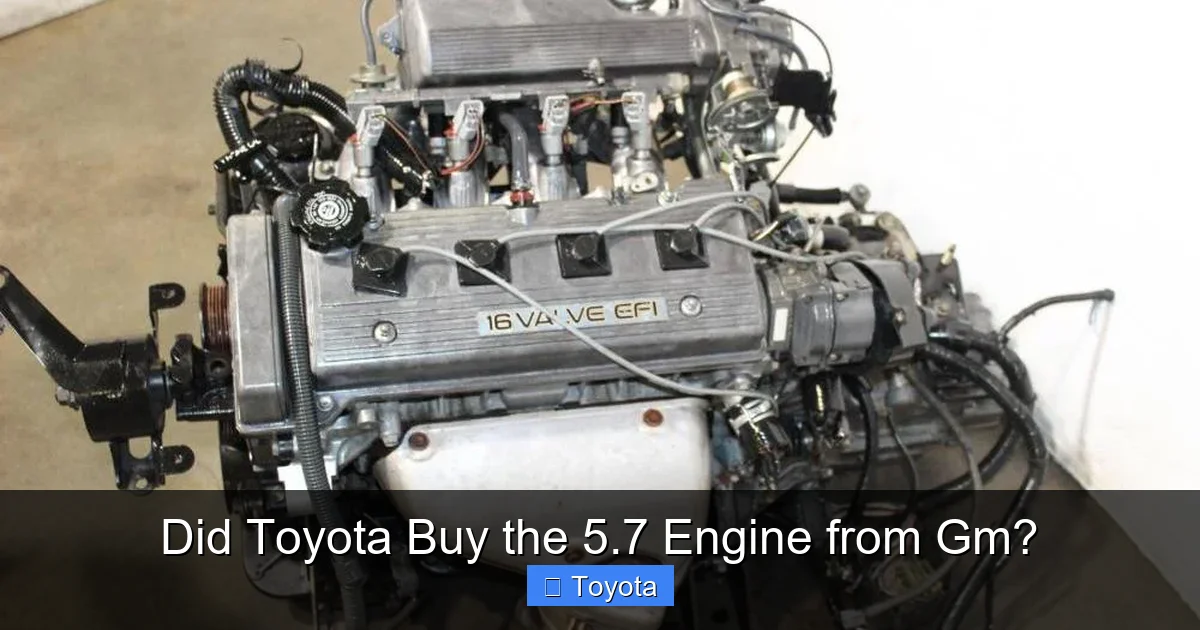
To understand why Toyota didn’t—and couldn’t—buy a 5.7L engine from GM, we need to look at the origins of Toyota’s own V8. The 1UR-FE engine was introduced in 2007 as part of Toyota’s effort to compete head-to-head with American full-size trucks like the Ford F-150, Chevrolet Silverado, and Ram 1500. At the time, Toyota’s Tundra was using a 4.7L V8, which was reliable but lacked the power needed to match its rivals.
Development and Design Philosophy
Toyota engineers set out to create a modern, high-output V8 that could deliver strong low-end torque, excellent towing capacity, and long-term durability. The result was the 1UR-FE—a 5.7-liter (346 cubic inches) V8 with dual overhead camshafts (DOHC), four valves per cylinder, and Variable Valve Timing with intelligence (VVT-i). This engine was designed from the ground up to meet North American demands for power and reliability.
Unlike GM’s pushrod-based small-block V8s, the 1UR-FE uses a more complex DOHC layout, similar to performance engines found in luxury cars. This design allows for better airflow, higher RPM potential, and improved fuel efficiency—though at the cost of added complexity and weight.
Key Features of the 1UR-FE
The 1UR-FE packs a punch with 381 horsepower and 401 lb-ft of torque in its most common form. It features an aluminum block and heads to reduce weight, a forged steel crankshaft for strength, and a sophisticated engine management system. Toyota also designed the engine with serviceability in mind—components like the timing chain and water pump are built to last over 200,000 miles with proper maintenance.
One of the engine’s standout traits is its smooth power delivery. Unlike some American V8s that feel peaky or high-strung, the 1UR-FE provides strong, linear torque from idle, making it ideal for towing trailers, hauling payloads, or cruising on the highway. This characteristic aligns with Toyota’s reputation for building vehicles that “just work” year after year.
Applications in Toyota Vehicles
The 1UR-FE engine has been used in several Toyota and Lexus models, including:
– Toyota Tundra (2007–2021)
– Toyota Sequoia (2008–2022)
– Lexus LX 570 (2008–2021)
These vehicles are known for their rugged capability and long service lives, and the 5.7L V8 plays a central role in that reputation. Even as Toyota has begun transitioning to hybrid and turbocharged powertrains, the 1UR-FE remains a favorite among truck owners who value simplicity and durability.
GM’s 5.7L V8 Engines: The LS and Small-Block Legacy
Visual guide about Did Toyota Buy the 5.7 Engine from Gm?
Image source: low-offset.com
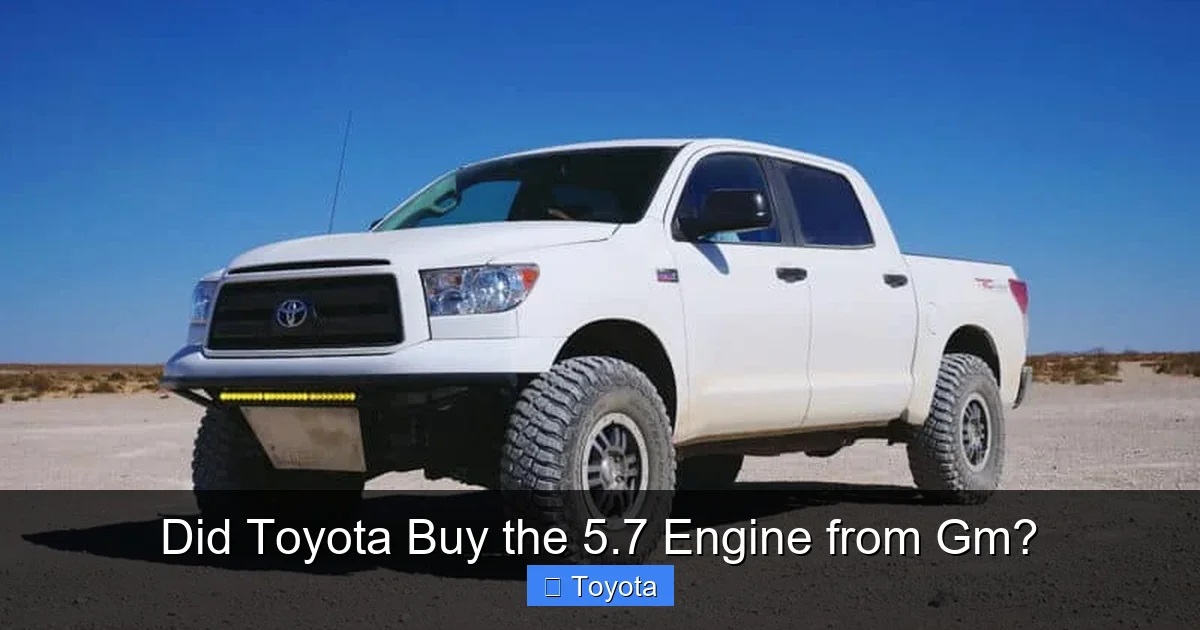
Now let’s look at the other side of the coin: General Motors’ 5.7-liter V8 engines. GM has a long history of building 5.7L V8s, most notably the LS1 (used in the Corvette and Camaro) and the L31 (used in trucks like the Silverado and Suburban). These engines are part of GM’s legendary small-block family, which dates back to the 1950s.
The LS1: A Performance Icon
Introduced in 1997, the LS1 was a revolutionary engine for its time. It featured an all-aluminum block, lightweight components, and a high-flow cylinder head design. With 345 horsepower in its original form, the LS1 helped redefine what a production V8 could do. It became the foundation for the modern LS engine family, which includes displacements from 5.3L to 7.0L.
The LS1 and its successors are known for their modular design, meaning parts are interchangeable across different models and years. This has made them incredibly popular in the aftermarket tuning community. Enthusiasts can easily swap in performance camshafts, superchargers, or even entire LS engines into non-GM vehicles.
The L31: The Workhorse V8
While the LS1 was built for sports cars, the L31 was designed for trucks and SUVs. Also known as the Vortec 5700, this 5.7L V8 was used in GM trucks from the mid-1990s to the early 2000s. It produced around 255 horsepower and 330 lb-ft of torque—less than the LS1, but optimized for low-end grunt and towing.
The L31 used a cast-iron block and pushrod valvetrain, which made it heavier but more durable under heavy loads. It was eventually replaced by the 6.0L Vortec engine, but many L31 engines are still on the road today, thanks to their simplicity and reliability.
Why GM’s 5.7L Is Different from Toyota’s
Despite the similar displacement, GM’s 5.7L engines are mechanically and philosophically different from Toyota’s 1UR-FE. GM’s small-block V8s use a pushrod design with two valves per cylinder, while Toyota’s 1UR-FE uses four valves per cylinder and dual overhead camshafts. This means the engines have different packaging, weight distribution, and performance characteristics.
Additionally, GM’s engines are designed with modularity and performance tuning in mind, while Toyota’s focus is on longevity and refinement. You won’t find a Toyota 5.7L with a carburetor or a GM 5.7L with VVT-i—these are clear indicators of different design priorities.
Why the Rumor Exists: Origins of the Myth
Visual guide about Did Toyota Buy the 5.7 Engine from Gm?
Image source: gmauthority.com
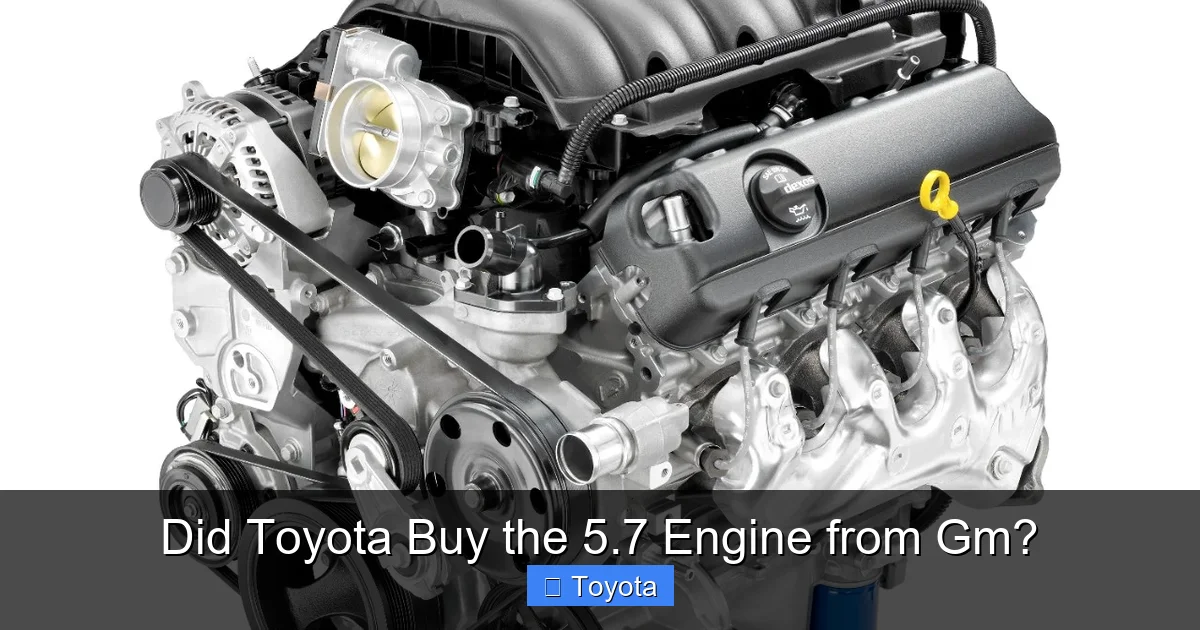
So why do people believe Toyota bought the 5.7L engine from GM? There are several factors that contribute to this persistent myth.
Similar Engine Sizes and Market Roles
Both Toyota and GM offer 5.7L V8 engines in their full-size trucks. The Tundra and Silverado are direct competitors, and both engines deliver strong towing and hauling capabilities. When two rival companies use similar-sized engines for the same purpose, it’s natural for people to assume there’s a connection—especially if they don’t understand the technical differences.
Confusion with Other Automaker Collaborations
There have been instances where automakers shared engines or platforms. For example, Toyota and BMW collaborated on the Supra and Z4, and Ford and Mazda have shared engines in the past. However, these partnerships are usually well-documented and involve clear licensing agreements. There’s no evidence of such a deal between Toyota and GM regarding a 5.7L V8.
Misinformation on the Internet
The internet is full of half-truths and exaggerated claims. A forum post from 2008 claiming “Toyota stole GM’s engine” might get shared thousands of times, even if it’s based on speculation. YouTube videos with sensational titles can amplify these myths, especially if they’re backed by convincing-sounding but inaccurate explanations.
Lack of Public Knowledge About Engine Development
Most consumers don’t know how long it takes to design and test a new engine. Developing a modern V8 like the 1UR-FE takes years of research, prototyping, and validation. Toyota began work on the 5.7L V8 in the early 2000s, long before it appeared in the Tundra. This level of investment makes it unlikely that Toyota would simply buy an engine from a competitor.
Toyota’s Engine Development Process: In-House Innovation
Toyota is known for its vertical integration and commitment to in-house engineering. The company designs and manufactures most of its components, from engines to transmissions to electronics. This approach allows for tighter quality control, better integration, and long-term reliability.
The Toyota Production System and Engine Design
The Toyota Production System (TPS) emphasizes efficiency, waste reduction, and continuous improvement. This philosophy extends to engine development. Toyota engineers use data from real-world testing, customer feedback, and durability trials to refine their designs. The 1UR-FE underwent extensive testing in extreme conditions, including desert heat, mountain altitudes, and freezing temperatures.
Global Engine Strategy
Toyota doesn’t use the same engines worldwide. The 5.7L V8 was developed specifically for the North American market, where large trucks and SUVs are popular. In other regions, Toyota uses smaller, more fuel-efficient engines. This regional approach allows Toyota to meet local demands without compromising on performance or efficiency.
Patents and Intellectual Property
A review of Toyota’s patent filings shows numerous innovations related to the 1UR-FE, including valve timing systems, combustion chamber designs, and cooling strategies. These patents are owned by Toyota, not licensed from GM. If Toyota had purchased the engine, we would expect to see licensing agreements or shared patents—neither of which exist.
Comparing the Toyota 5.7L and GM 5.7L: Side by Side
Let’s put the two engines head-to-head to see how they differ.
Performance and Power Output
– Toyota 1UR-FE: 381 hp, 401 lb-ft torque
– GM LS1: 345 hp, 350 lb-ft torque (early models)
– GM L31: 255 hp, 330 lb-ft torque
While the LS1 was designed for high-RPM performance, the 1UR-FE emphasizes low-end torque, making it better suited for towing. The L31, though older, was built for durability and simplicity.
Engine Layout and Technology
– Toyota: DOHC, 4 valves per cylinder, VVT-i, aluminum block and heads
– GM LS1: OHV (pushrod), 2 valves per cylinder, aluminum block, no VVT (early models)
– GM L31: OHV, 2 valves per cylinder, cast-iron block
The DOHC design gives Toyota better airflow and efficiency, while GM’s pushrod engines are lighter and more compact.
Reliability and Longevity
Both engines are known for reliability, but in different ways. Toyota’s 1UR-FE is built to last 300,000+ miles with regular maintenance. GM’s LS engines are also durable, but their simplicity makes them easier to rebuild and modify.
Aftermarket Support
GM’s LS engines have a massive aftermarket, with thousands of performance parts available. Toyota’s 1UR-FE has less support, though it’s growing as the engine ages. Swapping a GM LS into a Tundra is possible, but it requires significant modifications.
The Future of Toyota’s V8 Engines
As the automotive industry shifts toward electrification, the future of large V8 engines is uncertain. Toyota has already introduced hybrid versions of the Tundra and Sequoia, using a twin-turbo V6 paired with an electric motor. These new powertrains deliver more power and better fuel economy than the old 5.7L V8.
Transition to Hybrid and Turbocharged Powertrains
The 2022 Toyota Tundra replaced the 5.7L V8 with a 3.5L twin-turbo V6 hybrid. This engine produces 437 horsepower and 583 lb-ft of torque—more than the old V8—while improving fuel efficiency. This shift reflects Toyota’s commitment to innovation and sustainability.
Legacy of the 1UR-FE
Even as Toyota moves away from the 5.7L V8, the 1UR-FE will remain a beloved engine among truck enthusiasts. Its combination of power, smoothness, and reliability has earned it a place in automotive history. And it stands as proof that Toyota doesn’t need to buy engines from competitors—it can build them better on its own.
Conclusion: No, Toyota Did Not Buy the 5.7 Engine from GM
The idea that Toyota bought the 5.7L engine from GM is a myth with no basis in fact. The Toyota 1UR-FE is a fully independent design, developed over years of research and testing. While GM’s 5.7L engines are impressive in their own right, they come from a different engineering tradition and serve different purposes.
Understanding the origins and differences between these engines helps clarify why the rumor persists—and why it’s so easily debunked. Both Toyota and GM have built strong reputations for their V8 engines, but they’ve done so on their own terms.
So the next time someone asks, “Did Toyota buy the 5.7 engine from GM?” you can confidently say no—and explain why Toyota’s engine is a testament to in-house innovation, reliability, and engineering excellence.
Frequently Asked Questions
Did Toyota ever use a GM engine in any of its vehicles?
No, Toyota has never used a GM engine in its production vehicles. While there have been collaborations between automakers, Toyota maintains a strong focus on in-house engine development.
Are Toyota and GM engines interchangeable?
Generally, no. Toyota and GM engines have different mounting points, electronics, and dimensions. Swapping them requires significant modifications and is not practical for most owners.
Why do Toyota and GM both have 5.7L V8 engines?
Both companies developed 5.7L V8s to meet market demand for powerful truck engines. The similarity in size is coincidental and reflects industry trends, not collaboration.
Is the Toyota 5.7L engine reliable?
Yes, the 1UR-FE is known for its reliability and can easily last over 200,000 miles with proper maintenance. Many owners report 300,000+ mile lifespans.
Will Toyota bring back the 5.7L V8?
Unlikely. Toyota has shifted focus to hybrid and turbocharged powertrains, which offer better performance and efficiency. The 5.7L V8 has been discontinued in new models.
Can you put a GM LS engine in a Toyota Tundra?
Yes, but it’s a complex and expensive project. It requires custom mounts, wiring, and transmission adaptations. It’s popular in the off-road and racing communities.
