Car Won’t Start and No Noise

Contents
- 1 Key Takeaways
- 2 📑 Table of Contents
- 3 Why Your Car Won’t Start and Makes No Noise
- 4 Common Causes of a Silent No-Start Condition
- 5 Step-by-Step Troubleshooting Guide
- 6 When to Call a Professional
- 7 Prevention Tips to Avoid Future No-Start Issues
- 8 Real-Life Example: Solving a Silent No-Start
- 9 Conclusion
- 10 Frequently Asked Questions


If your car won’t start and there’s no noise at all—no clicking, no cranking—it’s likely an electrical or battery issue. This silent failure often points to a dead battery, faulty ignition switch, or bad connections, but don’t panic. With the right troubleshooting steps, you can often diagnose and fix the problem yourself.
Key Takeaways
- Dead or weak battery: The most common cause of a car not starting with no noise is a completely drained or failing battery.
- Faulty ignition switch: If the switch isn’t sending power to the starter, the engine won’t respond when you turn the key.
- Loose or corroded battery terminals: Poor connections prevent electrical current from reaching the starter motor.
- Blown main fuse or fusible link: A single blown fuse can cut power to critical starting components.
- Bad ground connection: Without a solid ground, the electrical system can’t complete its circuit, resulting in silence.
- Failed starter relay or solenoid: Even with power, a malfunctioning relay may prevent the starter from engaging.
- Safety switch issues (automatics): Neutral safety switches or clutch interlocks can block ignition if not properly engaged.
📑 Table of Contents
Why Your Car Won’t Start and Makes No Noise
Picture this: You’re running late for work, you hop into your car, turn the key—and nothing. Not a click, not a sputter, not even a faint whir. Just silence. Your dashboard lights might flicker or stay completely dark. It’s frustrating, confusing, and honestly a little scary. But before you assume the worst—like a seized engine or major mechanical failure—know this: a car that won’t start and makes no noise is usually an electrical problem, not a mechanical one.
When your car is completely silent when you try to start it, it means power isn’t reaching the starter motor. The starter is what physically turns the engine over to begin combustion. Without it, your engine stays still. And since the starter runs on electricity, any break in the electrical chain—from the battery to the ignition switch to the wiring—can cause total silence. The good news? Most of these issues are fixable, often without a tow truck or expensive mechanic visit.
In this guide, we’ll walk you through the most common reasons your car won’t start and makes no noise, how to diagnose them safely, and what you can do to get back on the road. Whether you’re a seasoned DIYer or a first-time car owner, these steps are simple, practical, and designed to save you time and money.
Common Causes of a Silent No-Start Condition
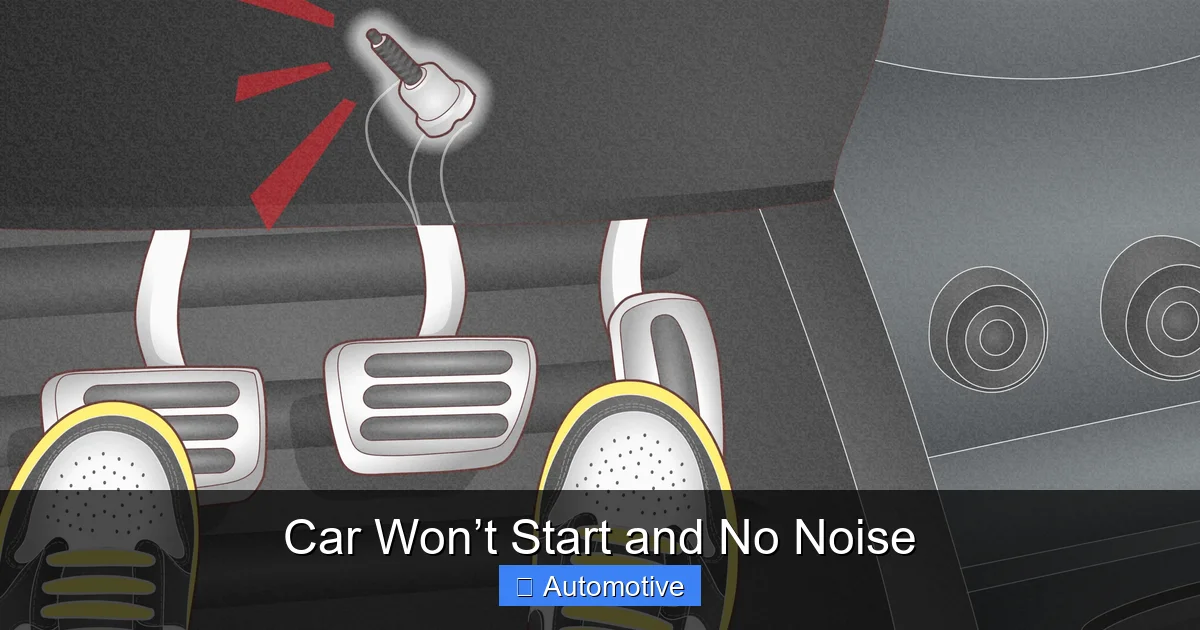
Visual guide about Car Won’t Start and No Noise
Image source: wikihow.com
When your car refuses to start and gives you absolute silence, it’s time to play detective. The absence of sound—especially the familiar clicking or cranking noise—tells us the starter isn’t engaging. That narrows the problem down to the electrical system. Let’s break down the most likely culprits.
1. Dead or Weak Battery
The battery is the heart of your car’s electrical system. It powers everything from the lights to the radio to the starter motor. If the battery is completely dead or too weak to deliver sufficient voltage, nothing will happen when you turn the key. You might see dim dashboard lights or none at all.
A fully charged car battery should read around 12.6 volts. If it drops below 12 volts, especially under load, it may not have enough power to crank the engine. Cold weather can worsen this—batteries lose up to 35% of their power in freezing temperatures.
How to check: Use a multimeter to test the battery voltage. If it’s below 12 volts, try jump-starting the car. If it starts with a jump but dies again soon after, the battery may need replacement or the alternator might not be charging it properly.
2. Faulty Ignition Switch
The ignition switch is what sends power from the battery to the starter when you turn the key. If it’s worn out or damaged, it may not complete the circuit, leaving you with silence. This is especially common in older vehicles or cars with high mileage.
You might notice other symptoms too—like interior lights flickering when you jiggle the key, or accessories not turning on even though the battery seems fine.
How to check: Turn the key to the “on” position (without starting). Do the dashboard lights come on? If not, the ignition switch could be the issue. You can also use a test light or multimeter to check for power at the starter relay when the key is turned.
3. Loose or Corroded Battery Terminals
Even a healthy battery can’t deliver power if the connections are loose or corroded. Over time, battery terminals can accumulate a white, powdery substance (corrosion), which acts as an insulator and blocks electrical flow.
Loose terminals are another common issue—vibrations from driving can gradually loosen the clamps, creating a poor connection.
How to check: Open the hood and inspect the battery terminals. Look for corrosion (green or white buildup) or loose clamps. If you see corrosion, disconnect the terminals (negative first, then positive), clean them with a wire brush and baking soda solution, and reconnect them tightly.
4. Blown Main Fuse or Fusible Link
Your car has several fuses that protect the electrical system. The main fuse—often located in the engine bay fuse box—controls power to the ignition and starter circuits. If this fuse blows, your car won’t start, and you’ll hear nothing.
Fusible links are thicker wires that act like fuses and can also burn out due to electrical surges or shorts.
How to check: Locate the main fuse (check your owner’s manual for its location). Use a test light or multimeter to see if it has continuity. If it’s blown, replace it with one of the same amperage. Be cautious—if it blows again immediately, there may be a short circuit.
5. Bad Ground Connection
Every electrical circuit needs a complete path—power from the battery, through the component, and back to the battery via the ground. The ground connection is usually a thick cable from the battery’s negative terminal to the engine block or chassis.
If this cable is loose, corroded, or damaged, the circuit is broken, and the starter won’t receive power—even if the battery is fully charged.
How to check: Inspect the ground cable where it connects to the battery and the engine. Look for rust, fraying, or looseness. Clean and tighten the connections. You can also test continuity between the battery negative terminal and the engine block with a multimeter.
6. Failed Starter Relay or Solenoid
The starter relay (also called the starter solenoid) acts as a switch that sends a large burst of current from the battery to the starter motor when you turn the key. If the relay fails, the starter won’t get the signal to engage—resulting in silence.
This is different from a bad starter motor. A failed relay often means no click at all, while a bad starter might still produce a clicking sound.
How to check: Locate the starter relay (usually in the fuse box under the hood). Swap it with a similar relay (like the horn relay) to see if the problem moves. If the car starts after swapping, replace the faulty relay.
7. Safety Switch Issues (Automatic and Manual Transmissions)
Modern cars have safety switches to prevent accidental starting. In automatic vehicles, the neutral safety switch ensures the car only starts in “Park” or “Neutral.” In manuals, the clutch interlock switch requires the clutch pedal to be fully depressed.
If these switches fail or become misaligned, they can block the ignition signal, leaving you with no response when you turn the key.
How to check: Try starting the car in “Neutral” instead of “Park.” If it starts, the neutral safety switch may be faulty. For manuals, ensure the clutch is fully pressed. If the switch is adjustable, you may be able to realign it; otherwise, replacement is needed.
Step-by-Step Troubleshooting Guide
Now that you know the possible causes, let’s walk through a practical, step-by-step process to diagnose and fix the issue. This method saves time and helps you avoid unnecessary repairs.
Step 1: Check the Battery
Start with the simplest fix. Open the hood and inspect the battery. Look for obvious signs of damage, leakage, or corrosion. Then, check the voltage with a multimeter.
– 12.6V or higher: Battery is fully charged.
– 12.0–12.4V: Partially charged—may struggle to start.
– Below 12.0V: Likely dead or failing.
If the battery is low, try jump-starting the car. If it starts and runs normally, the battery may just need a recharge. If it dies again quickly, the battery or alternator could be faulty.
Step 2: Inspect Battery Terminals and Cables
Even a good battery won’t work with poor connections. Check both the positive and negative terminals for corrosion or looseness.
– Disconnect the negative cable first (to avoid sparks).
– Clean terminals with a wire brush and a mix of baking soda and water.
– Reconnect tightly, starting with the positive cable.
After cleaning, try starting the car again. If it works, you’ve solved the problem.
Step 3: Test the Ignition Switch
Turn the key to the “on” position (without cranking). Do the dashboard lights illuminate? If not, the ignition switch may not be sending power.
Use a test light or multimeter to check for voltage at the ignition switch output. If there’s no power, the switch may need replacement.
Step 4: Check Fuses and Relays
Locate the main fuse box (usually under the hood or near the driver’s side kick panel). Find the main ignition or starter fuse and inspect it.
– If the fuse is blown, replace it.
– If it blows again immediately, there’s likely a short circuit—seek professional help.
Also, locate the starter relay and swap it with a known good one (like the horn relay). If the car starts, replace the faulty relay.
Step 5: Test the Ground Connection
Check the ground cable from the battery’s negative terminal to the engine block. Ensure it’s tight and free of corrosion.
Use a multimeter to test continuity between the battery negative terminal and the engine. There should be little to no resistance.
If the ground is faulty, clean or replace the cable.
Step 6: Try the “Tap Test” on the Starter
If all else fails, the starter motor itself might be stuck. Sometimes, a gentle tap with a hammer or wrench can free it temporarily.
Warning: Only do this if you’re confident in your safety. Never strike electrical components directly.
Locate the starter (usually near the transmission), and gently tap the metal housing while someone tries to start the car. If it starts, the starter is likely failing and needs replacement.
Step 7: Check Safety Switches
For automatics: Try starting in “Neutral” instead of “Park.” If it works, the neutral safety switch may be misaligned or faulty.
For manuals: Ensure the clutch is fully depressed. If the car still won’t start, the clutch interlock switch may need adjustment or replacement.
When to Call a Professional
While many no-start, no-noise issues can be resolved at home, some problems require expert diagnosis. Here’s when it’s time to call a mechanic:
– You’ve checked the battery, fuses, and connections, but the car still won’t start.
– The battery keeps dying even after replacement.
– You suspect an alternator issue (the car starts with a jump but dies shortly after).
– There’s a burning smell, smoke, or signs of electrical damage.
– You’re uncomfortable working with electrical systems.
A professional mechanic has specialized tools—like a load tester or oscilloscope—to diagnose complex electrical faults. They can also perform a starter bench test to confirm if the motor itself is faulty.
Prevention Tips to Avoid Future No-Start Issues
An ounce of prevention is worth a pound of cure. Here’s how to keep your car starting reliably:
1. Maintain Your Battery
– Clean terminals every 6 months.
– Check voltage regularly, especially before winter.
– Replace the battery every 3–5 years, even if it seems fine.
2. Drive Regularly
Short trips don’t give the alternator enough time to recharge the battery. If you only drive occasionally, consider using a battery maintainer or trickle charger.
3. Inspect Wiring and Connections
Periodically check battery cables, ground straps, and fuse boxes for wear, corrosion, or looseness.
4. Avoid Draining the Battery
Don’t leave lights, phone chargers, or accessories on when the engine is off. Parasitic drains can slowly kill the battery.
5. Use a Battery Tender in Extreme Climates
In very hot or cold weather, a battery tender can help maintain optimal charge levels.
Real-Life Example: Solving a Silent No-Start
Let’s look at a real scenario. Sarah, a college student, hopped into her 2012 Honda Civic one winter morning and turned the key—nothing. No lights, no sound. She panicked, thinking her car was dead.
She followed our troubleshooting steps:
1. Checked the battery voltage—11.8V (too low).
2. Tried jump-starting—it worked, but died after 10 minutes.
3. Took the battery to an auto parts store—it failed the load test.
4. Replaced the battery—problem solved.
Turns out, the cold weather had weakened an already aging battery. A simple $120 replacement saved her from a tow and mechanic bill.
Conclusion
A car that won’t start and makes no noise is alarming, but it’s rarely a sign of catastrophic failure. In most cases, the issue lies in the electrical system—starting with the battery, then moving to connections, fuses, relays, and switches. By following a logical troubleshooting process, you can often identify and fix the problem yourself.
Remember: silence doesn’t mean disaster. It means power isn’t reaching the starter. Check the battery first, then work your way through the electrical chain. Keep your terminals clean, your fuses intact, and your connections tight. And when in doubt, don’t hesitate to consult a professional.
With the right knowledge and a little patience, you’ll be back on the road in no time.
Frequently Asked Questions
Why won’t my car start and there’s no noise at all?
This usually means the starter isn’t receiving power. The most common causes are a dead battery, loose or corroded terminals, a faulty ignition switch, or a blown main fuse. Start by checking the battery voltage and connections.
Can a bad alternator cause a car to not start with no noise?
Not directly. A bad alternator won’t prevent starting if the battery is charged. However, if the alternator failed earlier and drained the battery, that could be the root cause. Test the battery first.
How do I know if my starter is bad if there’s no noise?
If the battery, fuses, and connections are good but the car still won’t start, the starter or its relay may be faulty. Try tapping the starter gently or swapping the relay to test.
Is it safe to jump-start a car that won’t start with no noise?
Yes, as long as the battery isn’t leaking or damaged. Jump-starting can help determine if the battery is the issue. If the car starts and runs, the battery was likely dead.
Why do my dashboard lights not come on when I turn the key?
This suggests a complete loss of power, often due to a dead battery, blown main fuse, or faulty ignition switch. Check the battery voltage and main fuse first.
Can extreme cold cause a car to not start with no noise?
Yes. Cold weather reduces battery efficiency and can cause fluids to thicken. A weak battery may fail completely in freezing temperatures, leading to a silent no-start condition.