
Choosing the Right Car Battery for Your 2002 GMC Yukon with a 5.3L Engine

If your 2002 GMC Yukon with the 5.3L V8 has started to crank slowly, or the dash lights dim when you turn the key on a cold morning, the battery is the first place to look. A truck of this age works its battery hard: a big engine to turn over, plenty of accessories, and often more than twenty years of heat, vibration and short trips behind it. This guide explains what to look for in a replacement battery, how to read the numbers on the label, which battery types and brands are commonly fitted, and how to install and look after the new one.
Battery fitment can vary with the exact trim, options and production date of the truck. Every group size and cold-cranking-amp figure below is a typical range, not a guarantee. Always confirm against your owner’s manual, the battery label that is on the truck now, or the tray itself before you buy.
Key Takeaways
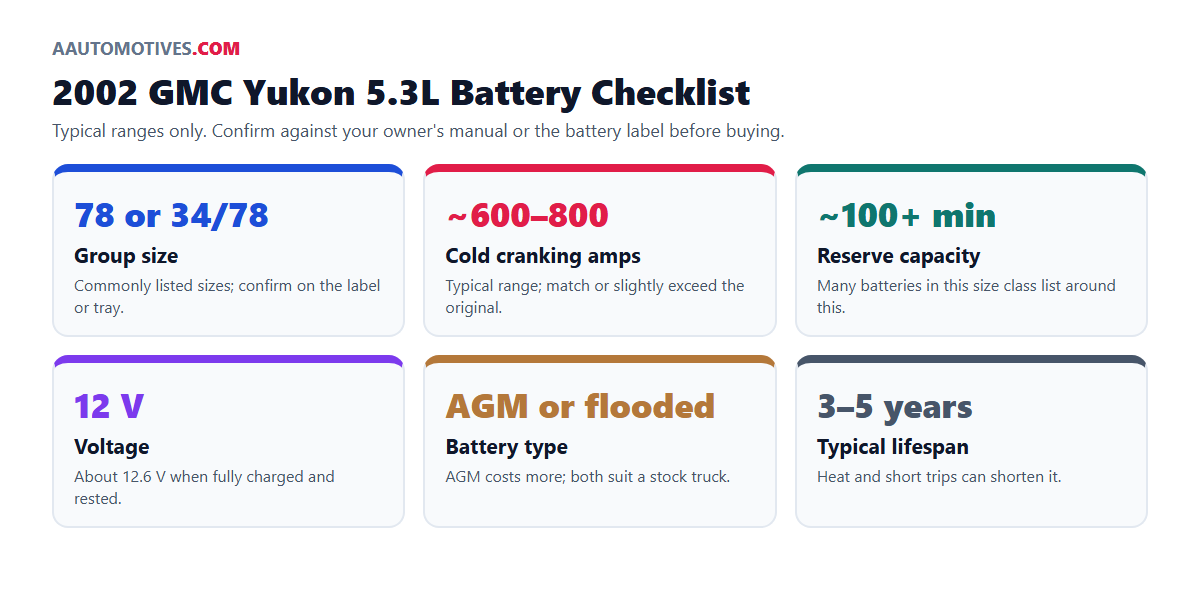
- Group size comes first: a 2002 Yukon with the 5.3L engine commonly uses a Group 78 side-terminal battery or the dual-terminal 34/78 size. Check the label on your current battery and the tray before you order.
- CCA is a minimum, not a target: roughly 600 to 800 cold cranking amps is a typical range for this engine. Matching or slightly exceeding the original rating is sensible, especially in cold climates.
- Type is a choice: a conventional flooded battery is the budget option; an AGM battery costs more but handles vibration, heat and heavy electrical loads better.
- Look at the date code: a battery that has sat on a shelf for a year or more has already lost some life.
- Fit and safety matter: the battery must sit tight in the tray, and the negative cable comes off first and goes back on last.
- Expect a lifespan of about three to five years: hot climates and short trips shorten it.
Table of Contents
Why the Battery Matters on a 2002 Yukon
A car battery stores energy chemically and releases it as electrical current. Its biggest job is turning the starter motor, but it also steadies the voltage for the engine computer, fuel pump, lights and audio system, and it supplies power whenever the engine is off. The alternator recharges it and runs the truck once the engine is going.
The 5.3L V8 is a large, durable engine, and large engines need a strong burst of current to start, particularly when the oil is cold and thick. A weak battery shows up first as slow cranking. Left alone, it can leave you stranded, and a failing battery also forces the alternator to work harder than it should.
Why Quality Pays Off
- Reliable starts: a healthy battery turns the engine over quickly in both summer heat and winter cold.
- Stable electronics: a good battery smooths out voltage dips that can cause flickering lights or odd gauge behavior.
- Lower long-term cost: a better battery with a longer warranty often costs less per year than a bargain unit you replace twice.
Battery Specifications for the 2002 GMC Yukon 5.3L
Five specifications decide whether a battery is right for your truck. For each one, a typical range is given, followed by how to confirm the number on your own vehicle.
Group Size
The group size is set by the Battery Council International (BCI) and describes the case dimensions, the terminal layout and the polarity. If the case is the wrong size, it will not sit in the tray or the cables will not reach. GM trucks of this era commonly use side-terminal batteries, and the sizes most often listed for a 5.3L Yukon are Group 78 or the dual-terminal 34/78, which has both top posts and side terminals. Read the group number printed on your current battery or ask the parts counter to look up your exact VIN.
Cold Cranking Amps (CCA)
CCA tells you how much current the battery can deliver for 30 seconds at 0 degrees Fahrenheit (about minus 18 degrees Celsius) while holding a usable voltage. For this engine, a rating of roughly 600 to 800 CCA is typical. If you live somewhere with hard winters, lean toward the upper part of that range. More CCA than you need does no harm, but it also does not make a truck start any better than the factory intended in mild weather.
Reserve Capacity (RC)
Reserve capacity is the number of minutes the battery can supply a steady 25-amp load with the engine off before it drops too low. Many batteries for this size class list somewhere around 100 minutes or more. Higher is better if you use accessories with the engine off, and it also gives you a longer cushion if the charging system fails while you are driving.
Voltage
Every standard automotive battery is 12 volts, and so is your Yukon’s electrical system. A fully charged battery that has rested should read around 12.6 volts on a multimeter. A reading near 12.4 volts means it is roughly 75 percent charged, and anything under about 12.0 volts is deeply discharged.
Battery Type: Flooded or AGM
Both types are lead-acid batteries. A conventional flooded battery has liquid electrolyte and is the cheaper choice. An Absorbent Glass Mat (AGM) battery holds the electrolyte in fiberglass mats inside a sealed case. AGM batteries are spill-resistant, handle vibration well and tolerate heavy electrical loads, which is why they are popular for trucks with extra lighting, audio or a winch. They usually cost more. Both are suitable for a stock 2002 Yukon, provided the group size and terminals match.
Popular Battery Choices for the Yukon
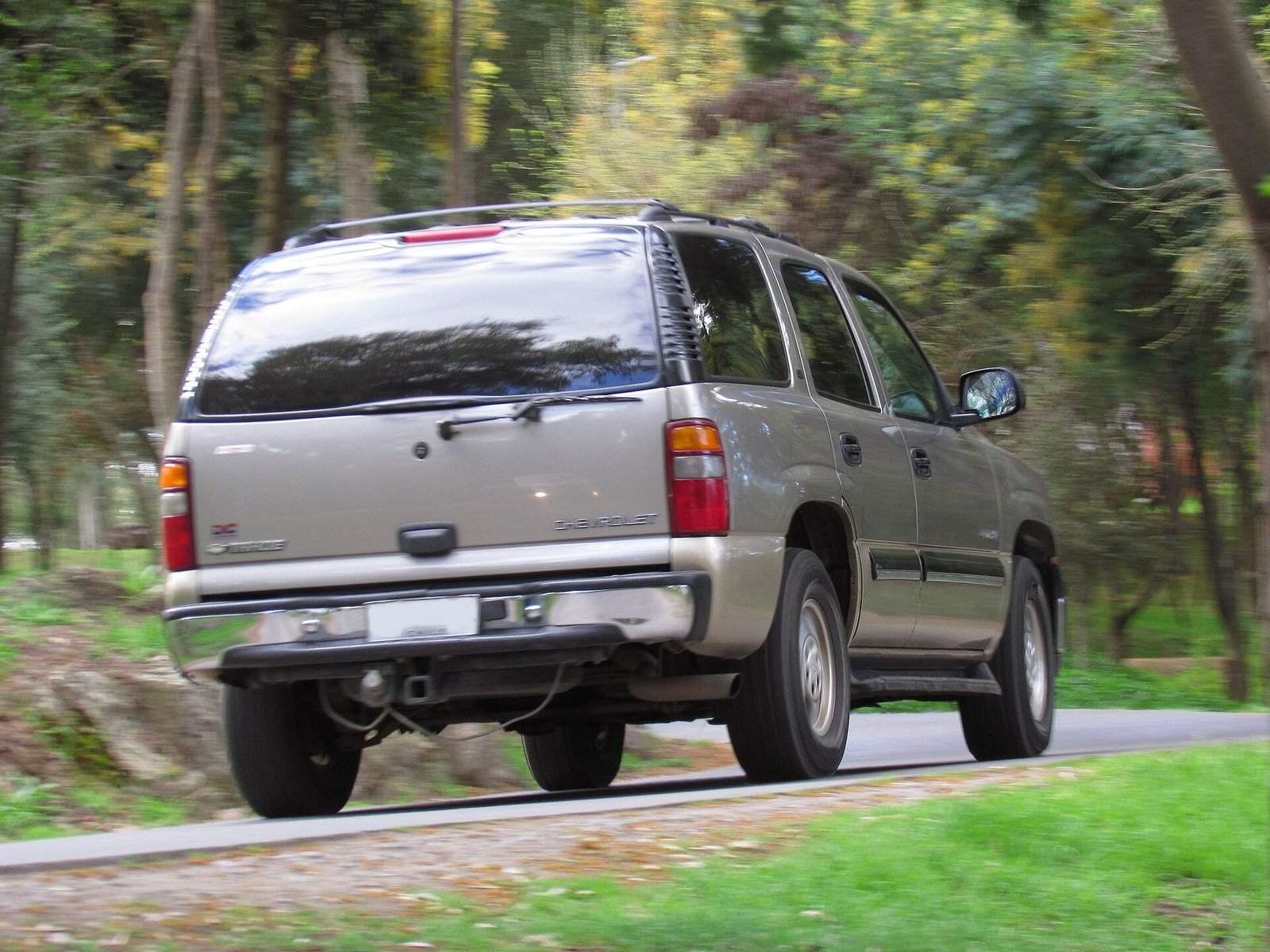
Several brands sell batteries in the sizes this truck uses. The following are examples of what is commonly fitted or recommended, not a ranking, and models, ratings and warranties change over time. Compare the numbers printed on the current listing for your exact part.
Optima RedTop 34/78
The Optima RedTop in the 34/78 size is a well-known AGM option. It uses spiral-wound cell construction, which resists vibration, and it is commonly listed at about 800 cold cranking amps and about 100 minutes of reserve capacity, with a 36-month warranty. The dual terminals make it a flexible fit. It is also one of the more expensive choices.
DieHard Platinum AGM
DieHard’s Platinum line is an AGM battery aimed at vehicles with heavy electrical demand. Its warranty is generally longer than that of its conventional batteries. Confirm the group size, CCA and warranty length for the specific part number sold in your area, because ratings differ by size.
ACDelco Professional AGM
ACDelco is General Motors’ own parts brand, and its batteries are engineered to fit GM trucks and SUVs. The Professional AGM line is built for corrosion resistance and long life, which makes it a natural option for a Yukon when you want something close to the original equipment.
Interstate Mega-Tron Plus
Interstate sells through a large network of battery dealers, and its conventional Mega-Tron line is a popular mid-priced flooded option. It suits owners who want a dependable, affordable battery rather than an AGM, and the dealer can usually test and recycle your old one on the spot.
Whichever you choose, check the date code, look at the warranty terms and find out whether the price includes a core charge for your old battery. Prices vary widely by size and type, so compare a few local and online sellers.
How to Install a Battery in a 2002 GMC Yukon
Replacing the battery is a basic job for most owners, but a few precautions make it safe and keep your settings intact.
- Prepare: park on level ground with the engine off and the key out. Wear safety glasses and gloves, and keep sparks and flames away from the battery, which can vent flammable hydrogen gas.
- Disconnect the negative cable first: loosen the clamp or bolt on the negative terminal and move the cable clear. Then disconnect the positive cable. Doing the negative first prevents an accidental short if your wrench touches metal.
- Remove the hold-down: take out the bolt, bar or bracket that secures the battery, then lift the battery out carefully. These batteries are heavy, often around 40 pounds, so lift with your legs.
- Clean the tray and cables: scrub away corrosion with a wire brush and a mixture of baking soda and water, then dry everything. Replace any cable that is badly corroded or frayed.
- Set the new battery: confirm the polarity matches the old battery, then lower it into the tray and secure the hold-down firmly. A battery that can move or vibrate will fail early.
- Reconnect in reverse order: attach the positive cable first and the negative cable last. Tighten the clamps so they do not twist on the posts, and apply a thin coat of terminal protector or grease if you like.
- Check operation: start the engine and confirm that the lights and gauges behave. Some radios or clocks may need resetting after the power was removed.
Dispose of the old battery responsibly. Most retailers and auto parts stores take it back, and lead-acid batteries are among the most recycled products in the world.
Maintenance Tips to Make It Last
- Keep the terminals clean: white or blue-green crust adds resistance and makes starting harder.
- Check the hold-down and cables: they should be tight and undamaged every time you check the oil.
- Test every year after year three: most parts stores will load-test a battery for free. A running engine should typically show a charging voltage somewhere around 13.5 to 14.5 volts at the battery.
- Avoid repeated short trips: they never give the alternator time to restore what the starter used. An occasional longer drive helps.
- Use a maintainer if the truck sits: a smart battery maintainer keeps a stored battery from going flat.
- Watch for parasitic drain: if a fresh battery goes flat within days, have the electrical system checked rather than replacing batteries repeatedly.
Conclusion
For a 2002 GMC Yukon with the 5.3L engine, the safest approach is to match the group size and terminal layout first, choose a CCA rating at or above the original, and then decide between a conventional and an AGM battery based on your budget, climate and how many accessories you run. Confirm every number against your owner’s manual or the battery label before paying, check the date code and install it carefully. A well-chosen battery should give you roughly three to five years of dependable starts.
Frequently Asked Questions
What battery group size does a 2002 GMC Yukon 5.3L use?
Group 78 and the dual-terminal 34/78 are the sizes most commonly listed. Because options and production dates differ, confirm with the label on your current battery, the tray, or a VIN lookup at the parts counter.
How many cold cranking amps does a 2002 Yukon need?
A typical range is about 600 to 800 CCA. Use the original battery’s rating as a minimum and consider a higher figure in cold climates.
Is an AGM battery worth it for a 2002 Yukon?
It can be. AGM batteries resist vibration and heat and cope better with heavy electrical loads, but they cost more. A conventional flooded battery is perfectly acceptable for a stock truck.
How long should a car battery last?
Typically about three to five years. Extreme heat, frequent short trips and a weak charging system can shorten that.
How do I know if the battery or the alternator is the problem?
A battery problem usually shows up as slow cranking or a dead engine that starts after a jump and then runs normally. An alternator problem tends to cause a battery warning light, dimming lights while driving, or a truck that dies after a jump start. A free load test and charging-system test at a parts store will tell you which one it is.
Can I replace the battery myself?
Yes, with basic hand tools and safety precautions. Disconnect the negative cable first, reconnect it last, and keep the new battery firmly secured in the tray.
Do I need to reset anything after changing the battery?
Possibly. Some radios, clocks and trip settings may reset, and the engine computer may take a short drive to relearn idle behavior.