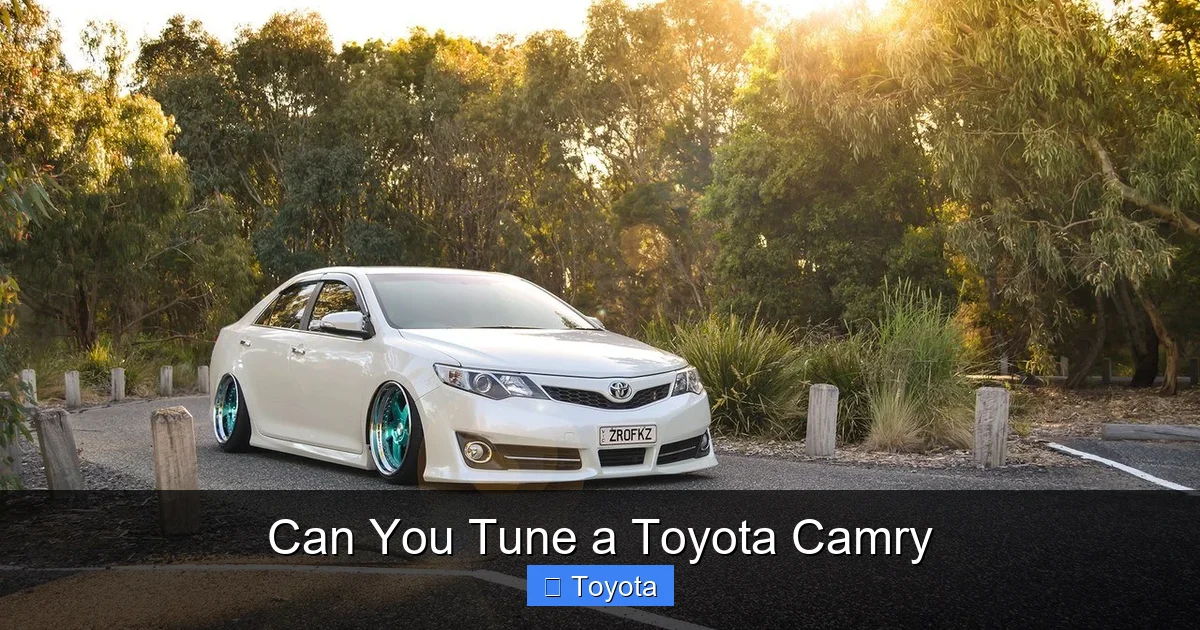
Can You Tune a Toyota Camry

Contents
- 1 Key Takeaways
- 2 📑 Table of Contents
- 3 Can You Tune a Toyota Camry? The Short Answer
- 4 What Does Tuning a Toyota Camry Actually Do?
- 5 Which Toyota Camry Models Can Be Tuned?
- 6 Popular Tuning Tools for the Toyota Camry
- 7 Benefits of Tuning Your Toyota Camry
- 8 Risks and Considerations When Tuning
- 9 Real-World Tuning Results: Owner Experiences
- 10 Conclusion: Should You Tune Your Toyota Camry?
- 11 Frequently Asked Questions



Yes, you can tune a Toyota Camry — and it’s easier than you think. Whether you want better throttle response, more horsepower, or improved fuel efficiency, tuning opens up new possibilities. With the right tools and knowledge, even daily drivers can enjoy a more responsive and enjoyable ride.
Key Takeaways
- Yes, you can tune a Toyota Camry: Modern Camrys, especially turbocharged or V6 models, respond well to tuning for better performance and drivability.
- Tuning improves throttle response and power: A quality tune can reduce lag, increase horsepower, and smooth out gear shifts in automatic transmissions.
- OBD2 tuning tools make it accessible: Plug-and-play devices like the JB4 or Flashpaq allow safe, reversible tuning without professional help.
- Not all Camrys are equal for tuning: Turbocharged engines (like the 2.0L in the 2018+) and V6 models offer the most gains, while base 4-cylinders see smaller improvements.
- Warranty and reliability matter: Always use conservative tunes and quality fuel to protect your engine and avoid voiding your warranty.
- Professional tuning offers precision: For maximum gains and safety, consider a dyno tune by a certified tuner familiar with Toyota platforms.
- Tuning enhances daily driving: Even small improvements in responsiveness and torque make commuting more fun and engaging.
📑 Table of Contents
- Can You Tune a Toyota Camry? The Short Answer
- What Does Tuning a Toyota Camry Actually Do?
- Which Toyota Camry Models Can Be Tuned?
- Popular Tuning Tools for the Toyota Camry
- Benefits of Tuning Your Toyota Camry
- Risks and Considerations When Tuning
- Real-World Tuning Results: Owner Experiences
- Conclusion: Should You Tune Your Toyota Camry?
Can You Tune a Toyota Camry? The Short Answer
If you’re driving a Toyota Camry and wondering, “Can you tune a Toyota Camry?” — the answer is a resounding yes. While the Camry has long been known as a reliable, comfortable family sedan, it’s not just a boring commuter car anymore. With modern engineering and advanced engine management systems, today’s Camrys are more capable than ever — and that includes being tuned for better performance.
Tuning a Camry doesn’t mean turning it into a race car overnight. But it does mean unlocking hidden potential in the engine and transmission. Whether you drive a 2018 Camry with the turbocharged 2.0L engine, a V6-powered model, or even a hybrid, there are tuning options available that can make your ride more responsive, smoother, and even more fuel-efficient in some cases.
The best part? You don’t need to be a mechanic or spend thousands of dollars. Thanks to user-friendly tuning devices and software, many Camry owners are tuning their cars at home with minimal tools. From improved throttle response to increased horsepower, tuning can transform your daily driver into something that feels more engaging behind the wheel.
What Does Tuning a Toyota Camry Actually Do?
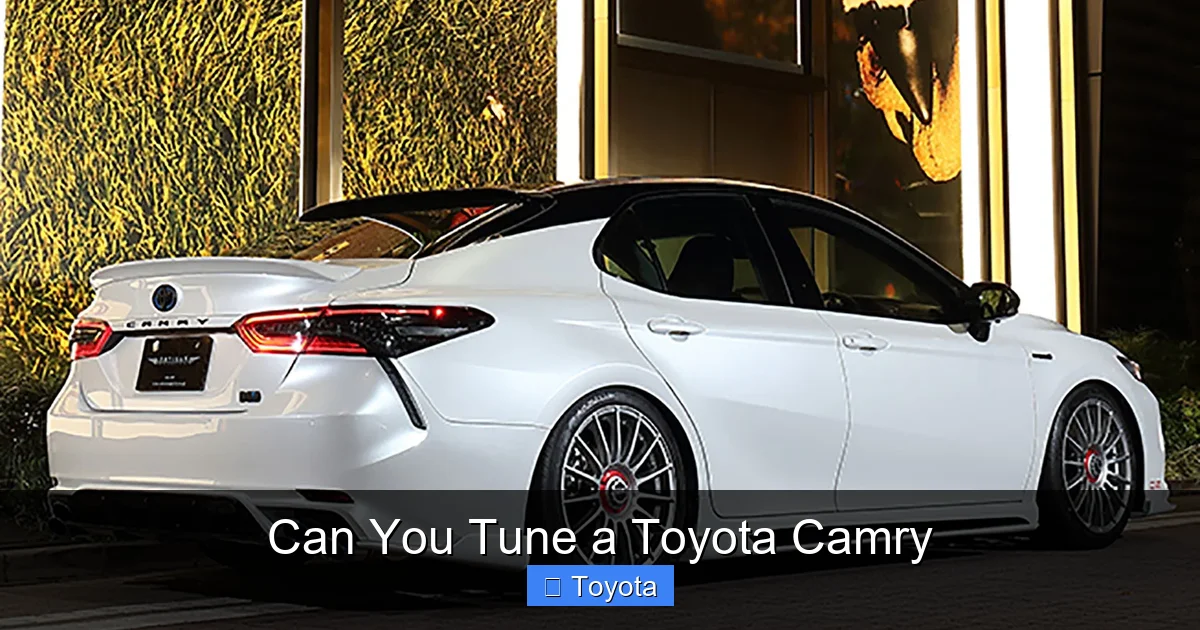
Visual guide about Can You Tune a Toyota Camry
Image source: carscoops.com
So, what exactly happens when you tune a Toyota Camry? At its core, tuning adjusts the engine’s electronic control unit (ECU) — the brain that manages fuel delivery, ignition timing, boost pressure (on turbo models), and transmission behavior. By modifying these parameters, tuning can optimize how the engine performs under various driving conditions.
Let’s break it down with some real-world examples.
Imagine you’re driving a 2020 Camry XSE with the 2.0L turbo engine. Out of the box, it makes about 203 horsepower and 184 lb-ft of torque. That’s plenty for daily driving, but there’s often a slight delay when you press the gas — what tuners call “throttle lag.” A tune can reduce that lag, making the car feel more immediate and responsive. You’ll notice it especially when merging onto highways or passing slower traffic.
On a V6 Camry, like the 2019 model with the 3.5L engine, tuning can smooth out the automatic transmission shifts. Many owners complain about jerky downshifts or hesitation during acceleration. A custom tune can refine shift points, reduce flare (when RPMs spike before engaging), and improve overall drivability.
Even the hybrid Camry can benefit. While you won’t get massive horsepower gains, tuning can optimize the power split between the gasoline engine and electric motor, improving acceleration and reducing the “sluggish” feeling some hybrids have at low speeds.
Types of Tuning: Piggyback vs. Flash Tuning
There are two main ways to tune a Camry: piggyback systems and flash tuning.
Piggyback tuners, like the popular JB4 from Burger Motorsports, plug into your car’s OBD2 port and intercept signals between sensors and the ECU. They don’t rewrite the factory software but instead “trick” the ECU into adjusting fuel, timing, or boost. These are great for beginners because they’re easy to install, reversible, and often come with pre-loaded maps for different fuel types.
Flash tuning, on the other hand, involves rewriting the ECU’s software directly. This is done using tools like the Flashpaq, HP Tuners, or professional dyno tuning. Flash tuning offers more precise control and can unlock greater performance, but it’s more complex and usually requires a laptop and some technical know-how.
For most Camry owners, a piggyback tuner is the best starting point. It’s safe, affordable, and delivers noticeable improvements without risking engine damage.
Which Toyota Camry Models Can Be Tuned?
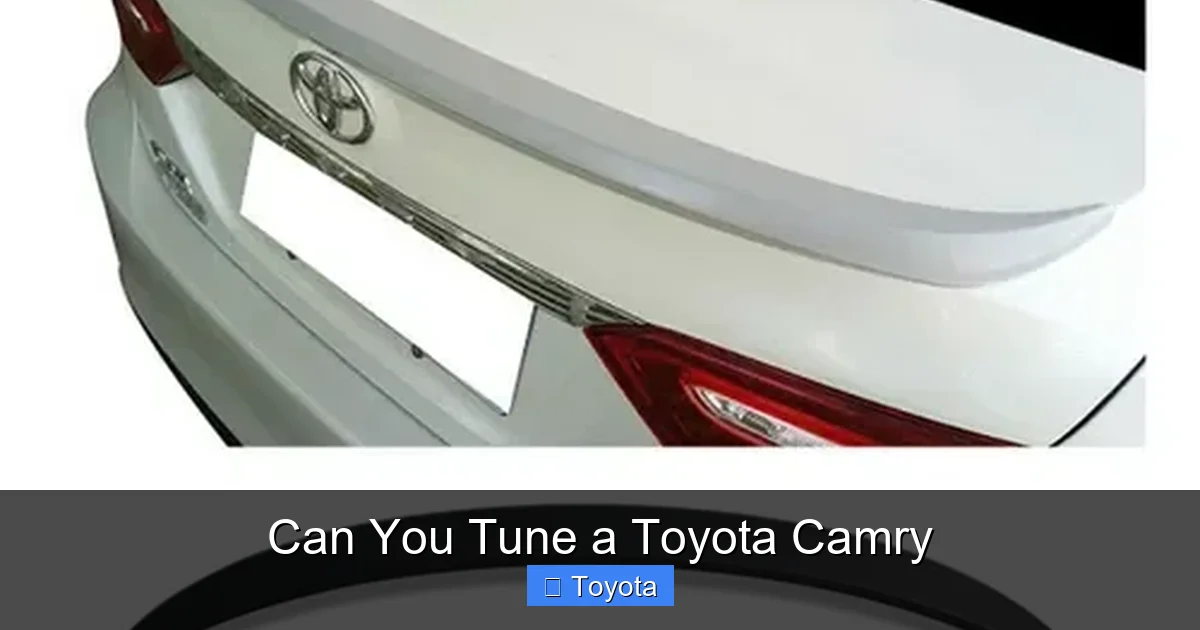
Visual guide about Can You Tune a Toyota Camry
Image source: http2.mlstatic.com
Not every Camry is created equal when it comes to tuning. The potential gains depend heavily on the engine type, model year, and drivetrain. Let’s look at which Camrys respond best to tuning.
Turbocharged Camry (2018 and Newer)
The 2018 redesign brought a major upgrade: the 2.0L turbocharged four-cylinder engine. This engine, shared with the Toyota RAV4 and Lexus NX, is a tuning favorite. With factory boost levels around 12–14 psi, there’s plenty of room to increase power safely.
With a quality tune, you can see gains of 30–50 horsepower and similar torque increases — all on regular 87-octane fuel. Some tuners even offer 91- or 93-octane maps for even more power. The turbo engine also benefits from reduced turbo lag and improved throttle mapping, making the car feel much more lively.
V6 Camry (2012–2017 and 2018–2023)
The 3.5L V6 engine has been a staple in the Camry for years. While it’s naturally aspirated (no turbo or supercharger), it still responds well to tuning. Gains are more modest — typically 10–20 horsepower — but the real benefit is in drivability.
Tuning can smooth out the 6-speed or 8-speed automatic transmission, reduce hesitation, and improve shift logic. Many V6 Camry owners report that their cars feel “tighter” and more responsive after a tune, especially during spirited driving.
Four-Cylinder Naturally Aspirated (2012–2017)
The older 2.5L four-cylinder engines (found in 2012–2017 models) are less exciting to tune. Since they lack forced induction, power gains are minimal — usually under 10 horsepower. However, tuning can still improve throttle response and transmission behavior, making the car feel more engaging.
These models are best suited for piggyback tuners that focus on drivability rather than raw power.
Hybrid Camry (2012 and Newer)
Hybrid Camrys are trickier. The ECU is more complex due to the dual power sources, and Toyota locks down the software more tightly. However, some tuners offer hybrid-specific maps that optimize power delivery and reduce the “rubber band” effect during acceleration.
Gains are subtle — maybe 5–10 horsepower — but the improved responsiveness can make a noticeable difference in city driving.
Popular Tuning Tools for the Toyota Camry
Visual guide about Can You Tune a Toyota Camry
Image source: allclash.com
If you’re ready to tune your Camry, you’ll need the right tool. Here are some of the most popular and reliable options on the market.
JB4 by Burger Motorsports
The JB4 is one of the most trusted piggyback tuners for turbocharged Toyotas. It plugs into the OBD2 port and connects to the MAP sensor, fuel rail pressure sensor, and other key inputs. With Bluetooth connectivity, you can monitor boost, air/fuel ratio, and engine parameters in real time using a smartphone app.
The JB4 comes with multiple pre-loaded maps for 87, 91, and 93 octane fuel. It also includes safety features like boost limiting and knock detection. For the 2.0L turbo Camry, it’s a top choice.
Flashpaq by Superchips
The Flashpaq is a flash tuner that works with select Toyota models. It connects via OBD2 and allows you to upload custom tunes or use pre-loaded performance maps. It’s more advanced than the JB4 but still user-friendly.
One advantage is that it can also read and clear diagnostic trouble codes (DTCs), making it a handy tool for maintenance. However, not all Camry models are supported, so check compatibility before buying.
HP Tuners Software
For serious tuners, HP Tuners offers professional-grade software that allows full access to the ECU. This requires a Windows laptop, a compatible interface cable, and a good understanding of engine tuning.
HP Tuners is best suited for those who want to do custom tuning or work with a professional tuner. It’s not recommended for beginners, but it offers the most flexibility and precision.
DIY vs. Professional Tuning
Many Camry owners start with a piggyback tuner like the JB4 and are happy with the results. But if you want maximum performance and safety, a professional dyno tune is the way to go.
A certified tuner can connect your Camry to a dynamometer, run it through various load conditions, and fine-tune the air/fuel ratio, ignition timing, and boost levels in real time. This ensures optimal performance without risking engine damage.
Professional tuning typically costs $300–$600, but it’s worth it if you’re serious about performance. Plus, many tuners offer data logging and follow-up adjustments to keep your tune dialed in.
Benefits of Tuning Your Toyota Camry
So, why should you tune your Camry? It’s not just about going faster — although that’s part of it. Tuning offers a range of benefits that can enhance your driving experience, even if you never hit the track.
Improved Throttle Response
One of the most noticeable improvements is throttle response. Stock Camrys often have a slight delay between pressing the gas and the engine reacting. This is done for smoothness and emissions, but it can feel sluggish.
A tune reduces or eliminates this lag, making the car feel more immediate and connected to your inputs. It’s like upgrading from a wireless mouse with latency to a wired one — everything just feels sharper.
Increased Horsepower and Torque
On turbocharged models, tuning can unlock significant power gains. With a JB4 or similar tuner, you can see 30–50 horsepower and 40–60 lb-ft of torque — all without touching the engine internals.
That’s enough to make your Camry feel like a sport sedan. Passing power improves, highway merging is easier, and the car feels more confident at speed.
Smoother Transmission Shifts
Automatic transmissions in Camrys are reliable but not always smooth. Some owners report jerky shifts, especially during downshifts or when the transmission hunts for the right gear.
Tuning can refine shift points, reduce flare, and improve torque converter lockup. The result is a smoother, more predictable driving experience — especially in stop-and-go traffic.
Better Fuel Efficiency (Sometimes)
Wait — tuning can improve fuel economy? It sounds counterintuitive, but yes, in some cases.
By optimizing air/fuel ratios and ignition timing, a tune can make the engine run more efficiently. On a turbo Camry, for example, a well-tuned car may see a 1–2 mpg improvement in highway driving — especially if you drive conservatively.
Of course, if you start driving more aggressively, you’ll burn more fuel. But for daily commuting, a tune can help you get the most out of every gallon.
Enhanced Driving Enjoyment
Let’s be honest — the Camry isn’t known for being exciting. But tuning changes that. Even small improvements in responsiveness and power make the car more fun to drive.
You’ll look forward to your morning commute, enjoy weekend drives, and feel more connected to the road. It’s not about turning your Camry into a sports car — it’s about making it a better version of itself.
Risks and Considerations When Tuning
Tuning isn’t without risks. While modern tools are safer than ever, it’s important to understand the potential downsides before you start.
Warranty Concerns
One of the biggest concerns is the factory warranty. If you tune your Camry and something goes wrong, Toyota may deny warranty coverage — especially if the issue is related to the engine or transmission.
However, many piggyback tuners are undetectable when removed. Devices like the JB4 can be unplugged, and the car returns to stock settings. This makes it harder for dealerships to prove tuning caused a problem.
Still, if you’re still under warranty, proceed with caution. Consider waiting until the warranty expires or using conservative tune settings.
Engine Reliability
Pushing your engine too hard can lead to premature wear or failure. This is especially true if you use aggressive tunes on low-octane fuel or don’t monitor engine parameters.
Always use quality fuel — 91 or 93 octane is recommended for performance tunes. Also, keep an eye on air/fuel ratios, boost levels, and coolant temperatures. If something looks off, revert to a safer map or consult a tuner.
Emissions and Legality
In some states, modified vehicles must pass emissions testing. Tuning can affect emissions, especially if it changes fuel delivery or timing.
Most street-legal tunes are designed to stay within emissions limits, but it’s important to check local laws. Some tuners offer “emissions-friendly” maps that keep your car compliant.
Insurance Implications
While tuning doesn’t usually require you to notify your insurance company, it could affect coverage if you’re in an accident. Some insurers may view modified vehicles as higher risk.
If you’re making significant modifications, it’s worth discussing with your agent. But for mild tuning, most owners don’t report any issues.
Real-World Tuning Results: Owner Experiences
Still not convinced? Let’s look at what real Camry owners are saying about tuning.
One 2020 Camry XSE owner installed a JB4 and reported a “night and day” difference. “The throttle response is instant,” he said. “It feels like a different car. I’m getting better mileage on the highway, and passing power is much stronger.”
Another owner with a 2016 V6 Camry used a Flashpaq to smooth out transmission shifts. “The car used to hesitate when I accelerated from a stop,” he explained. “After the tune, it’s much smoother. It’s not a race car, but it feels more refined.”
Even hybrid owners have seen benefits. A 2018 Camry Hybrid driver noted improved acceleration from a stop and better integration between the gas and electric motors. “It’s not faster, but it feels more responsive — like the car is working with me instead of against me.”
These stories show that tuning isn’t just for performance junkies. It’s for anyone who wants a better driving experience.
Conclusion: Should You Tune Your Toyota Camry?
So, can you tune a Toyota Camry? Absolutely. And should you? That depends on your goals.
If you want more power, better throttle response, and a more engaging drive, tuning is a smart and affordable upgrade. With tools like the JB4 or Flashpaq, it’s easier than ever to get started — even if you’re not a mechanic.
But remember: tuning is not a magic bullet. It won’t turn your Camry into a Mustang, and it comes with some risks. Always use quality fuel, monitor your engine, and consider professional tuning for the best results.
For most owners, the benefits far outweigh the drawbacks. Whether you drive a turbo four-cylinder, a V6, or even a hybrid, tuning can unlock hidden potential and make your Camry more fun to drive.
So go ahead — give it a try. You might just fall in love with your Camry all over again.
Frequently Asked Questions
Can you tune a Toyota Camry without voiding the warranty?
Yes, you can tune a Toyota Camry without automatically voiding the warranty, especially if you use a reversible piggyback tuner like the JB4. However, if an engine or transmission issue arises, Toyota may deny coverage if they suspect tuning was involved. Always remove the tuner before servicing and use conservative settings.
How much horsepower can you gain by tuning a Camry?
Horsepower gains depend on the engine. A tuned 2.0L turbo Camry can gain 30–50 horsepower, while a V6 may see 10–20 hp. Naturally aspirated four-cylinders and hybrids see smaller gains, typically under 10 hp, but still benefit from improved drivability.
Is tuning a Camry safe for daily driving?
Yes, tuning is safe for daily driving when done responsibly. Use quality fuel, avoid aggressive tunes on low-octane gas, and monitor engine parameters. Most street tunes are designed for reliability and won’t harm a well-maintained engine.
Do you need a mechanic to tune a Toyota Camry?
No, you don’t need a mechanic for basic tuning. Piggyback tuners like the JB4 plug into the OBD2 port and come with pre-loaded maps. Flash tuning may require more technical skill, but many tools include step-by-step guides for DIY users.
Can you tune a hybrid Toyota Camry?
Yes, hybrid Camrys can be tuned, but options are more limited. Some tuners offer hybrid-specific maps that improve throttle response and power delivery. Gains are modest, but the car can feel more responsive in daily driving.
What’s the best tuner for a Toyota Camry?
The JB4 by Burger Motorsports is the most popular and reliable tuner for turbocharged Camrys. For V6 or older models, the Flashpaq or HP Tuners are good options. Choose based on your engine type, budget, and tuning goals.