Can You Sell a Car Without a Title in Idaho

Selling a car without a title in Idaho is generally not allowed, but there are rare exceptions. Understanding state laws, lienholder rules, and alternative documentation can help you navigate the process legally and avoid penalties.
Selling a car is usually a straightforward process—clean it up, set a price, meet the buyer, and hand over the keys. But what happens when you can’t find the title? Maybe it’s lost in a move, damaged beyond recognition, or never received after buying the car years ago. If you’re in Idaho and facing this situation, you’re probably wondering: *Can you sell a car without a title in Idaho?* The short answer is: usually not. But like most things in life, there are exceptions, workarounds, and important steps to take to stay on the right side of the law.
Idaho, like most states, takes vehicle ownership seriously. The title isn’t just a piece of paper—it’s the legal document that proves you own the car. Without it, transferring ownership becomes complicated, if not impossible. Buyers want assurance they’re getting a legitimate vehicle with no hidden liens or legal issues. And the Idaho Department of Motor Vehicles (DMV) requires a properly signed title to register the car in a new owner’s name. So, while it might be tempting to skip the hassle and sell the car anyway, doing so can lead to serious problems down the road—both for you and the buyer.
But don’t panic just yet. If you’re missing your title, there are still ways to legally sell your car in Idaho. Whether you need to replace a lost title, deal with a lienholder, or sell an older vehicle that might not require a title, this guide will walk you through everything you need to know. We’ll cover the legal requirements, exceptions, step-by-step solutions, and practical tips to help you complete the sale smoothly and safely.
In This Article
- 1 Key Takeaways
- 2 📑 Table of Contents
- 3 Understanding Idaho’s Vehicle Title Laws
- 4 When Can You Sell a Car Without a Title in Idaho?
- 5 What to Do If You’ve Lost Your Car Title
- 6 Dealing with Liens and Outstanding Loans
- 7 Selling a Car Without a Title: Risks and Consequences
- 8 Best Practices for Selling Your Car in Idaho
- 9 Conclusion
- 10 Frequently Asked Questions
- 10.1 Can I sell my car in Idaho if I lost the title?
- 10.2 What vehicles don’t need a title in Idaho?
- 10.3 Can I sell my car to a junkyard without a title?
- 10.4 What happens if I sell a car without a title in Idaho?
- 10.5 How long does it take to get a duplicate title in Idaho?
- 10.6 Do I need a bill of sale if I have a title?
Key Takeaways
- Idaho law requires a title for most vehicle sales: The vehicle title is the legal proof of ownership, and buyers typically demand it to register the car.
- Exceptions exist for certain vehicles: Older cars (pre-1980), farm equipment, and off-road vehicles may not require a title under Idaho law.
- Lost or missing titles can be replaced: Idaho allows owners to apply for a duplicate title through the DMV if the original is lost, stolen, or damaged.
- Selling without a title can lead to legal issues: Buyers may refuse the sale, and you could face fines or complications if the buyer can’t register the vehicle.
- Lienholder involvement is critical: If a loan is still on the car, the lienholder must release their interest before the sale can proceed.
- Bill of sale is not enough: While a bill of sale is helpful, it does not replace the title as proof of ownership in Idaho.
- Work with the Idaho DMV for guidance: Contact your local DMV office or visit the official website for up-to-date forms and procedures.
📑 Table of Contents
Understanding Idaho’s Vehicle Title Laws
Before you attempt to sell your car, it’s essential to understand what Idaho law says about vehicle titles. In Idaho, a title is required for nearly all motor vehicles operated on public roads. This includes cars, trucks, SUVs, motorcycles, and most trailers. The title serves as the official record of ownership and must be presented when selling or transferring the vehicle to a new owner.
The Idaho Transportation Department (ITD), which oversees the DMV, mandates that the seller must sign over the title to the buyer at the time of sale. The buyer then uses this signed title to register the vehicle in their name and obtain new license plates. Without a valid title, the DMV will not process the registration, which means the buyer can’t legally drive the car.
There are a few key points to keep in mind:
– The title must be in the seller’s name or show a valid transfer of ownership.
– If the title is lost, stolen, or damaged, a duplicate must be obtained before the sale.
– The title must be free of liens unless the lienholder has released their interest.
One common misconception is that a bill of sale can replace the title. While a bill of sale is a helpful document that records the transaction details—such as sale price, date, and both parties’ information—it does not prove ownership. In Idaho, the bill of sale is supplementary, not a substitute for the title.
Another important detail is that Idaho does not issue titles for certain types of vehicles. For example, vehicles manufactured before 1980 may not have a title, especially if they were never titled in the first place. However, even in these cases, the DMV may require alternative documentation to establish ownership.
When Can You Sell a Car Without a Title in Idaho?
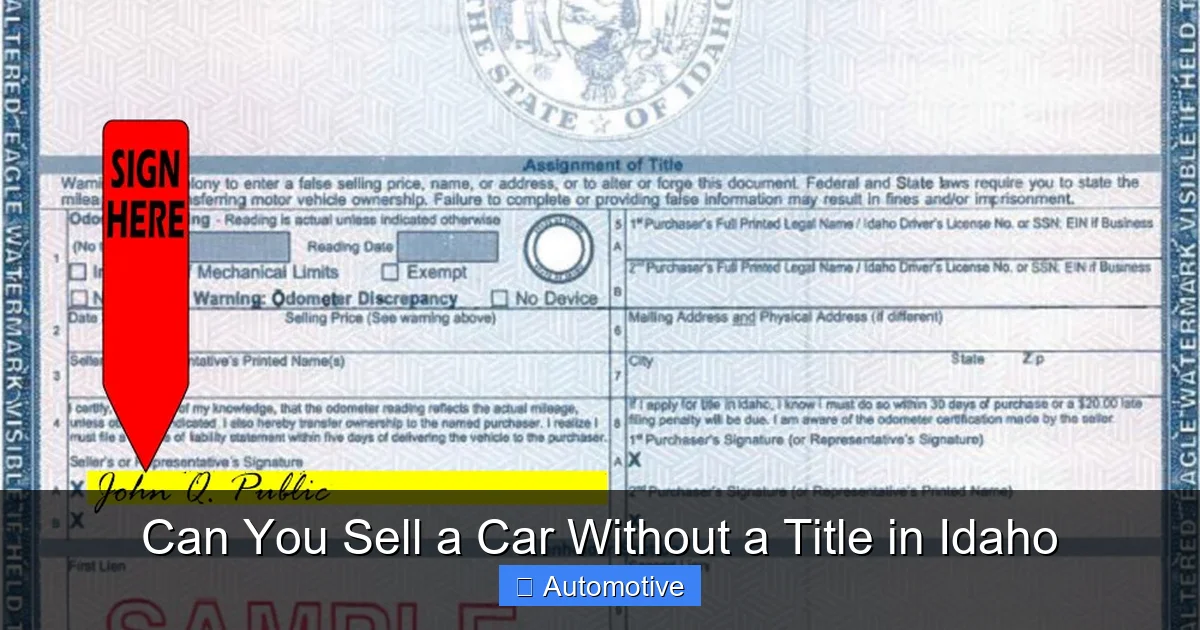
Visual guide about Can You Sell a Car Without a Title in Idaho
Image source: mytitle.org
Now, let’s address the big question: *Are there any situations where you can legally sell a car without a title in Idaho?* The answer is yes—but only in very specific cases. These exceptions are narrow and come with their own set of rules.
Vehicles Exempt from Titling
Idaho law exempts certain vehicles from the titling requirement. According to the Idaho Transportation Department, the following vehicles do not need a title:
– Vehicles manufactured before 1980 that were never titled
– Farm tractors and implements of husbandry
– Off-road vehicles (ATVs, dirt bikes) used exclusively off public roads
– Snowmobiles
– Certain types of trailers under a specific weight
If your vehicle falls into one of these categories, you may be able to sell it without a title. However, you’ll still need to provide alternative proof of ownership. This could include a notarized affidavit, previous registration documents, or a bill of sale signed by both parties.
For example, let’s say you own a 1975 Ford pickup that was never titled. You’ve used it on your farm for years, and now you want to sell it to a neighbor. Since it’s pre-1980 and was never titled, you don’t need a title to sell it. But you should still provide a detailed bill of sale and possibly a notarized statement confirming your ownership. The buyer may need this documentation to register the vehicle or prove ownership if questioned.
Selling to a Scrapyard or Junkyard
Another exception is selling a car to a licensed scrapyard or junkyard. In many cases, junkyards are willing to purchase vehicles without a title, especially if the car is non-operational or heavily damaged. However, this doesn’t mean the process is completely informal.
Idaho law requires scrapyards to follow specific procedures when purchasing vehicles. They must:
– Obtain a valid bill of sale from the seller
– Verify the seller’s identity with a government-issued ID
– Report the purchase to the DMV within a certain timeframe
– Ensure the vehicle is not reported as stolen
While the scrapyard may not demand a title, they are still required to follow these steps to avoid legal liability. As the seller, you should provide as much documentation as possible, including a bill of sale and proof of ownership if available.
Keep in mind that selling to a junkyard usually means accepting a lower price, as the buyer will likely dismantle the car for parts or scrap metal. But if your vehicle is beyond repair and you can’t locate the title, this may be your best option.
Transferring Ownership Between Family Members
Idaho allows for some flexibility when transferring a vehicle between immediate family members, such as spouses, parents, children, or siblings. In certain cases, the DMV may accept alternative documentation if the title is missing.
For instance, if a parent wants to give a car to their adult child but can’t find the title, they may be able to complete the transfer using a notarized affidavit of gift, a bill of sale, and proof of relationship (like a birth certificate or marriage license). The DMV will review the documents and may approve the transfer without a title.
However, this process is not guaranteed and depends on the specific circumstances. It’s best to contact your local DMV office in advance to confirm what documents are required.
What to Do If You’ve Lost Your Car Title
If your car requires a title and you’ve lost it, don’t despair. Idaho makes it relatively easy to obtain a duplicate title. Here’s how to do it step by step.
Step 1: Gather Required Documents
To apply for a duplicate title, you’ll need:
– A completed Application for Duplicate Title (Form ITD 333)
– Valid government-issued photo ID (driver’s license, state ID, passport)
– Proof of current vehicle registration (if available)
– Payment for the duplicate title fee (currently $12 as of 2024)
You can download Form ITD 333 from the Idaho Transportation Department website or pick it up at your local DMV office.
Step 2: Submit Your Application
You have three options for submitting your application:
1. **In Person:** Visit your local DMV office. This is the fastest method, and you’ll receive your duplicate title on the spot if all documents are in order.
2. **By Mail:** Send your completed form, ID copy, and payment to the address listed on the form. Processing times vary, so allow several weeks.
3. **Online (Limited Availability):** Some Idaho counties offer online duplicate title requests through the ITD website. Check if your county participates.
Step 3: Receive Your Duplicate Title
Once processed, you’ll receive a duplicate title with the same information as the original. It will be marked “DUPLICATE” to distinguish it from the original, but it holds the same legal weight. You can now use this title to sell your car.
Tips for a Smooth Process
– Make copies of all documents before submitting them.
– If your name has changed (e.g., due to marriage), bring legal proof of the name change.
– If the vehicle has a lien, the lienholder must sign the duplicate title application.
Replacing a lost title is a common issue, and the DMV handles hundreds of these requests each year. As long as you follow the steps and provide accurate information, you should have no trouble getting a new title.
Dealing with Liens and Outstanding Loans
One of the most common reasons people can’t sell their car is because there’s still a loan on it. In Idaho, if your vehicle has a lien (a legal claim by a lender), the title is typically held by the lienholder—usually a bank or credit union—until the loan is paid off.
Why the Lien Matters
You cannot legally sell a car with an active lien without the lienholder’s permission. The lienholder has a financial interest in the vehicle, and they must release their claim before ownership can be transferred. Attempting to sell the car without resolving the lien can result in legal action, fines, or the sale being voided.
How to Release a Lien
To sell a car with a lien, follow these steps:
1. **Pay Off the Loan:** Contact your lender to get the payoff amount. This includes the remaining balance plus any fees.
2. **Request a Lien Release:** Once the loan is paid, the lender will send a lien release document to you and the DMV. This document officially removes their claim on the vehicle.
3. **Obtain a Clear Title:** After the lien is released, the DMV will issue a new title in your name, free of any liens.
4. **Sell the Car:** Now that you have a clear title, you can sell the vehicle normally.
In some cases, the buyer may agree to pay off the loan directly. This is called a “lien payoff at sale” and requires coordination between you, the buyer, and the lender. The lender will provide a payoff statement, and the buyer’s payment must go directly to the lender. Once the loan is satisfied, the lien is released, and the title can be transferred.
What If the Lienholder Is Unresponsive?
If your lender is slow to release the lien or has gone out of business, contact the Idaho DMV for assistance. They may require a notarized affidavit or court order to clear the lien. This process can take time, so plan accordingly.
Selling a Car Without a Title: Risks and Consequences
While there are exceptions, selling a car without a title in Idaho is generally risky and not recommended. Here’s why.
Buyer Reluctance
Most buyers will refuse to purchase a car without a title. Why? Because they can’t register it. Without a title, the buyer can’t get license plates, insurance, or legal driving privileges. Even if they’re willing to take the risk, they may struggle to resell the car later.
Legal and Financial Liability
If you sell a car without a title and the buyer can’t register it, they may come back to you for help—or worse, sue you for misrepresentation. You could also be held liable if the car is involved in an accident or used illegally, especially if your name is still on the registration.
DMV Rejection
The Idaho DMV will not process a vehicle registration without a properly signed title. If the buyer tries to register the car and fails, they may report the issue, triggering an investigation. This could lead to fines, penalties, or even criminal charges in extreme cases.
Scams and Fraud
Selling a car without a title can attract scammers. Some buyers may offer cash and promise to handle the paperwork later, only to disappear with the car. Others may use the lack of title to negotiate a lower price unfairly.
To protect yourself, always ensure the title is in order before finalizing the sale. If you can’t get a title, consider alternatives like selling to a junkyard or waiting until you can replace the title.
Best Practices for Selling Your Car in Idaho
Whether you have a title or not, following these best practices will help you sell your car safely and legally in Idaho.
1. Prepare All Documentation
Gather the title, bill of sale, vehicle history report, and maintenance records. Even if the title is missing, having other documents can build trust with the buyer.
2. Be Honest About the Title Status
If you’re missing the title, disclose this upfront. Explain what you’re doing to resolve the issue and provide a timeline. Transparency builds credibility.
3. Use a Secure Payment Method
Avoid cash for large amounts. Use a cashier’s check or bank transfer to protect against fraud.
4. Complete a Bill of Sale
Even if it’s not required, a bill of sale protects both parties. Include the vehicle’s VIN, sale price, date, and both parties’ information. Idaho provides a free bill of sale template on the DMV website.
5. Notify the DMV of the Sale
After the sale, submit a Notice of Sale (Form ITD 345) to the DMV. This protects you from liability if the buyer doesn’t register the car or gets into an accident.
6. Consider a Notarized Agreement
For high-value or unusual sales (like selling without a title), a notarized agreement can add legal weight and reduce disputes.
Conclusion
So, can you sell a car without a title in Idaho? The answer is: usually not—unless your vehicle falls under a specific exemption, such as being pre-1980, used exclusively off-road, or sold to a licensed junkyard. For most cars on the road today, a valid title is required to legally transfer ownership.
If you’ve lost your title, don’t panic. Idaho allows you to apply for a duplicate title through the DMV, and the process is straightforward. If there’s a lien on the vehicle, work with your lender to release it before selling. And always be transparent with buyers about the title status to avoid misunderstandings.
Selling a car should be a smooth, positive experience—not a legal headache. By understanding Idaho’s title laws, preparing the right documents, and following the proper steps, you can sell your car confidently and legally. When in doubt, contact your local DMV office or visit the Idaho Transportation Department website for guidance. Your peace of mind—and your buyer’s—is worth the extra effort.
Frequently Asked Questions
Can I sell my car in Idaho if I lost the title?
No, you generally cannot sell a car without a title in Idaho unless it’s an exempt vehicle. However, you can apply for a duplicate title through the DMV using Form ITD 333 and valid ID.
What vehicles don’t need a title in Idaho?
Vehicles manufactured before 1980 that were never titled, farm equipment, off-road vehicles, snowmobiles, and certain lightweight trailers are exempt from titling requirements in Idaho.
Can I sell my car to a junkyard without a title?
Yes, many junkyards in Idaho will buy cars without a title, especially if the vehicle is non-operational. However, they must still follow state rules, including obtaining a bill of sale and reporting the purchase.
What happens if I sell a car without a title in Idaho?
The buyer may not be able to register the vehicle, and you could face legal or financial liability. The DMV will not process the transfer, and the sale may be considered invalid.
How long does it take to get a duplicate title in Idaho?
If you apply in person at a DMV office, you can receive a duplicate title immediately. Mail applications take several weeks, depending on processing times.
Do I need a bill of sale if I have a title?
While not legally required, a bill of sale is highly recommended. It documents the transaction and protects both the buyer and seller in case of disputes.