Can You Sell a Car with Bonded Title

Yes, you can sell a car with a bonded title, but it comes with unique challenges and legal steps. A bonded title acts as a temporary ownership document when the original title is missing or disputed, and selling one requires transparency, proper documentation, and often buyer education. With the right approach, you can find qualified buyers and complete the sale smoothly.
In This Article
- 1 Key Takeaways
- 2 📑 Table of Contents
- 3 Understanding What a Bonded Title Is
- 4 Can You Legally Sell a Car with a Bonded Title?
- 5 Steps to Successfully Sell a Car with a Bonded Title
- 6 Tips for Maximizing Your Sale Success
- 7 Common Misconceptions About Bonded Titles
- 8 Conclusion
- 9 Frequently Asked Questions
- 9.1 Can you sell a car with a bonded title in any state?
- 9.2 Will a bonded title affect the car’s resale value?
- 9.3 Can a buyer get financing for a car with a bonded title?
- 9.4 What happens if someone claims ownership after the sale?
- 9.5 Can the buyer convert a bonded title to a clean title?
- 9.6 Do I need to disclose the bonded title to buyers?
Key Takeaways
- Yes, it’s legal to sell a car with a bonded title: As long as the bonded title is valid and properly issued by your state’s DMV, you can legally sell the vehicle.
- Buyers may be hesitant: Many buyers are unfamiliar with bonded titles and may worry about future title issues, so clear communication is essential.
- Disclose the bonded title upfront: Honesty builds trust. Always inform potential buyers about the bonded title status before negotiations begin.
- Provide full documentation: Include the bonded title, surety bond certificate, and any DMV correspondence to prove legitimacy.
- Price the car competitively: A bonded title can reduce resale value, so pricing below market rate helps attract buyers.
- Work with experienced buyers or dealers: Some dealerships and private buyers specialize in salvage or non-standard titles and understand the process.
- Complete the transfer correctly: Ensure the buyer understands they may need to convert the bonded title to a clean title after purchase, depending on state rules.
📑 Table of Contents
Understanding What a Bonded Title Is
If you’ve come across the term “bonded title” while trying to sell a car, you’re not alone—many people are confused about what it means and how it affects ownership. Simply put, a bonded title is a special type of vehicle title issued by a state’s Department of Motor Vehicles (DMV) when there’s uncertainty about the legal ownership of a vehicle. This usually happens when the original title is lost, missing, or there’s a dispute over who actually owns the car.
Think of it like a safety net. When you apply for a bonded title, you’re essentially saying, “I believe I own this car, but I can’t prove it with a standard title.” To protect any potential rightful owner, the DMV requires you to purchase a surety bond—a type of insurance policy—that covers the vehicle’s value. If someone later comes forward with a legitimate claim to the car, the bond pays them. Once the bond is in place and the DMV approves your application, you receive a bonded title, which allows you to register, insure, and legally drive the vehicle.
How a Bonded Title Differs from a Clean Title
A clean title means the car has a clear ownership history with no major issues like salvage, flood damage, or title disputes. It’s the gold standard for vehicle ownership and makes selling straightforward. In contrast, a bonded title signals that there was a problem in establishing ownership. It doesn’t necessarily mean the car is damaged or unsafe—just that the title process was complicated.
For example, imagine you inherited a car from a relative, but the title was never transferred into your name. Or maybe you bought a vehicle at an auction, but the seller couldn’t provide a valid title. In both cases, you might need to apply for a bonded title to legally take ownership. While it’s not ideal, it’s a legitimate way to resolve title issues and move forward.
Common Reasons People End Up with Bonded Titles
There are several scenarios where a bonded title becomes necessary. One of the most common is when a car is purchased from a private seller who doesn’t have the title in their name. Maybe they lost it, never received it, or the title was never properly transferred after a previous sale. Without a valid title, the DMV won’t allow registration, so the buyer must apply for a bonded title to proceed.
Another frequent cause is inheritance. If someone passes away and leaves behind a vehicle, the heirs may not have immediate access to the title. If the estate isn’t settled or the title wasn’t transferred before death, the new owner may need to go through the bonded title process. Similarly, vehicles bought at salvage auctions or from out-of-state sellers sometimes lack proper documentation, leading to bonded title applications.
It’s also possible to end up with a bonded title if there’s a lien or legal dispute over the vehicle. For instance, if a bank repossessed a car but didn’t properly release the lien, the new buyer might need a bonded title to clear the issue. In all these cases, the bonded title serves as a temporary solution until ownership is fully established.
Can You Legally Sell a Car with a Bonded Title?
The short answer is yes—you can legally sell a car with a bonded title in most states, provided the title is valid and properly issued by the DMV. However, the process isn’t as simple as selling a car with a clean title. Because a bonded title indicates a past ownership issue, buyers may be cautious, and you’ll need to take extra steps to ensure a smooth transaction.

Visual guide about Can You Sell a Car with Bonded Title
Image source: bondedtitleintexas.com
Legally, a bonded title is considered a legitimate ownership document once it’s been approved and issued. You have the right to sell the vehicle just like any other car. But because it’s not a standard title, you must disclose its status to potential buyers. Failing to do so could lead to legal trouble, including accusations of fraud or misrepresentation.
State Laws Vary—Know Your Local Rules
While the general principle of selling a bonded title car is the same across the U.S., the specific rules depend on your state. Some states make it relatively easy to transfer a bonded title to a new owner, while others have stricter requirements. For example, in Texas, you can sell a car with a bonded title, but the buyer may need to apply for a new bonded title or convert it to a clean title after purchase. In California, the process is more complex, and buyers often need to go through additional verification steps.
It’s crucial to check with your local DMV or a qualified automotive attorney to understand the exact requirements in your area. Some states require a waiting period—such as 90 days to one year—before you can sell a vehicle with a bonded title. Others may require the buyer to assume responsibility for any future title claims covered by the bond.
Why Buyers Might Be Hesitant
Even though selling a bonded title car is legal, many buyers are hesitant. That’s because a bonded title can signal potential problems down the road. For instance, if the original owner or a lienholder comes forward with a valid claim, the new buyer could face legal challenges. While the surety bond is supposed to protect against this, the process of resolving such claims can be time-consuming and stressful.
Additionally, some buyers worry that a bonded title will make it harder to sell the car in the future. Resale value may be lower, and not all dealerships or private buyers are willing to take on the risk. Financing can also be an issue—many banks and credit unions won’t lend money for a car with a bonded title, limiting your pool of potential buyers to those who can pay cash.
Despite these concerns, there are still buyers out there who are comfortable with bonded titles. These are often experienced car enthusiasts, mechanics, or dealers who understand the process and are willing to take on the risk for the right price. The key is finding the right buyer and being completely transparent about the vehicle’s history.
Steps to Successfully Sell a Car with a Bonded Title
Selling a car with a bonded title requires more preparation than a standard sale, but it’s entirely doable with the right approach. The goal is to build trust, provide full transparency, and make the process as smooth as possible for the buyer. Here’s a step-by-step guide to help you navigate the sale successfully.

Visual guide about Can You Sell a Car with Bonded Title
Image source: bondedtitleintexas.com
1. Gather All Required Documentation
Before listing your car, make sure you have all the necessary paperwork. This includes the bonded title itself, the surety bond certificate, and any correspondence from the DMV related to the title application. You should also have the vehicle’s registration, proof of insurance, and a recent inspection report if required by your state.
Having these documents ready shows buyers that you’ve done your due diligence and that the bonded title is legitimate. It also helps answer common questions upfront, reducing back-and-forth communication and building confidence in the sale.
2. Disclose the Bonded Title Status Early
Honesty is the best policy when selling a car with a bonded title. Mention it in your listing description, and be upfront during initial conversations with potential buyers. Explain why the bonded title was necessary and what steps you took to obtain it. This transparency helps establish trust and prevents misunderstandings later.
For example, you might write in your ad: “This vehicle has a bonded title due to a missing original title from the previous owner. All paperwork is in order, and the surety bond is active.” This simple statement reassures buyers that you’re not hiding anything.
3. Price the Car Competitively
A bonded title typically reduces a car’s resale value. Buyers know there’s added risk, so they’ll expect a lower price. Research similar vehicles with clean titles in your area and price yours 10% to 20% below market value. This discount compensates for the uncertainty and makes your car more attractive to cautious buyers.
For instance, if a similar model with a clean title sells for $15,000, consider listing your bonded title car for $12,000 to $13,500. This pricing strategy can help you attract serious buyers who understand the value proposition.
4. Target the Right Buyers
Not every buyer is a good fit for a bonded title car. Focus your marketing efforts on individuals or businesses that are familiar with non-standard titles. This includes mechanics, car restorers, salvage dealers, and private buyers who pay in cash. You can also list your car on niche platforms that cater to salvage or project vehicles.
When communicating with buyers, emphasize the car’s condition, maintenance history, and any recent repairs. A well-maintained vehicle with a clear service record can outweigh concerns about the title status, especially if the buyer plans to use it as a project car or daily driver.
5. Be Prepared to Educate the Buyer
Many buyers don’t understand what a bonded title is or how it affects ownership. Be ready to explain the process, including how the surety bond works and what happens if a claim is made. You can also provide links to your state DMV’s website or official documents that outline bonded title rules.
Some buyers may worry about future title conversion. In many states, the new owner can apply to convert the bonded title to a clean title after a certain period—usually one to three years—if no claims are made. Let the buyer know this possibility, as it can ease their concerns about long-term ownership.
6. Complete the Sale Properly
Once you’ve found a buyer, make sure the transfer is handled correctly. Sign over the bonded title just like you would a clean title, and provide a bill of sale that includes the vehicle’s VIN, sale price, and both parties’ information. The buyer will need to take this paperwork to the DMV to register the car in their name.
In some states, the buyer may need to apply for a new bonded title or go through additional steps to finalize the transfer. Encourage them to contact the DMV ahead of time to understand the requirements. Offering to help with the process—such as providing copies of your documents—can make the sale more appealing.
Tips for Maximizing Your Sale Success
Selling a car with a bonded title can be challenging, but these practical tips can help you close the deal faster and with fewer headaches.
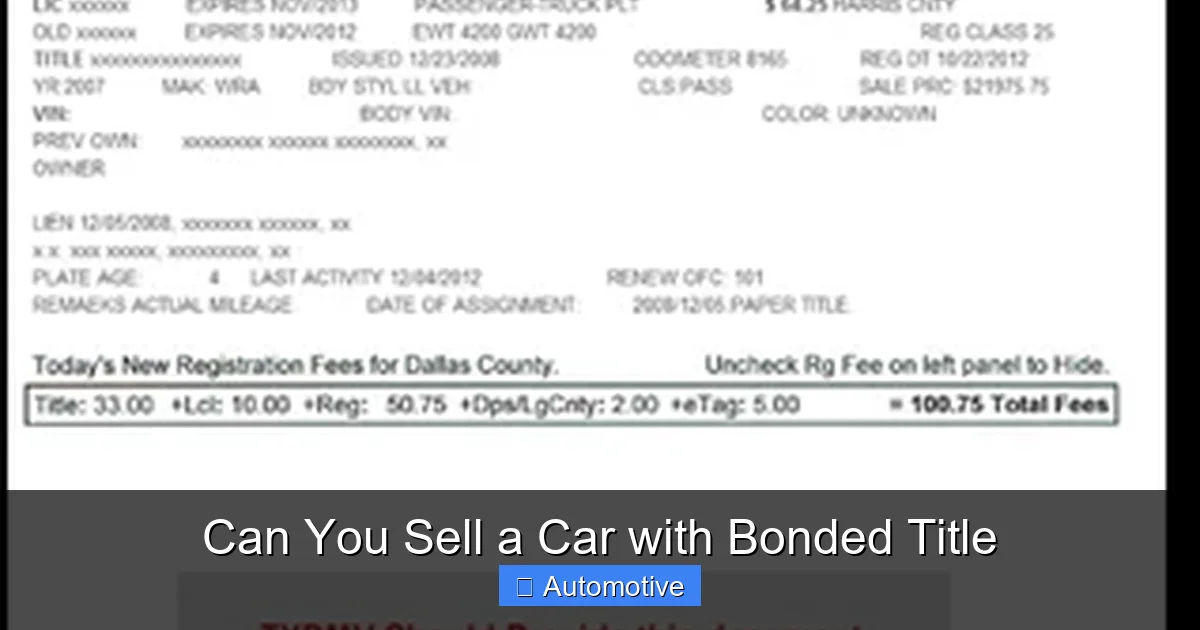
Visual guide about Can You Sell a Car with Bonded Title
Image source: txbondedtitle.com
Highlight the Car’s Strengths
Even with a bonded title, your car may have a lot to offer. If it’s in good mechanical condition, has low mileage, or includes valuable features like a new transmission or upgraded audio system, make sure to highlight these in your listing. A well-maintained vehicle can outweigh title concerns for the right buyer.
Get a Pre-Sale Inspection
Consider having a trusted mechanic inspect the car before listing it. A clean bill of health from a professional can reassure buyers that the vehicle is reliable, even if the title is non-standard. You can include the inspection report with your documentation to add credibility.
Use Clear, Honest Photos
Take high-quality photos of the car from multiple angles, including the interior, engine bay, and undercarriage. Be honest about any wear and tear—buyers appreciate transparency. Avoid overly edited or misleading images, as they can damage trust if the car doesn’t match expectations.
Be Responsive and Flexible
Potential buyers may have lots of questions about the bonded title process. Respond quickly and thoroughly to inquiries, and be willing to accommodate test drives or meet at convenient times. A positive, professional attitude can make a big difference in closing the sale.
Consider Selling to a Dealer or Auction
If private sales aren’t working, consider selling to a dealership that specializes in salvage or non-standard titles. Some dealers buy bonded title cars for parts, restoration, or resale. Alternatively, you can list the vehicle at an online auction platform that accepts bonded titles. While you may get less money than in a private sale, it can be a faster and easier option.
Common Misconceptions About Bonded Titles
There are many myths and misunderstandings about bonded titles that can scare off potential buyers. Let’s clear up some of the most common misconceptions.
Myth: A Bonded Title Means the Car Is Damaged
One of the biggest myths is that a bonded title indicates the car has been in an accident, flooded, or declared a total loss. In reality, a bonded title only reflects an issue with ownership documentation—not the vehicle’s condition. Many cars with bonded titles are in excellent shape and have never been damaged.
Myth: You Can’t Insure a Car with a Bonded Title
While some insurance companies are hesitant, many will insure a vehicle with a bonded title. You may need to provide additional documentation or pay a slightly higher premium, but it’s usually possible to get full coverage. Check with multiple insurers to find one that’s comfortable with bonded titles.
Myth: The Bonded Title Is Permanent
In most states, a bonded title is not permanent. After a set period—often one to three years—and if no claims are made against the bond, the owner can apply to convert it to a clean title. This process varies by state, but it’s a common path for bonded title owners.
Conclusion
Selling a car with a bonded title is not only possible—it’s a common solution for resolving ownership issues and moving forward with your vehicle. While it comes with unique challenges, such as buyer hesitation and additional paperwork, these can be overcome with transparency, proper preparation, and the right pricing strategy.
The key to success is treating the bonded title as a factual part of the car’s history, not a secret to hide. By disclosing it early, providing full documentation, and educating potential buyers, you can build trust and find a qualified buyer who understands the value of your vehicle. Whether you’re selling to a private individual, a dealer, or through an auction, a bonded title doesn’t have to be a dealbreaker—it’s just another step in the journey of car ownership.
Frequently Asked Questions
Can you sell a car with a bonded title in any state?
Yes, you can generally sell a car with a bonded title in most states, but the specific rules and requirements vary. Some states require a waiting period or additional steps for the buyer to complete the transfer. Always check with your local DMV to confirm the process in your area.
Will a bonded title affect the car’s resale value?
Yes, a bonded title typically reduces resale value because it signals a past ownership issue. Buyers may perceive it as a risk, so pricing the car below market value can help attract interest and compensate for the uncertainty.
Can a buyer get financing for a car with a bonded title?
Most traditional lenders won’t finance a car with a bonded title due to the added risk. Buyers usually need to pay in cash or seek alternative financing options. This limits the pool of potential buyers but doesn’t make the sale impossible.
What happens if someone claims ownership after the sale?
The surety bond purchased during the bonded title process is designed to cover such claims. If a legitimate owner comes forward, the bond pays them, protecting both the seller and buyer from financial loss.
Can the buyer convert a bonded title to a clean title?
In many states, yes. After a set period—often one to three years—and if no claims are made, the new owner can apply to convert the bonded title to a clean title. The process varies by state, so the buyer should check with their local DMV.
Do I need to disclose the bonded title to buyers?
Yes, you must disclose the bonded title status to potential buyers. Failing to do so could result in legal consequences, including accusations of fraud. Transparency builds trust and helps avoid disputes during the sale.