Can You Lease a Certified Pre-owned Car?

Contents
- 1 Key Takeaways
- 2 📑 Table of Contents
- 3 Thinking About Leaning a “Like-New” Car? Let’s Talk CPO Leases
- 4 What Exactly *Is* a Certified Pre-Owned Car? (It’s More Than Just a Used Car)
- 5 How Leasing a Certified Pre-Owned Car Actually Works
- 6 The Alluring Benefits of Leasing a CPO Car
- 7 The Important Drawbacks and Considerations (The Fine Print)
- 8 Who Qualifies? Understanding the Eligibility Requirements
- 9 Finding the Best Certified Pre-Owned Lease Deals: A Shopper’s Strategy
- 10 Alternatives to a Certified Pre-Owned Lease: What Are Your Other Options?
- 11 The Final Word: Is a Certified Pre-Owned Lease Right for You?
- 12 Frequently Asked Questions



Yes, you can lease a certified pre-owned (CPO) car, and it’s a smart way to drive a newer vehicle with lower monthly payments than financing a new car. These leases combine the manufacturer-backed warranty and inspection of a CPO program with the affordability of leasing. However, they often have stricter credit requirements and a more limited selection of vehicles compared to new car leases. It’s a great option for drivers who want a low-mileage, nearly-new car with protection but don’t want the long-term commitment of a loan.
Key Takeaways
- CPO Leases Are Available: Many dealerships and manufacturers offer lease programs on their certified pre-owned vehicles, providing a “newer used” leasing option.
- Lower Payments Than New Car Leases: Monthly payments are typically less than leasing a brand-new equivalent because the capitalized cost (leased value) is based on the used car’s price, which is lower.
- Strong Warranty Protection: The core benefit of a CPO car is the extended manufacturer’s warranty, which covers most repairs during the lease term, offering significant peace of mind.
- Strict Mileage and Condition Clauses Apply: Like all leases, CPO leases have annual mileage limits (usually 10,000-15,000 miles) and require the car to be returned in good condition, with wear-and-tear guidelines.
- Credit Requirements Can Be Tougher: Lessors may require a higher credit score for a CPO lease than for a traditional used car loan, as they are still taking on a relatively new asset.
- Selection Is Limited to CPO Inventory: You can only lease vehicles that have been certified by the manufacturer, which means they must meet specific age, mileage, and condition criteria, narrowing your choices.
- End-of-Lease Options Are Standard: At lease end, you can return the car, purchase it for a pre-set residual value, or sometimes trade it in for another new or CPO vehicle.
[FEATURED_IMAGE_PLACEHOLDER]
📑 Table of Contents
- Thinking About Leaning a “Like-New” Car? Let’s Talk CPO Leases
- What Exactly *Is* a Certified Pre-Owned Car? (It’s More Than Just a Used Car)
- How Leasing a Certified Pre-Owned Car Actually Works
- The Alluring Benefits of Leasing a CPO Car
- The Important Drawbacks and Considerations (The Fine Print)
- Who Qualifies? Understanding the Eligibility Requirements
- Finding the Best Certified Pre-Owned Lease Deals: A Shopper’s Strategy
- Alternatives to a Certified Pre-Owned Lease: What Are Your Other Options?
- The Final Word: Is a Certified Pre-Owned Lease Right for You?
Thinking About Leaning a “Like-New” Car? Let’s Talk CPO Leases
So, you’re in the market for a new set of wheels. You love the idea of a new car—the fresh smell, the latest tech, that feeling of being the first owner. But then you look at the price tag and your wallet whimpers. You start considering used cars, but the worry about unknown history and potential repair bills gives you pause. What if there was a middle ground? A way to get a car that’s barely broken in, backed by a strong warranty, without the new-car depreciation hit? That’s the promise of a certified pre-owned (CPO) car. But the big question for many smart shoppers is: Can you lease a certified pre-owned car?
The answer is a confident yes! Leasing a CPO vehicle is not only possible but can be a brilliantly savvy financial move. It combines the best aspects of leasing—lower monthly payments and the ability to drive a newer car more frequently—with the added security of a manufacturer’s certification and warranty. Think of it as leasing a used car, but only the absolute best, most thoroughly vetted used cars on the market. In this complete guide, we’ll rip back the curtain on CPO leases. We’ll explain exactly how they work, weigh the pros and cons, figure out who qualifies, and give you practical tips to score the best deal. By the end, you’ll know if leasing a certified pre-owned car is your perfect automotive match.
What Exactly *Is* a Certified Pre-Owned Car? (It’s More Than Just a Used Car)
Before we dive into leasing, we need to be crystal clear on what makes a CPO car special. It’s not just a fancy label a dealer slaps on any used vehicle. A true CPO program is a rigorous, manufacturer-run certification process. Here’s what typically separates a CPO car from the average used car on the lot.

Visual guide about Can You Lease a Certified Pre-owned Car?
Image source: automotive.social
The Stringent Inspection Process
Every car must pass a multi-point inspection, often 150 to 200 points, depending on the brand. This isn’t a quick once-over. Factory-trained technicians go through the vehicle with a fine-tooth comb, checking everything from the engine and transmission to the operation of the glove box and the wear on the floor mats. They inspect mechanical components, electronics, body and paint, interior, and undercarriage. Any item that doesn’t meet the manufacturer’s strict standards is either repaired or replaced with genuine OEM (Original Equipment Manufacturer) parts. If the car can’t be brought up to spec, it doesn’t get certified. Period.
The Gold-Standard Warranty
This is the crown jewel of the CPO program. Instead of the limited or non-existent warranty you get with a regular used car, a CPO vehicle comes with a significant extension of the original new-car warranty. For example, a brand like Toyota might offer a 7-year/100,000-mile powertrain warranty from the original in-service date. A BMW CPO might add an extra year or 50,000 miles beyond the original expiration. This warranty is often transferable and covers the major mechanical components—engine, transmission, drivetrain—and sometimes includes roadside assistance and loaner car benefits. It’s a factory-backed promise that gives you serious protection.
Other CPO Perks
Beyond the warranty, CPO programs frequently include other benefits designed to mimic the new-car buying experience. These can include:
- Vehicle History Report: A free CARFAX or AutoCheck report, which you should always review yourself.
- Limited Roadside Assistance: For a certain period or mileage.
- Satellite Radio Trial: A complimentary subscription to services like SiriusXM.
- Special Financing Rates: Manufacturers sometimes offer lower APRs for CPO vehicles compared to regular used car loans, though this is less common for leases.
In short, a CPO car is a used vehicle that’s been given a factory “seal of approval” with a comprehensive warranty to back it up. It’s the closest you can get to a new-car experience without paying the new-car price. And because it’s such a high-quality, low-risk asset for the leasing company, it becomes a viable candidate for a lease.
How Leasing a Certified Pre-Owned Car Actually Works
Leasing a CPO car follows the same fundamental principles as leasing a new car, but with a few key differences rooted in the vehicle’s used status. Let’s break down the process and the numbers.
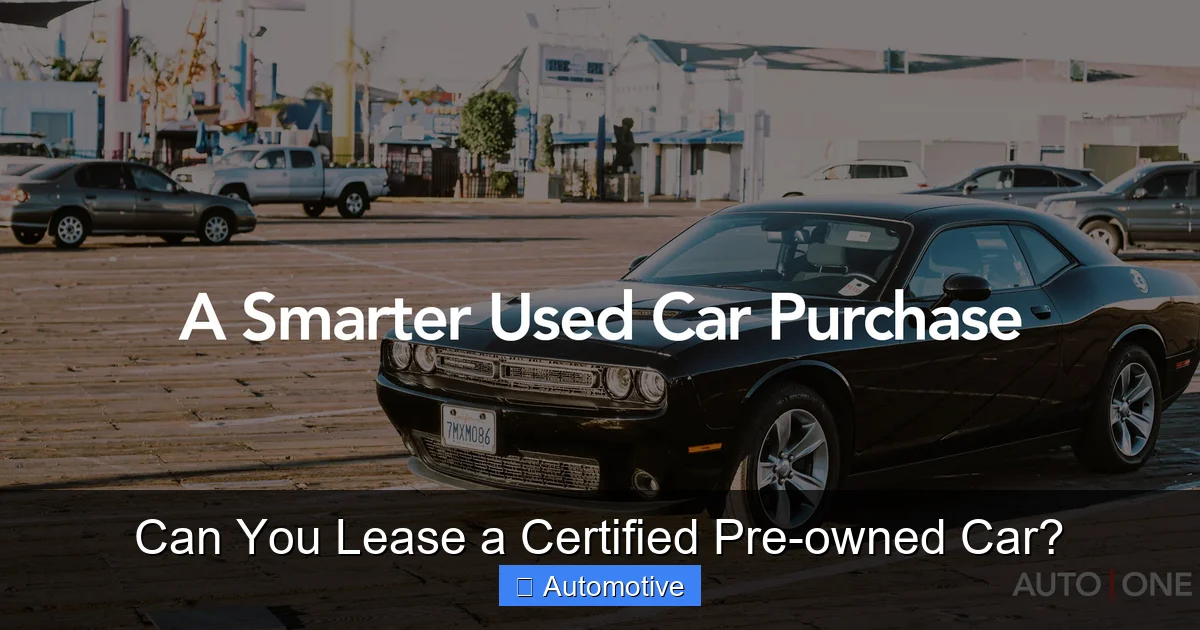
Visual guide about Can You Lease a Certified Pre-owned Car?
Image source: autoone.ca
The Lease Calculation: It’s All About Depreciation
Remember, when you lease, you’re not buying the car. You’re paying for the depreciation that occurs during your lease term. Your monthly payment is calculated based on the difference between the car’s capitalized cost (the agreed-upon price) and its residual value (the estimated worth at lease end), plus finance charges (the money factor).
For a CPO lease, the capitalized cost is the negotiated selling price of the used CPO vehicle. The residual value is set by the leasing company (often the manufacturer’s captive finance arm, like Toyota Financial Services or BMW Financial Services) based on their projections for that specific model year and mileage at the end of the lease term. Because a CPO car is already a few years old and has some miles on it, its residual value percentage might be slightly different than a brand-new equivalent.
Practical Example: Imagine a 2022 Honda CR-V EX. Its MSRP when new was $30,000. Today, as a 2022 CPO model with 25,000 miles, its market value might be around $24,000. A dealer might offer a 36-month lease with a residual value set at 58% of the original MSRP (a common method). That residual would be $17,400 (58% of $30,000). The depreciation you’d pay for is $24,000 – $17,400 = $6,600 over 36 months, or about $183 per month before fees and interest. Compare that to leasing a brand-new 2024 CR-V EX at $30,000 with a 60% residual ($18,000). Depreciation is $12,000 over 36 months, or $333/month. You can see the potential for significant savings.
The Lease Contract and Terms
The lease contract for a CPO car will look very similar to a new car lease. Key terms include:
- Lease Term: Typically 24, 36, or 39 months. Shorter terms on CPO leases are less common than on new.
- Annual Mileage Allowance: Usually 10,000, 12,000, or 15,000 miles per year. Exceeding this results in penalty fees (often $0.20-$0.30 per mile).
- Money Factor: The lease’s interest rate, expressed as a small decimal (e.g., 0.00125). Multiply by 2400 to get a comparable APR.
- Acquisition Fee: A fee charged by the leasing company to set up the lease.
- Disposition Fee: A fee charged at lease end if you don’t buy the car, to cover the cost of re-selling it.
- Due at Signing: This may include the first month’s payment, a security deposit (often refundable), acquisition fee, tags/title, and any down payment (cap cost reduction). Many CPO leases may require little to nothing down, but it varies.
End-of-Lease Options
When your lease term is up, you have the same three choices as with a new car lease:
- Return the Car: You turn it in, pay any excess wear-and-tear and mileage fees, and walk away. You have no equity.
- Buy the Car: You can purchase the CPO vehicle for its pre-set residual value. This can be a great deal if the car’s market value is higher than the residual (you have equity). You’ll need to secure financing for the buyout price.
- Trade or Lease a New Vehicle: You can trade in the CPO car (often at the same dealership) and start a new lease or purchase on a different vehicle. If you have equity (the car’s trade-in value exceeds the residual + any fees), that equity can be applied to your new deal.
The Alluring Benefits of Leasing a CPO Car
Why would someone choose a CPO lease over a new car lease or a traditional used car loan? The advantages are compelling, especially for value-conscious drivers.

Visual guide about Can You Lease a Certified Pre-owned Car?
Image source: carscoops.com
1. Significantly Lower Monthly Payments
This is the #1 draw. As shown in our earlier example, you’re leasing a car that has already absorbed the steepest part of its depreciation (the first 20-30% in year one). Your payments are based on the remaining depreciation over a shorter period, making them much lower than for a brand-new vehicle. This can get you into a higher trim level or a more luxurious brand than you could afford if buying or leasing new.
2. Factory-Backed Warranty Peace of Mind
This is the biggest differentiator from leasing a non-CPO used car. A standard used car lease might come with only the remnants of the original power train warranty, or perhaps a minimal dealer warranty. A CPO lease means that comprehensive manufacturer’s warranty is covering the vast majority of the vehicle’s vital systems for the duration of your lease. If the engine or transmission fails, you’re not writing a big check. This dramatically reduces the financial risk of leasing an older vehicle. You can also look into options like refinancing a car loan if you later decide to buy, but the warranty during the lease is the key perk.
3. Drive a Newer, More Reliable Car
CPO programs have strict age and mileage caps. For most brands, a CPO vehicle is typically less than 6 years old and has under 80,000 miles, though limits vary. This means you’re getting a car that’s only a few model years old, equipped with modern safety features, technology, and fuel efficiency. It’s not a clunker from the previous decade. The rigorous inspection also means it’s been thoroughly checked and any known issues addressed.
4. Avoid the Steepest Depreciation Curve
The moment a new car is driven off the lot, it loses a huge chunk of its value. By leasing a CPO car, you let the first owner eat that massive depreciation loss. You only pay for the depreciation from its current, lower value to its predicted residual value at lease end. If the market for used cars softens, you’re even more protected because your residual was set at the start of the lease.
5. Always Under Factory Warranty
Because the CPO warranty extends the original coverage, it’s highly likely that your entire lease term will be covered by the manufacturer’s warranty. You won’t find yourself in the awkward position of having a major repair needed just after your powertrain warranty expires. This makes budgeting for the lease simple and predictable.
The Important Drawbacks and Considerations (The Fine Print)
It’s not all sunshine and lower payments. Leasing a CPO car comes with its own set of constraints and potential pitfalls you must understand.
1. Stricter Credit Requirements
This is a critical point. While leasing a regular used car might be possible with fair credit, leasing a CPO vehicle often requires a very good to excellent credit score (typically 720+). The leasing companies view CPO leases as a hybrid: they’re lending on an asset that’s not brand new but is still relatively young and valuable. They want to minimize risk. If your credit isn’t pristine, you might be denied a CPO lease or offered one with a much higher money factor (interest rate). In this case, looking into leasing a car with bad credit might mean focusing on older, non-CPO used cars where the lender’s risk is lower, or considering a purchase instead.
2. Limited Selection and Availability
You can only lease the vehicles that the manufacturer has certified and that are currently on the dealer’s CPO lot. This is a tiny fraction of their total used inventory. You can’t just walk onto any used car lot and lease any car. You’re limited to specific models, years, trims, and colors that have been through the CPO process. If you have your heart set on a particular obscure model or a very specific configuration, your chances of finding it as a CPO lease candidate are slim.
3. Mileage Penalties Are Real and Costly
Lease contracts have strict annual mileage allowances, typically 10k-15k miles. CPO cars already have some miles on them, so you have to be extra mindful of your total annual usage. Exceeding the limit will cost you dearly at turn-in, usually $0.25-$0.35 per excess mile. If you’re a high-mileage driver, a CPO lease might not be the best fit, and you should consider shorter-term options or a purchase where you own the car outright and have no mileage caps.
4. Wear-and-Tear Charges Can Be Subjective
At lease end, the car will be inspected for “excessive wear and tear.” The definition can be fuzzy. Things like more than a few door dings, worn tires beyond normal, interior stains or tears, and even windshield chips can be deemed excessive and result in charges. With a CPO car that started in excellent condition, you’re expected to return it in similar condition. This requires more careful ownership than if you owned the car outright.
5. You Still Don’t Own the Asset
Just like any lease, you are making payments on an asset you will never own (unless you buy out at the end). You are responsible for maintaining it according to the lease agreement, but you build no equity. If your financial situation improves and you want to sell or trade, you’re limited by the lease terms. You can’t easily sell a car with a lien (which is what a leased car is) without going through the leasing company’s buyout process.
6. Potentially Higher Insurance Requirements
Leasing companies, especially manufacturer finance arms, will require you to carry full coverage insurance (comprehensive and collision) with relatively low deductibles ($500-$1,000). Because the car is newer and more valuable, your insurance premiums will be higher than they would be for an older, non-CPO used car you own.
Who Qualifies? Understanding the Eligibility Requirements
Not everyone will be approved for a CPO lease. Lenders look at several factors, and the bar can be set higher than for a conventional used auto loan.
Credit Score is King
As mentioned, a strong credit score is non-negotiable for the best CPO lease terms. Aim for a FICO score of 720 or above. Scores in the 680-719 range might get approved but with a less favorable money factor (higher implicit interest rate) and possibly a requirement for a larger down payment. Scores below 680 will face significant difficulty, as many CPO lease programs simply won’t be offered. If you’re in this range, it’s worth checking if you can lease a non-CPO used car or focusing on rebuilding credit first.
Stable Income and Employment
You need to demonstrate a stable income history, typically with proof of employment for at least two years (or in the same field). The debt-to-income (DTI) ratio is crucial. Leasing companies want to see that your monthly obligations (rent/mortgage, other loans, credit cards) plus the proposed lease payment don’t exceed a certain percentage of your gross monthly income (usually 40-50%).
Adequate Insurance Coverage
You must be able to obtain and maintain the required full coverage insurance on the vehicle. The leasing company will be listed as the lienholder and loss payee on the policy.
Clean Driving Record
While not always a hard requirement, a history of accidents or traffic violations can indirectly affect your rates or approval, as it may signal higher risk to insurers, which leasing companies monitor.
Residency and Age Requirements
You must be a legal resident of the state where you’re leasing and meet the age requirements (typically 18 or 21+, sometimes higher for certain brands). If you’re a younger driver, you might face higher rates or restrictions, similar to rental car age policies.
Finding the Best Certified Pre-Owned Lease Deals: A Shopper’s Strategy
If you’ve decided a CPO lease is for you, how do you find the best one? It requires a mix of online research and old-fashioned negotiation.
Shop at Manufacturer Dealerships
This is the most important rule. Only franchised dealerships of that specific brand can sell and lease their manufacturer’s certified pre-owned vehicles. A Toyota CPO must come from a Toyota dealer. A BMW CPO from a BMW dealer. You cannot get a true factory CPO from a standalone used car lot or a multi-brand dealer (unless they are a franchised dealer for that brand). Start your search on the manufacturer’s official website (e.g., BMW.com, Toyota.com) in their CPO inventory search tool.
Compare Like New Car Leases
When you find a CPO model you like, you must compare its lease offer to the current new-car lease offer for the same model and trim. Sometimes, with manufacturer incentives on new cars, the difference in payment might be smaller than you think. Use online lease payment calculators (from Edmunds, Kelley Blue Book) to model both scenarios. Factor in the CPO’s potentially lower insurance costs (slightly older) and the fact that the new car will have a full bumper-to-bumper warranty, while the CPO has the extended CPO warranty (which might not cover some interior or electronics items that a new car’s basic warranty would).
Negotiate the Selling Price, Not Just the Payment
This is leasing 101. The monthly payment is derived from the capitalized cost. The lower you can negotiate the selling price of the CPO vehicle, the lower your payment will be. Don’t just accept the dealer’s first lease quote. Research the fair market value of that specific CPO car (using KBB, Edmunds, and comparable listings on Autotrader). Come in with a target price and negotiate down from there. Remember, you are buying the car from the dealer at the start of the lease, you’re just financing the difference between that price and its future value.
Scrutinize the Lease Contract
Before signing, read every line. Verify:
- The capitalized cost (selling price) matches what you negotiated.
- The residual value percentage is clearly stated and seems reasonable.
- The money factor (interest rate) is competitive. You can ask the dealer for the “lease charge” or “rent charge” to understand the total cost.
- All fees are itemized (acquisition, disposition, documentation). Some are negotiable.
- The mileage allowance and excess mileage fee are clearly defined.
- The wear-and-tear policy is described (often in a separate addendum).
If something is unclear, ask. If a dealer is hesitant to provide the full, transparent lease breakdown, that’s a red flag.
Alternatives to a Certified Pre-Owned Lease: What Are Your Other Options?
A CPO lease isn’t the only path to a great car. Let’s quickly compare it to your other primary choices.
Leasing a Non-CPO Used Car
Some banks and credit unions will lease older, higher-mileage used cars that are not certified. The payments can be even lower. However, you lose the manufacturer’s extended warranty. You’re responsible for all repairs after any remaining original warranty expires. This is a much riskier proposition and requires a very thorough pre-purchase inspection by an independent mechanic. It’s generally not recommended unless you have a very tight budget and are mechanically savvy, or the car is still under its original power train warranty.
Financing (Loaning) a Certified Pre-Owned Car
Instead of leasing, you could take out a traditional auto loan to buy the CPO car. The monthly payment will be higher than a lease payment for the same car and term, because you’re paying off the entire principal plus interest. However, once the loan is paid off (typically 60-72 months), you own the car outright with no further payments. You also have no mileage limits or wear-and-tear clauses. You can modify the car, sell it anytime, or keep it forever. This builds equity over time. The trade-off is higher monthly cost and a longer financial commitment. You can learn more about negotiating on a used car when purchasing.
Leasing a Brand-New Car
The classic alternative. New car leases offer the lowest possible payments for the newest models with the latest tech and full bumper-to-bumper warranties. They often have the most attractive manufacturer incentives (subsidized money factors, rebates). The downside is you’re paying for the steepest part of the depreciation. You also have less negotiating room on the selling price (the MSRP is fixed). If having the absolute latest and greatest is your priority and your budget allows, a new lease might be better. If you want a “like-new” car for less money, CPO wins.
Buying a Less Expensive Used Car Outright (Cash or Loan)
You could skip leasing entirely and buy a reliable, non-CPO used car with a cash payment or a used car loan. This eliminates interest costs (if cash) and gives you 100% freedom. Your monthly transportation cost could be very low (just insurance, maintenance, gas). This is the most financially efficient long-term option but requires a larger upfront sum (if cash) or qualifying for a loan, and you accept the risk of older car repairs.
The Final Word: Is a Certified Pre-Owned Lease Right for You?
Leasing a certified pre-owned car is a fantastic, often-underutilized strategy for smart car shoppers. It bridges the gap between the allure of a new car and the practicality of a used one. You get a relatively new, low-mileage vehicle with a strong manufacturer’s warranty, all for a monthly payment that can be hundreds of dollars less than a new car lease. It’s ideal for someone who wants a worry-free driving experience for a few years, doesn’t put on excessive miles, and has a solid credit score.
However, it’s not without its strings. The credit bar is high, your model selection is limited to what’s certified, and you must abide by strict lease rules. You must do your homework: inspect the CPO paperwork, verify the warranty, negotiate the selling price aggressively, and read the lease contract with a fine-tooth comb. Compared to a traditional used car loan, you’ll pay more over time if you never buy the car, but you gain the benefits of a warranty and the ability to move on to a new car sooner.
Ultimately, the decision comes down to your personal finances, driving habits, and priorities. If you value lower payments, a recent model year, and the ultimate protection of a factory warranty, and you can qualify, a certified pre-owned lease is absolutely worth serious consideration. It might just be the smartest way to get behind the wheel of the car you really want.
Frequently Asked Questions
Can I lease a certified pre-owned car with bad credit?
It is significantly more difficult. CPO leases typically require very good to excellent credit (720+). With bad credit, you’ll likely face high money factors, large down payments, or outright denial. Your better bets are leasing a non-CPO older used car (from a bank/credit union) or financing a reliable used car.
How much money do I need to put down on a CPO lease?
It varies widely. Some promotional CPO leases may offer $0 down, requiring only the first month’s payment, fees, and taxes at signing. Others, especially for less-qualified lessees, may require a substantial cap cost reduction (down payment). Always ask for the “total due at signing” and understand what each fee is.
Who is responsible for maintenance on a leased CPO car?
You are responsible for all routine maintenance (oil changes, tire rotations, brakes, wipers, etc.) as outlined in the owner’s manual. The CPO warranty covers the repair of mechanical breakdowns due to defects in materials or workmanship. Keeping detailed maintenance records is crucial to avoid wear-and-tear disputes at lease end.
What happens at the end of a CPO lease if the car needs major repairs?
The CPO manufacturer’s warranty should cover the repair if the issue is a covered mechanical failure. You would take it to an authorized dealer for service. However, normal wear-and-tear items (like worn tires or brake pads beyond normal limits) are your responsibility and could result in charges if the car is returned with them.
Can I modify a leased certified pre-owned car?
No. All lease agreements strictly prohibit any permanent modifications or alterations to the vehicle. This includes aftermarket stereos, custom wheels, tinting (beyond factory), suspension lifts, or cosmetic changes. You must return the car in its original, unmodified condition, allowing for normal wear and tear.
Is the mileage limit on a CPO lease based on the car’s current miles?
No. The annual mileage allowance (e.g., 12,000 miles per year) is the total miles you can drive during your lease term, regardless of the car’s starting odometer reading. If you lease a CPO with 30,000 miles for 36 months with a 12k/year allowance, you can drive it up to 78,000 total miles (30k + 36*12k) before incurring penalties. The allowance is additive.