Can a Toyota Dealer Service a Lexus?

Contents
- 1 Key Takeaways
- 2 📑 Table of Contents
- 3 Can a Toyota Dealer Service a Lexus? The Short Answer
- 4 The Toyota-Lexus Connection: More Than Just a Family Tie
- 5 What Can a Toyota Dealer Actually Do for Your Lexus?
- 6 Pros and Cons of Using a Toyota Dealer for Lexus Service
- 7 When to Choose a Lexus Dealer Instead
- 8 Tips for Getting the Best Service for Your Lexus
- 9 Conclusion: Yes, But With Caveats
- 10 Frequently Asked Questions



Yes, a Toyota dealer can service a Lexus in many cases—especially for routine maintenance and shared components. While Lexus vehicles are luxury models with specialized needs, their close engineering ties to Toyota mean many service tasks overlap, making Toyota dealerships a viable option for cost-effective care.
Key Takeaways
- Shared Engineering Platforms: Many Lexus models are built on the same platforms as Toyota vehicles, allowing for overlapping parts and service procedures.
- Routine Maintenance Compatibility: Oil changes, brake inspections, tire rotations, and fluid top-offs can often be performed at a Toyota dealer with no issues.
- Certified Technicians May Vary: While Toyota technicians are trained on shared systems, Lexus-certified specialists have deeper expertise in luxury features and performance tuning.
- Warranty and Service Plans: Using a non-Lexus dealer for service may affect certain warranty claims or complimentary service programs, so check your contract.
- Advanced Diagnostics Require Special Tools: Complex electronics, adaptive suspension, and hybrid systems may need Lexus-specific diagnostic equipment and software.
- Cost vs. Expertise Trade-Off: Toyota dealers often charge less for labor, but Lexus dealers offer brand-specific knowledge and genuine parts guarantees.
- Best for Basic Repairs, Not Complex Issues: For minor fixes and scheduled maintenance, Toyota dealers work well; for major repairs or software updates, Lexus service centers are recommended.
📑 Table of Contents
- Can a Toyota Dealer Service a Lexus? The Short Answer
- The Toyota-Lexus Connection: More Than Just a Family Tie
- What Can a Toyota Dealer Actually Do for Your Lexus?
- Pros and Cons of Using a Toyota Dealer for Lexus Service
- When to Choose a Lexus Dealer Instead
- Tips for Getting the Best Service for Your Lexus
- Conclusion: Yes, But With Caveats
Can a Toyota Dealer Service a Lexus? The Short Answer
If you own a Lexus—or are thinking about buying one—you might be wondering whether your local Toyota dealership can handle its maintenance and repairs. After all, both brands are under the same parent company, Toyota Motor Corporation. And let’s be honest: Toyota service centers are often more convenient and less expensive than their Lexus counterparts. So, is it possible? The short answer is: **yes, in many cases, a Toyota dealer can service a Lexus—especially for routine maintenance and repairs involving shared components.**
But it’s not quite that simple. While there’s significant overlap between Toyota and Lexus vehicles, especially in engineering and parts, there are also important differences in technology, luxury features, and service expectations. Understanding where the lines blur—and where they don’t—can help you make smarter decisions about where to take your Lexus for service.
In this guide, we’ll break down the relationship between Toyota and Lexus, explore what kinds of services a Toyota dealer can realistically handle, and help you weigh the pros and cons of choosing a Toyota service center over a dedicated Lexus facility. Whether you’re driving a Lexus ES, RX, or even a performance-oriented IS, this article will give you the clarity you need to keep your luxury vehicle running smoothly—without overspending.
The Toyota-Lexus Connection: More Than Just a Family Tie

Visual guide about Can a Toyota Dealer Service a Lexus?
Image source: dealerimages.dealereprocess.com
To understand whether a Toyota dealer can service a Lexus, it helps to first understand how closely these two brands are related. Lexus isn’t just a sister brand to Toyota—it’s essentially Toyota’s luxury division, launched in 1989 to compete with European automakers like BMW and Mercedes-Benz. But instead of building entirely new platforms from scratch, Toyota leveraged its existing engineering expertise to create high-end vehicles that shared underlying structures with mainstream models.
Shared Platforms and Components
Many Lexus models are built on the same platforms as their Toyota counterparts. For example:
– The Lexus ES shares its platform with the Toyota Avalon.
– The Lexus RX is closely related to the Toyota Highlander.
– The Lexus NX is based on the Toyota RAV4.
– Even the performance-oriented Lexus IS has roots in the Toyota Camry’s architecture.
This shared DNA means that many mechanical components—such as engines, transmissions, suspension systems, and braking systems—are either identical or very similar between the two brands. In fact, some parts are literally interchangeable. For instance, the 2.5-liter four-cylinder engine used in the Toyota RAV4 Hybrid is nearly identical to the one found in the Lexus NX 350h.
Manufacturing and Assembly
Lexus vehicles are often assembled in the same factories as Toyota models. For example, the Lexus ES and Toyota Avalon are both built at the Toyota Motor Manufacturing Kentucky plant. This co-production reinforces the idea that the two brands are not just related in design—but in manufacturing as well.
Because of this deep integration, Toyota technicians are often trained on systems that appear in both brands. They’re familiar with Toyota’s hybrid technology (like the Hybrid Synergy Drive), which is also used in Lexus hybrids. They know how to service Toyota’s Direct Shift-CVT transmissions, which are used in both brands. And they’re accustomed to Toyota’s safety systems, such as Toyota Safety Sense, which has evolved into Lexus Safety System+.
Brand Differentiation: Where Lexus Diverges
Despite the similarities, Lexus vehicles are designed to deliver a more refined, luxurious experience. This means they often include:
– Higher-grade materials and finishes
– Advanced noise insulation
– Adaptive suspension systems (like Lexus’s Adaptive Variable Suspension)
– Enhanced infotainment and driver-assistance features
– More powerful or finely tuned engines
These upgrades require specialized knowledge and tools. For example, a Lexus with an air suspension system or adaptive dampers may need calibration tools and software that aren’t available at a standard Toyota service center. Similarly, Lexus’s Mark Levinson audio systems or advanced climate controls may require specific diagnostic procedures.
So while the foundation may be shared, the finishing touches are distinctly Lexus—and that’s where the service gap begins to show.
What Can a Toyota Dealer Actually Do for Your Lexus?

Visual guide about Can a Toyota Dealer Service a Lexus?
Image source: pictures.dealer.com
Now that we’ve established the relationship between Toyota and Lexus, let’s get practical. What kinds of services can a Toyota dealer realistically perform on a Lexus vehicle? The answer depends on the type of service, the model of your Lexus, and the capabilities of the specific Toyota dealership.
Routine Maintenance: A Safe Bet
For basic, scheduled maintenance, a Toyota dealer is often a perfectly suitable choice. This includes:
– Oil and filter changes
– Tire rotations and pressure checks
– Brake inspections and pad replacements
– Fluid top-offs (coolant, brake fluid, windshield washer fluid)
– Battery testing and replacement
– Air filter and cabin filter replacements
These tasks rely on standard procedures and widely available parts. Since many Lexus models use the same engines and drivetrains as Toyota vehicles, the oil type, filter size, and maintenance intervals are often identical. For example, a 2023 Lexus ES 350 and a 2023 Toyota Avalon both use a 3.5-liter V6 engine and require the same 0W-20 synthetic oil.
Toyota technicians are trained to follow Toyota Motor Corporation’s global service standards, which apply to both brands. So when it comes to changing oil or rotating tires, there’s little difference in the process—even if the car wears a Lexus badge.
Brake and Suspension Work
Brake systems on many Lexus models are very similar to those on Toyota vehicles. For example, the Lexus RX and Toyota Highlander use nearly identical brake calipers, rotors, and pads. A Toyota technician who’s worked on a Highlander will feel right at home servicing the brakes on an RX.
However, if your Lexus has performance brakes (like the Brembo brakes on a Lexus F Sport model) or an adaptive suspension system, things get more complicated. These systems may require specialized tools or software to properly diagnose and calibrate. A Toyota dealer might not have access to the Lexus-specific diagnostic software needed to reset or recalibrate these components.
Transmission and Drivetrain Services
Automatic transmissions in Lexus and Toyota vehicles are often shared or closely related. The 8-speed automatic in the Lexus ES 350, for instance, is similar to the one used in the Toyota Avalon. Routine services like transmission fluid changes can usually be handled at a Toyota dealer.
But if your Lexus has a hybrid system—like the Lexus NX 350h—the transmission is part of a more complex hybrid drivetrain. While Toyota technicians are trained on hybrid systems, Lexus hybrids may have additional software or calibration requirements. A Toyota dealer might be able to perform a basic fluid change, but a software update or hybrid battery diagnostic may need to be done at a Lexus center.
Electrical and Infotainment Issues
This is where Toyota dealers often hit a wall. Lexus vehicles come equipped with advanced infotainment systems, digital dashboards, and driver-assistance features that go beyond what’s found in most Toyota models. For example:
– The Lexus Interface multimedia system includes features like cloud-based navigation, voice recognition, and over-the-air updates.
– Lexus Safety System+ 3.0 includes advanced features like intersection turn assist and emergency driving stop.
These systems rely on proprietary software and require Lexus-specific diagnostic tools (like the Techstream or GTS diagnostic systems). A Toyota dealer may not have access to these tools, making it difficult—or impossible—to properly diagnose or repair electrical issues.
Warranty and Recall Work
If your Lexus is still under warranty, it’s generally best to have service performed at a Lexus dealership. While Toyota dealers can perform some warranty-covered repairs, only Lexus-certified technicians are authorized to handle certain warranty claims. Additionally, Lexus offers complimentary maintenance programs (like the Lexus Enform Service Connect) that may require service at a Lexus center to remain valid.
That said, for recalls involving shared components—like a faulty airbag sensor or engine control module—a Toyota dealer may be able to perform the repair, especially if the part is identical to one used in a Toyota model.
Pros and Cons of Using a Toyota Dealer for Lexus Service
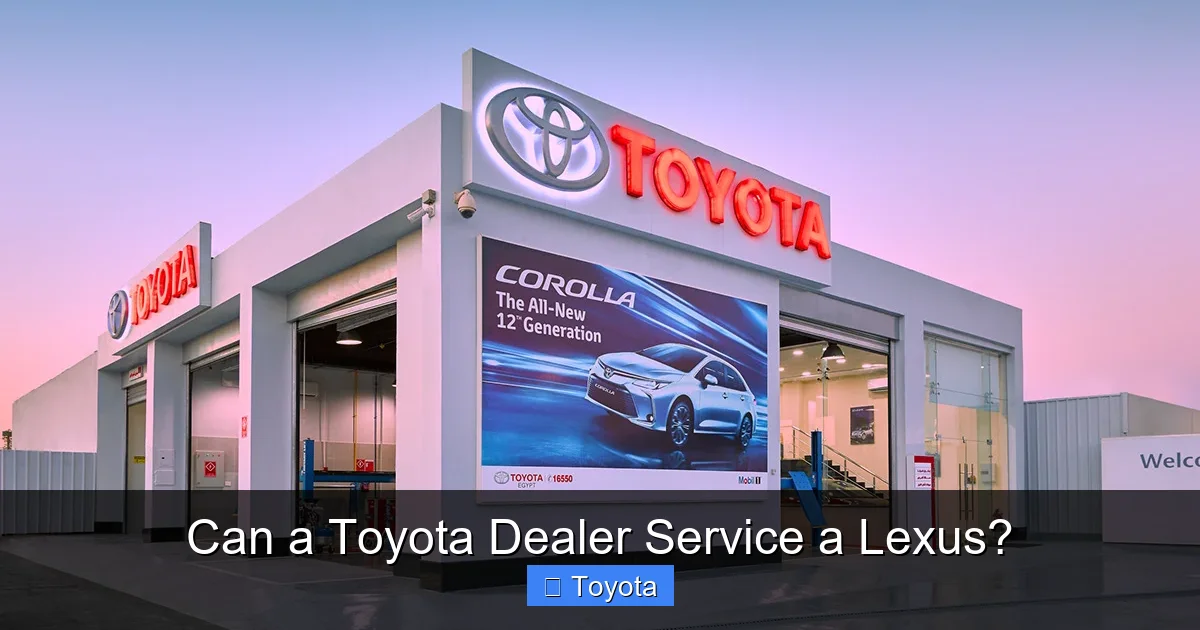
Visual guide about Can a Toyota Dealer Service a Lexus?
Image source: mir-s3-cdn-cf.behance.net
Now that we’ve covered what a Toyota dealer can and can’t do, let’s weigh the advantages and disadvantages of choosing a Toyota service center for your Lexus.
Advantages
- Lower Labor Costs: Toyota dealers typically charge less per hour for labor than Lexus dealers. This can add up quickly on major services or repairs.
- Convenience: Toyota dealerships are more common than Lexus centers, especially in smaller towns or rural areas. You may not have a Lexus dealer nearby, but a Toyota one could be just a few miles away.
- Familiarity with Shared Systems: Technicians at Toyota dealers are well-versed in the platforms, engines, and hybrid systems used in both brands. For basic repairs, they’re often just as capable as Lexus technicians.
- Faster Appointments: Lexus service centers can be busy, especially during peak seasons. Toyota dealers may offer quicker turnaround times for routine maintenance.
- Cost-Effective for Older Vehicles: If your Lexus is out of warranty and several years old, the savings at a Toyota dealer can be significant—without sacrificing quality for basic services.
Disadvantages
- Limited Access to Lexus-Specific Tools: As mentioned, advanced diagnostics, software updates, and calibration often require Lexus-only equipment.
- Less Specialized Training: While Toyota technicians are skilled, they may not have the same level of training on luxury features, performance tuning, or high-end electronics.
- Potential Warranty Complications: Using a non-Lexus dealer for service could void certain warranty provisions or affect eligibility for complimentary maintenance programs.
- Parts Availability: While many parts are shared, some Lexus-specific components (like trim pieces, sensors, or infotainment modules) may not be stocked at a Toyota dealer.
- Customer Experience Differences: Lexus service centers are designed to provide a premium experience—complimentary loaner cars, luxury waiting areas, and personalized service. Toyota dealers offer solid service, but the ambiance and amenities are more utilitarian.
When to Choose a Lexus Dealer Instead
Despite the cost savings and convenience of Toyota dealers, there are times when it’s best to stick with a Lexus service center. Here are some key scenarios:
Complex Repairs and Diagnostics
If your Lexus is experiencing electrical issues, transmission problems, or hybrid system faults, a Lexus dealer is your best bet. They have the tools, software, and expertise to diagnose and repair these issues correctly the first time.
Software Updates and Recalibrations
Modern Lexus vehicles rely heavily on software for everything from engine performance to driver-assistance features. Software updates, sensor calibrations, and system resets often require Lexus-specific tools and training.
Warranty and Leased Vehicles
If your Lexus is under warranty or you’re leasing the vehicle, it’s wise to follow the manufacturer’s recommended service schedule at a Lexus dealer. This ensures compliance with warranty terms and protects your investment.
High-End Features and Customizations
Vehicles with adaptive suspension, air ride systems, or advanced infotainment may require specialized service that only a Lexus technician can provide.
Peace of Mind
Even if a Toyota dealer *can* perform a service, you may simply feel more confident knowing your luxury vehicle is in the hands of a brand-certified expert. For many Lexus owners, that peace of mind is worth the extra cost.
Tips for Getting the Best Service for Your Lexus
Whether you choose a Toyota or Lexus dealer, here are some tips to ensure your vehicle gets the best possible care:
- Know Your Vehicle’s History: Keep detailed records of all services and repairs. This helps technicians understand your car’s needs and avoids重复 work.
- Ask About Technician Certification: At a Toyota dealer, ask if the technician has experience with Lexus vehicles or hybrid systems.
- Verify Parts Quality: Make sure any replacement parts are OEM (original equipment manufacturer) or high-quality aftermarket equivalents.
- Check for Recalls: Use the NHTSA website or Lexus’s VIN lookup tool to see if your vehicle has any open recalls.
- Consider a Hybrid of Both: Use a Toyota dealer for routine maintenance and a Lexus dealer for complex repairs. This balances cost and expertise.
- Read Reviews: Look up reviews of local Toyota and Lexus service centers to gauge customer satisfaction and reliability.
Conclusion: Yes, But With Caveats
So, can a Toyota dealer service a Lexus? The answer is a qualified yes. For routine maintenance, brake work, and many mechanical repairs, a Toyota dealer is often a capable and cost-effective option. Thanks to shared platforms, engines, and systems, Toyota technicians are well-equipped to handle a wide range of tasks on Lexus vehicles.
However, when it comes to advanced electronics, software updates, warranty work, or luxury-specific features, a Lexus dealer remains the gold standard. They offer specialized tools, deeper expertise, and a service experience tailored to high-end vehicles.
Ultimately, the best choice depends on your vehicle’s age, condition, and the type of service needed. For many Lexus owners, a hybrid approach—using Toyota dealers for basic maintenance and Lexus centers for complex issues—offers the perfect balance of cost, convenience, and quality.
By understanding the relationship between these two brands and knowing what each service center can offer, you can keep your Lexus running like new—without breaking the bank.
Frequently Asked Questions
Can a Toyota dealer perform a Lexus oil change?
Yes, a Toyota dealer can perform an oil change on a Lexus, especially if the engine is shared with a Toyota model. They’ll use the correct oil type and filter, and the process is nearly identical.
Will servicing my Lexus at a Toyota dealer void the warranty?
Generally, no—performing maintenance at a Toyota dealer won’t void your warranty as long as the work is done correctly and documented. However, some warranty claims may require service at a Lexus center, so check your contract.
Can a Toyota dealer program a new key fob for a Lexus?
It depends. Some Toyota dealers have the tools to program basic key fobs, but advanced smart keys with proximity sensors may require Lexus-specific software and equipment.
Are Lexus parts available at Toyota dealerships?
Some shared parts (like brakes, filters, and fluids) are available, but Lexus-specific components (like trim, sensors, or infotainment modules) are usually only stocked at Lexus centers.
Is it cheaper to service a Lexus at a Toyota dealer?
Yes, labor rates at Toyota dealers are typically lower than at Lexus centers. For routine maintenance, the savings can be significant—often 20–30% less.
Can a Toyota technician work on a Lexus hybrid?
Yes, for basic services like oil changes or brake work. However, hybrid battery diagnostics, software updates, or high-voltage system repairs should be handled by a Lexus-certified technician.