

Can a Ford F-150 Tow 8

Contents
- 1 Key Takeaways
- 2 📑 Table of Contents
- 3 Demystifying the “8”: What Does “Tow 8” Actually Mean?
- 4 How to Find Your F-150’s Exact Towing Capacity
- 5 Engine & Configuration: The Heart of Your Towing Power
- 6 The Critical Towing Packages: You Need This
- 7 Real-World Factors That Reduce Your “8,000 lb” Rating
- 8 Safety Gear: Making That 8,000 lb Tow Secure
- 9 Conclusion: Your F-150 and the 8,000 lb Goal
- 10 Frequently Asked Questions
Car Inverter

Car Cup Holder Expander

Jumper Cables

Magnetic Car Phone Mount
Yes, many Ford F-150 models can tow 8,000 pounds or more, but it depends entirely on your specific truck’s configuration. The maximum towing capacity varies dramatically based on the model year, engine choice, drivetrain, axle ratio, and whether you have the proper towing package. A base V6 model may struggle, while a properly equipped V8 or hybrid can easily exceed that figure. Always verify your exact truck’s capacity using the official Ford towing guide or your door jamb sticker before hitching any trailer.
So, you’re looking at your trusty Ford F-150 and wondering, “Can this thing really tow 8?” It’s a great question, and the answer is both simple and wonderfully complex. The short answer is: Yes, most Ford F-150s can tow at least 8,000 pounds, and many can tow significantly more. But the “how” and “how much” is where the details—and the fun—lies. Your F-150 isn’t a monolith; it’s a chameleon of configurations. The truck that rolls off the assembly line with a small V6 engine and a short bed is a different animal from the one equipped with a massive V8, a long bed, and every towing package available. Let’s pop the hood, check the specs, and figure out exactly what your specific half-ton can handle.
Key Takeaways
- Configuration is Everything: Your F-150’s tow rating is not a single number. It’s a formula based on engine, transmission, axle ratio, cab/bed length, and optional towing packages.
- 8,000 lbs is a Common Benchmark: Most modern F-150s with the 3.5L EcoBoost V6, 5.0L V8, or PowerBoost hybrid, when properly equipped, are rated to tow well over 8,000 lbs.
- Payload is NOT Towing Capacity: Do not confuse the two. Payload is what you can carry *in* the truck. Towing capacity is what you can pull *behind* it. Both are limited by your Gross Vehicle Weight Rating (GVWR).
- Always Verify Your Exact Specs: The only surefire way to know your truck’s capacity is to decode your VIN or consult the official Ford towing guide for your specific model year and configuration.
- Proper Equipment is Non-Negotiable: Towing 8,000 lbs requires a heavy-duty trailer hitch, integrated trailer brake controller, and often a specific axle ratio (like 3.73 or 4.10).
- Real-World Conditions Reduce Capacity: Altitude, temperature, passenger/cargo weight, and trailer aerodynamics will lower your effective towing capacity below the maximum rating.
- Safety Trumps Spec Sheets: Even if your truck is rated for 10,000 lbs, using a weight-distributing hitch and ensuring proper tongue weight is critical for safe, stable towing.
📑 Table of Contents
- Demystifying the “8”: What Does “Tow 8” Actually Mean?
- How to Find Your F-150’s Exact Towing Capacity
- Engine & Configuration: The Heart of Your Towing Power
- The Critical Towing Packages: You Need This
- Real-World Factors That Reduce Your “8,000 lb” Rating
- Safety Gear: Making That 8,000 lb Tow Secure
- Conclusion: Your F-150 and the 8,000 lb Goal
Demystifying the “8”: What Does “Tow 8” Actually Mean?
First, let’s clear up the most common point of confusion. When truck enthusiasts say “Can it tow 8?” they almost universally mean 8,000 pounds. That’s the standard benchmark for a “serious” half-ton truck. We’re not talking about 8,000 kilograms (about 17,600 lbs), which would be a three-quarter or one-ton job. We’re talking 8,000 lbs, which is the weight of a large boat, a sizable camper, or a car on a trailer.
It’s crucial to understand that towing capacity is a maximum *ceiling*, not a recommended target. Consistently loading your truck to its absolute limit is a fast track to premature wear and tear on your engine, transmission, and brakes. Smart owners aim for 80-85% of their rated capacity for daily, comfortable, and safe towing. So if your goal is an 8,000 lb trailer, you’ll want a truck rated for at least 9,500-10,000 lbs to have a safe buffer.
The Golden Rule: Your Truck’s Capacity is Unique
Ford publishes a massive, multi-page towing guide for each model year. It’s a grid that cross-references every possible combination: engine, cab style (Regular, SuperCab, SuperCrew), bed length (5.5′, 6.5′, 8′), drive system (2WD, 4×4), and axle ratio (3.15, 3.31, 3.55, 3.73, 4.10). Each intersection in that grid has a different number. Your neighbor’s identically looking 2021 F-150 might tow 500 lbs more or less than yours if he has a different axle gear. This is why the first step is always identification.
How to Find Your F-150’s Exact Towing Capacity
Guessing is dangerous. You need the official number. Here are your three best methods, in order of accuracy.

Visual guide about Can a Ford F-150 Tow 8
Image source: prestonford.com
- The Ford Towing Guide (Online PDF): Go to Ford’s official website, find the towing specs for your specific model year, and use the chart. You’ll need to know your cab, bed, engine, drive, and axle ratio. This is the most reliable source.
- Your Vehicle’s Door Jamb Sticker: Open the driver’s side door. Look for the yellow and white certification label. It lists your GVWR (Gross Vehicle Weight Rating) and GAWRs (Gross Axle Weight Ratings). While it doesn’t list *towing* capacity directly, it gives the fundamental weight limits your truck can handle. You can use these numbers in conjunction with your truck’s curb weight (found in your owner’s manual) to calculate your maximum *payload*. Towing capacity is a separate, engineered limit, but GVWR is the ultimate cap that both payload and towing must stay under.
- Ford VIN Decoder: Your Vehicle Identification Number (VIN) is a 17-digit code that contains all your truck’s specs. Use a reputable online VIN decoder (like Ford’s own service or a trusted automotive site) to pull your exact build sheet. This will tell you your factory axle ratio, transmission, and whether you have the Max Trailer Tow Package.
Pro Tip: If you frequently tow in mountainous areas or high altitudes, remember that engine power—and thus towing capacity—decreases as air density drops. Your “sea level” rating may be 2-5% lower in the Rockies.
Engine & Configuration: The Heart of Your Towing Power
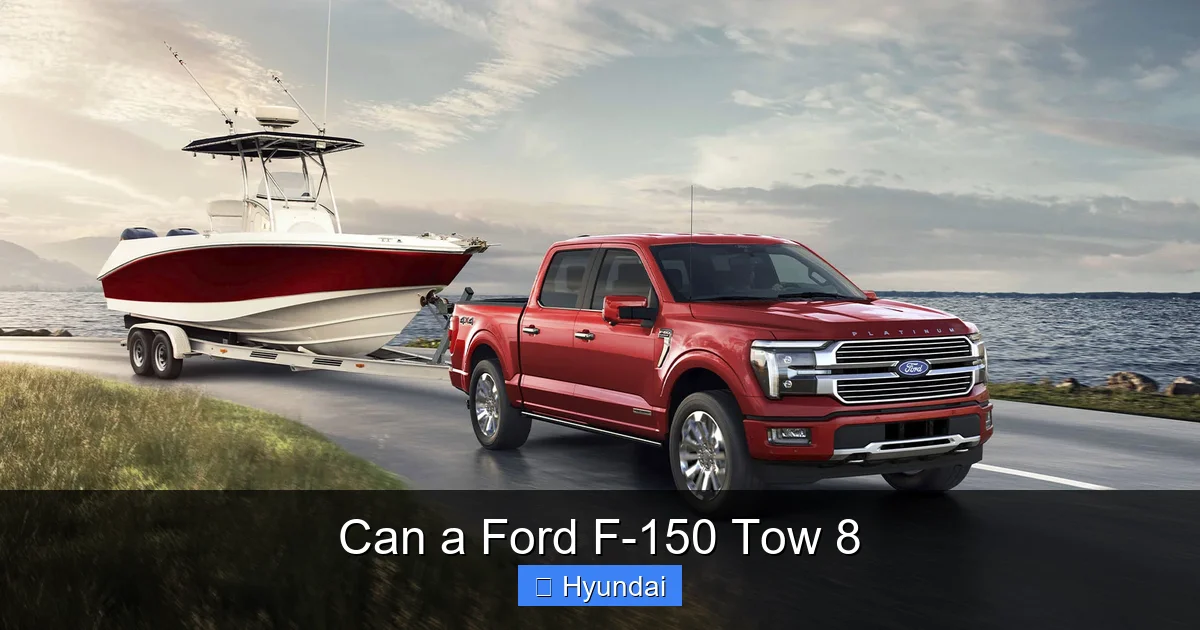
Let’s look at typical modern F-150s (2015-Present) and their general towing capabilities with the proper equipment. Remember, these are ranges; your specific truck will fall somewhere within them.
Visual guide about Can a Ford F-150 Tow 8
Image source: prestonford.com
The Workhorses: V6 EcoBoost Engines
The 3.5L EcoBoost V6 is the towing powerhouse of the F-150 lineup for many years. With the Max Trailer Tow Package (which usually includes a 3.73 or 4.10 axle, upgraded cooling, and an integrated trailer brake controller), these trucks are rated to tow between 10,000 and 14,000 lbs depending on the model year and configuration. A 2021-2023 F-150 with the 3.5L EcoBoost, 4×2, SuperCrew, 5.5′ bed, and 3.73 axle is often rated at 14,000 lbs. So for an 8,000 lb trailer? This engine makes it look easy, provided you have the right axle and package.
The Classic: 5.0L V8
The Coyote 5.0L V8 is a legend for a reason. It’s all about low-end torque and smooth power. With the Max Trailer Tow Package (again, requiring a 3.73 or 4.10 axle), V8 models typically tow in the range of 9,000 to 13,000 lbs. The 2020-2023 models with the 10-speed transmission saw significant gains, often hitting 13,000+ lbs. An 8,000 lb trailer is well within the comfortable, confident towing range of a properly geared V8 F-150.
The Newcomer: PowerBoost Hybrid
Ford’s 3.5L PowerBoost hybrid system combines the EcoBoost V6 with an electric motor. The result is staggering torque right off the line, making it exceptional for getting a heavy load moving. With the required towing package, PowerBoost F-150s are rated to tow 11,000 to 12,500 lbs. The instant electric torque is a huge advantage for starting and climbing grades with an 8,000 lb load.
The Base: 3.3L V6 and 2.3L I4
These are the standard engines on base model XL and work-truck trims. Their towing capacities without a special package are modest, often in the 5,000 to 7,000 lb range. Can they tow 8,000 lbs? Almost certainly not from the factory. You would need to check if a higher axle ratio (like 3.73) was available as an option for that specific engine/configuration, but it’s rare. If your F-150 has one of these engines and no towing package, 8,000 lbs is a hard no. You’d be severely over capacity.
The Critical Towing Packages: You Need This
Seeing an 11,000 lb rating on a sticker means nothing if your truck doesn’t have the hardware to support it. Ford bundles the necessary components into packages, most notably the Max Trailer Tow Package.

Visual guide about Can a Ford F-150 Tow 8
Image source: towstats.com
What’s typically inside?
- Heavy-Duty Trailer Hitch: Not the small ball mount in the bumper. This is a frame-mounted, Class IV hitch.
- Integrated Trailer Brake Controller: A built-in unit in the dash that syncs with your trailer’s electric brakes. This is essential for anything over a few thousand pounds.
- Upgraded Cooling System: An extra-large radiator and often an auxiliary transmission oil cooler. Towing generates immense heat.
- Specific Axle Ratio: Almost always a numerically higher gear (3.73 or 4.10) to give the engine mechanical advantage.
- Wiring Harness: A 7-pin connector for trailer lights and brakes.
- Sometimes Upgraded Rear Axle: A heavier-duty axle shaft and differential.
If your truck lacks this package, its factory towing capacity is dramatically lower. Don’t assume because you have a V8 you can tow 10,000 lbs. You must have the package. Check your window sticker or build sheet for “Max Trailer Tow.”
Real-World Factors That Reduce Your “8,000 lb” Rating
Even if your door sticker says “Max Trailer Weight: 11,300 lbs,” that’s under ideal, controlled conditions. The real world is messier. Here’s what eats into your margin:
- Payload Consumption: This is the #1 mistake. Everything in the truck—you, your passengers, tools, firewood, the hitch itself—counts against your payload rating. If your truck’s payload is 1,800 lbs and you have 1,000 lbs of people and gear, you’ve only got 800 lbs of *tongue weight* capacity left for your 8,000 lb trailer (which should be 800-1,000 lbs itself). You could be over your GVWR before you even hook up.
- Altitude: As mentioned, turbocharged engines suffer less than naturally aspirated ones, but all lose power. At 5,000 feet, you might lose 10-15% of your sea-level power.
- Trailer Aerodynamics & Size: A large, boxy travel trailer creates massive wind resistance (drag), which is harder on the powertrain than a sleek, low-profile car hauler of the same weight. The “8,000 lb” rating assumes a certain frontal area.
- Temperature: Extreme heat reduces engine and transmission efficiency. Towing in 100°F+ weather is harder than in 70°F.
- Tongue Weight & Weight Distribution: Too little tongue weight (10-12% of trailer weight) causes trailer sway. Too much (over 15%) overloads your rear axle and reduces steering control. You must get this right.
This is why the 80% rule is gospel. If your max is 10,000 lbs, plan to tow a 8,000 lb max trailer. It gives you a huge safety and performance buffer for all these real-world variables.
Safety Gear: Making That 8,000 lb Tow Secure
Assuming your truck is rated for it, the job isn’t done. Towing 8,000 pounds is a serious responsibility that requires serious equipment beyond the truck itself.
- Weight-Distributing Hitch (WDH): For trailers over ~5,000 lbs, a WDH is strongly recommended, and often required by law for that weight. It uses spring bars to distribute the trailer’s tongue weight across both the truck’s front and rear axles, preventing the rear from sagging and the front from lifting. This maintains steering, braking, and headlight aim. For an 8,000 lb trailer, this is non-negotiable for most half-tons.
- Sway Control: Many WDH systems include integrated sway control (friction or cam-style). This is a lifesaver if you get hit by a crosswind or passed by a semi. It damps any trailer oscillations before they become dangerous.
- Proper Tires: Your F-150’s tires are its only connection to the road. Towing massively increases tire stress and heat. Ensure your tires are properly inflated to the *towing pressure* listed on the door jamb sticker (often higher than normal pressure), are in excellent condition, and have adequate tread. For those who tow regularly in varied conditions, exploring options like best tire chains for Ford F-150 for winter traction or best winter tires for Ford F-150 for all-season control is a smart investment for year-round capability.
- Brake Controller: Your integrated controller must be properly calibrated to the weight of your trailer. A misadjusted controller can either not stop the trailer (dangerous) or lock up the trailer brakes (causing skids).
- Mirrors: You need to see the entire length of your trailer and the lanes beside it. Large, towing-specific mirrors or extensions are a must.
Conclusion: Your F-150 and the 8,000 lb Goal
So, can your Ford F-150 tow 8,000 pounds? The odds are very good that it can, provided it has one of the more powerful engine options and, most critically, the Max Trailer Tow Package with the appropriate axle ratio. The 3.5L EcoBoost, 5.0L V8, and PowerBoost hybrid engines were practically made for this task. However, a base-model truck with a standard V6 is almost certainly not up to the job.
The journey to the answer begins with you. Pop your door, find your VIN, and do the detective work. Identify your exact specifications. Then, be brutally honest about your real-world load: the weight of your family, your gear, the hitch, and the trailer itself. When in doubt, undersize your trailer. It’s better to have a truck that feels confident and secure than one that’s working at its absolute redline. Towing is one of the F-150’s core strengths, but it’s a strength that must be respected and properly equipped. Do your homework, invest in the right safety gear, and you and your F-150 will be ready to pull that 8,000 lb load with ease and safety.
Frequently Asked Questions
What does “Can a Ford F-150 tow 8” actually mean?
In automotive slang, “tow 8” is shorthand for “tow 8,000 pounds.” It’s a common benchmark for a half-ton pickup truck’s capability. The question asks if a given F-150 configuration is rated by Ford to safely pull an 8,000 lb trailer under ideal conditions.
Does my Ford F-150’s engine size determine if it can tow 8,000 lbs?
Engine size is a major factor, but not the only one. A 3.5L EcoBoost or 5.0L V8 with the Max Trailer Tow Package can almost certainly tow over 8,000 lbs. However, a 3.3L V6 or 2.3L I4 without a special package almost never can. You must also have the correct axle ratio and towing package.
How can I find the exact towing capacity for my specific F-150?
The three best ways are: 1) Use the official Ford towing guide for your model year and cross-reference your cab, bed, engine, drive, and axle ratio. 2) Decode your VIN to see your factory build sheet, which lists axle ratio and packages. 3) Check your door jamb sticker for GVWR and use it with your curb weight to understand your overall weight limits, though it won’t list towing capacity directly.
Is a weight-distributing hitch necessary for towing 8,000 lbs with an F-150?
For an 8,000 lb trailer, a weight-distributing hitch (WDH) is highly recommended and often legally required. It helps distribute the tongue weight across both axles of your truck, preventing rear sag and front-end lift. This maintains steering control, braking performance, and proper headlight aim, making your setup much safer and more stable.
What is the “Max Trailer Tow Package” and why do I need it?
This is Ford’s factory bundle of essential towing hardware. It typically includes a heavy-duty Class IV hitch, an integrated trailer brake controller, an upgraded cooling system (radiator & transmission cooler), a specific high-ratio axle (like 3.73), and the necessary wiring. Without this package, your truck’s factory towing capacity is significantly lower, and it lacks critical components like a proper brake controller.
Can I just add a bigger hitch to my F-150 to tow 8,000 lbs if it’s not rated for it?
Absolutely not. Adding an aftermarket hitch does not increase your truck’s engineered towing capacity. The limit is set by the engine, transmission, cooling system, axle strength, and frame. Exceeding your truck’s factory-rated capacity is illegal, dangerous, and will void warranties. It risks catastrophic failure of drivetrain components and causes severe handling problems. Always tow at or below your truck’s certified maximum.


