Can a Car Owner Be Sued for Another Driver’s Accident?

Contents
- 1 Key Takeaways
- 2 📑 Table of Contents
- 3 Can a Car Owner Be Sued for Another Driver’s Accident?
- 4 Understanding Owner Liability in Car Accidents
- 5 Legal Doctrines That Affect Car Owner Liability
- 6 How Insurance Plays a Role in Owner Liability
- 7 Real-Life Examples of Car Owner Lawsuits
- 8 How to Protect Yourself as a Car Owner
- 9 What to Do If You’re Sued
- 10 Conclusion
- 11 Frequently Asked Questions


Yes, a car owner can be sued for another driver’s accident—especially if they knowingly lent their car to an unsafe driver. Liability depends on state laws, insurance coverage, and whether the owner gave permission. Understanding your responsibilities helps protect you from unexpected legal and financial consequences.
Key Takeaways
- Owners can be held liable: In many states, car owners may face lawsuits if someone they allowed to drive their vehicle causes an accident.
- Permission is key: Liability often hinges on whether the owner gave explicit or implied permission for the other person to drive.
- Insurance matters: The owner’s auto insurance typically covers damages first, even if someone else was driving.
- Negligent entrustment applies: Owners can be sued if they knowingly let an unlicensed, intoxicated, or reckless person drive their car.
- State laws vary: Some states follow “family purpose doctrine” or “permissive use” rules that increase owner liability.
- Document everything: Keep records of who drives your car and under what circumstances to defend against false claims.
- Prevention is best: Only lend your vehicle to trusted, licensed, and insured drivers to minimize risk.
📑 Table of Contents
- Can a Car Owner Be Sued for Another Driver’s Accident?
- Understanding Owner Liability in Car Accidents
- Legal Doctrines That Affect Car Owner Liability
- How Insurance Plays a Role in Owner Liability
- Real-Life Examples of Car Owner Lawsuits
- How to Protect Yourself as a Car Owner
- What to Do If You’re Sued
- Conclusion
Can a Car Owner Be Sued for Another Driver’s Accident?
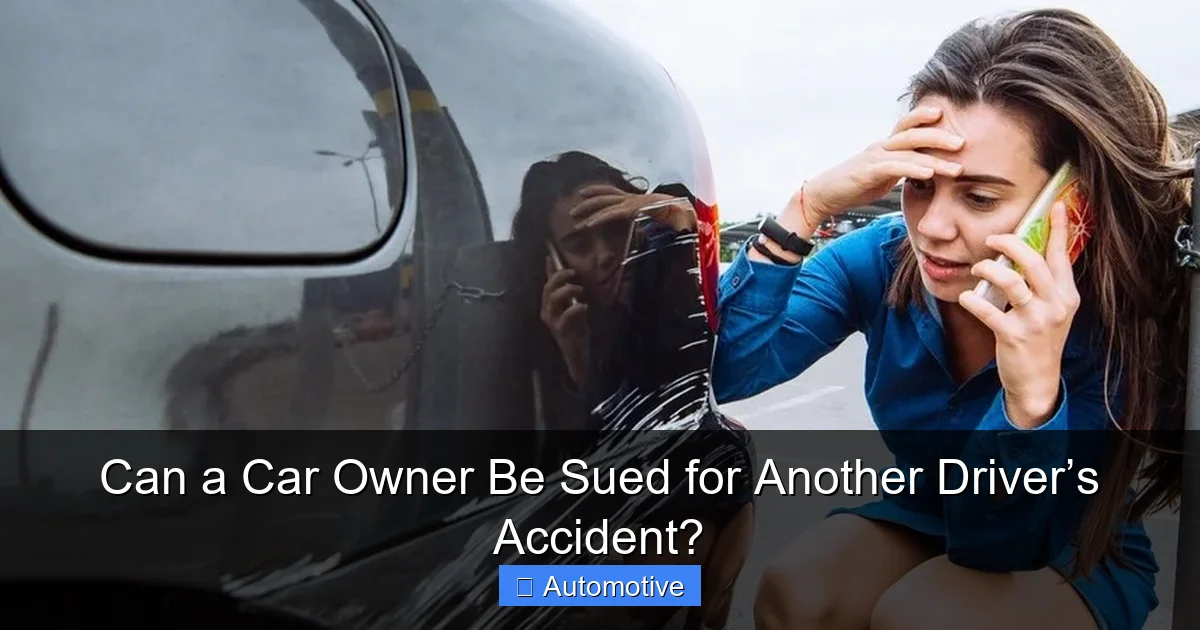
Picture this: You lend your car to a friend for a quick grocery run. Everything seems fine—they’re sober, licensed, and have a clean record. But halfway through the trip, they rear-end another vehicle at a stoplight. The other driver is injured, and now you’re getting a letter from their attorney. You didn’t cause the crash. You weren’t even in the car. So why are you being sued?
It’s a scary thought, but it happens more often than you might think. Many people assume that only the person behind the wheel is responsible for an accident. But in reality, car owners can—and sometimes are—held legally and financially liable when someone else crashes their vehicle.
This doesn’t mean every time you lend your keys, you’re opening yourself up to a lawsuit. But it does mean you need to understand the rules. Liability depends on a mix of state laws, insurance policies, and the circumstances under which you allowed someone else to drive. Whether it’s a family member, friend, or employee, the moment you hand over the keys, you may be stepping into legal territory.
In this guide, we’ll break down exactly when and how a car owner can be sued for another driver’s accident. We’ll explore the legal doctrines that apply, real-life examples, and practical steps you can take to protect yourself. Whether you’re a parent letting your teen borrow the car or a business owner managing a fleet, this information could save you from a costly legal battle.
Understanding Owner Liability in Car Accidents

Visual guide about Can a Car Owner Be Sued for Another Driver’s Accident?
Image source: maggianolaw.com
So, how exactly can someone who wasn’t even driving end up on the hook for an accident? The answer lies in a legal concept known as “vicarious liability.” This means that one person can be held responsible for the actions of another—especially when there’s a relationship or permission involved.
In the context of car accidents, this usually comes into play when the owner of a vehicle allows someone else to drive it. Most states follow what’s called the “permissive use” rule. Under this rule, if you give someone permission to drive your car—whether you say it out loud or it’s implied by past behavior—your insurance policy typically covers any damages they cause, up to your policy limits.
But here’s the catch: if the damages exceed your insurance coverage, the injured party may sue you directly for the difference. That’s because, legally, you’re seen as having entrusted your vehicle to the driver. And if that trust leads to harm, you could share responsibility.
What Is Permissive Use?
Permissive use is a legal term that refers to situations where a vehicle owner allows someone else to operate their car. This doesn’t have to be formal or written. If you hand your keys to a friend and say, “Go ahead, take it,” that’s permissive use. Even if you don’t say anything but regularly let a family member drive your car, courts may consider that implied permission.
Most auto insurance policies are written with permissive use in mind. They state that coverage extends to anyone driving the vehicle with the owner’s consent. So if your cousin borrows your car and gets into a fender bender, your insurance will likely step in to cover the damages—just as if you had been driving.
But again, if the accident results in serious injuries or extensive property damage, your policy limits might not be enough. That’s when lawsuits happen. The injured party may go after the driver first, but if the driver has little or no assets, they’ll turn to the car owner—who often has deeper pockets or better insurance.
When Does Owner Liability Apply?
Not every time someone drives your car will you be liable. Liability usually applies under these conditions:
– The driver had your permission to use the vehicle.
– The accident occurred while the driver was using the car for a purpose you allowed (e.g., running errands, commuting).
– The driver was not acting outside the scope of that permission (e.g., using your car for a joyride or illegal activity without your knowledge).
For example, if you let your roommate borrow your car to pick up dry cleaning, and they cause an accident on the way, you’re likely covered under permissive use. But if they take your car without asking and get into a crash, you probably won’t be held liable—unless you were negligent in securing your keys.
Legal Doctrines That Affect Car Owner Liability

Visual guide about Can a Car Owner Be Sued for Another Driver’s Accident?
Image source: maggianolaw.com
Different states apply different legal rules when determining whether a car owner can be sued. Some follow strict liability standards, while others require proof of negligence. Understanding these doctrines can help you assess your risk.
The Family Purpose Doctrine
In some states—like California, Texas, and Florida—the “family purpose doctrine” holds that a car owner can be held liable for accidents caused by family members who live in the same household, even if the owner wasn’t aware of the specific trip.
This doctrine is based on the idea that the vehicle is used for the benefit of the entire family. So if your spouse, child, or sibling causes an accident while driving your car for a family-related purpose (like taking kids to school or going to the store), you could be on the hook.
For example, imagine your teenage daughter borrows your car to drive her younger brother to soccer practice. She runs a red light and hits another car. Under the family purpose doctrine, you—the car owner—could be sued, even if you didn’t know she was driving that day.
This doctrine doesn’t apply in all states, so it’s important to know your local laws. But if you live in a state that follows it, you should be extra cautious about who in your household has access to your vehicle.
Negligent Entrustment
Another major legal theory is “negligent entrustment.” This applies when a car owner knowingly allows an unfit or dangerous person to drive their vehicle—and that person causes an accident.
To prove negligent entrustment, the injured party must show:
– The owner knew or should have known the driver was incompetent, unlicensed, intoxicated, or otherwise unsafe.
– The owner allowed the driver to use the vehicle anyway.
– The driver’s negligence directly caused the accident and resulting damages.
For instance, if you lend your car to a friend who’s clearly drunk, and they crash into a pedestrian, you could be sued under negligent entrustment. Even if you didn’t cause the crash, your decision to hand over the keys could be seen as reckless.
Courts take this seriously. In one notable case, a man in Ohio was found liable after letting his friend—who had a suspended license and a history of DUIs—drive his truck. The friend caused a fatal accident, and the victim’s family successfully sued the car owner for $2.3 million.
Vicarious Liability and Employer Responsibility
If you’re a business owner, the risks are even higher. Under the legal principle of “respondeat superior,” employers can be held liable for accidents caused by employees acting within the scope of their job.
For example, if a delivery driver uses a company van to make a delivery and causes an accident, the business owner may be sued—even if they weren’t involved in the incident. This is why many companies require commercial auto insurance and conduct background checks on drivers.
Even if an employee uses their own car for work (like a salesperson driving to client meetings), the employer might still be liable under a theory called “negligent hiring” or “negligent supervision” if they failed to ensure the employee was a safe driver.
How Insurance Plays a Role in Owner Liability

Visual guide about Can a Car Owner Be Sued for Another Driver’s Accident?
Image source: injuryclaimcoach.com
Insurance is often the first line of defense when a car owner is sued for another driver’s accident. In most cases, the owner’s auto insurance policy will cover the damages—up to the policy limits—regardless of who was driving, as long as they had permission.
Primary vs. Secondary Coverage
When an accident occurs, insurance companies follow a hierarchy to determine which policy pays first. Typically:
– The car owner’s insurance is primary.
– The driver’s personal insurance (if they have their own policy) is secondary.
For example, if your friend borrows your car and causes $50,000 in damages, your insurance will cover it first—up to your liability limits (say, $100,000). If your friend also has auto insurance, their policy might kick in if damages exceed your limits, but only after yours is exhausted.
This is why it’s crucial to have adequate liability coverage. Minimum state requirements are often too low to cover serious accidents. If damages exceed your policy, you could be personally sued for the difference.
Uninsured and Underinsured Motorist Coverage
Even if the other driver is at fault, your own uninsured/underinsured motorist (UM/UIM) coverage can protect you. This type of coverage steps in when the at-fault driver doesn’t have insurance or doesn’t have enough to cover your damages.
But here’s a twist: if you’re the car owner and someone else is driving your car, your UM/UIM coverage may still apply—depending on your policy and state laws. Some policies extend this coverage to permissive drivers, while others don’t.
Always check your policy details. If you frequently lend your car, consider adding an endorsement that extends UM/UIM coverage to other drivers.
What Happens When Insurance Isn’t Enough?
Unfortunately, insurance doesn’t always cover everything. If the damages exceed your policy limits, the injured party may sue you for the remaining amount. This is especially common in cases involving severe injuries, long-term medical care, or lost wages.
For example, if your policy covers $100,000 in bodily injury liability, but the court awards $300,000 to the victim, you could be personally responsible for the $200,000 difference—unless you have umbrella insurance.
That’s why many financial advisors recommend umbrella policies. These provide extra liability coverage (often $1 million or more) that kicks in after your auto and home insurance limits are reached. It’s a small price to pay for peace of mind.
Real-Life Examples of Car Owner Lawsuits
To understand how these laws play out in real life, let’s look at a few actual cases where car owners were sued for accidents they didn’t cause.
Case 1: The Drunk Friend
In 2018, a woman in Arizona lent her car to a friend who had been drinking at a party. The friend drove off, ran a stop sign, and collided with another vehicle, seriously injuring the driver. The injured party sued both the driver and the car owner.
The court found the owner liable under negligent entrustment, ruling that she should have known her friend was too intoxicated to drive. The owner was ordered to pay $750,000 in damages—partly because her insurance limits were too low to cover the full amount.
Case 2: The Teen Driver
A father in Georgia allowed his 16-year-old son to drive the family SUV to school. The teen, who had only had his license for two months, lost control on a wet road and hit a pedestrian. The pedestrian sued the father, claiming he was negligent in entrusting the vehicle to an inexperienced driver.
The court agreed, citing the family purpose doctrine. The father was held liable for $400,000 in medical expenses and pain and suffering. His insurance covered $300,000, but he had to pay the remaining $100,000 out of pocket.
Case 3: The Employee Accident
A small business owner in Illinois allowed an employee to use a company truck for a weekend trip. The employee caused an accident while returning from the trip, injuring another driver. The victim sued the business owner, arguing that the vehicle was used for work-related purposes.
The court ruled in favor of the victim, stating that the trip was connected to the employee’s job (deliveries were made earlier that week). The business owner had to pay $1.2 million in damages, highlighting the importance of clear policies about vehicle use.
These cases show that liability isn’t just theoretical—it can have serious financial consequences. They also underscore the importance of knowing who’s driving your car and under what circumstances.
How to Protect Yourself as a Car Owner
The good news? There are practical steps you can take to reduce your risk of being sued for someone else’s accident.
Only Lend Your Car to Trusted Drivers
This might seem obvious, but it’s worth repeating: only let people you trust drive your vehicle. That means they should be licensed, insured, and have a clean driving record. Avoid lending your car to anyone who’s been drinking, is distracted, or has a history of reckless behavior.
If you’re unsure, ask questions. “Have you had any accidents in the past year?” “Are you feeling okay to drive?” These simple checks can prevent big problems.
Check Your Insurance Policy
Review your auto insurance policy regularly. Make sure your liability limits are high enough to cover potential damages. Consider adding:
– Umbrella insurance for extra protection.
– Rental reimbursement if your car is in the shop.
– Coverage for permissive drivers (some policies exclude certain people).
If you frequently lend your car, talk to your agent about adding a “named driver” endorsement or adjusting your coverage.
Document Permission and Use
Keep a record of who drives your car and when. A simple log—either digital or on paper—can help if you’re ever sued. Note the date, time, purpose of the trip, and whether you gave explicit permission.
For example: “June 10, 2024 – Gave keys to sister, Maria, to pick up prescription. Returned by 3 PM.”
This documentation can be crucial in defending against claims of negligent entrustment or unauthorized use.
Set Clear Rules for Family Members
If you have teens or other family members who drive your car, establish clear rules. No driving under the influence. No texting while driving. No passengers after midnight. Put these rules in writing and review them regularly.
You might even consider a parent-teen driving agreement, which outlines expectations and consequences. These agreements can reduce risky behavior and protect you legally.
Secure Your Vehicle
Never leave your keys in an unlocked car or in a place where unauthorized people can access them. If someone takes your car without permission and causes an accident, you might still be liable if you were negligent in securing it.
Use key locks, garage storage, or keyless entry systems with PIN codes to reduce the risk of theft or unauthorized use.
What to Do If You’re Sued
Despite your best efforts, you might still face a lawsuit. If that happens, here’s what to do:
Don’t Ignore the Lawsuit
Ignoring a lawsuit won’t make it go away—it could lead to a default judgment against you. As soon as you receive legal papers, contact your insurance company and an attorney.
Notify Your Insurance Company Immediately
Your insurer has a duty to defend you in most cases. Report the lawsuit right away so they can assign a lawyer and begin investigating.
Gather Evidence
Collect all relevant documents: your insurance policy, driving logs, witness statements, photos of the accident scene, and any communication with the driver. This evidence can help prove you weren’t negligent.
Work with Your Attorney
A qualified attorney can help you navigate the legal process, negotiate settlements, and represent you in court if necessary. They’ll also advise you on whether to fight the claim or settle out of court.
Consider Mediation or Settlement
Many lawsuits are resolved through mediation or settlement. This can save time, money, and stress. Your attorney can help determine if a settlement is in your best interest.
Conclusion
So, can a car owner be sued for another driver’s accident? The short answer is yes—under the right (or wrong) circumstances, you could be held legally and financially responsible for someone else’s mistake behind the wheel.
But that doesn’t mean you should never lend your car again. With the right precautions—choosing drivers wisely, maintaining adequate insurance, documenting use, and understanding your state’s laws—you can significantly reduce your risk.
The key is awareness. Knowing that liability doesn’t always end with the driver empowers you to make smarter decisions. Whether you’re a parent, a friend, or a business owner, taking responsibility for who uses your vehicle is one of the most important steps you can take to protect yourself, your assets, and your peace of mind.
Remember: your car is more than just a mode of transportation—it’s a potential liability. Treat it with care, and it will serve you well for years to come.
Frequently Asked Questions
Can I be sued if someone crashes my car without my permission?
In most cases, no—if someone takes your car without your knowledge or consent, you likely won’t be held liable. However, if you were negligent (e.g., left keys in an unlocked car), a court might still find you partially responsible.
Does my insurance cover accidents caused by family members?
Yes, most policies cover permissive drivers, including family members living in your household. But check your policy, as some exclude certain relatives or require them to be listed.
What if the driver has their own insurance?
The driver’s insurance may act as secondary coverage, but your policy is usually primary. Both insurers may share the cost, depending on policy terms and state laws.
Can I be sued if my teen causes an accident?
Yes, especially under the family purpose doctrine. Parents are often held liable for accidents caused by their minor children, particularly if the car was used for family purposes.
How much liability insurance should I have?
Experts recommend at least $100,000 per person and $300,000 per accident for bodily injury, plus property damage coverage. Consider an umbrella policy for added protection.
What is negligent entrustment?
Negligent entrustment occurs when you knowingly allow an unfit driver (e.g., unlicensed, drunk, or reckless) to use your vehicle, and they cause an accident. You can be sued for your role in enabling the harm.