Are Toyota 4runners Awd?

Contents
- 1 Key Takeaways
- 2 📑 Table of Contents
- 3 Understanding AWD vs. 4WD in the Toyota 4Runner
- 4 Which 4Runner Trims Come with AWD or 4WD?
- 5 How the 4Runner’s AWD/4WD System Enhances Performance
- 6 Fuel Economy and Maintenance Considerations
- 7 Should You Buy a 4Runner with AWD or 4WD?
- 8 Conclusion
- 9 Frequently Asked Questions



Yes, most Toyota 4Runners come with available or standard all-wheel drive (AWD), but not all trims include it. The 4Runner offers both part-time 4WD and full-time AWD systems depending on the model and year, making it a top choice for off-road enthusiasts and daily drivers alike.
If you’re in the market for a rugged, reliable SUV that can handle everything from snowy mountain passes to muddy trails, you’ve probably considered the Toyota 4Runner. It’s a legend in the off-road world—known for its durability, boxy design, and go-anywhere attitude. But one question keeps popping up among buyers: Are Toyota 4Runners AWD?
The short answer? Yes—but it’s not quite that simple. While most 4Runners come equipped with some form of all-wheel drive (AWD) or four-wheel drive (4WD), not every model includes it as standard. The availability depends on the trim level, model year, and whether you’re looking at a new or used vehicle. Understanding the difference between AWD and 4WD—and how Toyota implements these systems in the 4Runner—is key to knowing whether this SUV fits your lifestyle.
Whether you’re planning weekend camping trips, daily city commutes, or tackling rocky backcountry trails, the drivetrain plays a huge role in performance and safety. In this guide, we’ll break down everything you need to know about the Toyota 4Runner’s AWD and 4WD systems, including how they work, which trims offer them, and what to look for when shopping. By the end, you’ll have a clear picture of whether the 4Runner’s all-wheel-drive capability matches your needs.
Key Takeaways
- Most 4Runners have AWD or 4WD options: Nearly every 4Runner trim offers some form of all-wheel drive, though availability varies by model year and package.
- Two main drivetrain systems: Toyota offers part-time 4WD (for off-roading) and full-time AWD (for everyday driving with improved traction).
- SR5 and TRD models commonly include 4WD: These popular trims often come standard or optionally equipped with 4WD, ideal for rugged terrain.
- 2WD models exist but are less common: Some base models, especially older ones, may come with rear-wheel drive (RWD), but AWD/4WD is widely available.
- AWD enhances safety and performance: All-wheel drive improves handling in rain, snow, and off-road conditions, making the 4Runner a versatile SUV.
- Check trim and year before buying: Always verify the drivetrain configuration when shopping for a used or new 4Runner to ensure it meets your needs.
- 4Runner’s AWD is built for adventure: With high ground clearance and robust suspension, the 4Runner’s AWD system is designed for real off-road capability, not just light weather traction.
📑 Table of Contents
Understanding AWD vs. 4WD in the Toyota 4Runner
Before diving into which 4Runners have AWD, it’s important to understand the difference between all-wheel drive (AWD) and four-wheel drive (4WD). These terms are often used interchangeably, but they serve different purposes and operate in distinct ways.
AWD systems automatically send power to all four wheels when needed, typically for improved traction in slippery conditions like rain, snow, or light off-roading. They’re designed for everyday driving and work seamlessly in the background without driver input. Most modern AWD systems are full-time, meaning all wheels are powered continuously, or part-time, engaging only when sensors detect wheel slip.
4WD, on the other hand, is built for serious off-road use. It allows the driver to manually engage all four wheels, often with a low-range gear for crawling over rocks, climbing steep inclines, or powering through deep mud. 4WD systems are typically part-time, meaning they’re not meant for constant use on dry pavement, which can cause drivetrain damage.
So, where does the Toyota 4Runner fit in? The 4Runner primarily uses a 4WD system, but some models—especially in earlier years—offered a full-time AWD setup. Let’s explore how Toyota has implemented these systems over the years.
Part-Time 4WD: The 4Runner’s Off-Road Workhorse
The majority of Toyota 4Runners, especially from the fourth generation (2003–2009) onward, come with a part-time 4WD system. This system uses a transfer case that allows the driver to switch between two-wheel drive (2WD) and four-wheel drive (4WD) using a lever or electronic switch.
In 2WD mode, power is sent only to the rear wheels, which improves fuel efficiency during normal driving. When you hit a slippery road or head off the pavement, you can engage 4WD High for better traction at normal speeds. For extreme off-road conditions—like rock crawling or deep snow—you can shift into 4WD Low, which provides maximum torque and crawling power.
This system is ideal for drivers who want the flexibility to save fuel on the highway but still tackle tough terrain when needed. It’s one of the reasons the 4Runner remains a favorite among overlanders and outdoor enthusiasts.
Full-Time AWD: Rare but Available
While less common, some Toyota 4Runners—particularly earlier models—came with a full-time AWD system. This setup sends power to all four wheels at all times, automatically adjusting torque distribution based on driving conditions. It’s similar to the AWD systems found in crossovers like the Toyota RAV4, but tuned for the 4Runner’s heavier, more rugged frame.
Full-time AWD was more prevalent in the third-generation 4Runner (1996–2002), especially in the Limited trim. These models used a center differential that allowed for smooth operation on dry pavement while still providing excellent traction in adverse weather. However, Toyota gradually phased out full-time AWD in favor of the more off-road-capable part-time 4WD system.
Today, if you find a 4Runner with full-time AWD, it’s likely a used model from the early 2000s. For most buyers, the part-time 4WD system offers better off-road performance and is more aligned with the 4Runner’s rugged identity.
Which 4Runner Trims Come with AWD or 4WD?
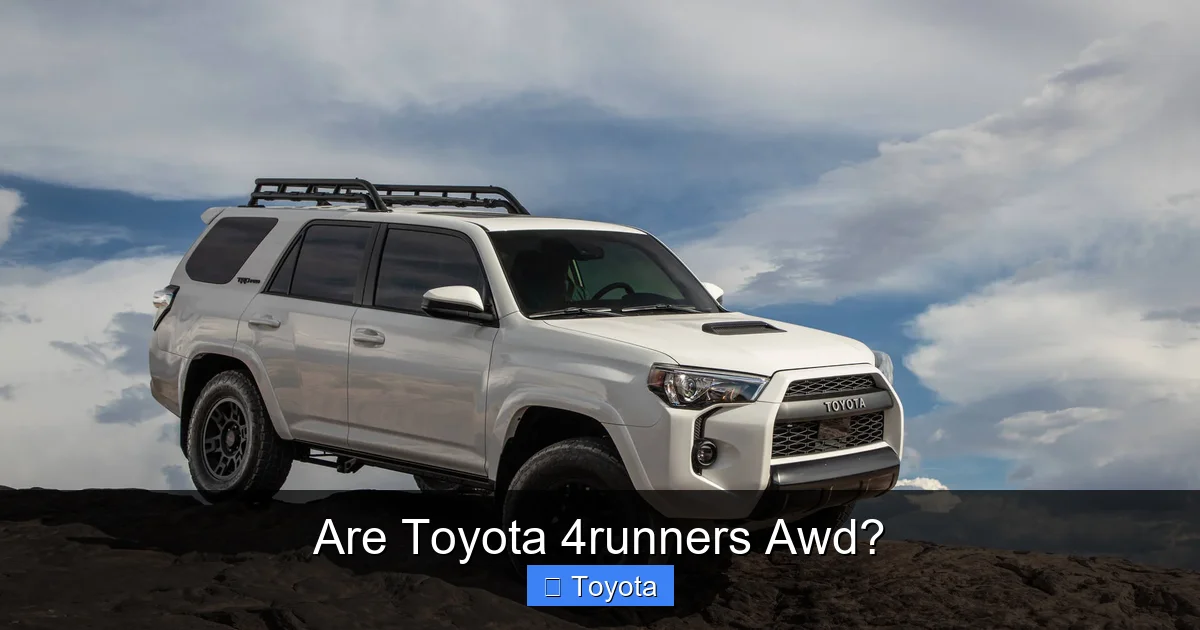
Visual guide about Are Toyota 4runners Awd?
Image source: i.gaw.to
Now that we’ve covered the types of drivetrains, let’s look at which 4Runner trims actually offer AWD or 4WD. The answer depends on the model year, but as a general rule, most 4Runners—especially newer ones—come with 4WD as standard or optional equipment.
New 4Runners (2020–2024): 4WD is Standard on Most Trims
If you’re shopping for a new Toyota 4Runner, you’ll find that 4WD is standard on nearly every trim level. The only exception is the base SR5 trim, which offers 4WD as an option. Here’s a quick breakdown:
– SR5: 4WD is optional. You can choose between 2WD and 4WD when configuring your vehicle.
– SR5 Premium: 4WD is standard.
– TRD Off-Road: 4WD is standard, with additional off-road features like crawl control and multi-terrain select.
– TRD Off-Road Premium: 4WD standard, plus upgraded interior and tech features.
– TRD Pro: 4WD standard, with Fox shocks, skid plates, and aggressive styling for serious off-roading.
– Limited: 4WD standard, with luxury features like leather seats and a premium sound system.
– Nightshade: 4WD standard, with blacked-out exterior accents.
This means that unless you specifically choose a 2WD SR5, your new 4Runner will come with 4WD. For most buyers, that’s a good thing—especially if you live in an area with snow, rain, or rough roads.
Used 4Runners: What to Look For
When shopping for a used 4Runner, the situation gets a bit more complicated. Older models, especially from the 1990s and early 2000s, may have different drivetrain configurations. Some came with full-time AWD, while others had part-time 4WD or even rear-wheel drive (RWD).
Here’s a quick guide by generation:
– First Generation (1984–1989): Mostly 4WD, but some early models had RWD.
– Second Generation (1990–1995): 4WD was common, but RWD was still available on base models.
– Third Generation (1996–2002): 4WD standard on most trims; Limited models often had full-time AWD.
– Fourth Generation (2003–2009): 4WD standard on most trims; 2WD available on base SR5.
– Fifth Generation (2010–present): 4WD standard on most trims; 2WD only on base SR5.
If you’re buying used, always check the vehicle’s VIN or ask the seller about the drivetrain. A quick look at the transfer case or shift lever can also give you clues—4WD models usually have a secondary shifter or electronic switch for engaging 4WD.
How the 4Runner’s AWD/4WD System Enhances Performance
Visual guide about Are Toyota 4runners Awd?
Image source: overtake-images.sfo2.digitaloceanspaces.com
So, what does having AWD or 4WD actually do for the 4Runner’s performance? The answer depends on your driving conditions, but in general, these systems provide significant advantages in traction, stability, and off-road capability.
Improved Traction in Adverse Weather
One of the biggest benefits of AWD or 4WD is better grip in slippery conditions. Whether you’re driving through a snowstorm, heavy rain, or muddy backroads, having power sent to all four wheels reduces the chance of wheel spin and helps maintain control.
For example, imagine you’re driving up a snowy mountain pass in a 2WD vehicle. When you hit a patch of ice, the rear wheels might lose traction, causing the vehicle to slide or get stuck. In a 4Runner with 4WD engaged, power is distributed to all wheels, giving you better grip and helping you power through the snow.
Even in full-time AWD models, the system automatically adjusts torque to the wheels with the most traction, improving safety without requiring driver input.
Off-Road Dominance
Where the 4Runner really shines is off the pavement. The combination of 4WD, high ground clearance (up to 9.6 inches on TRD Pro models), and a robust suspension system makes it one of the most capable SUVs in its class.
Let’s say you’re heading out on a weekend camping trip and need to cross a rocky riverbed or climb a steep, muddy trail. In 4WD Low mode, the 4Runner can crawl over obstacles with precision, thanks to its low-range gearing and torque multiplication. Features like crawl control (available on TRD Off-Road and TRD Pro trims) act like an off-road cruise control, automatically managing speed and braking so you can focus on steering.
Compare that to a typical crossover with AWD—while it might handle light snow or gravel roads, it’s not built for serious off-roading. The 4Runner’s body-on-frame construction and heavy-duty components give it a clear advantage when the going gets tough.
Daily Driving Benefits
You don’t need to be an off-road enthusiast to benefit from the 4Runner’s AWD or 4WD system. Even in everyday driving, these systems provide added confidence and safety.
For instance, if you live in a region with frequent rain or occasional snow, having 4WD can make a big difference in winter months. You’ll notice better acceleration from a stop, more stable handling on wet roads, and reduced risk of getting stuck in a snowbank.
And because most 4Runners with 4WD can be switched back to 2WD for normal driving, you still get decent fuel economy when you don’t need the extra traction.
Fuel Economy and Maintenance Considerations
Visual guide about Are Toyota 4runners Awd?
Image source: autocareaids.com
While AWD and 4WD offer clear performance benefits, they do come with some trade-offs—mainly in fuel economy and maintenance.
Fuel Efficiency Impact
All-wheel drive and four-wheel drive systems add weight and mechanical complexity, which can reduce fuel efficiency. In the 4Runner, this is especially noticeable because the SUV already has a boxy design and powerful V6 engine.
For example, a 2023 Toyota 4Runner SR5 with 2WD gets an EPA-estimated 16 mpg city and 19 mpg highway. The same model with 4WD drops to 16 mpg city and 18 mpg highway—a small but noticeable difference.
Over time, that can add up. If you drive 15,000 miles per year and gas costs $3.50 per gallon, the 4WD model could cost you an extra $100–$150 annually in fuel.
That said, for many buyers, the added capability and safety are worth the slight drop in efficiency. And if you only engage 4WD when needed, you can minimize the impact by running in 2WD mode during normal driving.
Maintenance and Repair Costs
4WD systems require more maintenance than 2WD setups. The transfer case, front differential, and driveshaft all need periodic servicing, and repairs can be more expensive if something goes wrong.
For example, a failed transfer case or worn-out U-joints can cost hundreds of dollars to fix. Regular maintenance—like changing the transfer case fluid every 30,000 to 60,000 miles—can help prevent major issues.
However, Toyota’s 4WD system is known for its reliability. With proper care, it can last the life of the vehicle. Many 4Runners with high mileage still have functioning 4WD systems, a testament to Toyota’s engineering.
Should You Buy a 4Runner with AWD or 4WD?
Now that you know the ins and outs of the 4Runner’s drivetrain options, the big question remains: Should you get one with AWD or 4WD?
The answer depends on your needs, driving habits, and budget.
Choose 4WD If:
– You live in an area with snow, rain, or rough roads.
– You plan to go off-roading, camping, or overlanding.
– You want maximum traction and capability.
– You’re buying a TRD Off-Road, TRD Pro, or Limited trim.
Consider 2WD Only If:
– You live in a warm, dry climate with smooth roads.
– You prioritize fuel economy over off-road performance.
– You’re on a tight budget and the 2WD model is significantly cheaper.
– You don’t plan to drive in adverse conditions.
Keep in mind that even if you don’t go off-roading, 4WD can be a lifesaver in unexpected situations—like a sudden snowstorm or a flooded road. It’s one of those features you hope you never need, but you’ll be glad to have when you do.
Final Tip: Test Drive Both
If you’re on the fence, try test driving both a 2WD and 4WD 4Runner. You might not notice a huge difference on dry pavement, but the 4WD model will feel more planted and confident in slippery conditions. And if you get the chance, take it on a dirt road or through a puddle—see how it handles when the traction gets tricky.
Conclusion
So, are Toyota 4Runners AWD? The answer is nuanced, but generally yes—most 4Runners come with some form of all-wheel drive or four-wheel drive, especially in newer models. While full-time AWD is rare and mostly found in older Limited trims, the part-time 4WD system is standard on nearly every 4Runner today, making it one of the most capable and versatile SUVs on the market.
Whether you’re navigating city streets, mountain highways, or remote trails, the 4Runner’s AWD and 4WD systems provide the traction, stability, and confidence you need. Just remember to check the trim and drivetrain configuration before buying, especially if you’re shopping used.
With its legendary durability, off-road prowess, and available all-wheel drive, the Toyota 4Runner remains a top choice for adventurers and daily drivers alike. If you’re looking for an SUV that can handle anything you throw at it—rain, snow, mud, or mountain—then yes, the 4Runner with AWD or 4WD is definitely worth considering.
Frequently Asked Questions
Are all Toyota 4Runners AWD?
No, not all Toyota 4Runners are AWD. While most trims offer 4WD (four-wheel drive) as standard or optional, some base models—especially older ones—come with rear-wheel drive (RWD). Always check the specific trim and model year to confirm the drivetrain.
What’s the difference between AWD and 4WD in a 4Runner?
AWD (all-wheel drive) sends power to all wheels automatically for better traction in everyday conditions, while 4WD (four-wheel drive) is manually engaged and designed for off-road use. The 4Runner primarily uses a part-time 4WD system for rugged performance.
Can I drive a 4Runner with 4WD on dry pavement?
Yes, but only in 2WD mode. The part-time 4WD system should not be used on dry pavement as it can cause drivetrain binding. Use 4WD High only on slippery or loose surfaces, and switch back to 2WD when conditions improve.
Do 4Runners with 4WD get worse gas mileage?
Yes, slightly. 4WD adds weight and mechanical resistance, reducing fuel economy by about 1 mpg compared to 2WD models. However, the difference is small, and many drivers find the added capability worth the trade-off.
Is the 4Runner’s 4WD system reliable?
Yes, Toyota’s 4WD system is known for its durability and long-term reliability. With regular maintenance—like fluid changes—it can last well over 200,000 miles without major issues.
Can I add AWD or 4WD to a 2WD 4Runner?
No, you cannot retrofit a 2WD 4Runner with AWD or 4WD. The drivetrain, frame, and components are fundamentally different. If you need 4WD, you must purchase a model that originally came with it.