
Does Ford Own Maserati?

No, Ford does not own Maserati. Maserati is currently owned by Stellantis, the multinational automotive giant formed from the merger of Fiat Chrysler Automobiles (FCA) and PSA Group. While Ford has never owned the Italian luxury brand, a historical partnership in the 1990s and Ford’s own luxury brand, Lincoln, often fuel this common misconception. The truth involves a complex web of Italian industrial history and modern corporate mergers.
Key Takeaways
- Ford never owned Maserati: Despite a close technical partnership in the 1990s, Ford was never a majority or full owner of the Maserati brand.
- Current owner is Stellantis: Maserati has been part of Fiat Chrysler Automobiles (FCA) since 1993 and is now under the Stellantis umbrella following the 2021 merger with PSA Group.
- The 1990s partnership caused confusion: Ford supplied engines and components for Maserati’s Biturbo and Shamal models, leading many to believe Ford had acquired the company.
- Maserati’s history is independently Italian: The brand was founded in 1914 and has been owned by various Italian entities, most notably the Orsi family and later Fiat.
- Ford’s luxury focus was on Lincoln: Ford’s own premium brand ambitions were centered on Lincoln (and later Mercury), not on acquiring foreign exotic marques like Maserati.
- Corporate structures are complex: The modern auto industry is defined by holding companies and cross-shareholdings, making simple “X owns Y” answers sometimes misleading.
📑 Table of Contents
- Introduction: Unraveling a Common Automotive Myth
- The Ford-Maserati Connection: What Actually Happened in the 1990s?
- Maserati’s Ownership Timeline: From Founding to Stellantis
- Current Ownership: Stellantis and the Future of Maserati
- Why Do People Think Ford Owns Maserati? The Psychology of Brand Confusion
- Conclusion: Setting the Record Straight
Introduction: Unraveling a Common Automotive Myth
If you’ve ever found yourself staring at a sleek, low-slung Maserati on the street and wondered, “Does Ford own Maserati?” you’re not alone. It’s one of the most frequently asked questions in the automotive world, right up there with “Does Audi own Porsche?” (the answer to that one is also no, by the way—it’s Volkswagen Group). The confusion is understandable. Both are historic brands with a focus on performance and luxury. Both have iconic trident and blue oval logos that are instantly recognizable. And in the 1990s, their engineering teams worked incredibly closely together. But the simple, definitive answer is: No, Ford Motor Company has never owned Maserati.
This myth persists because it seems logical. Ford is an American giant. Maserati is an Italian icon. In an era of massive global conglomerates buying up prestigious brands, it feels like a match that should have happened. But Maserati’s path has always been distinctly Italian, winding through family ownership, nationalized industries, and ultimately landing within the sphere of what is now Stellantis. To truly understand why Ford doesn’t own Maserati, we need to dive into the actual history of both companies, examine that pivotal 1990s partnership, and trace Maserati’s journey to its current home. We’ll also explore why this particular myth is so resilient and what it tells us about how we perceive brand ownership in the modern automotive landscape.
The Ford-Maserati Connection: What Actually Happened in the 1990s?
The root of the “Ford owns Maserati” myth lies in a very real and deeply collaborative technical partnership that defined Maserati’s product line for nearly a decade. It wasn’t an acquisition; it was a lifeline. To understand this, we need to set the stage for Maserati in the late 1980s.
Visual guide about Does Ford Own Maserati?
Image source: motorverso.com
Maserati in Crisis: The Biturbo Era
By the mid-1980s, Maserati, then owned by the Italian state-run holding company GEPI (which had bailed it out in 1975), was in trouble. Its flagship model, the Biturbo, was intended to be a competitive, relatively affordable luxury sports sedan. However, it was plagued with reliability issues, particularly with its complex twin-turbocharged engines and cooling systems. The brand’s reputation for exquisite craftsmanship was tarnishing. Maserati needed a savior with deep engineering resources and, crucially, robust drivetrain technology.
Ford Steps In: A Partnership, Not a Purchase
Enter Ford of Europe. In 1989, Ford and Maserati signed a pivotal agreement. Ford would supply complete powertrains—engines and transmissions—for the next generation of Maserati cars. This was not a secret buyout; it was a public, contractual partnership. The first fruits of this labor were the 1991 Maserati Shamal and the 1992 Maserati Ghibli (the first of the modern Ghibli nameplate). These cars used a development of Ford’s robust and proven 2.0-liter and 2.8-liter V6 twin-turbo engines, mated to Ford-sourced automatic transmissions. The collaboration was a massive success from an engineering standpoint. The new engines were significantly more reliable and powerful than the problematic Maserati units they replaced. This technical dependence on Ford became the defining characteristic of Maserati for the next seven years.
During this period, from roughly 1991 to 1998, Maserati was still an independent Italian company, but one breathing with Ford’s mechanical heart. The Shamal, Ghibli, and later the 3200 GT all relied on Ford-derived V6 power. This deep integration is the single biggest reason people assumed Ford owned Maserati. If a car has Ford parts under the hood, the logic follows, it must be a Ford. But in reality, it was a supplier relationship, akin to how many brands use components from Bosch or Magna. Ford was a critical partner and parts supplier, not a parent company.
Maserati’s Ownership Timeline: From Founding to Stellantis
To put the Ford partnership in context, let’s trace the full ownership timeline of Maserati since its founding. This journey is a microcosm of 20th-century Italian industrial history.
Visual guide about Does Ford Own Maserati?
Image source: rcfact.com
The Founding and the Orsi Family (1914-1937)
The Maserati brothers—Alfieri, Bindo, Carlo, Ernesto, and Ettore—founded the company in Bologna in 1914, initially building race cars. After Alfieri’s death in 1932, the remaining brothers struggled to keep the company afloat during the Great Depression. In 1937, they sold the company to the Orsi family, industrialists from Modena. The Orsis moved production to their hometown and, under the leadership of Adolfo Orsi, steered Maserati through the pre-war and post-war periods, balancing racing ambitions with road car production. This era established Maserati’s identity as a builder of exclusive, high-performance grand tourers.
State Intervention and the Fiat Era Begins (1968-1993)
In 1968, facing financial difficulties again, the Orsi family sold Maserati to the French automobile manufacturer Citroën. This partnership brought some technological sharing (like the Citroën-derived hydropneumatic suspension on the Merak SS) but ultimately ended in failure. By 1975, Citroën was in its own crisis, and the Italian government, keen to preserve the national automotive heritage, orchestrated a bailout through the state-owned holding company GEPI. Maserati was placed under the control of the de Tomaso group, owned by the flamboyant Argentine-Italian industrialist Alejandro de Tomaso. De Tomaso, who also owned Innocenti and had a stake in Benelli, ran Maserati as part of his personal industrial empire for nearly two decades. During this time, the infamous Biturbo was developed and launched. It was under de Tomaso’s ownership that Maserati’s financial and quality problems intensified, setting the stage for the need for a partner like Ford.
The Fiat Takeover and The Ford Partnership (1993-2000)
In 1993, Fiat S.p.A., the massive Italian automotive conglomerate, purchased Maserati from de Tomaso. This is a critical date. From 1993 onward, Maserati has been owned by an Italian entity that was either Fiat itself or a company descended from Fiat. The Ford partnership, which began in 1989, continued seamlessly under this new Fiat ownership. Fiat saw the value in the Ford engineering collaboration and let it run its course. When the partnership ended around 1998, Fiat was already investing heavily in Maserati’s renaissance, culminating in the stunning 3200 GT in 1998 and the Quattroporte in 2003. So, while Ford was the engine supplier during the Fiat ownership period, Ford never owned the brand. Fiat was the true owner during this entire time.
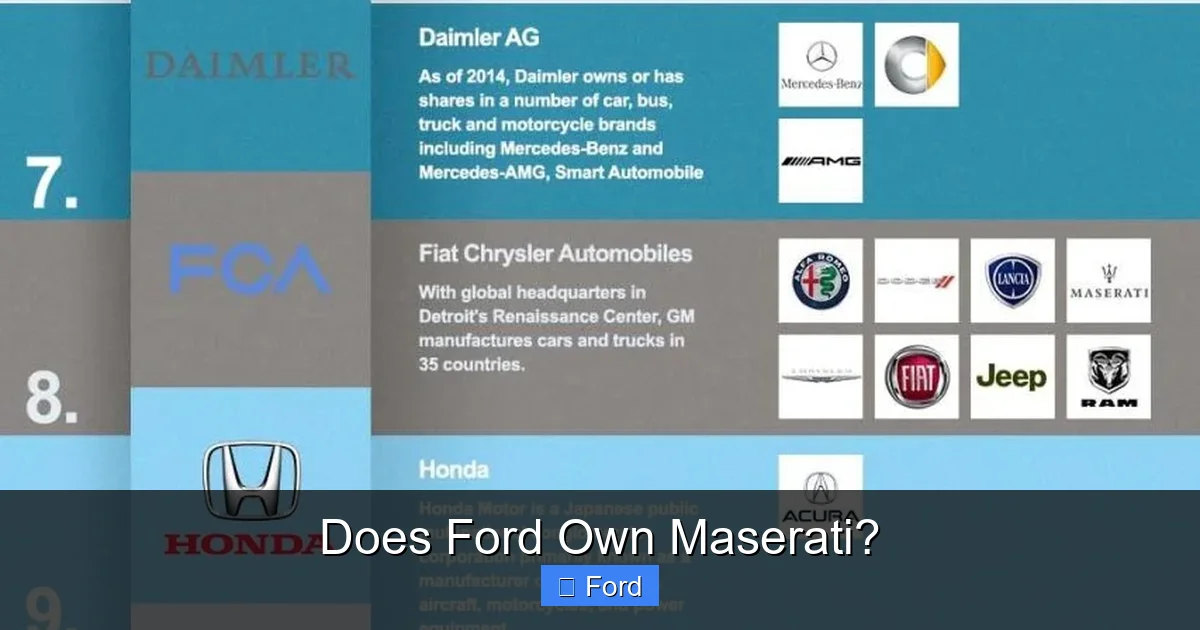
Fiat Chrysler Automobiles (FCA) and the Stellantis Merger (2014-Present)
The next major shift came in 2014 when Fiat and Chrysler merged to form Fiat Chrysler Automobiles (FCA). Maserati became part of FCA’s “Alfa Romeo-Maserati” brand group. This period saw Maserati’s aggressive expansion with the introduction of the Levante SUV in 2016 and the Ghibli sedan’s repositioning as a more accessible entry model. For those curious about the pricing of this new wave of Maseratis, our detailed look at how much a Maserati costs breaks down the ranges for different models and years. Then, in 2021, FCA merged with PSA Group (Peugeot, Citroën, etc.) to form Stellantis, the world’s fourth-largest automaker by volume. Maserati is now a brand within the Stellantis constellation, owned by a Dutch-domiciled parent company with a truly global footprint. Its Italian heritage is preserved in its design, engineering, and production (at the historic Modena and Turin plants), but its corporate home is a European multinational.
Current Ownership: Stellantis and the Future of Maserati
So, who calls the shots at Maserati today? The chain of command runs from the boardrooms of Stellantis N.V. in Amsterdam down to the Maserati headquarters in Modena. Stellantis is led by Chairman John Elkann (of the Agnelli family, which controls Exor, the largest shareholder of Fiat/Stellantis) and CEO Carlos Tavares. Maserati operates as a distinct brand within Stellantis’s “Premium” segment, alongside Alfa Romeo, DS, and others.
Visual guide about Does Ford Own Maserati?
Image source: pictures.dealer.com
The Stellantis Strategy for Maserati
Under Stellantis, Maserati is undergoing a significant transformation, often called the “Maserati 2025” or “Alfa Romeo-Maserati” strategy. The goals are clear: increase production volume, introduce a full electrified lineup (with the first fully electric models expected soon), and compete more directly with German luxury brands like BMW, Mercedes-AMG, and Porsche. The introduction of the MC20 supercar in 2020 was a flagship statement of intent, showcasing a new, in-house developed V6 engine. The brand is also heavily investing in its SUV lineup, with the Levante being its best-seller. Understanding the cost of ownership for these vehicles is key for potential buyers, which is why our guide to insuring a Maserati is such a popular resource.
Why This Matters to Enthusiasts and Buyers
The corporate owner has real-world implications. Stellantis’s vast resources mean shared platforms, hybrid and electric technology, and economies of scale. For example, the next-generation Maserati models will likely share some electrical architecture and possibly even some platform components with other Stellantis brands. This can help control costs and accelerate development. However, purists often worry that this integration will dilute the unique, hand-crafted Italian character that defines Maserati. The challenge for Stellantis is to leverage its might without losing the soul of the Trident brand. For someone looking at a used Maserati from the Fiat or early FCA era, knowing the ownership history is crucial for understanding parts availability and service expertise. A Maserati service cost breakdown can vary significantly between a 1990s Ford-engined model and a 2020s Stellantis-era model.
Why Do People Think Ford Owns Maserati? The Psychology of Brand Confusion
The myth is so persistent because of several powerful cognitive and marketing factors that blur the lines of corporate ownership in our minds.
The Power of the “Engine Partnership”
As detailed, the Ford engine supply deal was deep and long-lasting. For a generation of car enthusiasts, “Maserati” and “Ford V6” were inseparable concepts. The sound, the maintenance procedures, the parts catalog—all had a distinct Ford flair. When a brand’s mechanical identity is so intertwined with another, it’s natural to assume a deeper relationship. This is compounded by the fact that during the same period, Ford owned other luxury brands like Jaguar (1989-2008) and had a stake in Aston Martin. It looked like Ford was on a buying spree for prestigious European brands, so adding Maserati to the list seemed plausible.
Ford’s Own Luxury Ambitions: The Lincoln-Mercury Division
Ford has always had its own internal luxury division, primarily Lincoln (and formerly Mercury). When people think of Ford’s luxury aspirations, they think of Lincoln Town Cars, Navigators, and MKZs. There’s a cognitive gap: if Ford wants a luxury brand, why wouldn’t it just use Lincoln? Why would it need to buy an exotic Italian brand? The answer is strategic. Lincoln was (and is) focused on the American luxury market—large sedans and SUVs emphasizing comfort and quietness. Maserati, even in its more accessible modern form, is a global performance-luxury brand with a very different image, rooted in racing and Italian style. The two serve different purposes. Ford never needed Maserati to fulfill its luxury segment goals; Lincoln was its tool for that. The confusion arises because people merge the concepts of “Ford’s luxury cars” and “Ford buying foreign luxury brands.”
The “Big Auto Conglomerate” Assumption
Today’s landscape is dominated by giants: Volkswagen Group (VW, Audi, Porsche, Lamborghini, Bentley, etc.), Toyota (Lexus), Hyundai (Genesis), and Stellantis (Maserati, Alfa Romeo). It’s easy to assume all premium brands are bundled under a few massive umbrellas. Since Ford is a massive automaker itself, the assumption is that it must own other luxury names. In reality, Ford has largely stayed out of the “brand portfolio” game compared to its rivals. Its acquisitions have been strategic and focused (like its 33% stake in Mazda for many years, or its ownership of Aston Martin from 1987-1991, which was also a partnership, not a full buyout). The modern Ford Motor Company is primarily focused on its Ford and Lincoln brands, plus significant minority investments and partnerships (like with Rivian). The idea that it quietly owns a brand like Maserati is a fiction born from this oversimplified view of the industry.
Conclusion: Setting the Record Straight
So, to state it unequivocally one final time: Ford does not own Maserati, never has, and never did. The truth is both simpler and more interesting than the myth. Maserati’s story is one of Italian resilience. From the visionary Maserati brothers, through the stewardship of the Orsi family, the turbulent de Tomaso era, and the savior of Fiat (and now Stellantis), the Trident has remained an independent marque within the Italian industrial family. The Ford chapter was a period of crucial technical cooperation, a partnership that saved Maserati from its own engineering missteps and allowed it to produce some of its most beloved modern cars, like the Shamal and the first Ghibli. But the ownership papers always remained with an Italian entity—first de Tomaso, then Fiat.
This myth’s endurance is a testament to how deeply that Ford engineering influenced Maserati’s identity in the 1990s and how we, as car fans, try to fit complex corporate histories into neat, familiar boxes. Understanding the real history is more rewarding. It highlights Maserati’s ability to survive and thrive through different owners, always clinging to its core mission of building exclusive, soulful sports and luxury cars. As Maserati charges into its electric future under the Stellantis banner, it does so with a lineage that is proudly, unambiguously its own—not an offshoot of the blue oval, but a distinct chapter in the grand story of Italian automotive excellence. The next time you see a Maserati, you’ll know its true heritage, and you can appreciate the sound of its engine (whether Ford-derived or Stellantis-developed) as the note of an independent legend.
Frequently Asked Questions
Did Ford ever own Maserati?
No, Ford never owned Maserati. While Ford supplied engines and transmissions for Maserati models from 1991 to 1998, the Italian brand was owned by the de Tomaso group and later by Fiat during that entire period. The relationship was a technical partnership, not an acquisition.
Who owns Maserati now?
Maserati is currently owned by Stellantis N.V., the multinational automotive group formed in 2021 from the merger of Fiat Chrysler Automobiles (FCA) and PSA Group. Maserati has been part of Fiat’s sphere of influence since 1993.
Why do Maseratis from the 1990s have Ford engines?
Due to reliability issues with its own engines, Maserati partnered with Ford of Europe in 1989. Ford supplied complete V6 twin-turbo powertrains for models like the Shamal, Ghibli, and 3200 GT until the partnership ended around 1998. This engineering collaboration is the source of the ownership confusion.
What is the connection between Ford and Maserati today?
There is no current corporate or ownership connection between Ford and Maserati. Maserati is a brand within Stellantis, while Ford operates independently with its Ford and Lincoln brands. Any mechanical parts commonality ended over two decades ago.
Is Maserati considered a luxury brand?
Yes, Maserati is unequivocally a luxury automotive brand. It positions itself in the premium sports and luxury segment, competing with brands like Porsche, BMW M, and Mercedes-AMG, with a focus on Italian design, performance, and exclusivity.
Will Ford ever buy Maserati?
There is no indication or credible rumor that Ford has any interest in acquiring Maserati. Ford’s luxury strategy is focused on its Lincoln brand in North America and its performance division, Ford Performance. Maserati’s future is firmly aligned with the Stellantis group’s electrification and volume expansion plans.
