
How Long Is a Ford F-150

The length of a Ford F-150 is not a single number—it varies dramatically based on cab configuration (Regular Cab, SuperCab, SuperCrew) and bed length (5.5-foot, 6.5-foot, or 8-foot). Overall lengths range from approximately 210 inches for the shortest configuration to over 260 inches for the longest. These differences directly affect parking ease, maneuverability, cargo capacity, and towing stability. Knowing the precise dimensions for your desired setup is essential before purchase. Always measure your garage or typical parking spots against the specific configuration you choose.
So, you’re eyeing a Ford F-150. Smart move. It’s been America’s best-selling truck for decades for good reason—it’s tough, versatile, and comes in more flavors than a giant ice cream shop. But before you sign on the dotted line, there’s one critical question you absolutely must answer: how long is a Ford F-150? The answer isn’t simple, and that’s exactly what we’re here to unpack. Because knowing the exact length of the specific configuration you want isn’t just trivia; it’s the key to whether that truck fits in your garage, your parking spot at work, and your life. Let’s dive in and measure every inch.
Key Takeaways
- Length varies by configuration: The F-150’s total length changes significantly with cab style (2-door vs. 4-door) and bed size, creating multiple distinct dimensions.
- Three bed lengths are available: Short (5.5 ft), Standard (6.5 ft), and Long (8 ft). The bed length is the primary driver of overall truck length.
- Model year matters: Dimensions have evolved slightly over generations. A 2024 F-150 is not identical in length to a 2015 model, even with the same cab/bed combo.
- Longer isn’t always better: While an 8-foot bed offers max cargo, it creates a much longer vehicle that’s harder to park and less maneuverable in tight spaces.
- Wheelbase is a key related metric: The distance between axles (wheelbase) changes with configuration and heavily influences ride quality, cabin space, and towing stability.
- Compare before you buy: Always compare the F-150’s specific configuration length against competitors. For example, a Toyota Tacoma’s maximum bed length is shorter (see how long is a Toyota Tacoma truck bed).
- Practical implications are huge: Length affects garage fit, turning circle, ease of loading/unloading, and even fuel economy due to weight and aerodynamics.
[FEATURED_IMAGE_PLACEHOLDER]
📑 Table of Contents
Decoding the Numbers: It’s Not Just One Length
When someone asks “how long is a Ford F-150?” they often picture one generic truck. But Ford builds the F-150 in a stunning array of configurations. The total length is a sum of several parts: the front overhang (from the front bumper to the front axle), the wheelbase (distance between front and rear axles), and the rear overhang (from the rear axle to the back bumper). The bed length is a major component of that rear overhang.
The Big Three: Cab Styles
First, you choose your cab. This is the passenger compartment. For the current generation (introduced for 2021), you have three main choices:
- Regular Cab: This is the classic two-door setup with a small rear seat (or just storage). It’s the shortest cab option.
- SuperCab (or SuperCrew®): Wait, this is confusing. Ford uses “SuperCab” for the version with rear-hinged smaller rear doors and a smaller rear seat area. The “SuperCrew” has four full-sized doors and a spacious rear cabin. Both are considered “extended” or “crew” cabs, but they have different lengths. For our length discussion, the SuperCrew is longer than the SuperCab.
Here’s the crucial part: for a given bed length, a SuperCrew is longer than a SuperCab, which is longer than a Regular Cab. The extra door and rear seat space add inches to the overall vehicle.
The Bed Length Breakdown
Next, you pick your bed. This is the cargo box in the back. There are three standard lengths:
- 5.5-foot Bed: The shortest. Typically only available with the SuperCrew cab on certain trims (like the higher-end Platinum, Limited, or Raptor). It’s great for those who prioritize a tighter turning circle and easier parking but still want a full-size crew cab.
- 6.5-foot Bed: The “Goldilocks” bed for many. A great balance of cargo length and overall vehicle size. Available with all cab styles on most trims.
- 8-foot Bed: The king of cargo. The longest bed, perfect for serious work hauling long items like lumber or ladders. It’s only available with the Regular Cab and SuperCab (not SuperCrew) on most work-oriented trims (XL, XLT, Lariat).
Combining these options creates a matrix of lengths. A Regular Cab with an 8-foot bed will be the longest overall F-150 you can buy. A SuperCrew with a 5.5-foot bed will be the shortest SuperCrew and one of the shortest overall configurations.
Official Specs: The 2024 Model Year Example
Let’s look at concrete numbers for the latest 2024 model to make this real. These are Ford’s published overall lengths with the standard front bumper:
- Regular Cab, 8-ft Bed: ~227.7 inches (19′ 0″)
- SuperCab, 8-ft Bed: ~231.7 inches (19′ 4″)
- SuperCab, 6.5-ft Bed: ~224.4 inches (18′ 8″)
- SuperCrew, 6.5-ft Bed: ~231.7 inches (19′ 4″)
- SuperCrew, 5.5-ft Bed: ~223.3 inches (18′ 7″)
See the pattern? The jump from a 6.5-ft to an 8-ft bed adds about 3.3 inches, but switching from a SuperCab to a SuperCrew with the same bed adds about 7.3 inches. The cabin space you choose has a bigger impact on length than the bed size difference between 6.5 and 5.5 feet.
How Length Has Changed Over the Years
Ford continuously tweaks the F-150. While the core dimensions have been stable in recent years, comparing across generations shows some growth. The move to an all-aluminum body for the 2015 model year didn’t drastically change length, but subsequent refreshes (like the 2021 redesign) have subtly adjusted overhangs and bumpers.
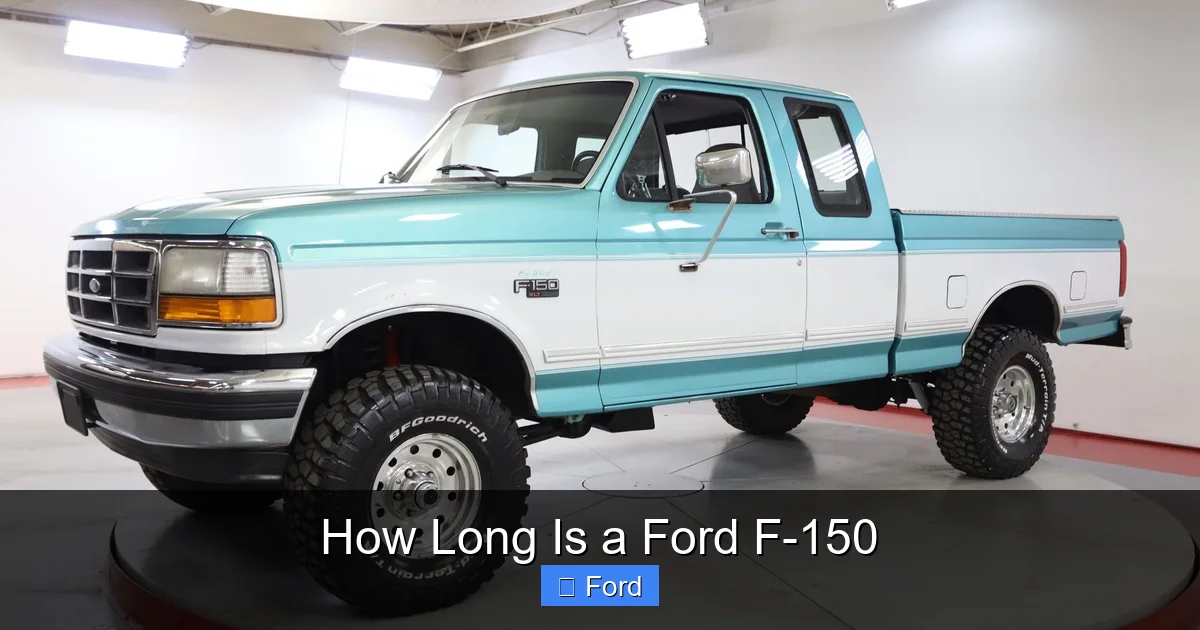
Visual guide about How Long Is a Ford F-150
Image source: cdn.dealeraccelerate.com
Pre-2015 vs. Post-2015
A 2014 F-150 SuperCrew with a 6.5-foot bed measured approximately 231.9 inches. The 2024 equivalent is ~231.7 inches. The difference is negligible. However, if you look at the very first F-150 from 1975, a SuperCab with an 8-foot bed was about 210 inches—a full foot shorter! Modern trucks have grown to accommodate larger cabins, more safety equipment, and improved aerodynamics.
Why the Consistency Matters
This consistency is good news if you’re looking at a used F-150 from the last decade. A 2018 and a 2023 SuperCrew with a 6.5-foot bed will have nearly identical exterior lengths. You can generally use the current specs as a very close guide for models from 2015 onward. For older models (2004-2014), you’d want to check specific year guides, but the configuration rules (Cab + Bed = Length) still apply perfectly.
The Real-World Impact of Those Extra Inches
Okay, we have the numbers. But what do they mean for you in the real world? This is where it gets practical—and sometimes stressful.
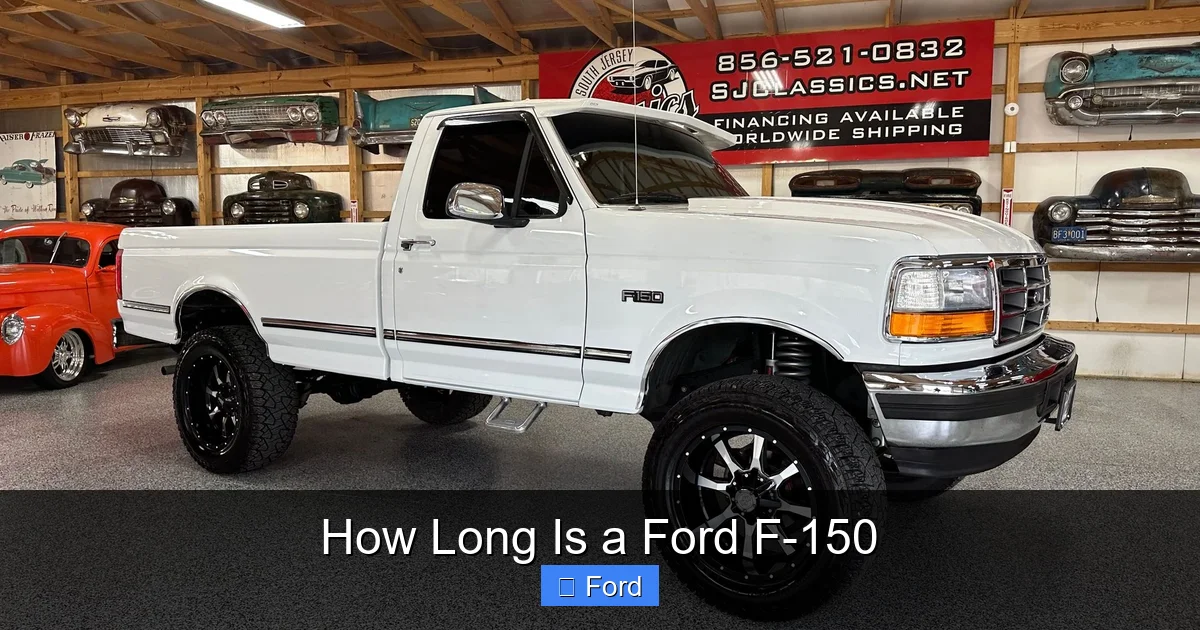
Visual guide about How Long Is a Ford F-150
Image source: cdn.dealeraccelerate.com
Parking and Garaging: The Daily Grind
This is the #1 concern for most buyers. If your garage is 20 feet deep, a 19′ 4″ truck leaves you with just 8 inches of wiggle room. Factor in garage door clearance, storage against the back wall, and you might be out of luck. Always, always measure your parking space (garage, driveway, work parking spot) and subtract at least 12-24 inches from the truck’s length for maneuvering room. That 8-foot bed Regular Cab might be a non-starter for a tight urban garage, while the 5.5-foot bed SuperCrew could fit with inches to spare.
Towing and Stability: The Long and Short of It
Here’s a pro tip: a longer wheelbase (which correlates strongly with overall length) is a major advantage for towing. The longer distance between axles creates a more stable “lever” between the tow vehicle and the trailer. It reduces sway and makes the combination feel more planted. So, if you’re regularly pulling a large boat, RV, or heavy trailer, the longer configurations (SuperCab/Regular Cab with long bed) offer a tangible stability benefit over the shorter SuperCrew models. It’s not just about raw towing capacity; it’s about how *easy* and *safe* that capacity is to manage.
Cargo and Usability: Bed Length vs. Total Length
Don’t confuse total vehicle length with usable cargo space. An 8-foot bed is fantastic for 4×8 sheets of plywood or drywall (they lie flat). A 5.5-foot bed will not. But that 8-foot bed comes on a truck that’s nearly 228 inches long. You’re paying for that cargo length with overall vehicle length. Ask yourself: what’s the longest item you *regularly* transport? If it’s a dirt bike or a short quad, the 5.5-foot bed might suffice. If it’s building materials, you need the 8-footer. The trade-off is always maneuverability vs. cargo capacity.
How the F-150 Stacks Up Against the Competition
Numbers in a vacuum are useless. Let’s see how the F-150’s length compares to its arch-rivals. This context is vital for your decision.

Visual guide about How Long Is a Ford F-150
Image source: autopro8.mediacdn.vn
vs. The Toyota Tacoma
The Tacoma is a fantastic mid-size truck. But it’s in a different class. Its longest bed is about 6.1 feet. Its overall length, even in the longest Access Cab (Toyota’s term for extended cab) with long bed, is around 225 inches. The longest F-150 (Regular Cab, 8-ft bed) at ~227.7 inches is only a few inches longer overall, but it offers a full foot more bed length. This highlights the F-150’s advantage as a full-size workhorse. For a direct comparison of bed sizes, you can see exactly how long a Toyota Tacoma truck bed is across its configurations.
vs. The Nissan Frontier
Like the Tacoma, the Nissan Frontier is a mid-size. Its King Cab (extended cab) with the long bed is approximately 219 inches long with a 6.1-foot bed. The F-150’s shortest SuperCrew (5.5-ft bed) is about 223 inches. So, the smallest F-150 crew cab is actually longer overall than the longest Frontier, yet the Frontier’s bed is longer than the F-150’s shortest bed. It’s a classic trade-off: the Frontier gives up some overall cabin length for more bed, while the F-150 offers immense cabin space even in its shorter bed models. Check the specifics of the Nissan Frontier’s bed lengths to see the contrast.
vs. The Chevrolet Silverado & Ram 1500
These are the direct full-size competitors. Their length ranges are nearly identical to the F-150. A 2024 Silverado 1500 Regular Cab Long Bed is 227.7 inches—the exact same as the F-150. A Ram 1500 Quad Cab (their extended cab) with the 6.5-foot bed is 232.3 inches, very close to the F-150 SuperCrew 6.5-foot. The competition here is a dead heat on paper. Your choice will come down to cab interior feel, bed features (like the F-150’s Pro Power onboard generator or Ram’s multifunction tailgate), and brand loyalty—not raw inches.
A Different Beast: The Lexus RX 350
What if you’re comparing a truck to a luxury SUV? The Lexus RX 350 is about 196 inches long. That’s a full 30+ inches shorter than a long-bed F-150! This puts the F-150’s scale into perspective. You’re not just choosing a vehicle; you’re choosing a class. The RX prioritizes nimble city driving and a plush ride. The F-150 prioritizes payload and towing. The length difference is the most obvious symptom of that philosophical divide.
Practical Tips for Choosing Your Perfect Length
Armed with data, how do you decide? Here’s a simple, step-by-step process.
Step 1: Measure Your World
Grab a tape measure. Go to your garage. Measure from the inside of the closed garage door to the back wall or any obstacle. Do the same for your most common parking spot at work or the grocery store. Write these numbers down. This is your maximum allowable length. Subtract 12 inches for breathing room. Now you have a hard limit.
Step 2: Prioritize Your Primary Use
Make a list. What will this truck do 80% of the time?
- Daily commuting/city errands? Shorter is better. Lean towards SuperCrew 5.5-ft or SuperCab 6.5-ft.
- Work hauling (contractor, farming)? Bed length is king. Regular Cab or SuperCab with 8-ft bed.
- Family hauler + occasional cargo? SuperCrew is a must for rear seat space. Choose 5.5-ft or 6.5-ft bed based on your longest regular cargo item.
- Heavy towing (RV, large boat)? Prioritize the longest wheelbase available for your cab preference. This often means avoiding the 5.5-ft bed SuperCrew if maximum towing stability is the goal.
Step 3: Test Drive and “Park”
Never buy a vehicle this size without a test drive. Don’t just drive it. Take it to a parking lot. Try to parallel park. Pull into a standard parking spot. Try to turn it around in a small alley. The difference between a 223-inch and a 231-inch truck in a tight spot is massive. Your hands, eyes, and gut will tell you if a length is manageable.
Step 4: Consider the “Hidden” Length
Remember, the published length is with the standard front bumper. If you add a aftermarket front bumper, a winch, or a large grille guard, you’re adding inches to the front. A trailer hitch ball extends the rear. Factor these in if you plan to add accessories.
Conclusion: Your Length, Your Life
So, how long is a Ford F-150? The answer is: it depends entirely on you. It can be a “mere” 223 inches for a family-friendly, city-maneuverable crew cab, or a sprawling 231+ inches for a workhorse with a bed that eats 4×8 sheets for breakfast. The genius of the F-150 is that it doesn’t force one size on everyone. It offers this spectrum of lengths so you can match the truck to your specific needs, not the other way around.
The key is to move beyond the generic question. Get specific. Decide on your cab. Decide on your bed. Then, take that exact configuration’s length and hold it up against the reality of your life—your garage door, your parking spot, your typical cargo. That intersection of specification and reality is where you find your perfect F-150 length. It’s not about the biggest number on the spec sheet; it’s about the right number for your driveway.
Frequently Asked Questions
What is the shortest overall length for a new Ford F-150?
The shortest configuration is the SuperCrew cab with the 5.5-foot bed, measuring approximately 223.3 inches (18′ 7″) for the 2024 model. This combination prioritizes cabin space while keeping overall vehicle length more manageable for parking.
What is the longest overall length for a new Ford F-150?
The longest configuration is the Regular Cab (2-door) with the 8-foot bed, measuring approximately 227.7 inches (19′ 0″) for the 2024 model. The SuperCab with an 8-foot bed is nearly identical at 231.7 inches, but the Regular Cab has a slightly shorter rear overhang.
How much longer is an 8-foot bed compared to a 5.5-foot bed on the same cab style?
For the same cab style (e.g., SuperCab), choosing an 8-foot bed instead of a 6.5-foot bed adds about 7.3 inches to the overall length. The difference between a 6.5-foot and 5.5-foot bed is smaller, around 1.1 inches. The biggest length jumps come from changing cab styles, not just bed sizes.
Does a longer F-150 have a larger turning circle?
Yes, generally. A longer wheelbase (which correlates with overall length) results in a larger turning circle. A long-bed SuperCab will have a turning diameter about 3-4 feet larger than a short-bed SuperCrew. This is a major factor in maneuverability for tight streets or small parking lots.
Is the F-150 significantly longer than a Toyota Tacoma or Nissan Frontier?
In its longest configuration, the F-150 is only a few inches longer overall than the longest Tacoma or Frontier. However, the F-150’s bed is dramatically longer (8 ft vs. ~6 ft). The F-150 achieves its massive cargo capacity within a similar overall length footprint by having a shorter front overhang and different cab-to-bed proportions compared to some competitors.
Should I worry about length if I only tow occasionally?
If towing is secondary, prioritize your daily driving needs (parking, maneuverability). A shorter configuration will be more pleasant for daily chores. However, if you ever plan to tow a large, heavy trailer, the extra stability from a longer wheelbase is a meaningful safety and comfort benefit worth considering, even for occasional use.
